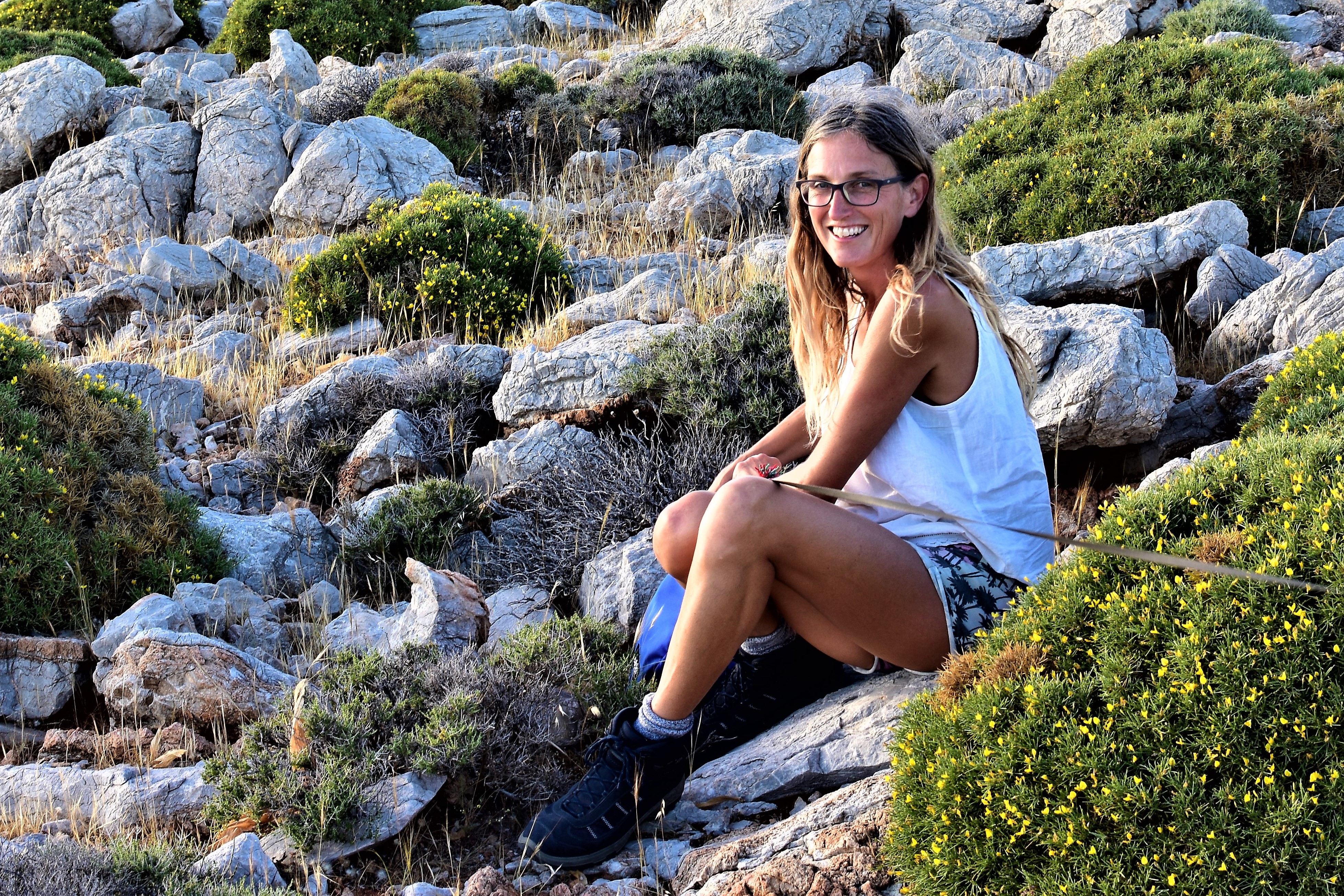
Matthias Nöth, a visit to the fortifications of Phoenix.
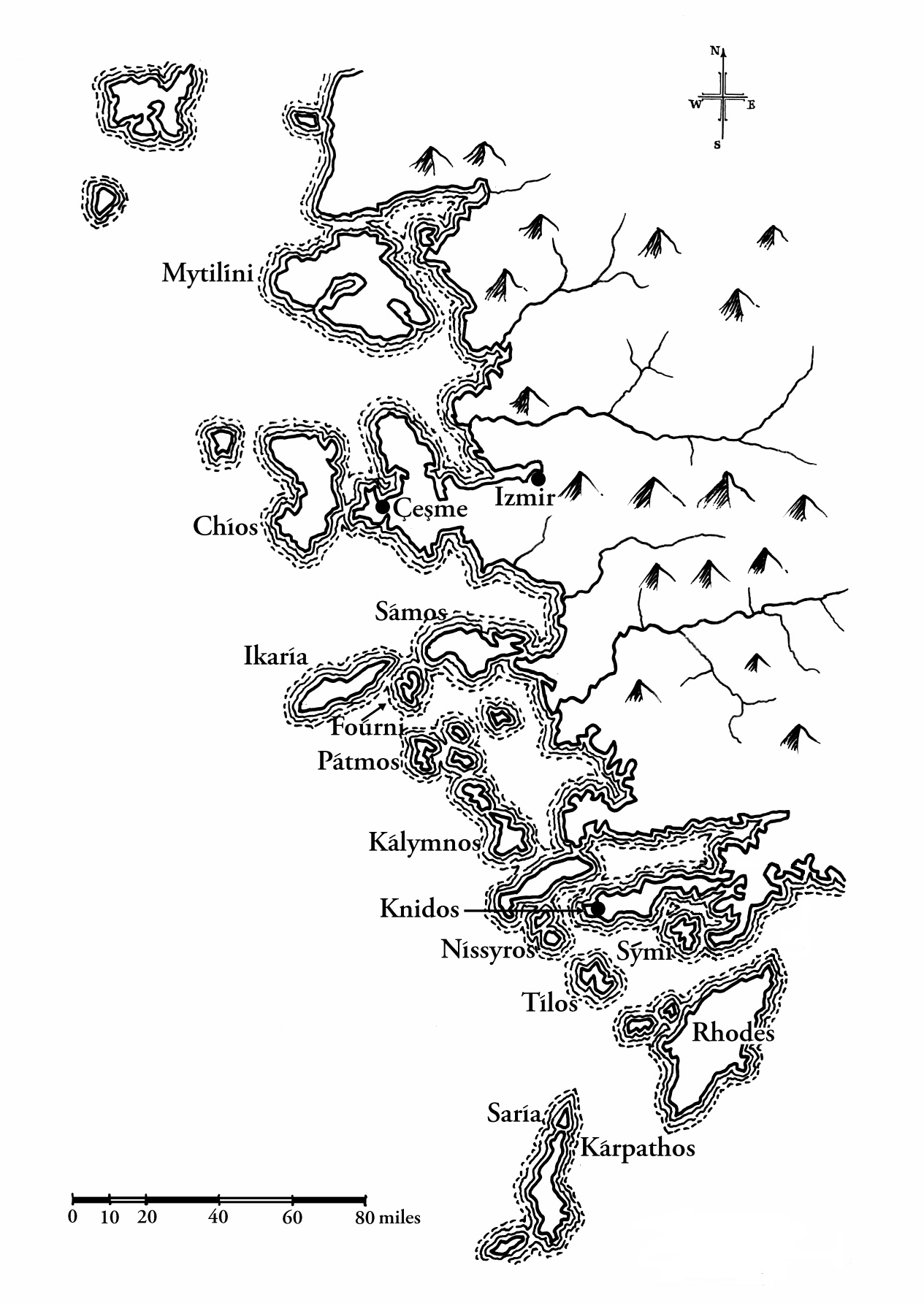
A short while ago (the summer of 2020), the Bent Archive received a most helpful communication from Matthias Nöth, pointing out anomalies in the Google map we had plotted showing the itinerary Theodore and Mabel Bent had taken in 1888 when exploring areas of the western coast of Turkey, as far down as the (now Greek) island of Kastellorizo.
Realizing Matthias had a much deeper knowledge of the region than we did, we asked him if he would care to write for us a short illustrated sketch, a Bent-tour if you like, just referring to some of the sites the couple visited, perhaps from a modern archaeological perspective, something that dedicated travellers to those, still unspoiled, spots would enjoy.
And so, without further ado, we hand you over to Matthias (who shares his Christian name, incidentally, with the Bents long-term assistant from Anafi, who was with the couple on their slow cruise down this delightful extent of the Outer Levant — Matthias, the floor is yours:-
Theodore Bent’s map of Ancient Loryma and its environs for E.L. Hicks’ paper in JHS 1889, Vol. 10, page 46 (The Internet Archive).
Between 1882 and 1898, Theodore and Mabel Bent made a total of seven trips that took them along the Greek and Turkish coasts. Mabel had kept diaries of all these trips. In these, the couple’s sixth voyage, or thereabouts, which took place in 1888 note 1 , we learn that the Bents – after a short stay on Symi – anchored in the bay of “Aplotheka” on the night of 10th March to the 11th.
They decided on this bay, which Mabel describes as having a “very deep, slope to the water in most places, but there are several little beaches of sand where landing is easy”, as there one may find “the ruins of ancient Loryma”. On one of these beaches there are “the remains of some large building and another a mandhra, or sheep fold. The wall of the yard runs along the shore and the family live in a little hut of rough stones, that one can see through, about 12ft. x 10ft. No window or chimney, fire on the earth in one corner, a few sticks stuck between the stones to hang things on and a shelf made with a pole across the end of the room and some branches on it. It is about 3 feet 6 inches wide and may be the bedroom, but we saw very few bedclothes or possessions of any kind, and yet the people seemed clean in their persons and certainly provide us with excellent cream and milk.”.
About her stay in the bay, we learn from Mabel that her husband Theodore undertook “a walk in the morning with Vassilis […] and Ioannis” on March 11th, while she stayed on board their ship. In the afternoon she roamed the bay with her husband and “choose a digging place for the morrow”. For March 12th, she reports that they were excavating “quite unmolested at large tombs, all with altars on them, but vainly”. Unfortunately, as with Theodore’s article in the Journal of Hellenic Studies (Vol. 9, 1888), Mabel’s chronicles are not very meaningful from an archaeological point of view. Presumably he does not elaborate on the ruins there as they were presented by O. Benndorf and G. Niemann four years earlier in their Reisen in Lykien und Karien (Vienna 1884) note 2 .
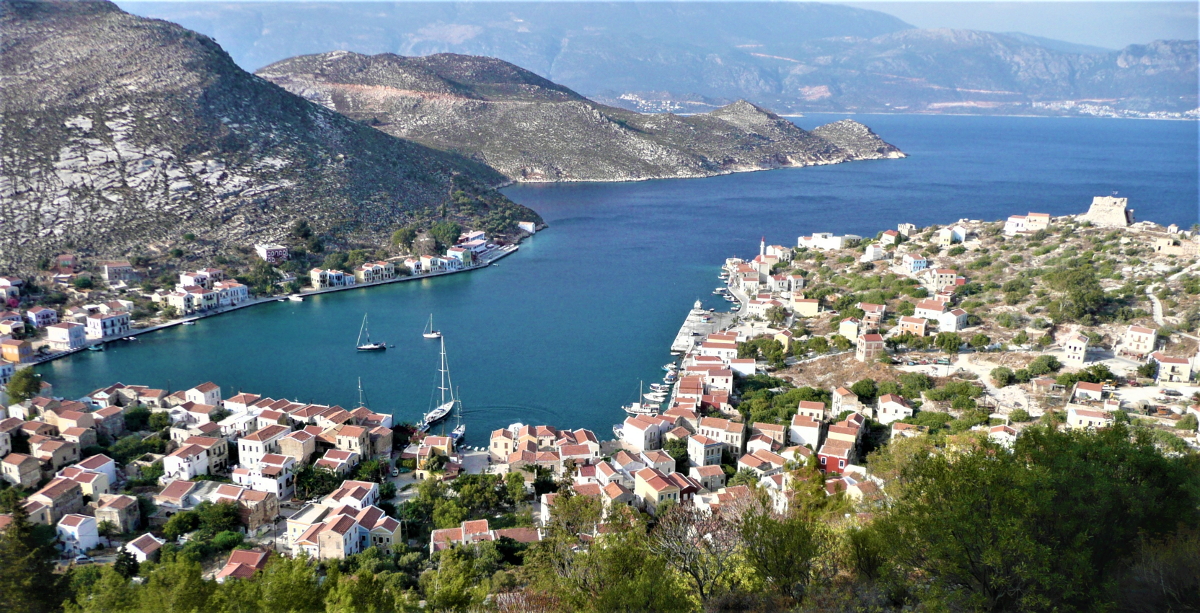
Fig. 1: View of Bozukkale, or Loryma Bay, from north-northwest, with the island of Rhodes in the distance (Matthias Nöth).
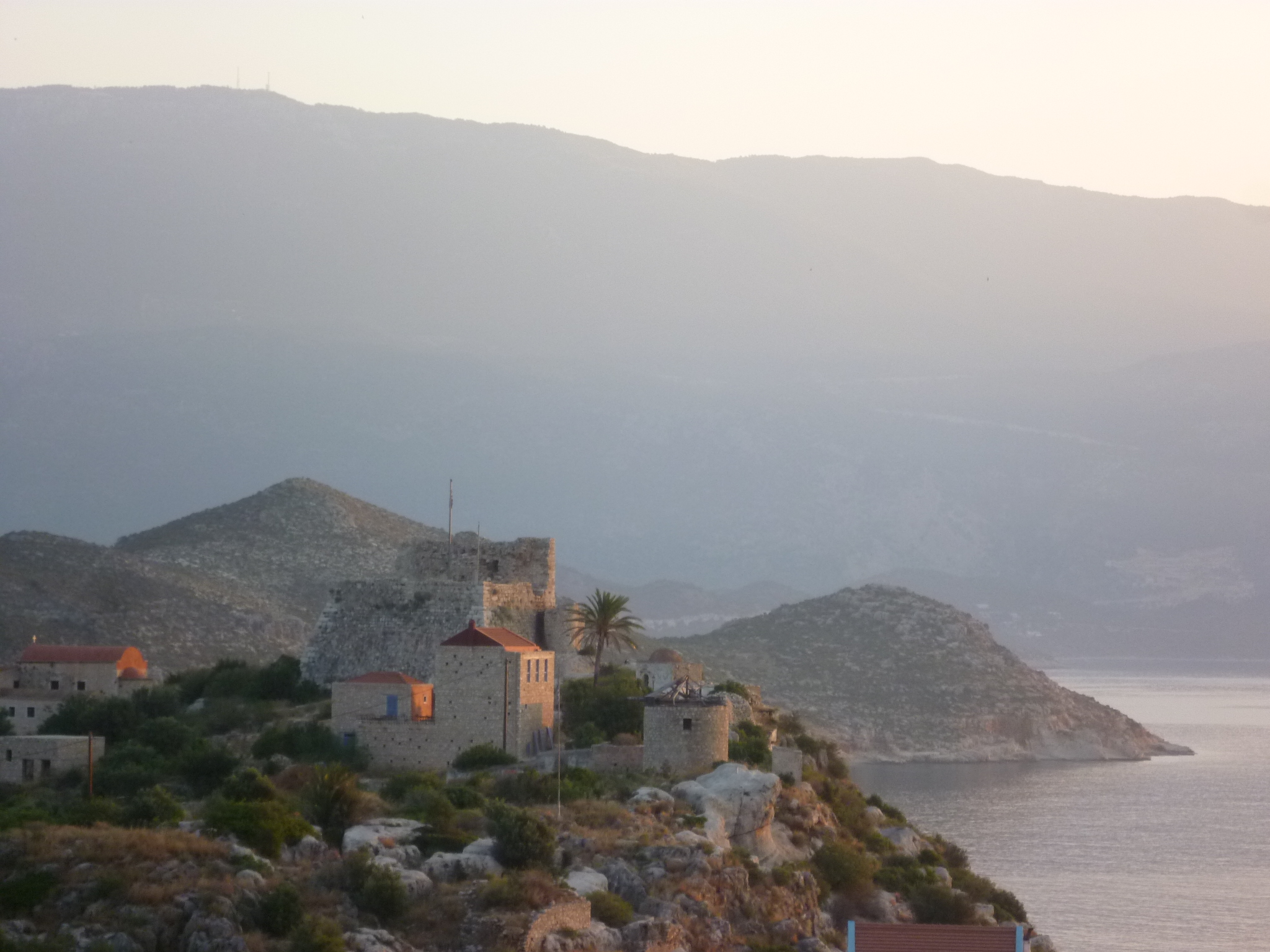
“Aplotheka” bay is known today as Bozukkale or Loryma Bay (Fig. 1), located on the southwestern edge of the Bozburun peninsula. This was known in antiquity as the Carian Chersonese and later belonged to the Rhodian Peraia. The bay itself can only be reached by boat or by taking a long walk overland. Despite, or perhaps because of, its remote location, it is a popular destination for sailing tourists, and since the opening of the Carian Trail also for hiking tourists. There are three seasonal restaurants in the bay and apart from these there are only two or three huts inhabited by shepherds.
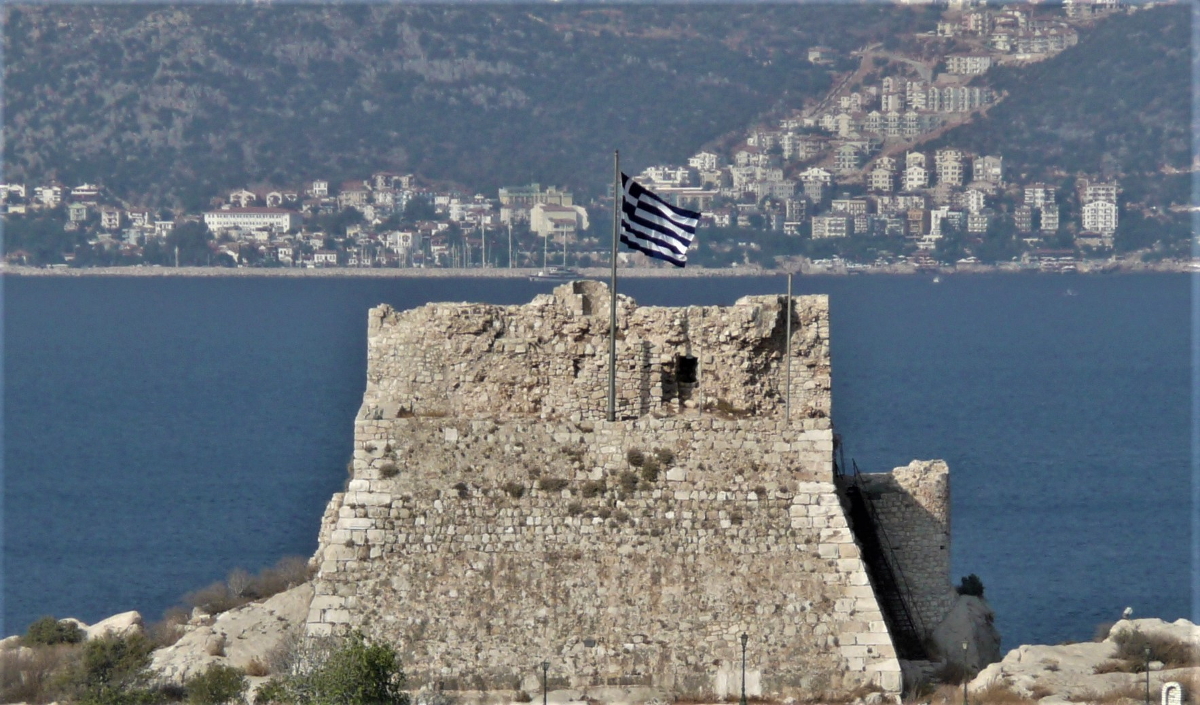
Fig. 2: Loryma: View from the southeast over the Rhodian harbour fortress (Matthias Nöth).
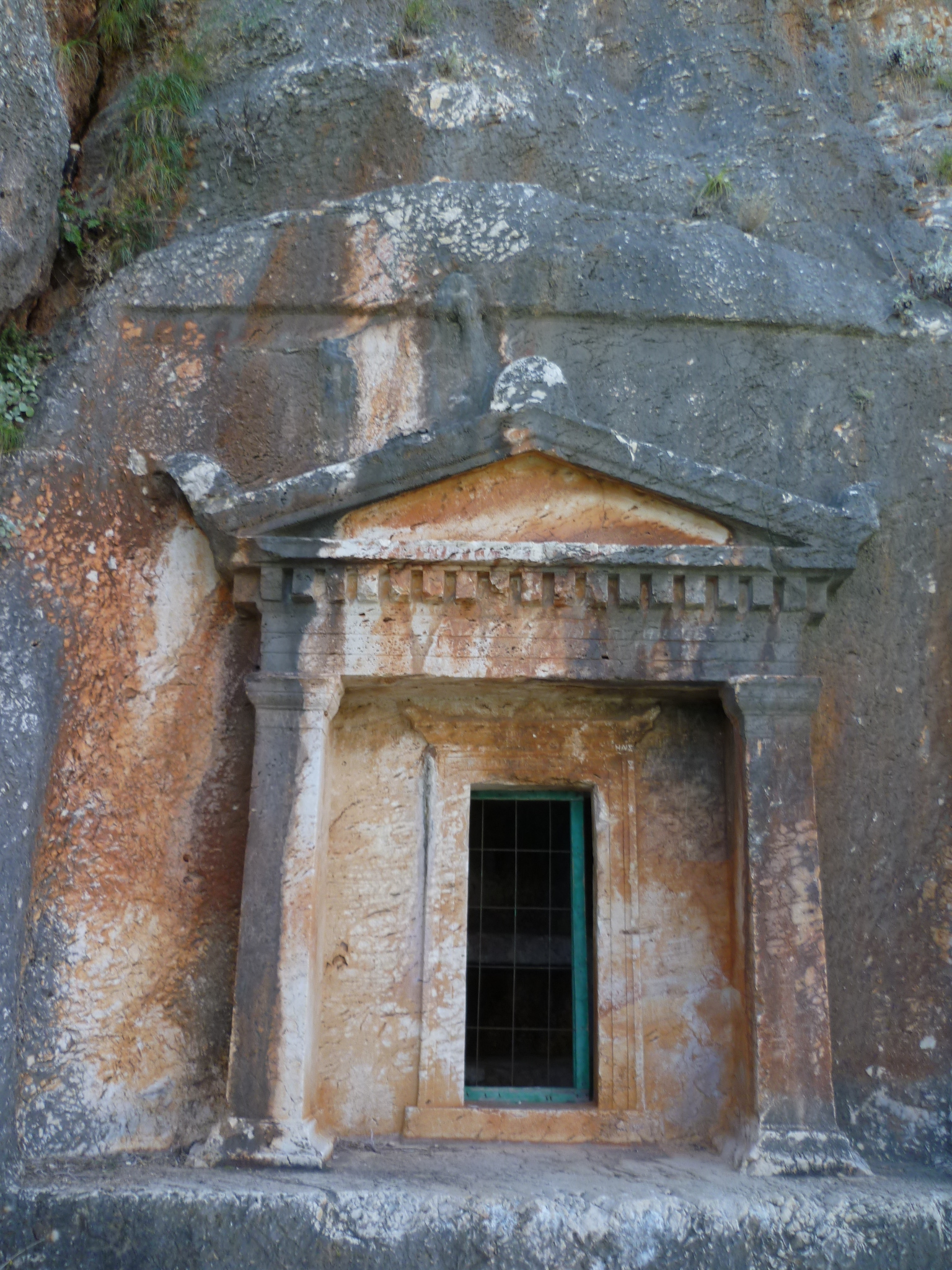
Thus little has changed since the Bents stayed there. The “remains of some large building” mentioned by Mabel have also been preserved. These could be the remains of a large building, probably built from spolia in Byzantine times, which may be seen in connection with an Amalfi trading post [Αποθήκη = warehouse ?]. It was built on the site where there were five ship sheds in antiquity (Fig. 1, right of the rocks in the foreground). The “ruins of ancient Loryma” include the large Rhodian harbour fortress (Fig. 2), the scant remains of two temples, the Loryma settlement, numerous ancient farmsteads, and the extensive settlement necropolis in which Mabel and Theodore apparently carried out excavations. The “altars” on the graves mentioned by Mabel are the grave top parts typical of the Carian Chersonese, in the form of monolithic or composite stepped bases (in English also referred to as “stepped pyramids”) (Fig. 3).
Fig. 3: Examples of grave top parts, typical of the Carian Chersonese (Matthias Nöth).
On March 13th, the Bents, accompanied by a shepherd serving as a guide, went eastwards to “a little harbor called Sigás and then walked to the sea on the other side of the promontory called Sikies (fig tree)” (= north coast). However, the excursion was, in Mabel’s words “disappointing”, probably because they did not make the hoped-for discoveries.
Fig. 4: View from the north over the “hidden” port of Serçe Limanı and its small entrance (Matthias Nöth).
The port “Sigás”, which – according to the memoranda of Theodore published by E. L. Hicks (JHS 10, 1889) – was also called “Sersa” in Bent’s time, and is a bay now known as Serçe Limanı (Fig. 4). In ancient times it was called Κρήσα λιμήν or “portus Cressa”. Although the entrance to the “curiously hidden” bay is quite narrow – as Theodore wrote in his article – it was apparently a popular anchorage over the ages; this is shown by the five shipwrecks found there that date from the 3rd century BC to early 11th century AD.
In addition to Mabel’s chronicle entry, we learn from Theodore’s article that, after “about an hour’s walk”, there are extensive ruins in “a basin”. According to Theodore’s memoranda, he found there “covered by the ruins of a Byzantine church”, “a row of bases of columns (apparently in situ), as if a temple had stood here”, as well as numerous graves and a few inscriptions. According to one of these inscriptions, the temple was dedicated to Apollo. Three more inscriptions are featured in Hick’s article. In the north of the valley Theodore’s memoranda mentions “tombs composed of blocks of marble piled pyramid-wise upon each other”.
Fig. 5: The so-called Asardibi plain, seen from the north. At the edges are the remains of ancient agricultural terraces (Matthias Nöth).
The “basin” is the valley that adjoins Serçe Limanı to the north and is known today as Asardibi; ancient Kasara is also located there. Today only a few ruins have survived in this valley (Fig.5). The alleged temple remains were apparently not found in the recent survey, as they are not mentioned in the relevant publications. The ruins visible today are mainly graves with the grave top parts of the form known from Loryma, as well as some ancient farmsteads and the remains of associated agricultural terraces. In the far north of the valley, on a prominent hill, are the sparse remains of a small Byzantine settlement or fortress. However, between the Byzantine walls there are also remains of more ancient ones, so that one might possibly look for the acropolis of ancient Kasara on that hill. A few years ago, at the western foot of the hill, you could still see the graves discovered by the Bents; however, illegal construction work has taken place there, which has destroyed a large part of the historical substance.
Apparently Mabel and Theodore visited another ancient site on their trip to Kasara, i.e. locating Phoenix “about an hour’s walk [in an] eastward direction”. Since Theodore only mentions it briefly in his article (“… the modern village of Phoenike […] is built on the site of the old town …”), it will not be discussed further here. However, Phoenix and other ruins in the area are shown on the map created by Theodore for Hicks’ article. From an archaeological point of view, this map is also the most interesting result of the Bents’ stay on the Carian Chersonese, as some of the ancient ruins recorded there by Theodore are still almost unexplored.
About Matthias Nöth
After doing his Magister Artium in Classical Archaeology at the University of Würzburg, Matthias completed an archaeological traineeship at the Archäologisches Spessartprojekt (with a focus on Medieval archaeology). He then went on to read for a Doctorate in Classical Archaeology at the University of Marburg, graduating in 2015. His dissertation on the Fortifications of the Carian Chersonese is currently in press. For his bibliography, see here.
During his studies, and as a volunteer, Matthias took part in several excavations in Bavaria, before he participated in survey projects in Turkey: at “Loryma” (2000) and “Bybassos and Kastabos” (2006-2011, 2015), both of which are on the Carian Chersones, today the Marmaris/Muğla region. After several round trips and hikes in the area, Matthias now knows the Carian Chersonese very well.
Note 2: The ancient remains were examined between 1995 and 2001 by Dr. Winfried Held in a survey in which the author was also able to participate. Partial results of this survey were last published in: W. Held (ed.), Die Karische Chersones von Chalkolithikum bis in die byzantinische Zeit. Forschungen auf der Karischen Chersones Band 1 (Marburg 2019). Return from Note 2
Our recent post (13 Oct 2020) on the hundreds of items in the British Museum collected by Theodore and Mabel Bent, was ultimately about things – their contexts, consequences, associations, the meanings of value…
It will probably come as no surprise that Mabel Bent’s paternal grandmother, Elizabeth Hall Dare (née Grafton, 1793-1858), also had a great many things (the wider family units being landowners in Essex and with interests in the sugar plantations of British Guyana)… including, it seems, a towel, a drinking-horn, a bell, a thermometer, and, oh yes, a quantity of butter, two and half pounds in weight in actual fact.
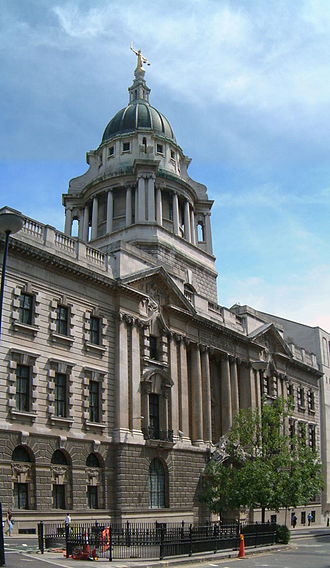
The Old Bailey, London (wikipedia).
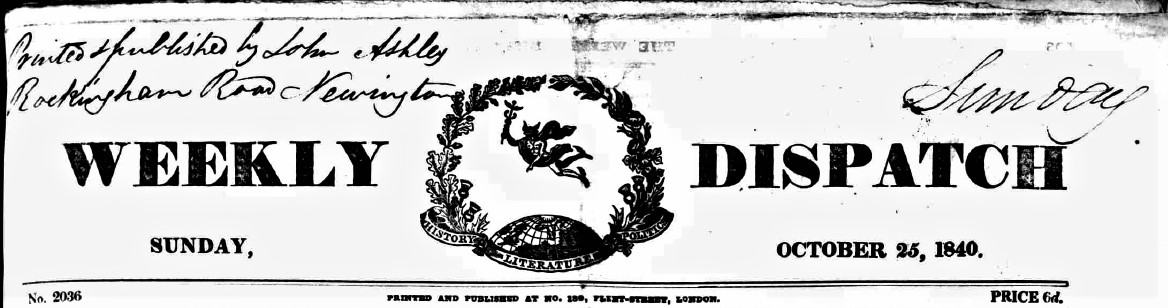
Oddly, let’s move at this point to that lowering fortress of justice, the Old Bailey in London in 1840, as recorded in The Weekly Dispatch (page 507) of Sunday, 25 October, with reference to a petty case that was tried on the 19th of that month and year.
We read in the said tabloid, obiter dicta: “Christopher Johann Frederick Auguste Struve, described as a dealer, was… indicted for burglariously entering the dwelling house of Mrs. Elizabeth Hall Dare, and stealing therefrom a towel, a drinking-horn, a bell, a quantity of butter, and various other articles. Mary Humby, servant to the prosecutrix, a widow lady, residing on Streatham-common, stated that on the night of the 11th of September [1840] she fastened the doors and windows previous to retiring to bed. She left the larder-window open, but secured before it an iron grating, which, on the following morning, between five and six o’clock, she found broken down, and a number of articles, named in the indictment, were taken away; there was also a thermometer taken from the side of the window.”
Masthead of the “Weekly Dispatch” for Sunday, 25 October 1840 (The British Library).
We need more evidence, clearly, and the verdict – although it rather seems an open-and-shut case, doesn’t it? The Weekly Dispatch obliges: “Inspector Campbell stated that on the 15th of September he went to the prisoner’s lodgings, and on searching his room discovered various property, and amongst it all the articles stolen from Mrs. Dare’s. Eleanor Evans said the prisoner had occupied a room in her house for about a month previous to his being taken into custody. He always locked his door when he went out, so that nobody had access to it. When called upon for his defence the prisoner said he purchased all the articles sworn to by the witnesses of a person in the street. The Recorder having summed up the evidence, the Jury returned a verdict of Guilty. The Recorder told the prisoner that he appeared to be an experienced and systematic robber. He had been convicted of two burglaries committed within three or four days of each other. It was quite impossible that he could be allowed to remain in the country. The sentence of the Court, therefore, was that he be transported beyond the seas for the space of ten years.”
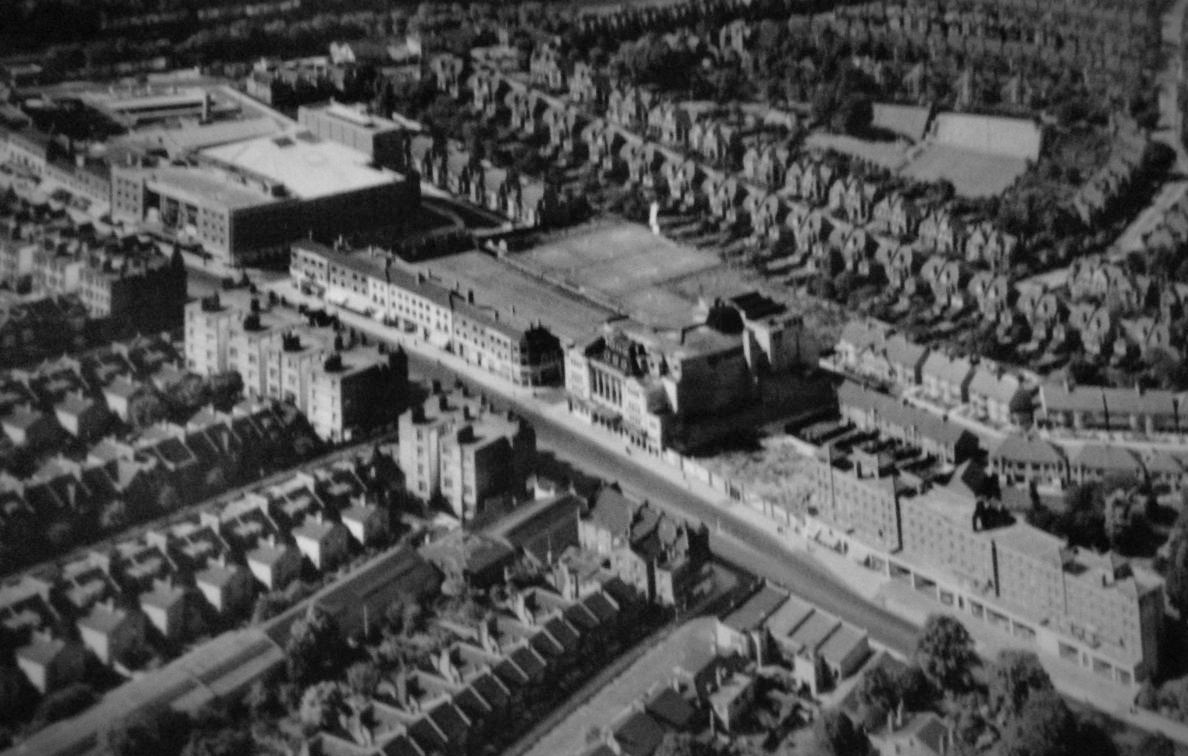
Fashionable Streatham Hill (Sutton & Croydon Guardian).
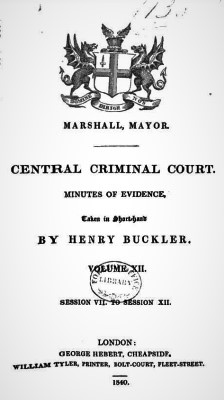
For the location of the house concerned, we refer you at this point to our second source for this abominable crime perpetrated on Elizabeth Hall Dare, Mabel Bent’s grandmother, i.e. the Central Criminal Court, Minutes of Evidence(1840, Vol 12, p. 1059), which informs us that the property was in South London’s fashionable Streatham parish, an enclave of well-heeled souls in Victorian times.
Title page of “Central Criminal Court, Minutes of Evidence”, Volume 12, 1840 (via Google Books).
The facts and characters of the case are a cross between Tom Jones and Much Ado About Nothing. It is worth extensively quoting, if for nothing more than a reprise of ‘burglarously’ – a word it’s doubtful you will encounter three times in your life, and for the true value of things:
“Christopher Johann Frederick Auguste Struve was again indicted for burglarously breaking and entering the dwelling house of Elizabeth Grafton Hall Dare, at Streatham, about twelve o’clock in the night of the 11th September, with intent to steal, and stealing therein, 1 towel, value 1s.; 2½ lbs. weight of butter, value 2s.; 1 bell, value 5s.; 1 butter-mould, value 6d.; 1 plate, value 1d.; and 1 cup, value 6d.; her property.
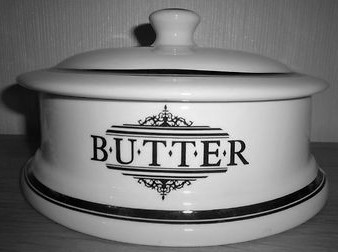
Hard to believe… but true. A Victorian butter dish (one of several examples online).
“Mary Hamby: I am single, and am cook to Mrs. Elizabeth Grafton Hall Dare, widow, of Streatham Common, in the parish of Streatham. On the night of the 11th of September the larder window was open, but there was a wire-guard inside before it, which must be broken to get at anything. I saw it safe a little after ten o’clock – it opens into the garden – the grating was secured by four large nails – the next morning I went down into the larder before six o’clock, and found the wire pushed quite round behind a milk pan, to prevent it going back to its place. I missed the articles stated. A person could get through the wire place – he had then opened a door out of the larder, and taken a white jug, bell, and drinking-horn – I lost a thermometer from outside the window.
“Prisoner: I bought these things of a man in the street.
“Eleanor Evans: I am the wife of John Evans and live in Church-street Minories. The prisoner lived with us four weeks and three days until he was apprehended – the policeman came to me, and I showed him his room – they found this jug, the bell and other articles there – nobody but him could have put them there, as the door was locked – I did not see the articles there till they were found – I had missed him two or three days before that, but did not know he was in custody.
“Samson Darkin Campbell: I am a police-inspector, of the V division. On the 15th of September I went with Pitcher to No. 51, Church-street. Evans showed me a room, and I found this towel, with the name of Hall Dare on it, a thermometer, a butter-strainer, two files, a pair of pliers, and some skeleton-keys, some of them unfinished.
“Thomas Pitcher (police-constable P 167.) I accompanied Campbell, and found these articles in the room – the prisoner was in custody at the time. (Property produced and sworn to.)
“GUILTY. Aged 41. Transported for Ten Years.” (‘Central Criminal Court, Minutes of Evidence’, Vol. 12, 1840, p. 1059)
The unfurled “David Clarke”; she transported Struve to Tasmania in 1841 (www.gouldgenealogy.com).
Researches are continuing into the life of Christopher Struve -could he have been a black sheep in the noble Struve family we can read about online? His convict records inform us simply that he was 41, married to Maria, had two girls, and was a Lutheran. We are still researching, too, exactly where in London’s fashionable Streatham it was that Christopher Struve decided to enter and remove therefrom a towel, a drinking-horn, a bell, a thermometer; and a quantity of butter – the most expensive thing in his swag, worth over £10 in today’s money. Wherever it was, it was a long way from Van Diemen’s Land (Tasmania), something Christopher Struve wasn’t when he arrived in Hobart on 4 October 1841, transported in the yare David Clarke with 308 or so other men, one of whom (John Timbers, 19) died on the journey.
Tasmania/Van Diemen’s Land (wikipedia).
Probably in some form of restraint, it is unlikely that Struve met with the captain, William B. Mills, or saw that much of the Sound when they sailed from Plymouth on 7 June 1841 on that four-month voyage to Tasmania’s prison colony. Unloading her human cargo, the David Clarke sailed away again “for Bombay in ballast on 17 October 1841”; Christopher Struve remained, and we can imagine him coming ashore, almost exactly a year after his trial, contemplating the true value of a towel, a drinking-horn, a bell, a thermometer; all in all, it was a long, long way to come for a plate of butter.
We don’t know where these things are now, but they are not in the British Museum with the collections of Theodore and Mabel Bent.
On 24 April 1885, British explorer Theodore Bent wrote from Syros in the Cyclades to Charles Thomas Newton, famous traveller himself and now Keeper of the Department of Greek and Roman Antiquities at the British Museum (BM): “We returned from Karpathos yesterday and had hoped to catch a steamer which would have brought us and our things straight to England. Unfortunately we shall have to wait a week at least, and as we have so much plunder we cannot take the Marseilles route. I had hoped to have been in time for the Hellenic meeting, but of course now we shall not reach England till the middle of May. We were fairly successful in Karpathos, finding a large number of rock cut graves unopened which have produced pottery, etc., which, if not of the highest order, offer a good deal which I believe to be of a new character… Of quaint manners and customs I have got a fine collection, also of old Karpathiote dresses and jewelry… We had rather a rough time of it, Karpathos being very far behind the world in comforts, and decidedly we enjoyed ourselves best when living in our own tent. Mrs. Bent survives and is well and begs her kind regards. Yours very truly, J. Theodore Bent.” (Mabel Bent 2006: 123, fn. 74)
(The Bents’ trip to the Dodecanese in 1885 was probably contributed to by the BM, and significant finds from there are now in London.)
To draw attention to, and thank the BM for their great and newly re-vamped online database, and make a nod to Neil MacGregor’s seminal TV/radio series, and subsequent exhibition, at the same time, the Bent Archive is selecting four significant objects to feature from the several hundreds of items (752, no less, the BM claim, though some are duplicated) either donated to or sold by Theodore and Mabel Bent to the Museum over a period of five decades or so from the 1880s, beginning with the artifacts Bent brought home from the Cycladic island of Antiparos, then an almost abandoned islet, today a hipster destination for some of Europe’s silliest teenagers; the Bents would be amused. The fifth item, as we shall see, is one that got away… but it should be there.
For about twenty years, Theodore and Mabel Bent travelled to regions in the Eastern Mediterranean, Africa, and Arabia, on the look out for things of archaeological and ethnographical interest (usually linked to Theodore’s current bonnet-bees and theories). Occasionally the British Museum contributed to the Bents’ travel costs on the understanding that the institution would get first refusal. We know that the museum also paid Theodore for certain acquisitions, but there were also donations from the Bents – in particular the large assemblage given by Mabel in 1926, a few years before her death (Theodore, alas, died early, in 1897).
The Museum’s archives (and elsewhere) contain much correspondence between Bent and their various curators and associated scholars, such as William Paton, E. L. Hicks, David Hogarth, Sir William Mitchell Ramsay, Charles Newton, Arthur Smith, Alexander Stuart Murray, Cecil Smith, William Henry Flower …
Good examples of these interactions include a letter from Theodore to the Keeper at the British Museum, dated 30 May 1884: “Dear Sir, Do you care to make me an offer for my figures, vases, ornaments, etc., from Antiparos? It occurs to me that a collection of this nature is rather lost in private hands. Yrs truly, J. Theodore Bent.” (Mabel Bent 2006: 46, fn. 49)
The BM archives also include the Museum’s day books and accession registers, fascinating records that bring you closer to collector and curator, in contexts of mutual scholarship, curiosity, and wonder.
This is not the place to comment on the history of the Museum, collectors’ activities, or the acquisition policies current in the late 19th century. You will have your own thoughts and opinions.
The objects collected by the Bents are featured below, in a sort of virtual ‘The Bents at the BM’ mini-exhibition, by the date they were acquired by the Museum, and representing the main regions of the Bents’ fields of studies, as already mentioned – the Eastern Mediterranean, Africa, and Arabia, over a period twenty years following their marriage in 1877. In most cases the BM item number consists in part of the year the piece was acquired from the Bents, i.e. Af1892,0714.144, denotes 1892 – in this instance when Theodore and Mabel returned out of Africa.
Thus, without further ado… “The Bents and the BM: in Five Objects”
Let’s make a start in the Greek Cyclades – the scene of Theodore’s first (1883/4) substantial ‘excavations’ (although his modus operandi bears little resemblance to the science of today and raises eyebrows, if not ire, still among archaeologists).
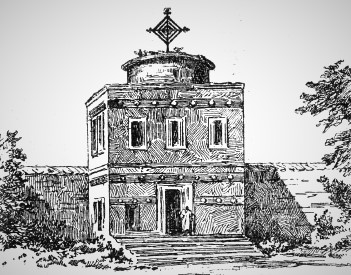
‘The Church of the Saviour of the World, Adowa’. Sketch by Theodore Bent. ‘The Illustrated London News’, 6 May 1893, p.556 (The Bent Archive).
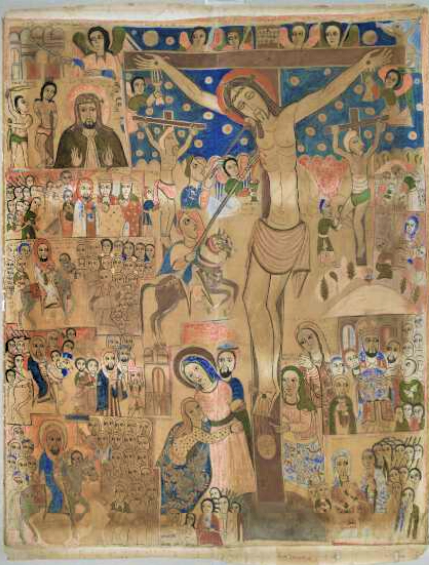
The Bents’ 1883 tour of the region was ultimately unsuccessful due to local unrest, exacerbated by the colonial ambitions of the Italians. By far the most interesting of the artifacts Bent brought back was this large painting of the Crucifixion, he bought for ‘Ten pieces of silver’ from the Church of the Saviour of the World, Adwa. Bent describes the transaction in the book that resulted from the journey: “It was here… that I espied a picture cast on one side, for the colours were somewhat faded, which I faintly hoped to acquire. At first our offers were received with contempt, but again and again we sent our interpreter, and with him ten pieces of silver, the sight of which eventually overcame the priest’s dread of mutilation, and the evening before our final departure from Adoua the picture was ours. Our interpreter himself was terrified at what he had done, ‘We must not breathe a word of the transaction, even to the Italians,’ he said ; ‘we must bury the treasure at the bottom of our deepest bag ‘ ; and to all these regulations we gladly acquiesced, for we knew the great difficulty of acquiring these things in Abyssinia, and the danger to which we all should be exposed if our transaction should be discovered, and I am pretty nearly sure that this picture which is now in the British Museum is the first of its kind which has reached Europe…” (The Sacred City of the Ethiopians, 1893, pp. 129-33)
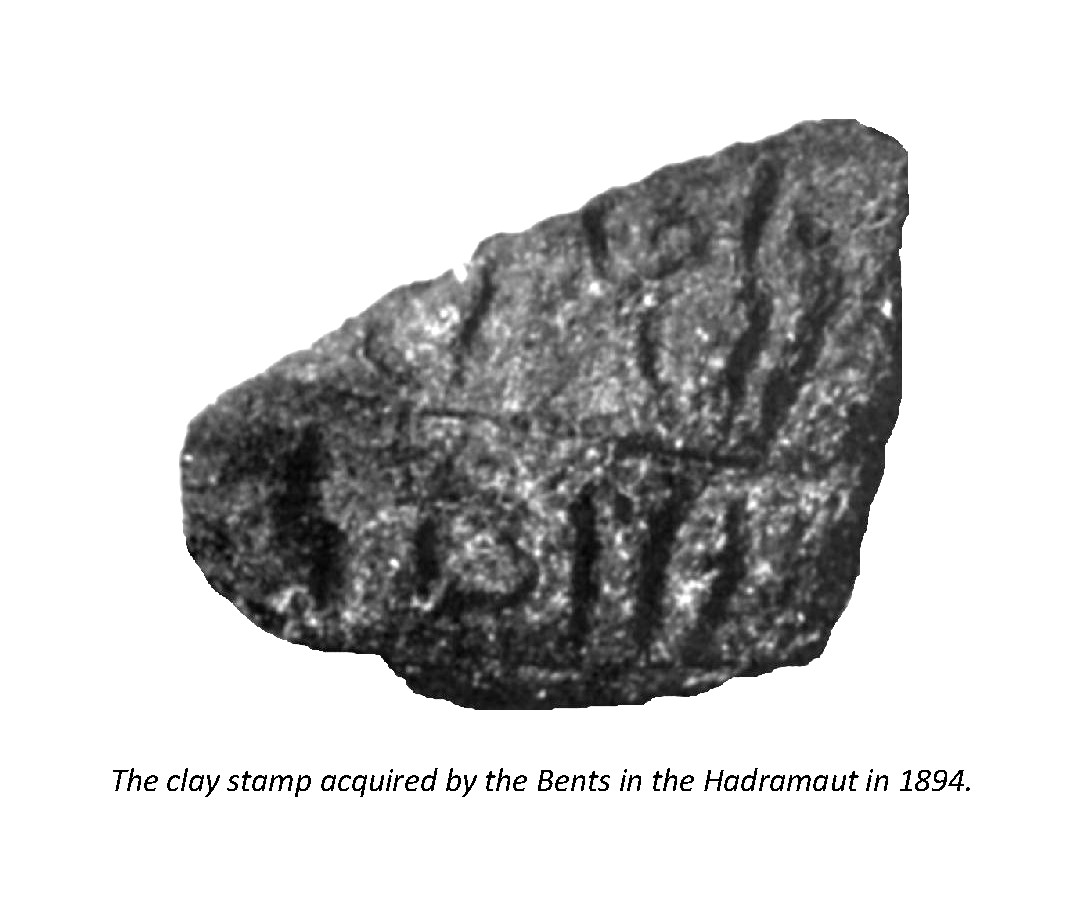
[Cultured female voice, slow, musical, dark, clear] “Object No. 5: A pottery stamp/clay seal from the Wadi Hadramaut, Yemen, aka ‘The Bethel Seal’? Used presumably by a merchant for designating ownership, or contents, of traded merchandise. Date uncertain.” It must be quickly said that this is a deceit; it is a mystery object that should have been given by Mabel with a few other artifacts from the Wadi Hadramaut (Yemen) in 1926, but was not, and thereby hangs a tale worth the telling.
The Bents are admired for their three attempts to traverse the dangerous Wadi Hadramaut in the Yemen, from west to east and down to the Gulf of Aden, from 1894-7. The final trip cost Theodore his life. The couple were travelling on horses and camels and were restricted in what they could bring away with them and the largest collection consisted of hundreds of botanical specimens, reasonably light, now in the Herbarium, Kew.
Mabel has left us in her diary some idea as to how acquisitions were made along the way: “On Saturday the 13th [January 1894], the day after our arrival, at 8 o’clock, the Sultan, Theodore, Saleh and a groom on the four horses, and I on [my horse] Basha, and a vizier on a camel with a soldier, and the soldiers on foot, rode about five miles to a good old ruin (Al Gran), but embedded in an inhabited house so that excavation would be impossible; from a very well cut scrap of ornament we thought it to be a temple, and it is perhaps from this temple that a kind of small stone trough has been brought, with a dedication, rather long, in Sabean, which Theodore has nearly deciphered – a trough with a spout coming to England. Two stones have been brought us by camels at the Sultan’s orders.” (Mabel Bent 2010: 167)
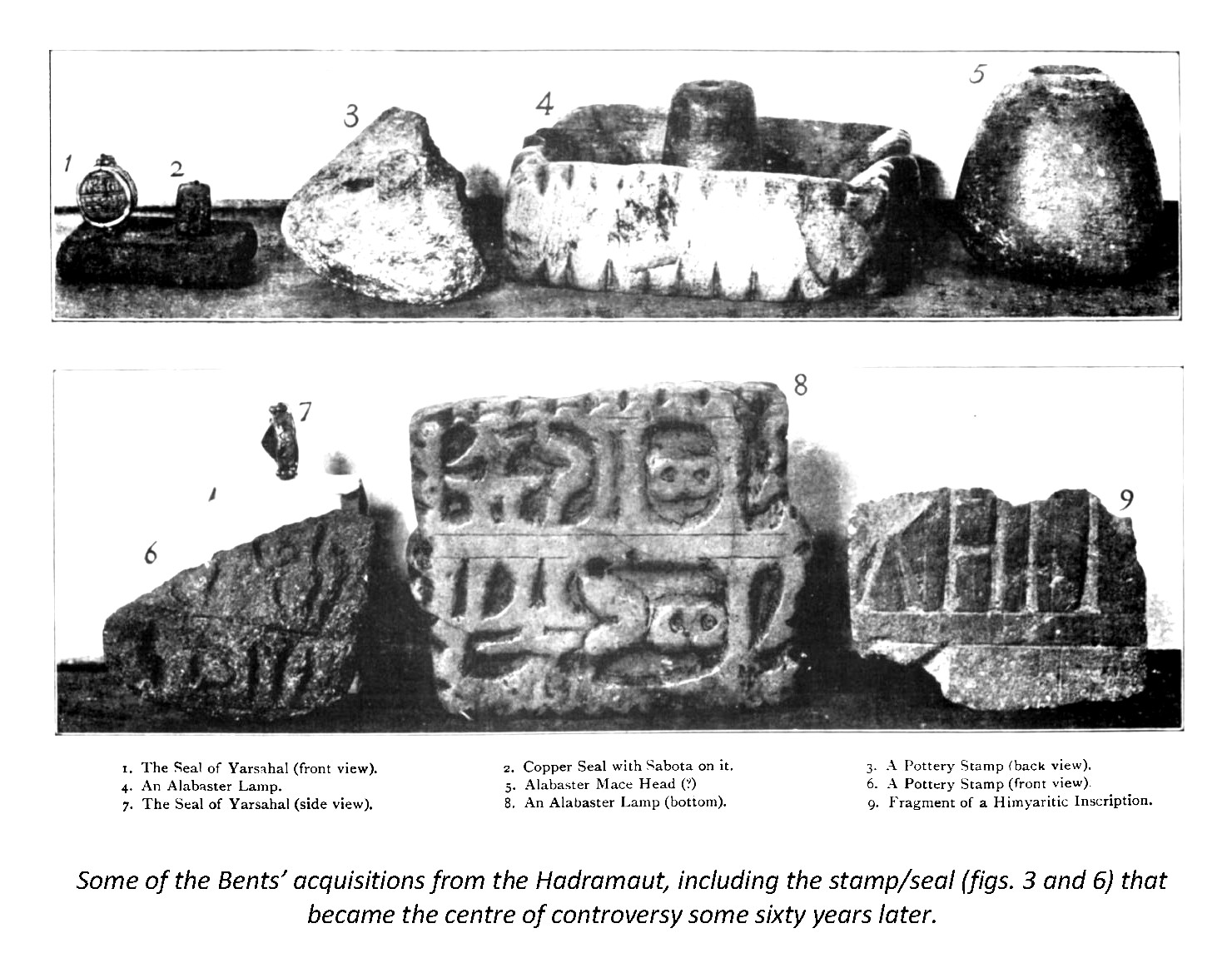
The Bents returned in 1894 from the Hadramaut with the modest lump of clay – the stamp/seal in question. It featured with a small collection of other items on page 436 of the Bents’ great book on Southern Arabia (1900), including the ‘trough’ Mabel mentions above. Then, rather like a great ring, the seal disappeared from view – until it reappeared in an archaeologist’s shovel in the late 1950s at a site at Beitin, Biblical Bethel, Palestine, and the scene of Mabel Bent’s accident in the early 1900s, when she broke a leg in the wilderness, riding, unaccountably, on her own.
But was it the same modest lump of clay, or another, identical artifact? Today it (or both?) is/are lost, and a debate has waxed and waned over the mystery ever since. A strong argument is made that Mabel, distressed, widowed, mourning her late husband and her lost life as an explorer, ceremoniously placed the stamp in a deposit at Bethel in the early 1900s as a tribute to Theodore – not caring if it were ever found again or not – the significance of the site being that it marked the end of a frankincense route (the resin being one of his passions) that began thousands of miles away in the Wadi Hadramaut – and thus Theodore could rest easily, his journey over; the love of a grieving widow.
For a scholarly overview of the seal in context, see ‘Arabian and Arabizing Epigraphic Finds from the Iron Age Southern Levant’, by Pieter Gert Van Der Veen with François Bron, in J.M. Tebes (ed.) Unearthing The Wilderness: Studies on the History and Archaeology of the Negev and Edom in the Iron Age: 203-226. Leuven: Peters.
As a coda, perhaps the Bents’ acquisitions no longer quite justify the hyperbole appearing in Mabel’s interview to The Hearth and Home (2 November 1893) before leaving for Arabia: “Gifted with great artistic taste, Mrs. Bent’s personal collection of curiosities include many beautiful things brought from abroad, and, as our readers are doubtless aware, ‘The Bent Collection’ in the British Museum is one of the most interesting in that venerable building.”
Other finds: Very much smaller collections of the Bents’ acquisitions can be found in: the V&A, London; the Pitt Rivers Museum, Oxford; as well as in Cape Town, Harare, Istanbul, and elsewhere.
Don’t overlook, too, the wonderful, though small, collection of dried plants in the Herbarium, Kew Gardens. Most of the specimens were collected by Kew’s William Lunt, who travelled to the Hadramaut with the Bents in 1894, but there is some additional material from their later expeditions. Kew’s super online catalogue (with some illustrations) makes a great start.
It should also be remembered that in the late 19th century London’s Natural History Museum legally remained a department of the British Museum with the formal name ‘British Museum (Natural History)’. Thus the select assemblage of molluscs, insects and reptiles the Bents collected was gradually transferred to their care, e.g. we know that Mabel presented her collection of 186 “land and freshwater shells from the island of Socotra, including several new species”. (For publications on the shells, see, e.g. J.C. Melvill, Journal of Molluscan Studies, Vol. 1, Issue 5, 224-5; for some of the Bents’ shells in the NHM, click here). [For an article on new botanical and zoological species discovered by the Bents, click here].
Very importantly, the skeletal material Bent removed from two sites on Cycladic Antiparos in 1884, believed lost but now rediscovered, is stored in the National History Museum, awaiting further study.
(In 1926, a few years before she died (1929), Mabel had a sort out of the things she still treasured in her London home. This explains why many of the inventory numbers in the above museums have a 1926 date.)
One of those things that itches has just been scratched.
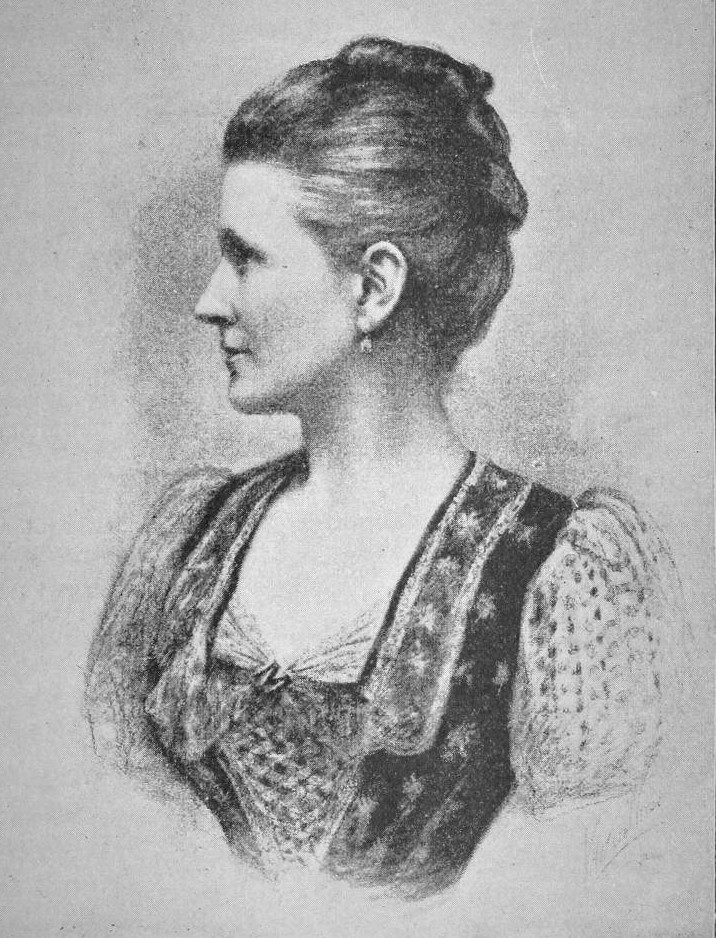
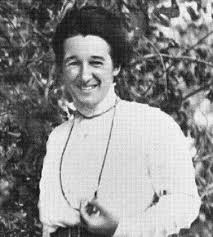
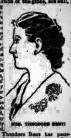
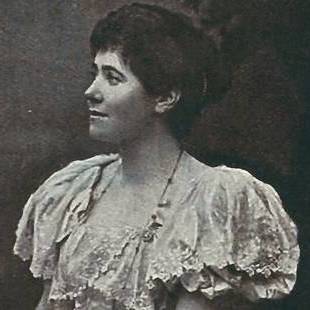
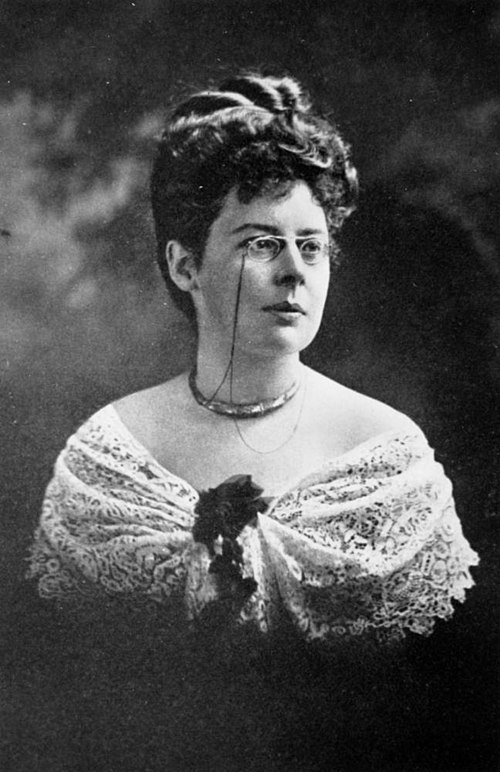
The unattributed portrait of Mabel Bent appearing on page 61 of her husband’s notorious book ‘The Ruined Cities of Mashonaland’ (1892). It also features in the Irish periodical ‘The Lady of the House’, 15 September 1893, p. 19 and 14 July 1894, p. 4.
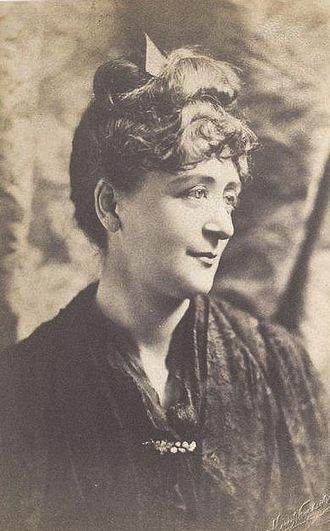
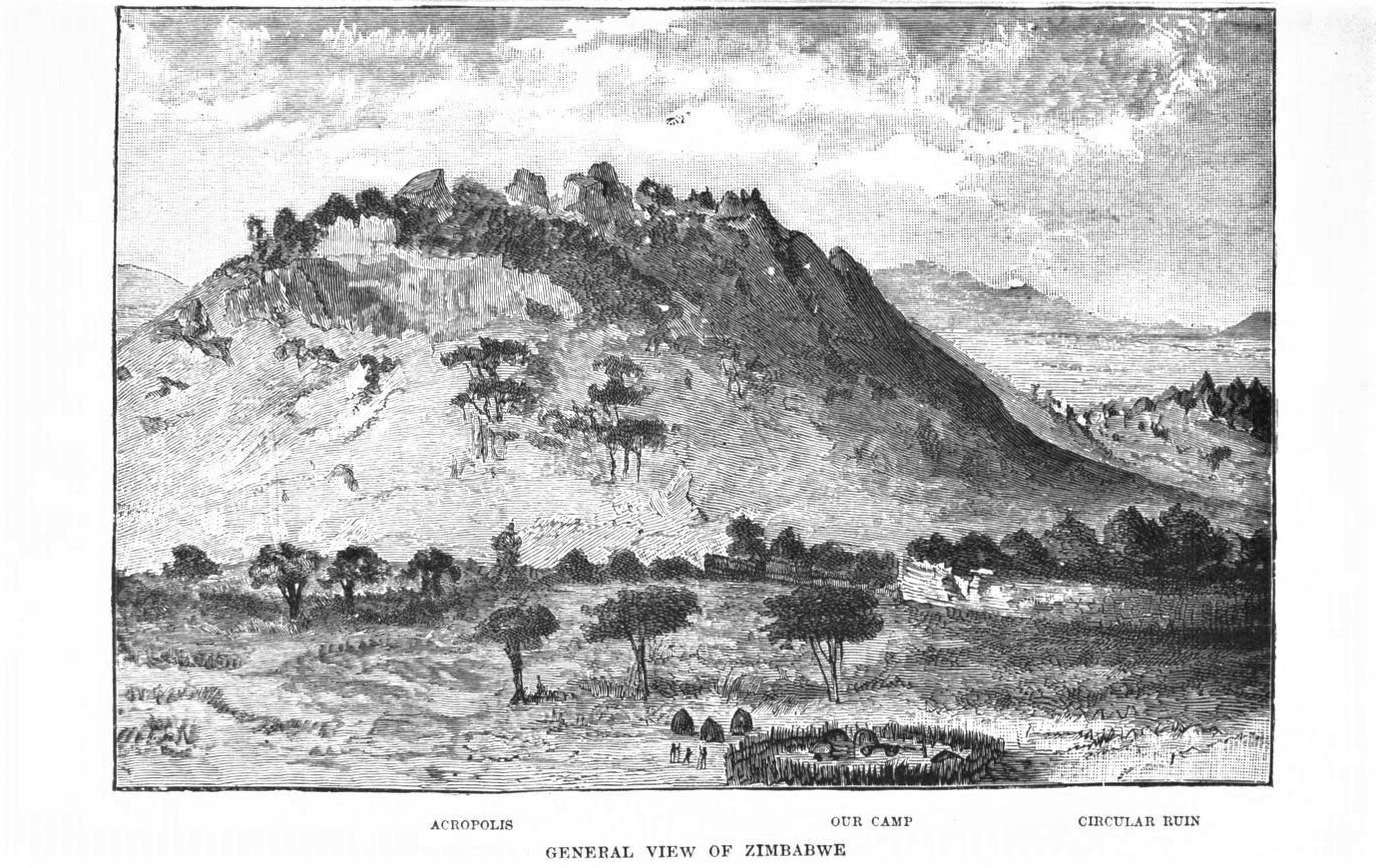
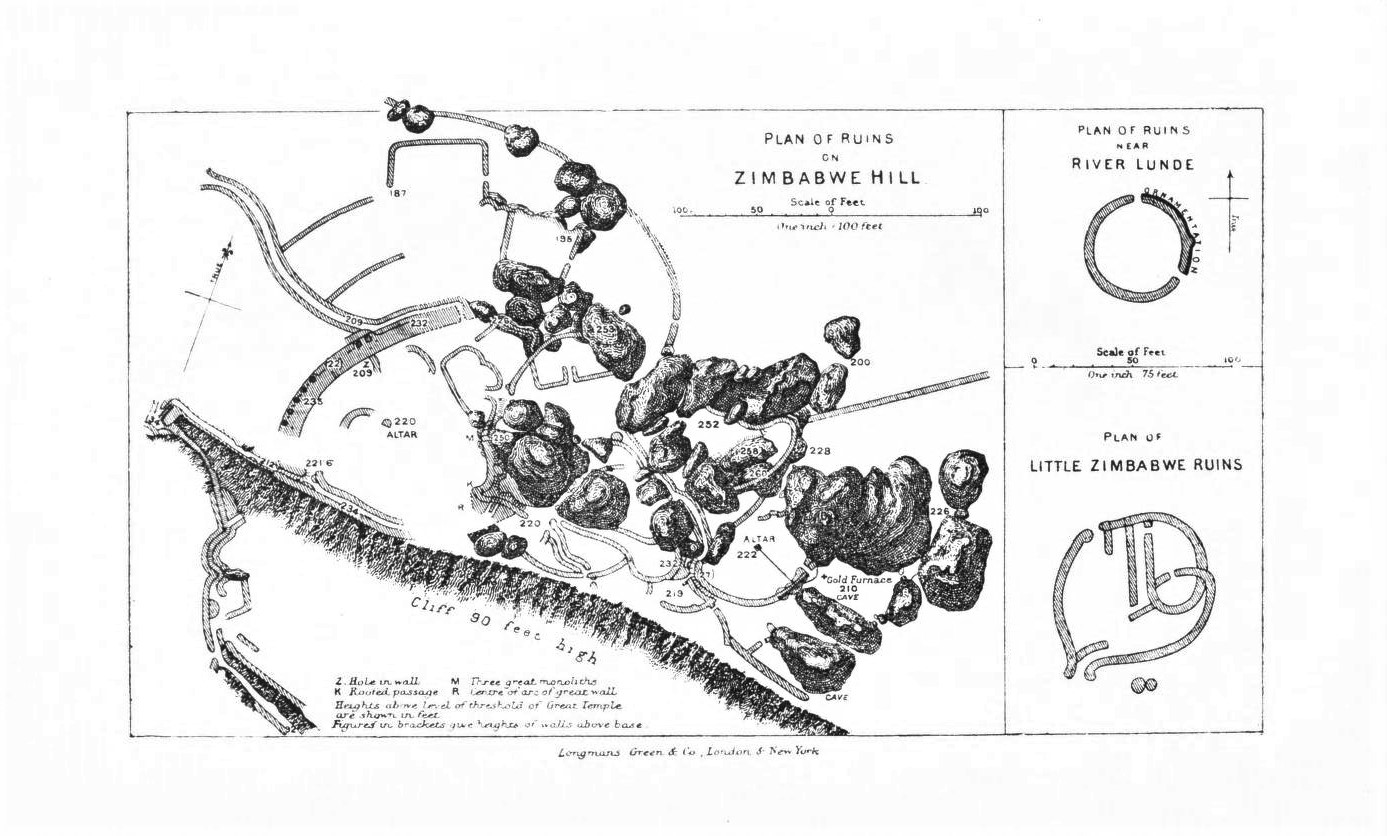
Theodore Bent’s ground-breaking monograph on Mashonaland – The Ruined Cities of Mashonaland (1892) – the volume that appeared following the year (1891) spent in ‘Rhodesia’ investigating the ruins of ‘Great Zimbabwe’ for Cecil Rhodes, and the work that was in effect to make Bent’s name, and him and his wife minor celebrities on both sides of the Atlantic, contains a charming portrait (page 61) of Mabel Bent – really charming actually, although adapted from the original photograph via the processes in those days required for printing; the image, however, has no attribution.
Charm? Yes, and obvious, in the professional lighting and a lightness of touch, almost modelling; and Mabel’s wild, long red hair (that famously captivated the villagers of Mashonaland (page 271)) is tamed, just, and her embonpoint sealed with an ‘M’; her dress is picturesque. It is a society portrait (we are talking London in the 1890s here), by a society photographer – but which one? This is the itch that needs scratching.
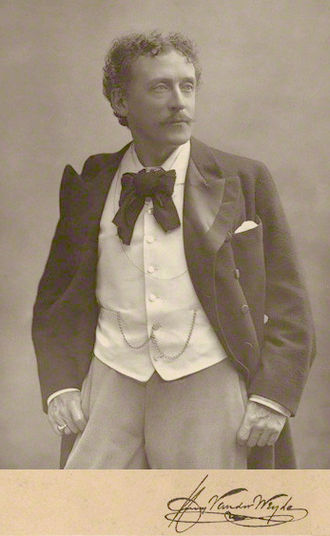
Celebrated society photographer, Henry Van der Weyde (1838-1924) (wikipedia).
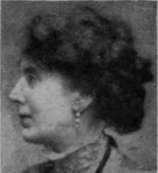
Then a surprise. Almost illegible, or whatever the word is for a photograph too dark to make out, the promise of a picture appears on page 621 of The Gentlewoman – The Illustrated Weekly Journal for Gentlewomen, No. 175, Vol. VII, for Saturday, November 11, 1893, within an article entitled “Gentlewomen ‘At Home’, no. CLXXV, Mrs. Theodore Bent”. We clearly read the sitter is Mrs. Theodore Bent. And, serendipitously, the photographer is a famous one – Henry Van der Weyde (1838–1924), the Dutch-born English painter and photographer, celebrated for his photographic portraits of the great and the good in the late 19th century; his studios equally fashionable, at “183 Regent-street, W.”
Mabel Bent in obscurity, from “The Gentlewoman”, No. 175, Vol. VII, for Saturday, November 11, 1893 (after the British Library).
And there is something about the promise in this photograph – the outlines, vague suggestions in the almost ectoplasmic patches of the blacks and the whites. Surely, this photograph of Mabel Bent and the one in The Ruined Cities of Mashonaland are the same? The Bents had commissioned the colourful society photographer Henry Van der Weyde, the David Bailey of his day, hadn’t they, whose work Theodore and Mabel would show off in Bent’s bestseller ?
At this stage, both images go to Ben Heaney at Archaeopress, Oxford, to put Photoshop through its paces. This is his report: “To compare the two images identifiable reference points were taken – these were the neckline of the dress, the position of the earring and ear, the top of the hair and the ruffles of the dress sleeve. This allowed the images to be matched in size by lining up the reference points on separate layers in Adobe Photoshop. The higher quality image was on the top layer, the darker, poorer quality, image on the bottom layer. When the top layer was ‘faded out’ by adjusting the ‘opacity’ of the top layer, the two images clearly matched up.” (Ben Heaney, pers. comm. 21/09/2020)
Thus it can be revealed, the unattributed photograph of Mabel Bent on page 61 of The Ruined Cities of Mashonaland is based on an original by Henry Van der Weyde, the leading London portrait photographer of the period.
The itch scratched, we can let the Bents continue on their way, the E. Med. and Africa behind them, towards Arabia Felix and the last cycle of their odyssey together…
[See also the transcription of Mabel’s interview with The Gentlewoman]
Just before (Western) Easter 1888, the tireless British explorers Theodore and Mabel Bent, on an extended cruise down the Turkish coast, had reached the small, thriving island of Kastellorizo – one more location to add to their twenty-year gazetteer; not a lot of people know that…
Wikipedia (03/09/2020) has plenty by way of introduction to this, perhaps the remotest of Greek islands one can step on via scheduled services:
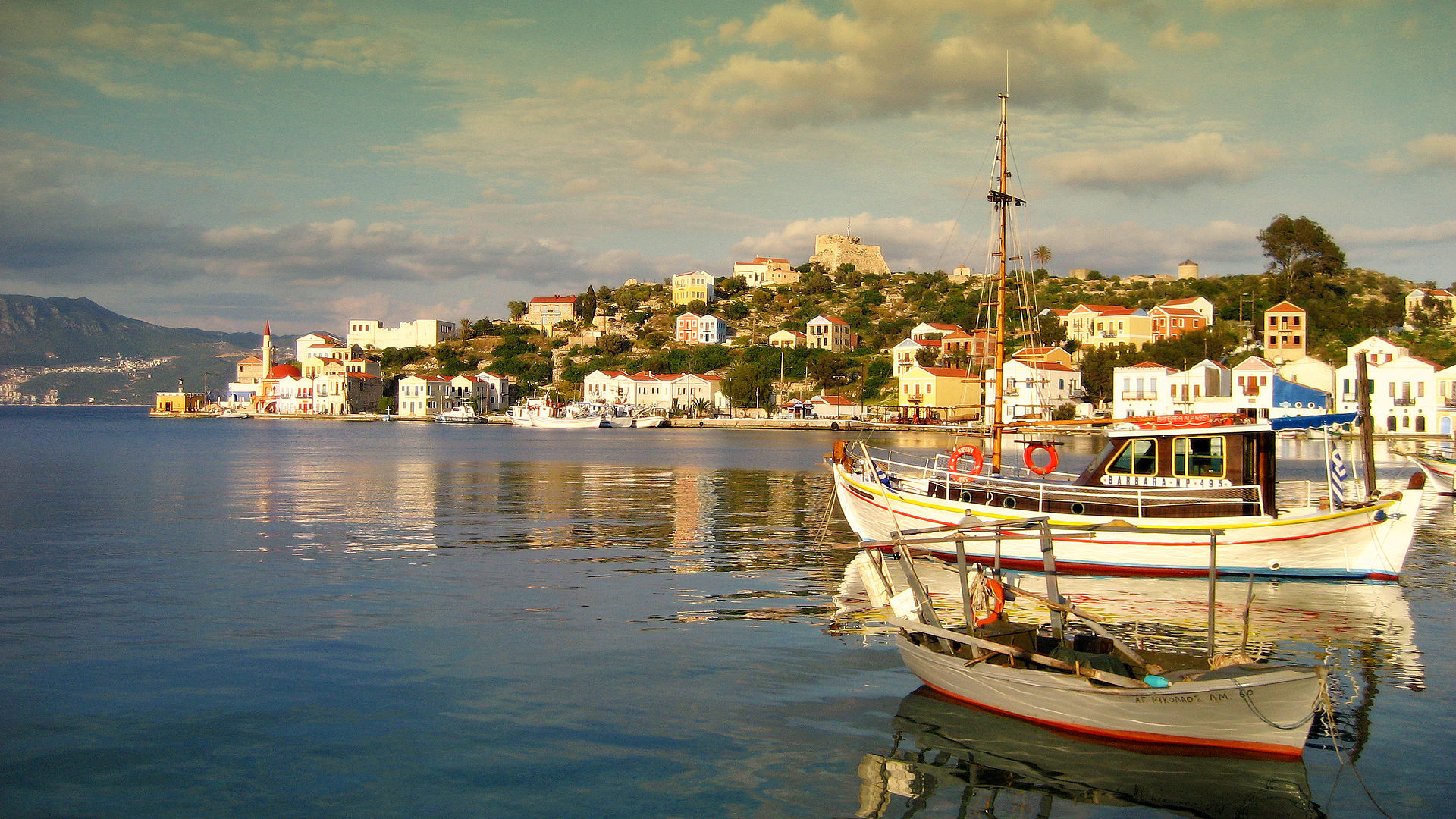
Kastellorizo harbour (wikipedia).
“Kastellorizo or Castellorizo (Greek: Καστελλόριζο, romanized: Kastellórizo), officially Meyisti (Μεγίστη Megísti), a Greek island and municipality of the Dodecanese in the Eastern Mediterranean. It lies roughly 2 kilometres (1 mile) off the south coast of Turkey, about 570 km (354 mi) southeast of Athens and 125 km (78 mi) east of Rhodes, almost halfway between Rhodes and Antalya, and 280 km (170 mi) northwest of Cyprus.”
The previous year (1887), our explorers, Theodore and Mabel Bent, had been excavating way up north on Thasos, finding some important marbles (including a fine statue they were not allowed to take home), which are now in the archaeological museum in Istanbul. Denied their rightful gains (as they saw them), and never a couple to give up easily, the pair spent a good deal of the summer and autumn of 1887 trying to drum up enough support to have these marbles rescued from the Turkish authorities and cased up for London. Letters exist from Bent to the British Museum requesting their kind interventions (it all sounds very familiar): “We have indeed been unfortunate about our treasure trove but I have hopes still. I sent to Mr. Murray [of the BM] a copy of two letters which recognize the fact that I had permission in Thasos both to dig and to remove. These I fancy had not reached Sir W[illiam] White [our man in the City, see below] when you passed through Constantinople. Seriously, the great point to me is prospective. Thasos is wonderfully rich and I have some excellent points for future work and … I am confident we could produce some excellent results.”
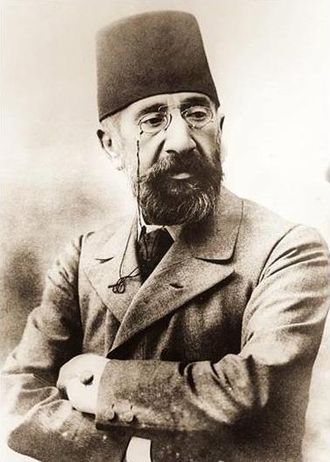
Osman Hamdi Bey (1842–1910) (wikipedia).
In January 1888, Theodore did receive a further grant of £50 from the Hellenic Society to return to Thasos to excavate, and the couple duly left for Istanbul. Unsurprisingly, the implacable, very capable Director of Antiquities in the Turkish capital, Hamdi Bey, refused Bent a firman to carry out further investigations, not only on Thasos, but also implying that the Englishman was not welcome to use unauthorized picks and shovels on Turkish lands in general.
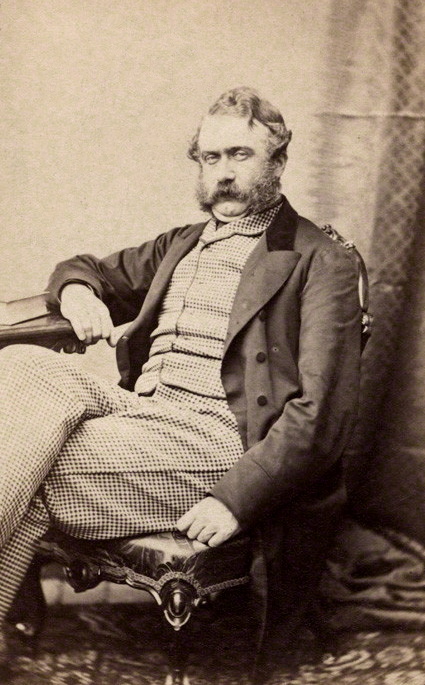
A friend indeed. William Arthur White (1824–1891), HM Ambassador at the Sublime Porte, but politely not prepared to assist the Bents in their piratical activities (wikipedia).
Despite various appeals to canny career diplomat, the Ambassador, Sir William White, he and Mabel were forced to change their plans. Theodore may well have been expecting this. In the Classical Review of May 1889, his friend E.L. Hicks reveals that when Bent was first digging on Thasos in 1887 he had employed a local man to “to make some excavations in the neighbourhood of Syme” (far down the Turkish coast, north of Rhodes) on his behalf. Obviously satisfied with the results, the couple, after an excursion to Bursa to see the fabled Green Mosque, decided to return to Cycladic Syros, where they chartered for about fifty days the pretty yacht Evangelistria (the Bents refer to her as “the ‘Blue Ship’ from the gaudy colour with which her sides were painted”), with “Kapitan Nikólaos Lambros” and her crew, under Greek papers; and they embark (Wednesday, 29 February 1888) on this fall-back plan that will take them with the winds and currents as far south as Levantine, if not Oriental, Kastellorizo, frozen just off the Turkish coast, as a map will show you, like a mouse under a cat’s paw.
Meanwhile Mabel, on Syros before embarking, can be candid for her diary – they are to don pirate gear, “Theodore at once took to visiting ships to put into practice our plan of chartering a ship and becoming pirates and taking workmen to ‘ravage the coasts of Asia Minor’. Everyone says it is better to dig first and let them say Kismet after, than to ask leave of the Turks and have them spying there.” All, of course, reprehensible behaviour today. The couple also meet up here with their long-term dragoman, Manthaios Símos, who has sailed up from his home on Anafi , close to Santorini, to lend a hand.
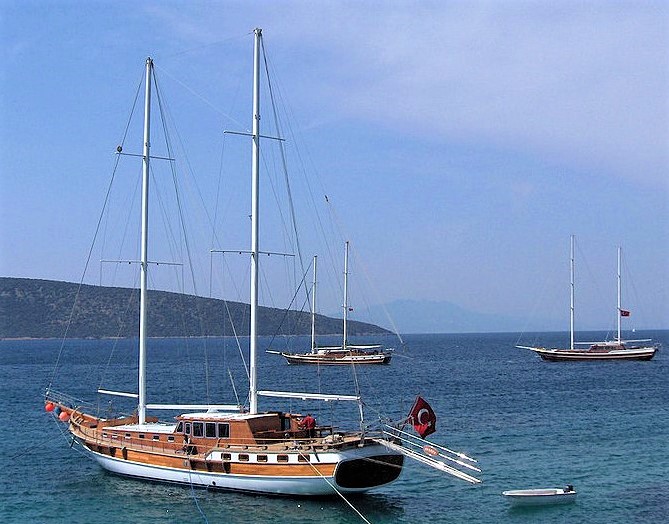
‘Gulets’ off Bodrum (wikipedia).
Thus, on a sort of early tourist ‘gulet’ cruise (“There is a dog called Zouroukos, who was at first terrified… and the little tortoise, Thraki”), the couple’s investigations along the Asia Minor littoral (in particular the coastline opposite Rhodes) turned out fairly fruitful, and some of Theodore’s ‘finds’ from this expedition are now in London (see below). He briefly wrote up his discoveries of ancient Loryma, Lydae, and Myra for the Journal of Hellenic Studies (Vol. 9, 1888 – but a lengthier account was provided by E.L. Hicks (Vol. 10, 1889)), including transcriptions of over forty inscriptions and passages of text from Theodore’s own notebooks.
No doubt his notebooks were to come in handy when, a few years later, Bent is editing his well-known version of Thomas Dallam’s diary for the Hakluyt Society (1893), recounting the latter’s adventures in these same waters: ‘The 23rd [June, 1599] we sayled by Castle Rosee, which is in litle Asia.’ (Incidentally, musical-instrument maker Dallam’s Gulliver-like exploits below the gigantic walls of Rhodes, not so very far away northish, are highly recommended.)
But back to the Bents, a popular account of the their 50-day cruise in 1888 – well worth a read for those who get off on the rugged coastline from Symi to Kastellorizo – was written by Theodore for The Cornhill Magazine, (Vol. 58 (11), 620-35), and entitled ‘A Piratical F.S.A.‘ (Bent had recently been made a Fellow of the Society of Antiquaries of London, and was indulging in shameful hubris.)
The safe, not to say stunning, harbour of Kastellorizo with the Turkish coast 2km distant.
(For the rest of Bent’s articles on this coastal meander, see the year 1888 in his bibliography.)
After various adventures, the Bents reached the Kastellorizo offing on 30th March 1888. Theodore sets the scene: “Great preparations were made for the arrival of the ‘Blue Ship’ at the first civilised port she had visited since leaving Syra. One of the ‘boys’, it appeared, understood hair-cutting, and borrowed Mrs. F.S.A.’s scissors for that purpose; beards were shaved, and shaggy locks reduced with wonderful rapidity… Castellorizo was the port, and it is a unique specimen of modern Greek [sic] enterprise, being a flourishing maritime town, built on a barren islet off the south coast of Asia Minor, far from any other Greek centre – a sort of halfway halting place in the waves for vessels which trade between Alexandria and Levantine ports; it has a splendid harbour, and is a town of sailors and sponge divers.”
Half thinking of home, the Bents are in need of some fancy paperwork to ensure their acquisitions thus far are protected from the prying eyes of both Greek and Turkish customs officials. Mabel’s ‘Chronicle’ gives us a little more, beginning with a sketch of their plans:
The ‘red fort’, after which the island is named, so called from its appearance at sunset, proudly asserts its nationality to the Turkish town of Kaş, 2km across the strait.
“First to go to the island of Kasteloriso, where there is a Greek consul, and have a manifesto made that we came from Turkey so that the Greeks may not touch our things in Syra… Now all was preparation for this civilized place. Theodore assured himself that his collar and tie were at hand. I hung out my best Ulster coat and produced respectable gloves and shoes… We really made a very tidy party when we reached our goal… We had a calm voyage. An average time from Myra to Kasteloriso is 6 hours; we took about 26. We did not land in the regular harbour. The captain said questions would be asked as to why there were 18 people in such a boat. We landed about 8. It is a flourishing looking little town, divided by a point on which rise the ruins of a red castle. The name should be Castelrosso, but first the Greeks have made it ‘orso’ and then stuck in an ‘i’. The Genoese or Venetians made it. Kapitan Nikólaos was greeted wherever he went by friends. He did not seem anxious to be questioned much, and once when asked where he had come from gaily answered, ‘Apo to pelago!’ (from the open sea). I was delighted at this answer and so, when some women, sitting spinning on rocks, called out, ‘Welcome Kyria,’ to which I answered, ‘Well met!’ and then asked, ‘Whence have you troubled yourself?’ ‘Apo to pelago!’ I smilingly replied and swept on round a corner where we could laugh, and who more than Kapitan Nikólaos…”
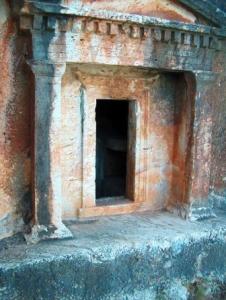
The iconic ‘Lycian tomb’ on Kastellorizo (4th century BC) (from Kastellorizo.online).
There is nothing in Mabel’s diary to suggest the couple made any sort of tourist excursion around the island, not even to the famous blue caves, which is a shame. Surprisingly, too, Theodore makes no mention of perhaps the most iconic ‘snap’ on the island, the Lycian rock-cut tomb (4th century BC), unique on Greek soil.
Mission accomplished, the next we learn is that the Evangelistria has reached the ancient site of Patara on the mainland: “Yesterday morning, Good Friday [March 30th], we had a very quiet voyage hither…”
Within days, Theodore and Mabel will be casting off for Syros once more, but, after 50 days in their gulet, they have had enough of open waters and decide to return to London the long way, overland, via Smyrna – Istanbul – Scutari – Adrianople – Plovdiv – Istanbul – Nicea – Istanbul – Odessa – Berlin. All a far cry from ‘civilised’, Levantine Kastellorizo… and one wonders of their dreams.
“We stopped 2 nights in Berlin at the Central Hotel”, writes Mabel, “We had travelled from Saturday night to Monday night, the 14th, and nearly always through forests. We crossed from Flushing and on Thursday [17th May 1888] we safely reached home… All our marbles reached England soon after, and after spending some weeks here are housed in the British Museum.” (‘The Travel Chronicles of Mrs J. Theodore Bent’, Vol 1, Oxford, 2006, p. 260)
‘Here’ is the couple’s smart townhouse near Marble Arch, a vast magpies’ nest, with every tabletop, bookcase and cabinet showing off souvenirs from 20 years of travels in Arabia, Africa, and the Eastern Mediterranean, perhaps, too, some embroideries and large, distinctive chemise buttons (from the women Mabel chatted to on Kastellorizo), just arrived back in rough, pine crates, recently unloaded from the decks of the Evangelistria:
The distinctive chemise clips from the Kastellorizo region (from ‘An account of discoveries in Lycia, being a journal kept during a second excursion in Asia Minor’ by Sir Charles Fellows, 1841, London, J. Murray, p. 190).
“The women here all wear the dress of Kasteloriso: long full coloured cotton trousers, then the shirt fastened down the front with… large round silver buckles, and then married women wear a gown slit up to the waist at the side. The 2 front bits are often tied back as they become mere strings. Then a jacket with sleeves ending above the elbow and very long-waisted, and very low is wound a scarf. The girls do not wear the gown. They have a fez on the head and a turban round it or not…” (‘The Travel Chronicles of Mrs J. Theodore Bent’, Vol 1, Oxford, 2006, p. 246)
Like most explorers, let us presume, Theodore Bent was protective and proud of his achievements – setting difficult targets, being first, or among the very first. And in his list of hard things done, right up there is his first foray of 1894 (January-March) deep into Southern Arabia, the Yemeni interior – the breath-taking Wadi Hadhramaut – unforgiving, challenging, alien, romantic.
“And the award goes to….” Extract from ‘The Morning Post’ of 3 October 1894.
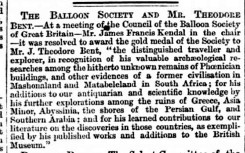
Some background. By 1894 Bent stood out in a crowd; a respected and spur-earned explorer – FSA, FRGS, and winner of the Balloon Society’s prestigious gold medal. Most readers associate the Bents with the Eastern Mediterranean and their researches there, and these readers get no further than the Cyclades or Dodecanese. Yet this region represents only a third of their travels, and we must not overlook them, too, in the dusts and deserts of Africa and Arabia.
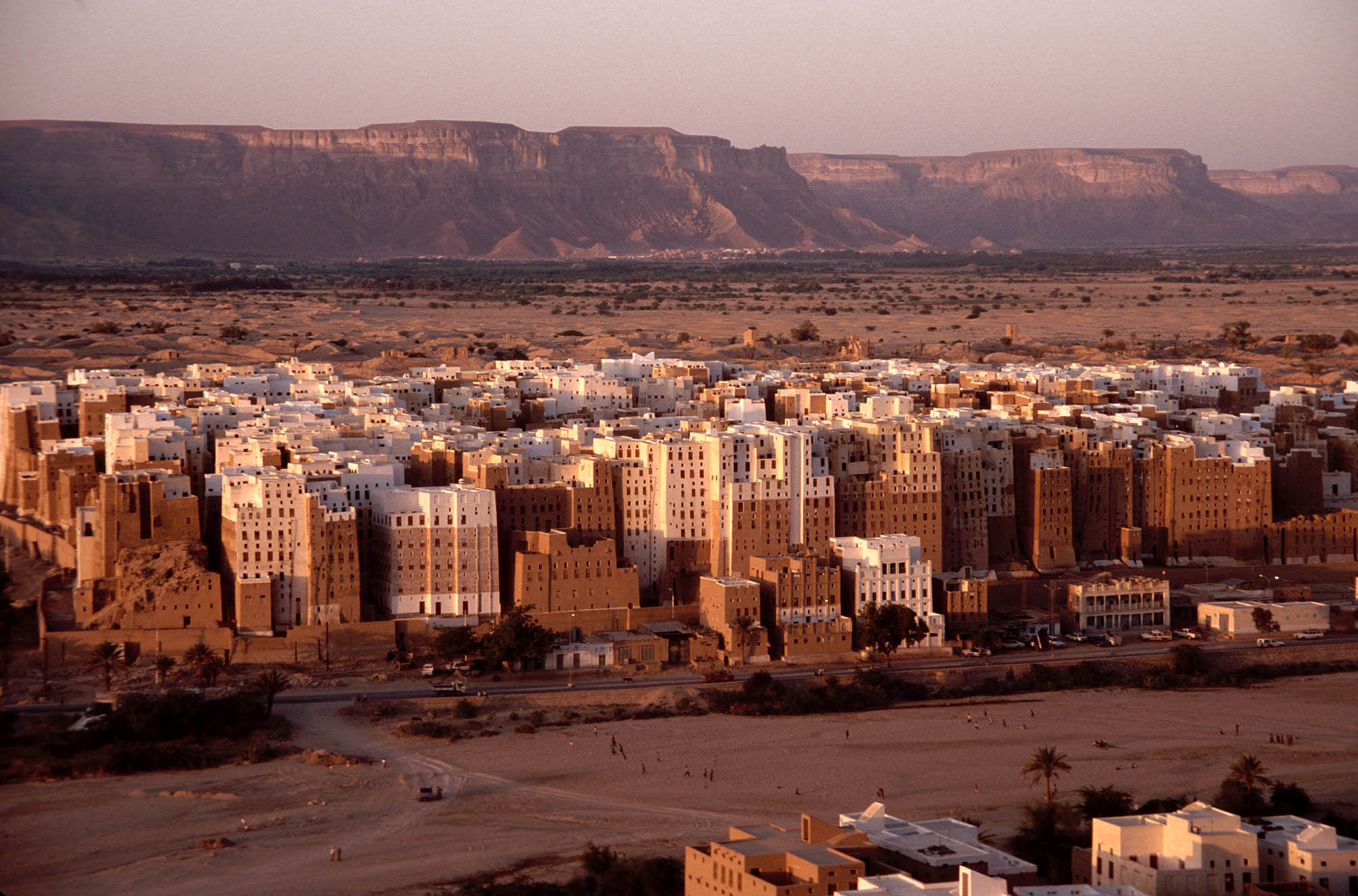
The Bents reach Shibam in the Hadhramaut on Thursday 25th January 1894, as Mabel notes in her diary: “We got away earlier than we hoped, 8.30 with 11 camels. Imam Sheriff rode a very fidgety horse of the Sultan’s… About 12.30 we reached Shibahm.” (wikipedia)
For their early 1893 season, Theodore and Mabel headed for the north-east of the Horn of Africa, looking for possible clues in the civilisations of early Ethiopians that might link Mashonaland’s ruins (modern Zimbabwe) of ‘Great Zimbabwe’, the couple’s quest in 1891, to the very old trade routes that led into Egypt, to the west, and to Southern Arabia to the east. Clues would include early ‘Arabian’ (Sabaean primarily) inscriptions from ancient Aksum (its royal family claiming descent from Menelik, the son of the Queen of Sheba, who had the Ark of the Covenant from Jerusalem hidden in his capital). And it was, in a way, the Queen of Sheba who beguiled Theodore for the last five years of his short life.
Back in London from the Red Sea by the early summer of 1893, Theodore lectured widely, announcing that he had now evidence from Zimbabwe and Ethiopia of the remains of a Sabaean ‘civilisation’ from the vast peninsula of Southern Arabia, out-posting down the east coast of Africa. Bent hoped soon to be able to “reconstruct the history of a once mighty commercial race, which was contemporaneous with the best days of Egypt, Greece and Rome, and which provided the ancient world with most of its most valued luxuries.” Included with these luxuries were the exotic resins of frankincense and myrrh; it was the search for them, and the many routes they were transported along, that were the themes of Theodore’s articles and lectures in the summer of 1893.
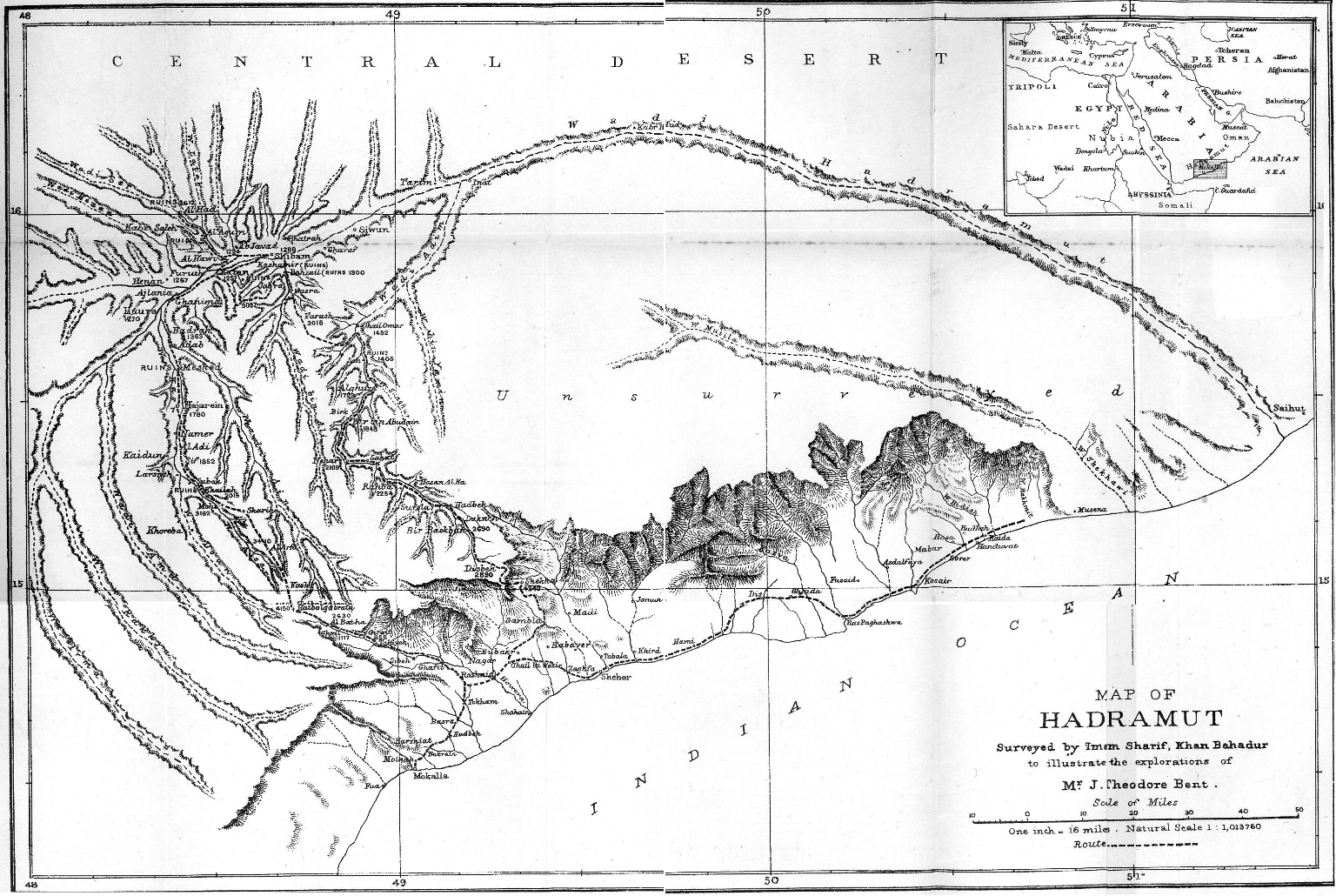
By summer’s end, Theodore was in a position to begin preparing a large expedition to Southern Arabia and the Wadi Hadhramaut (Hadramawt or Hadramout) itself the following season, a party that would include his wife Mabel, of course, as well as his Sancho Panza-like assistant, the Anafiot Matthew Simos, a young botanist from Kew, William Lunt (1871-1904), “Baÿoumi, known to us as Mahmoud, an Arab, who came on at Alexandria. He is provided by the Madras Museum as our Zoologist”, and the highly accomplished Indian surveyor/cartographer, Imam Sharif, whose later map of the region is a delight to this day.
A few weeks before setting off (via Marseilles, Suez and Aden), the Bents had sent out a press release (they were unabashed self-publicists): “Mr. Theodore Bent has almost completed his arrangements for his journey to the Hadhramaut country, in Southern Arabia, which he proposes to explore this winter. He starts about the end of next month for Aden, and will then proceed along the coast to Makulla, which is to be his starting point into the interior. The extensive region of Hadhramaut is but little known, and Mr. Bent proposes to make as thorough a survey as possible of the country. He, himself, will pay particular attention to the archæology of the districts, and he will probably be accompanied by a native Indian surveyor, as well as by specialists in botany and zoology. Mr. Bent, who will, as on all his journeys, be accompanied by Mrs. Bent, hopes to be back in England by May or June of next year.” (The Manchester Guardian, 22 October 1893.)
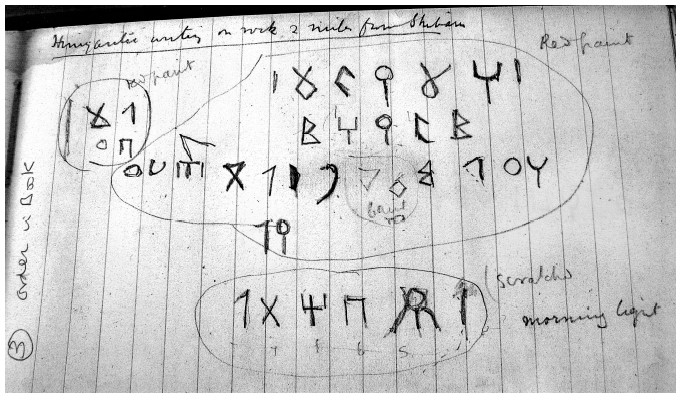
‘Himyaritic’ inscriptions copied by Theodore Bent into his own notebook in the Hadhramaut in 1894 (Hellenic and Roman Societies, Joint Library, London)
The Iron Age (1100–650 BC) of Southern Arabia, primarily of interest to Theodore, is marked by a network of competing city-states and pre-Islamic kingdoms (Sabaean, Awsanian, Minaean, Qatabanian, Hadramautian and Himyarite). Distinguished by the appearance of early writing, the Sabaeans rose to prominence, based at Marib by the 5th century BC, their influence extending throughout the western Hadhramaut. Notwithstanding a brief annexation by the kingdom of Aksum (in modern Ethiopia) around 500 BC, keen for more control of the area’s rich natural resources, Shabwa remained a centre of culture and learning until its eventual decline around the 5th century AD and the ascendancy of the highland-Yemen Himyarites, followed by periods of Sassanian (eastern) and Roman/Byzantine (western) power, before the rise of Islam (c. 650 AD).
For Theodore and his contemporaries the Hadhramaut was represented by the eponymous wadi/valley system in today’s eastern Yemen. As for its physical geography, the region extends over 600 km from west to east, consisting of a narrow, arid coastal plain, a broad plateau averaging 1400 m in height, a bewildering maze of deeply sunken wadis, and a final escarpment that abuts the great desert to the north. These uncompromising, awe-inspiring landscapes have facilitated movements of people over the millennia, and the objective of Theodore’s mission in 1894 was to penetrate the said Wadi Hadhramaut (approaching from the south, via Al-Makulla on the coast) and, ultimately descending south–east, to reach the Indian Ocean again at Sayhut.
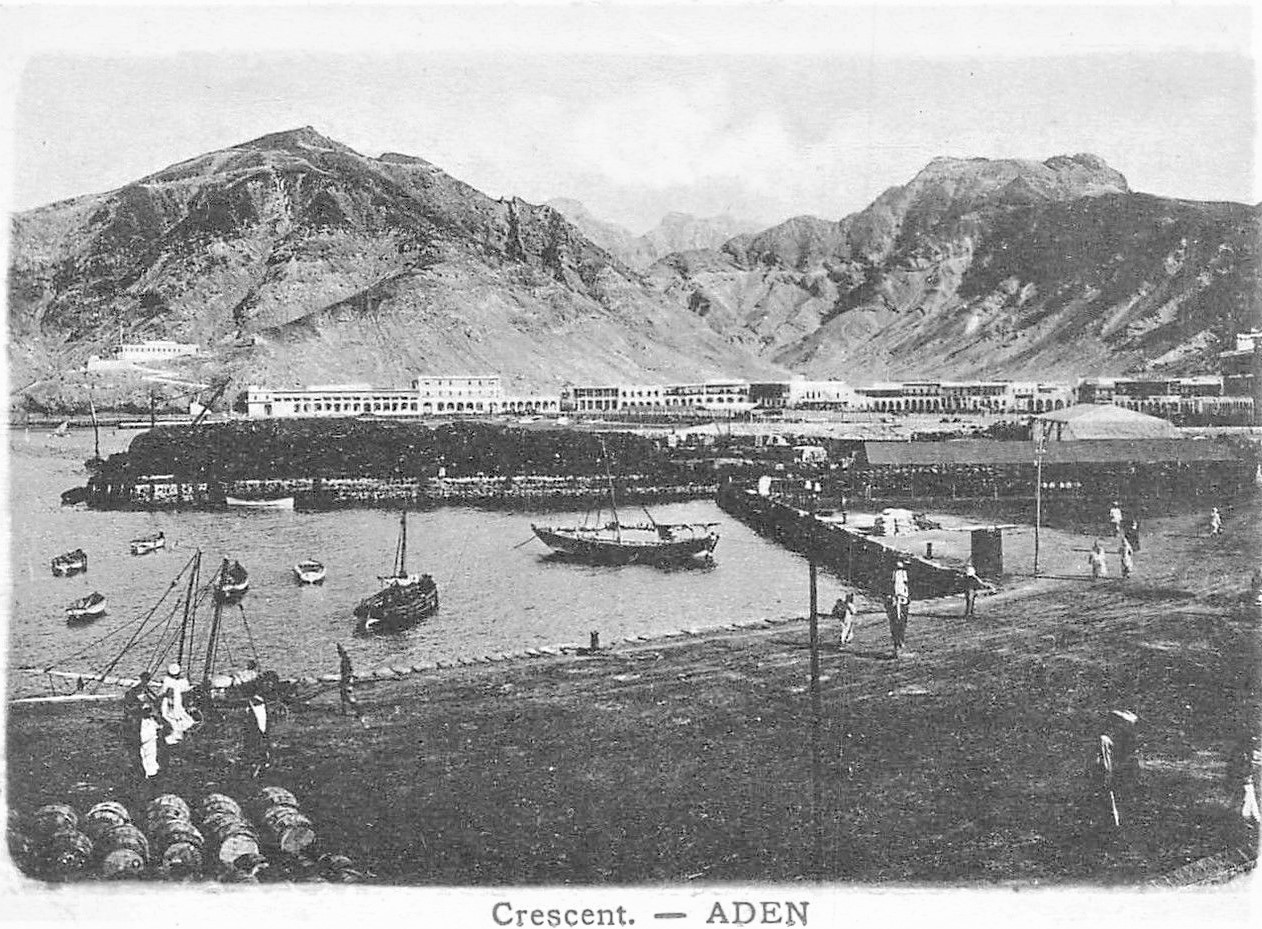
Aden – the Bents point of entry for the Yemen in the 1890s (a contemporary postcard).
Although ‘Europeans’ had been sailing and exploiting the coastlines of Arabia for hundreds of years, Britain’s need in the early 19th century to secure its sea-lanes to India and the Persian Gulf precipitated a brilliant campaign of coastal surveys that effectively drifted from Aden to Muscat. The captains and officers of British vessels wrote and eventually reported back to London on their findings – strategic, botanic, folkloric.
Dependence on their ships meant that these men (and of the women, Mabel Bent, not Lady Anne Blunt, not Freya Stark, not Kate Humble even, was, we think, the first willing Western woman to do so – how many hundreds have unwillingly seen the moon and stars there?) were unable to venture far inland, and it was not until as late as 1843 that the borders of the Hadhramaut interior were reached by the German Baron Adolf von Wrede in 1843. As for the great mud-brick cities of the main Wadi Hadhramaut itself, they were not visited until 50 years later, and by another German, Leo Hirsch, who, by great coincidence, was covering some of the same trails as the Bents, and just a few months ahead of them in 1894: therefore ‘to these two parties the credit of the discovery of the Wadi Hadhramaut itself belongs.’ (generally for this background, see Hogarth 1905: 206-225)
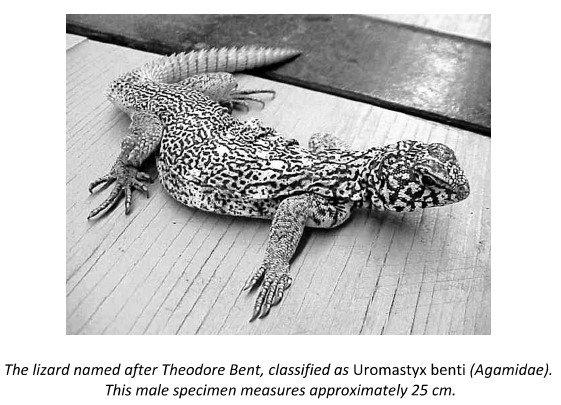
Some achievement – unarguably the area is more dangerous now than at the time of the Bents’ visits (they were to make three concerted attempts). Today the region is fatal for tourists; there are pirates off Aden and in January 2008 two Belgian and two Yemeni nationals were shot dead, with four other Belgians seriously injured, in an incident in the Hadhramaut. As a result, the UK government issued a warning that would have stopped the Bents in their tracks (well, perhaps): ‘We advise against all but essential travel to the Governorates of Sa’dah, Ma’rib and Hadhramaut due to the threat of terrorism and tribal violence. You should take all the necessary steps to protect your safety, and you should make sure that you have confidence in your individual security arrangements. You should maintain a high level of vigilance in public places and exercise caution, particularly outside urban areas.’ (N.B. the lizards are harmless.)
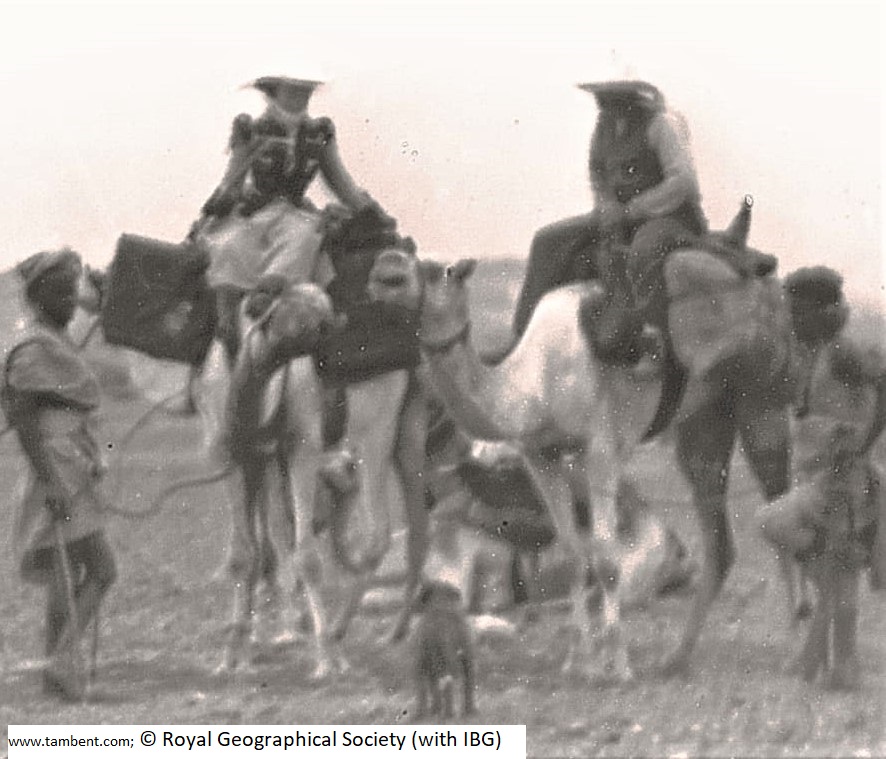
“… and one day they said ‘come down off your camels and we’ll cut your throats’”. Not the Yemen, but a detail from a lantern slide of the Bents’ trip into the Sudan (Royal Geographical Society, London).
Mabel often boasted later of an incident on this 1894 adventure when they were “Besieged by crowds calling us pigs and dogs and gavers, and one day they said ‘come down off your camels and we’ll cut your throats’. I drew [our] interpreter aside and said ‘Tell them when they ask you not to be afraid, for… if wanted, our Queen would have taken [the country] long before we were born, and if she wanted it now she would not send 8 subjects unarmed for the business…’” (The Travel Chronicles of Mabel Bent, Vol. 3, 2010: 346).
Understandably, the Bents looked on their adventures in the Hadhramaut with considerable pride, even though they never completely realized their objective to traverse the wadi west–east, and arrive, their considerable gear and large party on camels, mules and horse, trekking south, weeks later back at the sea, not so far from the borders of modern Oman.
Imagine then, disembarking from the fine P&O steamer Kaisar i Hind at Marseilles in the third week of April 1894, resting and waiting there a few days for a train to Calais and the Dover ferry for home, his surprise, nay outrage, on reading in a copy of The Graphic, waiting for him poste restante, a flippant account by three boys in an article that could have come straight from a rag mag (by the tone of some of its paragraphs), boasting that this trio of pranksters had got to the Hadhramaut first! The piece is redeemed only by some astonishingly fine sketches done by one of them…
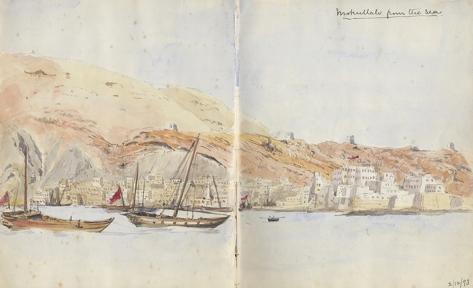
H.B. Molesworth’s sketch of Al Mokulla, the Bents’ port of entry for the Hadhramaut. Molesworth’s wonderfully illustrated notebook is in the Royal Geographical Society, London (gettyimages).
Here is a cut-and-paste flavour of the boys’ breathless account in The Graphic; Theodore’s outrage is palpable: “The territory traversed by the Bent expedition, recently noticed in the English and other journals, is more circumscribed than Mr. Bent probably supposed before starting… There is nothing but rock and dust, soda and sulphur, fever and sunstroke. If an enterprising Bedouin, or even Mr. Bent succeeds in finding in that country something that is useful or important, he will deserve great credit… These facts may, perhaps, be found of interest; and they may be relied upon as accurate, seeing that the writer [Paton], with two other Englishmen [the Molesworth boys], has just returned from traversing the same ground which Mr. Bent is now exploring… Our friend [M. Jacques de Zogab], who had taken the steamer back to Aden on the 3rd [December 1893], gladly offered Mr. Bent and his companions a passage on the return voyage to Hadramaut. He landed them at Mokullah on the 17th, and picked us up at Shehr on the 18th, so that we had no opportunity of putting our experience at Mr. Bent’s disposal [!]. It was not till we then received accumulated letters that we learned from enclosed journalistic reports of Mr. Bent’s communication about his expedition, that our position as pioneers of that region would obtain imprimatur of such authority [!!]. We may mention that in a cairn on the summit of Chub-thub will be found a scroll bearing the signatures of H.B. Molesworth and Guy Molesworth; while in the Palace at Ghraïl is a mural picture representing our State entry into that city, and signed Frederick Noel Paton… The writer of the above points out that he traversed the ground which Mr. Bent proposed to explore, and it is interesting to note that, according to the latest intelligence received from Aden, Mr. Theodore Bent and his party on the 3rd inst. reached Shehr (or Sheher), on the coast to the north-east of Mokullah, the point from which the expedition commenced its march into the interior. Mr. and Mrs. Bent and the other members of the party were in good health…” (The Exploration of Southern Arabia – A Journey in the Hadramaut, by F. Noel Paton; The Graphic, 31 March 1894, pp. 370 ff.). Outrageous stuff!
Apoplectic probably, Theodore demanded a right of reply immediately from their hotel (the “Hôtel du Louvre and de la Paix (otherwise pay)” – and got one; it is reproduced in full from The Graphic of 5 May 1894, page 518: “The Exploration of the Hadramaut – Mr. Theodore Bent, writing from Marseilles with reference to an article in The Graphic of March 31, says:- ‘I should be much obliged if you will kindly correct certain statements therein contained concerning my expedition to the Hadramaut. Your correspondent, Mr. Noel Paton, did not traverse the ground which we proposed to explore,’ only going twelve miles inland, whereas the Hadramaut does not begin until 120 miles inland, and the coast line has nothing to do with that district. Our exploration of the Hadramaut in no way has to do with the part of the country traversed by Mr. Noel Paton.’” So there.
Balloon Society of Great Britain, Gold Medal, similar to the one presented to Bent in 1894.
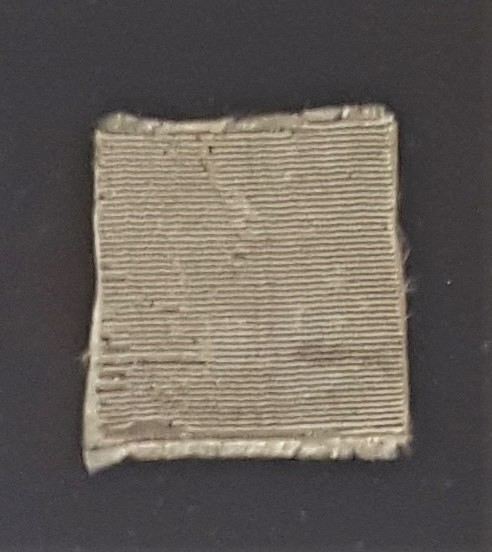
Indulge us – we digress over a slice of wedding dress, the size of a large postage stamp.
Sulgrave Manor, Oxfordshire, UK (Wikipedia)
Sulgrave Manor is a modest Tudor house not far from Oxford (UK), built in 1539 for the wool merchant Lawrence Washington, a direct ancestor of George Washington, the future first President of the United States. The house was sold out of the family in 1659 and gradually substantial alterations were made as it became home to a succession of tenant farmers. The old manor was at last rescued from dereliction in 1914 after being purchased by the Anglo-American Peace Centenary Committee as part of the commemorations of the Treaty of Ghent, which established peace of sorts between Britain and the USA in 1814. The house and gardens were restored by arts and crafts architect Sir Reginald Blomfield and eventually opened to the public in 1921. In the same year, the Sulgrave Manor Board (now Sulgrave Manor Trust) was established to preserve the estate for the public and promote its historic and symbolic role in Anglo-American relations. It is open as a museum (with luck, reopening to the public from 20 July 2020).
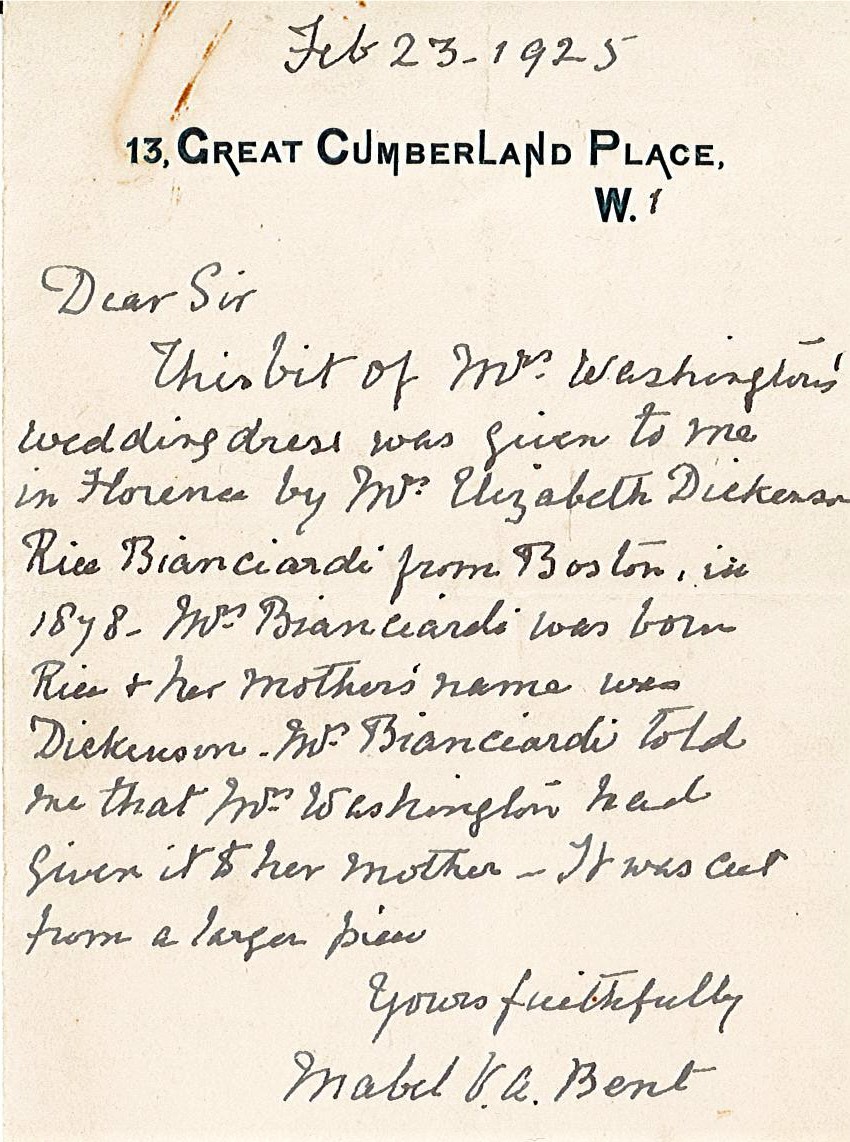
Letter from Mabel Bent of 23 February 1925 to the Sulgrave Manor Board (rights: Sulgrave Manor Trust).
Meanwhile, by the mid 1920s, Mabel Bent, impressive widow of the explorer Theodore Bent (1852-1897), was nearing the end of her own travels and disposing of some of her most significant and prized possessions. Presumably knowing of the great Washington work at Sulgrave, Mabel sent the Board a packet with a letter (dated 23 February 1925 and addressed from her London home, 13 Great Cumberland Place, W1); it would have arrived out of the blue, containing an amazing object-the subject of this digression. The letter reads:
Dear Sir
This bit of Mrs. Washington’s wedding dress was given to me in Florence by Mrs. Elizabeth Dickenson Rice Bianciardi from Boston, in 1878. Mrs. Bianciardi was born Rice and her mother’s name was Dickenson. Mrs. Bianciardi told me that Mrs. Washington had given it to her mother. It was cut from a larger piece.
Yours faithfully
Mabel V. A. Bent
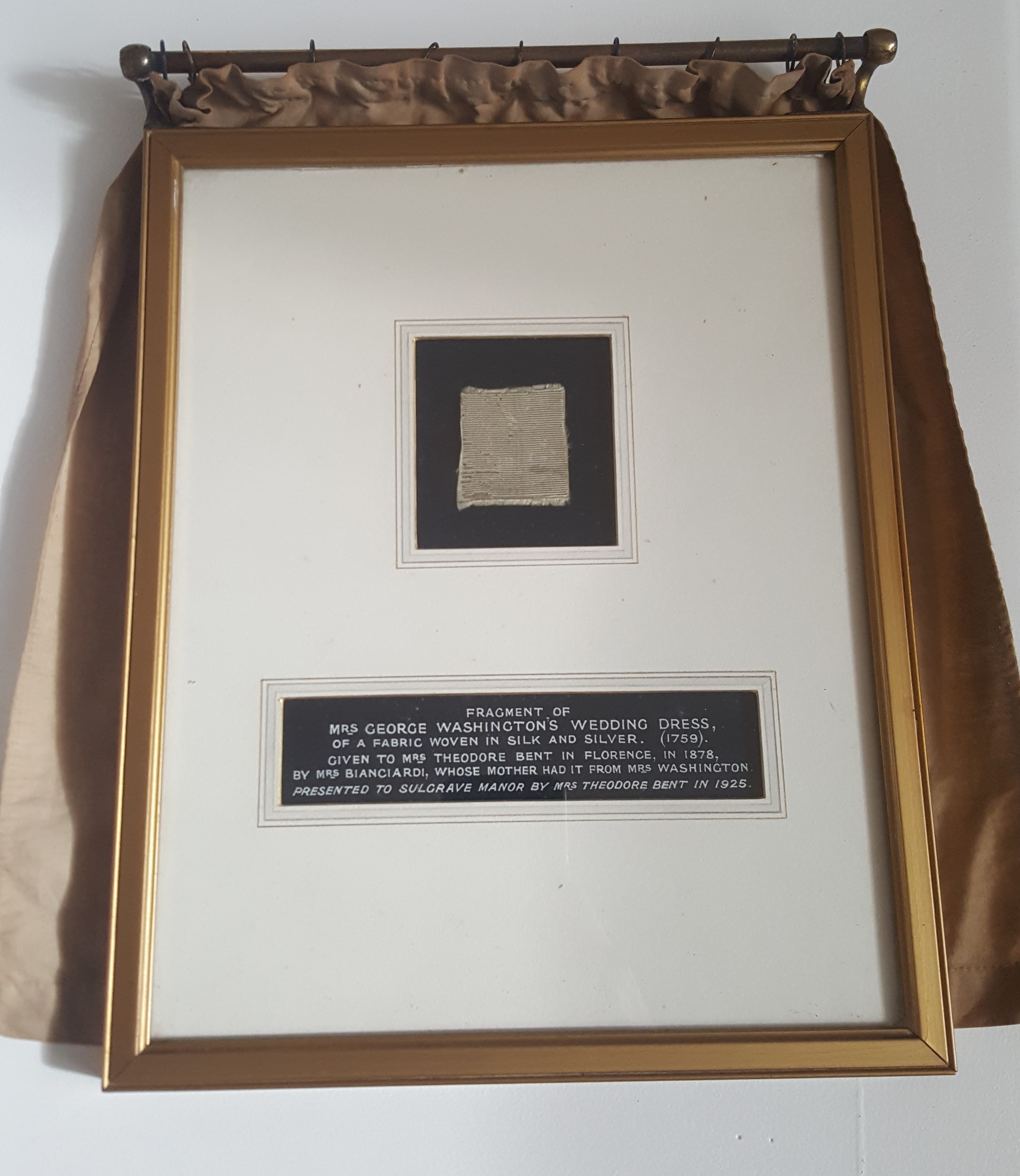
Framed fragment of Martha Washington’s wedding dress presented to Sulgrave Manor in 1925 by Mabel Bent (rights: Sulgrave Manor)
And this ‘bit of Mrs. Washington’s wedding dress’, was thus wrapped up, together with a small unlabelled photo (see below) and two US half penny coins (now lost), and posted off to Sulgrave, where it remains – one of the star exhibits of the museum, neat in its frame, and protected from the light by its own small, theatrical curtain. (All the Sulgrave Manor information and images have been most kindly provided by Laura Waters, House & Collections Manager.) Presumably the fragment was mounted at Sulgrave, as the frame’s inset caption infers: “Fragment of Mrs George Washington’s wedding dress (1759), of a fabric woven in silk and silver. Given to Mrs Theodore Bent in Florence, in 1878, by Mrs Bianciardi, whose mother had it from Mrs Washington. Presented to Sulgrave Manor by Mrs Theodore Bent in 1925.”
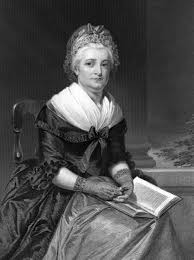
Martha Washington (wikipedia)
Martha Custis (née Dandridge, 1731 (?) – 1802), famously married (age 27) George Washington (26) on 6 January 1759, at the White House plantation. According to the Mount Vernon website “Their attraction was mutual, powerful, and immediate. Martha was charming, accomplished, and, of course, wealthy. George had his own appeal. Over six foot two inches tall (compared with Martha, who was only five feet tall), George was an imposing figure whose reputation as a military leader preceded him. After his half-brother Lawrence and his widow died, Washington would inherit Mount Vernon, a beautiful 2000-acre estate located high above the Potomac River in Northern Virginia.”
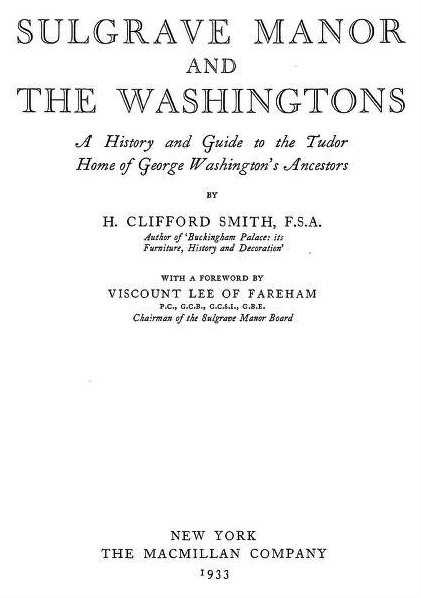
Title-page to the US edition of H. Clifford Smith’s “Sulgrave Manor” (archive.org)
It seems that the first publication of Mabel Bent’s involvement as a footnote in American history is recorded in “Sulgrave Manor and the Washingtons. A History and Guide to the Tudor Home of George Washington’s ancestors” (Jonathan Cape: London, 1933), a fine and charmingly illustrated account of the manor by H. Clifford Smith F.S.A; on pages 135-6 we discover: “A relic of Mrs. Washington consists of a small fragment of her wedding-dress, presented in 1925 by Mrs. Theodore Bent. It was given to Mrs. Bent when in Florence, in 1878, by Mrs. Bianciardi, whose mother had received it from Mrs. Washington herself.”
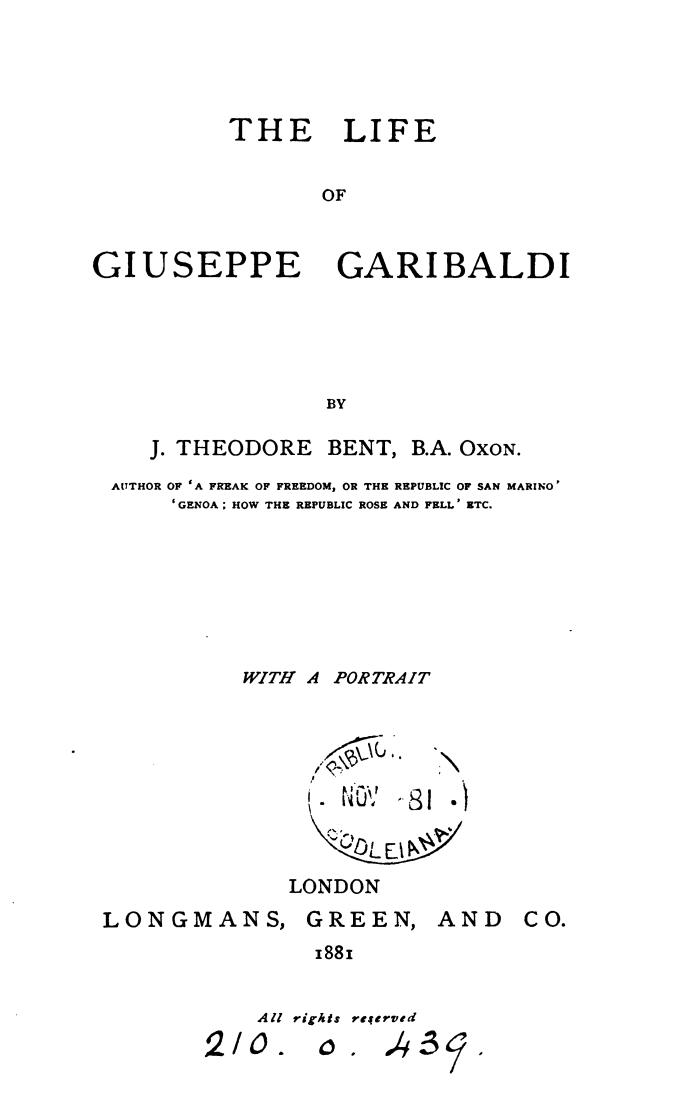
Title-page from Theodore’s 1881 biography of Garibaldi (archive.org)
And Mabel in Florence in 1878? No riddle. Theodore and Mabel were married in southern Ireland in August 1877 and embarked on a (very) extended honeymoon to Italy thereafter. Theodore had read modern history at Oxford and felt inspired to begin a trio of monographs on aspects of the ‘Risorgimento’, including a biography of Garibaldi – not much consulted today if truth be told. The Bents, thus, and of independent means, made frequent Italian trips over a number of years in the late 1870s and early 1880s. Florence, of course, was on their itinerary, and, in 1878, Mabel must have become close enough to Mrs Elizabeth Bianciardi of Boston (more on her in a moment) such that the latter would give the former a special keepsake – a fragment of Martha Washington’s wedding dress, ‘woven in silk and silver’. (And seemingly no question of any sale, the Bents were great acquirers of costumes on their travels; Elizabeth must have retained a larger piece, as the last line of Mabel’s letter suggests.)
Caleb Rice (1792-1873) of Springfield, Massachusetts, the father of Elizabeth Bianciardi (archive.org)
Not ‘Dickenson’ as Mabel wrote, Elizabeth Dickerson Rice Bianciardi (1833–1886), was in the last few years of her shortish life (she died at 52 or 53) when she met Theodore and Mabel Bent in Florence in 1878. A quick search through a family history (“Conway, Mass., and the Rice Family” by Edwin Botts Rice (1909, New York) reveals a few details, including that she was the daughter of Caleb Rice (1792-1873) of Springfield, Massachusetts, and Marietta (Parsons) Stebbins (d. 1856). The equally arcane “Sketches of the old inhabitants and other citizens of old Springfield of the present century, and its historic mansions of ‘ye olden tyme’” by Charles Wells Chapin (1893, Springfield Press), provides us with a little extra, in that Caleb’s only surviving child was “Elizabeth D. Rice, who went abroad many years ago, and was married to Professor Carlo Bianciardi, [and] died at Vevay, Switzerland, January 2, 1886”. And to instill pride and educate the younger generation, Charles H. Barrows wrote “The history of Springfield in Massachusetts, for the young; being also in some part the history of other towns and cities in the county of Hampden” (1921, The Connecticut Valley Historical Society); the entry for Caleb Rice tells children that “He had a daughter Elizabeth, who, when she grew to womanhood, went to Italy for study and married a citizen of that country. She wrote verses and, under her married name of Bianciardi, published a book called ‘At Home in Italy’” (page 133). A recent research paper by Joseph Carvalho III & Wayne E. Phaneuf – “Notable Women of Central and Western Massachusetts from the 1600s to today” – crosses the t’s and dots the i’s: “Elizabeth Dickerson Rice (b. 22 Apr 1835 in West Springfield, MA; d. January 2, 1886 in Vevey, District de la Riviera-Pays-d’Enhaut, Switzerland; buried in Park Street Cemetery, West Springfield, MA)”.
Elizabeth moved in literary circles in and around Florence and was herself a busy writer; both she and Theodore were working on their biographies of Garibaldi at the time (Elizabeth’s (1882) entitled “The Personal History of Garibaldi”): Florentine society would surely have had them gravitate towards each other. And Mabel came away with a piece of Martha Washington’s wedding dress, the size of a large postage stamp. This fragment Mabel somehow kept safely (her London home was itself something of an ethnological museum, with curios from Africa, Arabia, the E Med, etc., etc.) for the next 50 years, and at the end of her life wanted to ensure its conservation – it was not to go to her acquisitive nieces – and where better in England than the home of Washington’s ancestors; and where you can see it still.
And of Mabel’s friend? The (controversial) Unz Review lists 15 articles by E.D.R. Bianciardi: ‘A Vintage Song’. The Century Magazine, October 1877, p. 852; ‘Siena – The City of the Winds’. The Harpers Monthly, April 1878, pp. 653-664; ‘The Village Church’. The Century Magazine, April 1880, p. 859; ‘Serenade’. The Century Magazine, September 1880, p. 732; ‘Luca Della Robbia and His School’. The Harpers Monthly, April 1880, pp. 692-698; ‘A Florentine Family in the Fifteenth Century’. The Atlantic Monthly, November 1881, pp. 672-681; ‘The Personal History of Garibaldi’. The Century Magazine, August 1882, pp. 495-502; ‘Life in Old Siena’. The Atlantic Monthly, June 1883, pp. 782-788; ‘Under the Olives’. The Century Magazine, August 1883, pp. 552-557; ‘Vallombrosa’. The Harpers Monthly, August 1883, pp. 347-353; ‘Dum Vivimus, Vivamus’. The Century Magazine, January 1884, p. 418; ‘The Haunts of Galileo’. The Atlantic Monthly, July 1884, pp. 91-98; ‘A Lovers’ Pilgrimage’. The Harpers Monthly, April 1884, pp. 659-670; ‘A Pisan Winter’. The Atlantic Monthly, March 1884, pp. 320-331; ‘The Warrior’s Quest’. The Harpers Monthly, September 1884, p. 584.
In addition there is a short series of books, including “At Home in Italy” (1885), and a collection of (sentimental) verse. Academic and enquiring in nature, a fair example of her style can be found here: ‘A Florentine Family in the Fifteenth Century’. Further research is required in terms of how she married and moved to Florence – the Bianciardi family is one of note. As for ‘Professor Carlo Bianciardi’, we must keep looking; it would be romantic to learn that Elizabeth left America to marry the actor/dancer who pops up with that name. (Any photos would be most welcome – if you have any info to share, please contact us.)
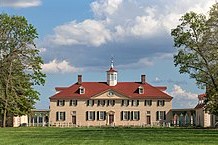
West front of the Mansion at Mount Vernon (wikipedia)
Returning to the slice of wedding dress, the size of a large postage stamp, given by Bianciardi to Bent, and by Bent to Sulgrave, it seems appropriate to leave the last words to the Washingtons’ spiritual home, Mount Vernon, VA, and Amanda Isaac, Associate Curator (George Washington’s Mount Vernon/Mount Vernon Ladies’ Association, personal communication, June 2020):
Fragment of Martha Washington’s wedding dress presented to Sulgrave Manor in 1925 by Mabel Bent (rights: Sulgrave Manor)
“The fragment appears to be of the same type as several in our collection, that is, a cream color ribbed silk woven with very flat think strips of metal plate (likely tarnished silver), of the type of fabric known as “silver tissue” in the eighteenth century. According to Martha Washington’s granddaughters (Eliza Parke Custis Law (1776-1831), Martha Custis Peter (1777-1854), and Eleanor Parke Custis Lewis (1779-1852)), the fragments were cut from the petticoat of the gown she wore at her marriage to George Washington on January 6, 1759… We do not know what Mrs. Washington’s full wedding outfit looked like, though the grandchildren described it as a gown of yellow damask, with a silver petticoat, and purple silk and silver trimmed shoes. The purple and silver shoes do survive, and are quite rare in the American context… Likewise, the silver tissue fragments are extraordinary, and one of the few provenanced examples of this type of costly fabric being used by the British colonists. All together, Mrs. Washington’s wedding ensemble bespoke her position as a leading member of the colonial gentry.
“It is wonderful to know about this particular example and the exchange between Mrs. Bianciardi and Mrs. Bent… [We] do wish we could track down Mrs. Bianciardi’s mother, Mrs. Rice. It is most likely that the fragment was distributed by one of the grandchildren mentioned above, and that Mrs. Rice received it from one of them, or from an intermediary who had received it from the grandchildren.”
The fragment was obviously much valued by the Bents, and in July 1893 exhibited it at a prestigious event in London. This from The Gentlewoman of 8 July 1893, page 53: “The summer sale of the Ladies’ Working Guild was opened on Wednesday [5 July 1893] by H.R.H. the Princess Beatrice, at 35, Dover-street, the house of Mr. and Mrs. Robert Smith. The loan exhibition, held under the presidency of the Princess Frederica included… [from] Mrs. Theodore Bent a very fine lappet in needle point, and Mr. Theodore Bent a little piece of George Washington’s wife’s wedding gown, and a curious painting on wood of Allah, the face not painted in as being too holy to depict…”
Did the Bents ever doubt the authenticity of the heirloom one wonders? Hard to tell, yet there is a very casual remark made off camera by Theodore in an article he wrote about a journey home via the Balkans in 1887: “The relics of a new country are always amusing. An American once gave me a scrap of Mrs. Washington’s wedding-dress, treasured, and doubtless as often reproduced, as portions of the true cross.” (A New Overland Route to India, Macmillan’s Magazine, 1887 May/Oct, p. 290)
“A romanticized portrait of Mrs. Washington… published in the mid-nineteenth century” (rights: Sulgrave Manor)
And there is a postscript… Remember the little anonymous photo Mabel also sent to Sulgrave in 1925? Amanda informs us that it “is a romanticized portrait of Mrs. Washington that was published in the mid-nineteenth century”.
And with that, this digression ends, well, nearly – for, as a coda, in one of those serendipitous flashes, it happened that a female descendant of Mabel’s brother Robert Hall-Dare (1840-1876), married a direct descendant of the Washington family from Sulgrave Manor – Elsie Washington.
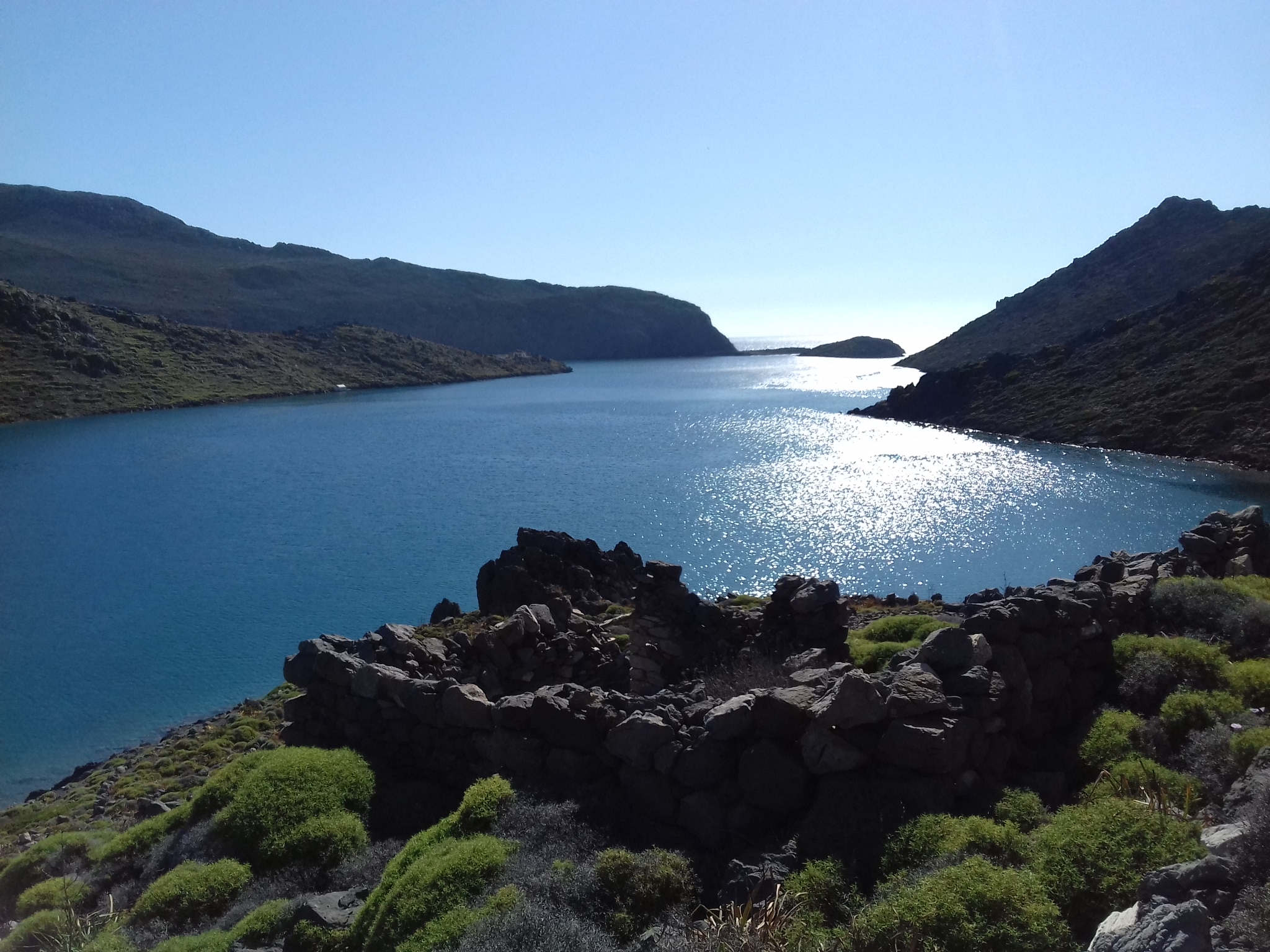
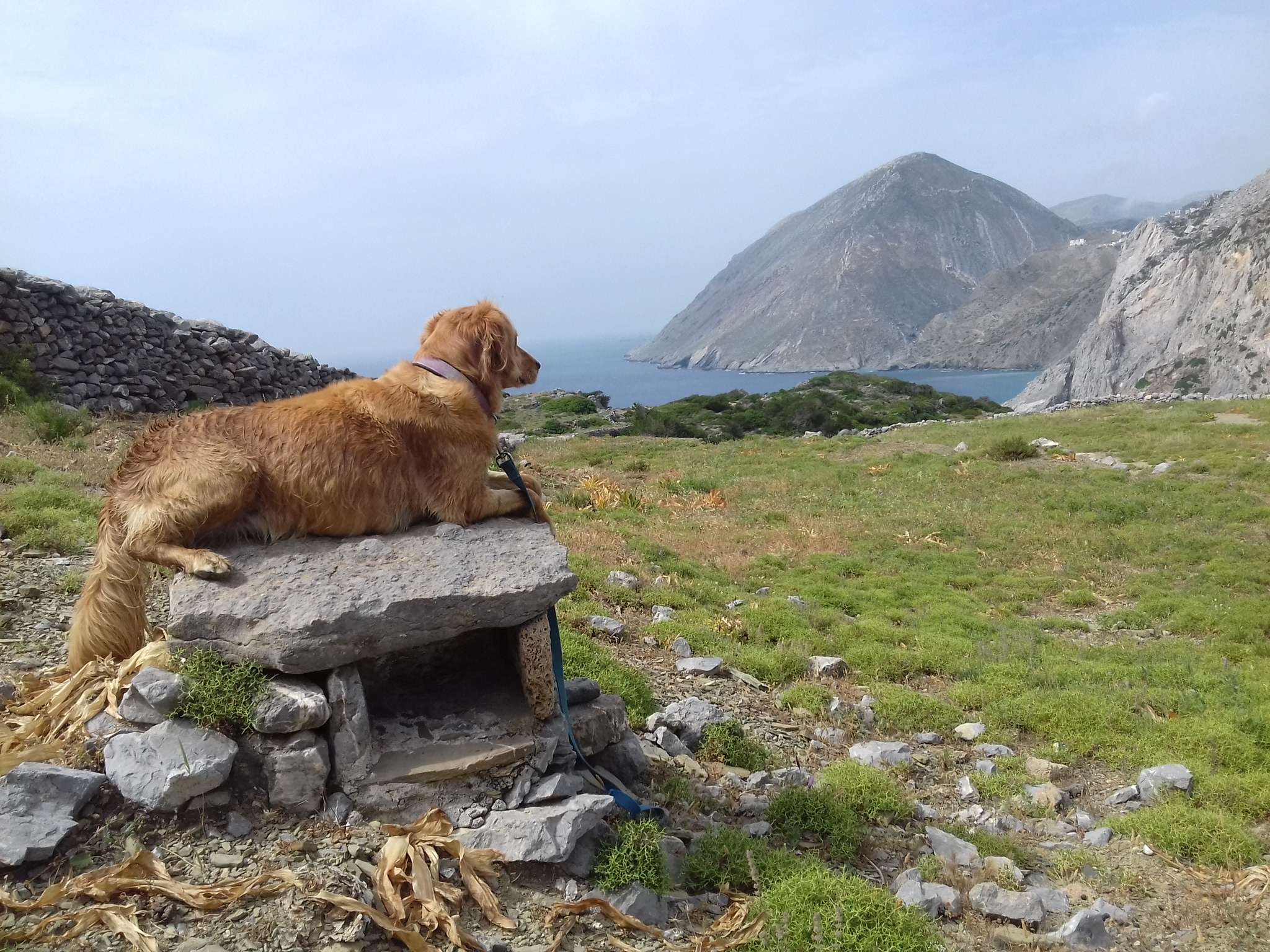
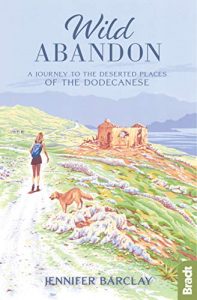
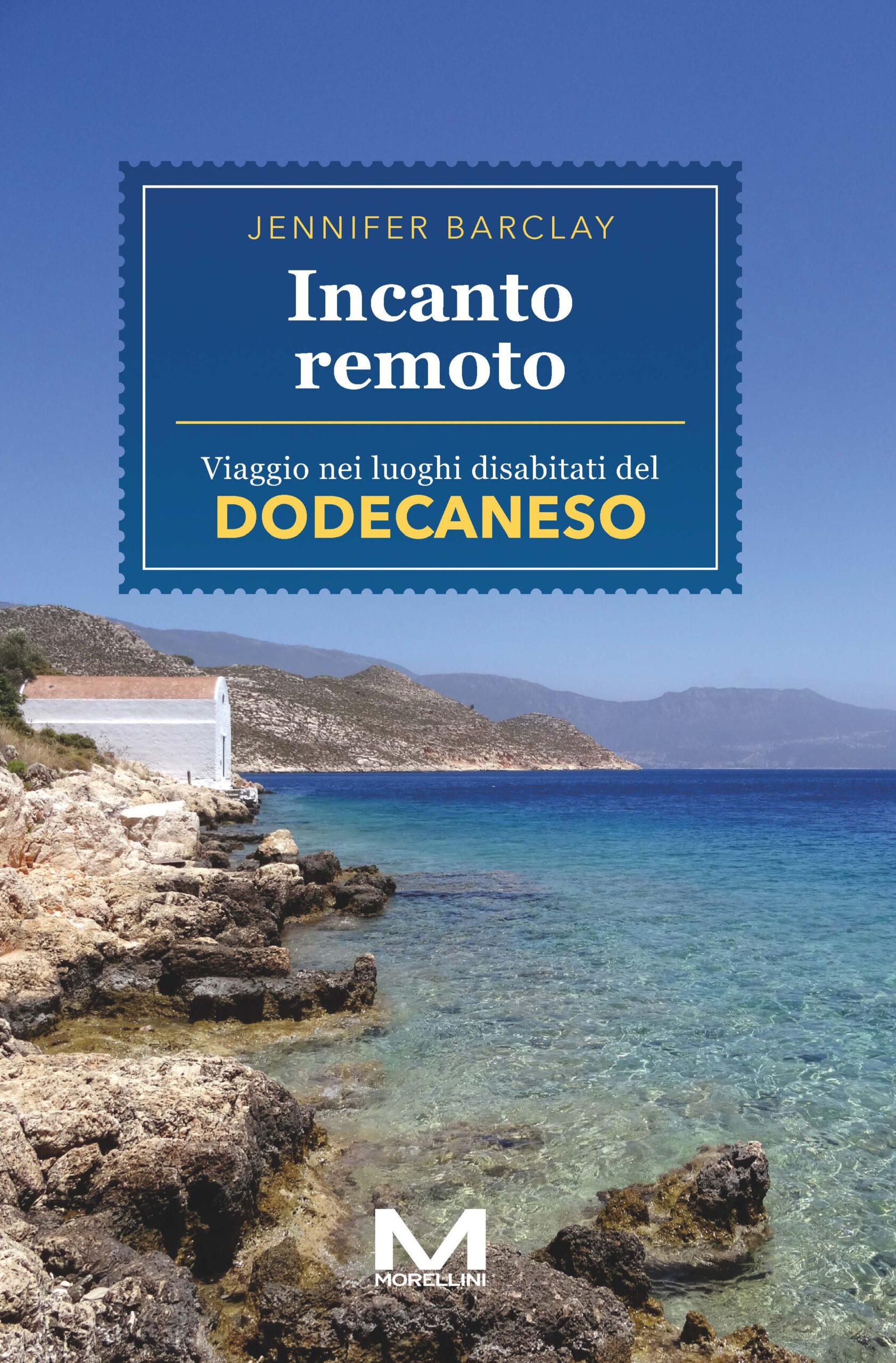
Our recent post (May, 2020) of an article by Jennifer Barclay (Wild Abandon: A Journey to the Deserted Places of the Dodecanese, Bradt Travel Guides, 2020), in which Jen says how she finds the Bents, generated a fair bit of interest. A series of posts by other well-known travel writers (if this could be you, write to us), who were guided by Theodore and Mabel, will therefore follow, as and when…
Marc Dubin (Rough Guides and much else for decades) was kind enough to write a Preface for Bent’s second Greek island book (The Dodecanese: Further Travels Among the Insular Greeks, 2015) and this can now appear online – at a time when hopping around the Cyclades and Dodecanese, for British tourists at least, is all but impossible this summer (2020).
Marc, a long-term resident of Samos, is a favourite of ours; actually more than that, because it was his inclusion of a reference to Bent’s The Cyclades, or Life Among the Insular Greeks (1885) in a Rough Guide bibliography that led circuitously, a kalderimi stumbled upon, right to the Bent Archive’s front door, some 30 years later. Here is what he has to say about the Bents; and thank you Marc.
Detail from Bent’s own 1885 map of the Greek islands (photo: Bent Archive).
“I have been writing about the Greek islands since 1981, and the Bents have accompanied me from the start. After graduating from UC Berkeley in 1977, I stayed around town for some years; I was fortunate in having a part-time job at the university library which was piecework based and allowed me to work full-time for three months and then take equal time off to travel. It also gave me complete, unchallenged run of the book stacks, where I furthered my education through omnivorous reading. There was no security whatsoever at the employees’ entrance, so books could be ‘borrowed’ indefinitely.
The pre-computerisation card catalogue listed no less than four copies of J. Theodore Bent’s Aegean Islands: The Cyclades, or Life Among the Insular Greeks, published as a 1966 reprint by Argonaut in Chicago. I had just signed my first contract to write a guidebook on Greece. Why should the library keep four copies of this title, when my research needs were greater? Home it went, to stay, in 1980.
The church of the Panayía Portaïtissa, within the Kástro of Hóra, Astypálea (photo: Marc Dubin).
James Theodore and Mabel spent nearly a year travelling around the Aegean on their first trip, back when it took a year to visit all the islands given the vagaries of the wind – as he writes in the volume you are holding, ‘those who go to Astypalæa must be people of a patient disposition’. They more (or less) cheerfully tolerated ferocious winter weather, leaking quarters, foul-smelling wooden boats, monotonous food (‘pease porridge hot, pease porridge cold, pease porridge in the pot nine days old’ was literally and repeatedly enacted), rapacious boatmen and voracious vermin. They took shelter in bare churches when necessary, something sadly unlikely now when so many rural chapels are locked against theft or desecration. It all puts today’s island-traveller whinges about cancelled sailings, greasy food and wonky water heaters in stark perspective. To their immense credit, the Bents were keenly interested in the contemporary Greek islanders, not just in antiquities, unlike 18th-century Grand Tourists who disparaged the supposedly degenerated medieval Greeks and modern tourists who are only after sun, sea and sex.
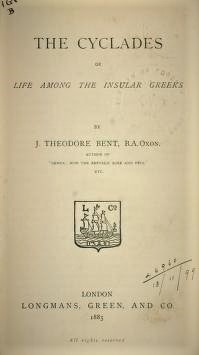
Title-page to the 1st edition of Bent’s ‘The Cyclades’ (London, 1885)(from an archive.org online e-version).
The Cyclades, or Life Among the Insular Greeks, also available through Archaeopress, has the dubious honour of being the most plagiarized book ever written on the Greek islands – almost every 1960s to 1980s writer on the Aegean helped themselves to entire pages worth of Bent, verbatim. It was legally if not ethically okay to do so, since the text (as the Argonaut publisher told me when I asked him) had long since been in the public domain; the Bents had died without issue or any other heirs to extend the copyright. Copyright aside, it’s easy to see why this happened: the intrepid Bents had been there, and done that, long before there were any t-shirts, and what they had observed and documented was far more compelling than anything actually visible on the islands from the 1960s onwards. Bent had also described their sojourns in brisk, to-the-point prose; it’s hard not to warm to someone who could write ‘on my remarking that I should prefer an inside place [on a raised communal family bed] for fear of a fall, they laughed and told stories of a sponge fisherman who dreamt that he was going to take a dive into the sea, and found himself on the floor instead; and of a priest, who rolled out of bed when drunk and broke his neck…in inferior establishments the space beneath the bed is used as a storeroom for all imaginable filth’.
On my extended 1981 trips to Greece, I had to quell lurking disappointment that the islanders were no longer as Bent described them. Or not quite anyway; on Sífnos my young hostess told me that there was still an old woman alive locally who could ‘draw out the sun’ from those afflicted with sunstroke-headache by sleight of handkerchief and incantations, exactly as described in Bent’s Kímolos account from 1883. Later a much older friend told me how, serving as a British delegate to the United Nations Special Commission on the Balkans (UNSCOB), monitoring border violations during the Greek civil war, he had – despite his total disbelief in the rite – the effects of the Evil Eye exorcised, again through spells and fabric manipulations, by an old Sifnian man, Nikos, in 1948, in Macedonia.
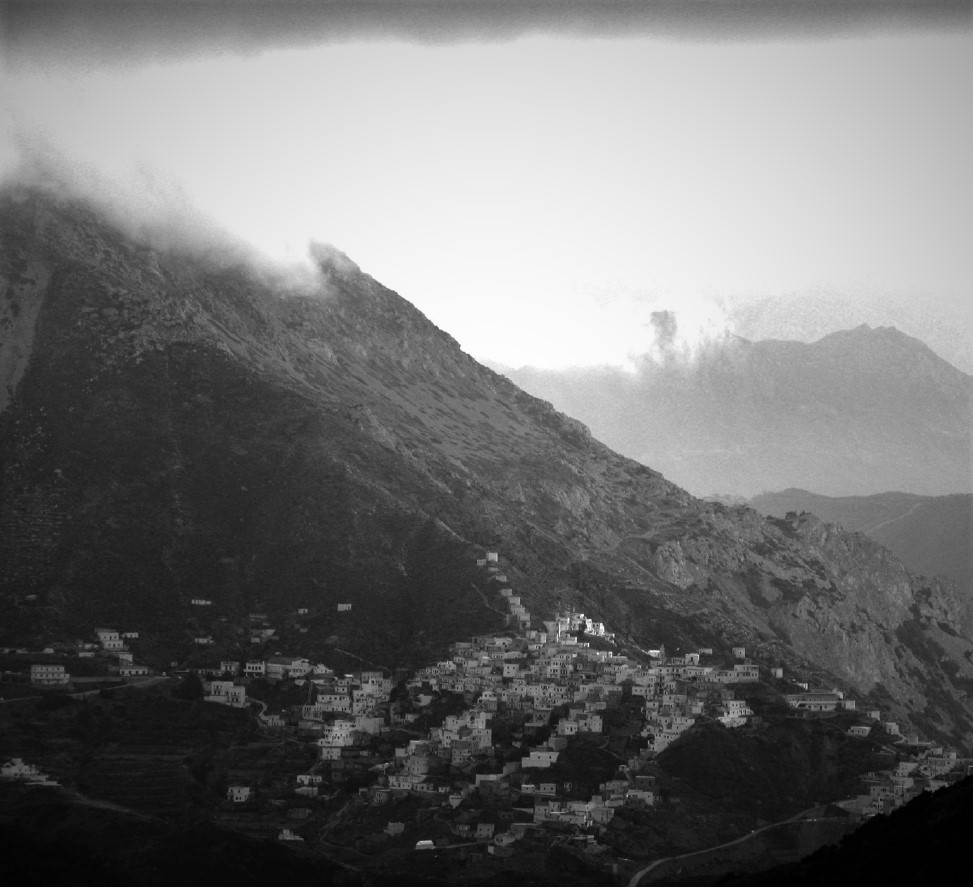
Olymbos, Karpathos (photo: Bent Archive).
But one can hardly expect such customs and costumes to have survived decades of emigration, electrification, radio and gramophones, public schooling whether Italian or Greek, meddling foreigners and government policy. Bent himself took a dim view of his own countrymen abroad: ‘It is the Union Jack which scatters [quaint costumes and still quainter customs] to the winds: great though our love is for antiquity, we English have dealt more harshly than any other people with the fashions of the old world.’ During the mid-1960s, even before the culturally destructive colonels’ junta, Kevin Andrews observed how local police felt it necessary to ban the playing of bagpipes at Mykonos port lest ‘foreigners…think us Mau-Mau’. You wonder what the Bents would make of today’s mercenary anthropological zoo centred on the village of Ólymbos in northern Kárpathos, which I first decried in my own 1996 guide to the Dodecanese and North Aegean. Research for that first edition involved criss-crossing the archipelago for several consecutive seasons in just about every month of the year (barring February and March) and every conceivable seagoing conveyance. Perhaps my most Bent-ian experience was in that self-same Ólymbos, when a nistísima meal (compliant with the Lenten fast) turned out to be simply limpets and myrouátana, a delicious seaweed which I have never been served again despite asking repeatedly.
During the late 1980s, in Moe’s – that Berkeley shrine of used books on Telegraph Avenue – I found another copy of the Argonaut Press edition of Aegean Islands, in mint condition, for the paltry price of $7 US: a fair measure of the scant esteem then in the USA for the Bents and their writings. The same copy in Britain at that time fetched at least thirty quid. Even now, antiquarian bookselling websites do not much value this handsome original reprint.
Shortly afterwards – I had not yet left the US to settle in Britain and Greece – I retrieved the purloined copy from my own shelves and headed for my old haunt, the UC Berkeley library. Back then (and probably still now) you could return a book in perfect anonymity, which I did eight years after its initial ‘check-out’, using the large-mouthed chutes near the main doors. It is not a small book in any sense, especially the old cloth-cover edition which is by my desk as I write, and made a satisfying clunk as it hit the bottom. So there should be once again four copies of Aegean Islands in the library’s holdings.
Mabel Bent in exalted, not to say exhausted, company…
“Taking the sphere alone of travel in unknown regions of the world, the history of British adventure can shew several pairs of the kind who rank as enthusiastic explorers of the highest type. We might single out from the number of these a few such as Sir Richard and Lady Burton, Mr. and Mrs. Theodore Bent, and Mr. and Mrs. St. George Littledale, where the wife has been entitled equally with the husband to the fame which is won by an arduous journey in barbarous lands.” (Graham Sandberg, The Exploration of Tibet, London, 1904, p. 236)
The ‘Tatler’, 30 Nov. 1910, page 270. (c) ‘The Illustrated London News/Mary Evans Picture Library’, used with permission.
A little research the other day (May 2020) turned up a fascinating, pre-Great War travel article in the Tatler for Wednesday, 30 November 1910 (no. 242, page 270) – and many thanks to the Illustrated London News/Mary Evans Picture Library, whose copyright it is, for allowing us to reproduce it here. It’s a tremendous, rare read. The author is one Joseph Heighton; forgive its title – ‘Pioneers in Petticoats’.
Twenty years or so either side of 1900, the journeys of Western women travellers were headline news – emancipatory, they very much reflected the times these women voyaged in, times every bit as challenging and frustrating for women as the tough terrain and hardships they fought through.
Mabel’s fortitude and abilities over the twenty years of explorations she undertook with Theodore Bent were indeed often written about, frequently on pages intended for women readers (some feature elsewhere in this archive).
The Tatler article is typical in its obvious admiration for Mabel, who has reached the age of 63, and has been travelling since she was a girl – most summers on the continent with her family, and then really taking metaphorical wing once she married (August 1877).
Here is what the Tatler has to say about Mabel:
“Asia Minor, Persia, Mashonaland, Abyssinia, Eastern Soudan, and South Arabia. These are some of the out-of-the-way corners of the globe which Mrs. Theodore Bent has penetrated when she accompanied her late husband on his archaeological expeditions. She has had several narrow escapes from death. In South Arabia she was nearly shot by bandits, while on another occasion she was ordered to dismount ‘in order that her throat might be cut’. Luckily better counsel prevailed with the would be murderers.”
Jane Dieulafoy (1851-1916), Mabel’s Persian rival (wikpedia).
Mabel would not be overshadowed by the company she keeps. And what exalted company it is – very much the great and the good of Western, or adopted Western, women travellers. Of course on one small page there must be notable omissions, e.g. the ubiquitous, already mentioned, Isabella Bird Bishop (1831-1904), the Nile travellers Amelia Edwards (1831-1892) and Florence Baker (1841-1916), or fellow Egyptologists Marianne Brocklehurst and Mary Booth, both of whom Mabel knew. And the women featured are all English speakers: ‘Europeans’, such as Mabel’s nemesis, Jane Dieulafoy, are not included.
Also absent is the mysterious American Mabel refers to unkindly just as ‘Mrs. Phelps, a very fat American, in man’s attire’. The reference comes in Mabel’s diary entries for the couple’s amazing ride, south-north, the length of Persia in 1889: “They were all amazed indeed when they heard of our resolution to ride those 1300 miles or more ‘with a lady’, for not more than 3 ladies have done this before, and 2, Mme. Dieulafoy and Mrs. Phelps, a very fat American, in man’s attire. And as the days go on they are still more amazed at seeing me sitting serenely wondering what saddle I shall have.” (The Travel Chronicles of Mabel Bent, Vol 3, pages 27-8)
If anyone knows who this intrepid, if large, traveller is, then we would be fascinated to hear and give her recognition on this.
How well known to you are these ‘Pioneers in Petticoats’? Corona lockdown hours may well give you world enough and time to read up on them. A few notes are added here, courtesy of Wikipedia, to get you in the mood for travel…
Mary Eliza Bakewell Gaunt (Wikipedia)
The article begins with Mary Eliza Bakewell Gaunt (20 February 1861 – 19 January 1942), an Australian novelist with a taste for Africa.
Barbara Freire-Marreco (Facebook)
Next to arrive is Barbara Freire-Marreco (1879–1967), an English anthropologist and folklorist. She was a member of the first class of anthropology students to graduate from Oxford in 1908.
Agnes Smith Lewis (left) and Margaret Dunlop Gibson (Wikipedia)
Academically the most gifted, coming into focus now are Agnes Smith Lewis (1843–1926) and Margaret Dunlop Gibson (1843–1920), nées Agnes and Margaret Smith (sometimes referred to as the Westminster Sisters), were Semitic scholars. Born the twin daughters of John Smith of Irvine, Ayrshire, Scotland, they learned more than 12 languages between them, and became pioneers in their academic work, and benefactors to the Presbyterian Church of England, especially to Westminster College, Cambridge. Without our access to Wikipedia, Joseph Heighton gets it wrong in his line where he says Margaret Gibson is a friend, she is the twin sister; the girls were born four years or so before Mabel Bent.
Mary Henrietta Kingsley (Wikipedia)
Also high in academic esteem is Mary Henrietta Kingsley (13 October 1862 – 3 June 1900), English ethnographer, scientific writer, and explorer whose travels throughout West Africa and resulting work helped shape European perceptions of African cultures and British imperialism.
Charlotte Mansfield (Wikipedia)
Again, it seems that Joseph Heighton was not quite right in saying that Charlotte Mansfield (1881-1936), English novelist, poet, and traveller, completed Rhodes’ dream tour of the Cape to Cairo; she made it as far as Lake Tanganyika, good going nevertheless (see Mary Hall a little later).
Mary French Sheldon (Wikipedia)
Mary French Sheldon (May 10, 1847 – 1936), as author May French Sheldon, was an American author and explorer. Born the same year as Mabel Bent (and they, indeed, knew each other, see below), she was made a fellow of the Royal Geographical Society, among the first fifteen women to receive this honour, in November 1892. (Mabel Bent was in line for the next group of women Fellows, but the privilege was shamefully withdrawn and women Fellows were not elected again until 1913.)
Mary Hall (frontispiece to her book ‘A Woman’s Trek from the Cape to Cairo’.
Mary Hall (1857-1912) really did make the trip from Cape to Cairo (see Charlotte Mansfield above). Her book A Woman’s Trek from the Cape to Cairo (1907) is available online. After Africa, Mary switched to Australia and the Far East; it seems her adventures there were published posthumously (A Woman in the Antipodes and in the Far East, c. 1914).
Josephine Cecilia Diebitsch Peary (Wikipedia)
Our caravan of great women travellers continues, after the heat of Australia, in the ice of the Arctic with Josephine Cecilia Diebitsch Peary (May 22, 1863 – December 19, 1955), an American author and Arctic explorer of renown.
‘…full of the most wonderful curios brought back by Mrs Bent’ Some of Mabel’s Turkish plates (private collection).
We know, at least, that Mabel and May French Sheldon (see above) were acquaintances, if not friends. The Belfast Telegraph of Saturday, 27 June 1908 informs us that “Mrs Theodore Bent was ‘at home’ recently to some 200 of her friends, when a very enjoyable evening was spent in the beautiful suite of rooms in her house in Great Cumberland Place, that are much more interesting than many museums, as they are full of the most wonderful curios brought back by Mrs Bent from Persia, Russia, Norway, the Soudan, the Holy Land, and the many other parts of the world in which she has travelled and explored. The hostess, handsomely dressed in mauve, with white lace and many diamonds, received her guests at the entrance to the principal drawing-room, and near her stood her sister, Mrs Bagenal, dressed in black and silver, who had come over from her place in Co. Carlow for this and other functions of the season; and amongst other invited guests were …. Mrs French Seldon, etc., etc.”
Celebrated Egyptologist, Dr Mary Brodrick (1858-1933) (Wikipedia).
Another acquaintance was Mary Brodrick (1858-1933), one of the first female excavators in Egypt. Wikipedia mentions a description from the Daily Mail (1906) noting her as ‘perhaps the greatest lady Egyptologist of the day’. From Mabel’s diaries we have two direct references to her:
December 1895: “We have been to the museum twice, and to lunch with Professor Sayce on the ‘dahabeya’, which is his charming home, and have been asked by Miss Brodrick, an Egyptologist lady, to tea on hers on Thursday…” [Travel Chronicles of Mrs J Theodore Bent, Vol 2, Oxford, 2012, p.225]
Sunday 6th, February 1898: “I walked by land to church in the hotel with a funny old American woman, Mrs. Austin. Professor Sayce preached a beautiful sermon. The chaplain is Mr. [left blank]. Coming out I was hailed by Miss Brodrick, who edited ‘Murray’, and she asked me to tea on the ‘Alma’. Her chum, Miss Morton, was with her – also 2 others, Miss Dickson and Miss Kilburn. I also dined with them. We rowed round Elephantine. Professor Sayce had taken me over it. His dahabeya was off to Luxor…” [Travel Chronicles of Mrs J Theodore Bent, Vol 2, Oxford, 2012, p.270]
Of course, there is a library of literature now available on women travellers. A workable summary is provided by Tracey Jean Boisseau for her contribution under the heading ‘Explorers and Exploration’ in The Oxford Encyclopedia of Women in World History, Volume 1, 2008, pages 227-231.
Now and then in the pages below we will add notable references to Mabel which appeared in other contemporary magazines of a more general nature.
An article in The Liverpool Weekly Courier, for Saturday, 9 December, 1893. The Courier picked it up from Hearth and Home of 2 November 1893 (Bent being a well-known name in Liverpool – Theodore’s uncle being Lord Mayor in the 1850s). The Bents had been circulating a press release announcing their forthcoming expedition to ‘South Arabia’ and, as ever, Mabel’s participation aroused interest:
‘Mabel Bent’ the “Courier”, 9 December 1893.
“One of the most interesting collections in the British Museum is that contributed by Mr. and Mrs. Theodore Bent, who, after having explored almost every known portion of the globe, are still, like Alexander, sighing for fresh regions to conquer. Of recent years, women have shown much intrepidity as travellers, as witness the peregrinations of Lady Baker [See above: Barbara Maria Szasz, 1841-1916, Hungarian-born British explorer], the indomitable fortitude of Lady Burton [Isabel Burton, née Arundell, 1831-1896, English writer, explorer and adventurer], and the wonderful resourcefulness of Mrs. French Sheldon [See above: Mary French Sheldon, 1847-1936, American explorer], who, capable authoress as she is, abandoned the field of literature temporarily for a lonely wander through the Dark Continent, and who came out smiling with such staggering, yet solid, stories that incredulity retired baffled and only admiration remained. In the same way Mrs. Theodore Bent has penetrated unknown and barbarous regions until to hear her tales of adventures is like listening to one of Ballantyne’s [R. M. Ballantyne, 1825-1894, Scottish author] or Henty’s [G. A. Henty, 1832-1902, English novelist and war correspondent] delightful books. Next week we see her depart, accompanied by her husband, to explore South Arabia, whence they will return, all being well, in March or April. There must be a great deal to see and write about in this little travelled part of the earth’s surface, and one may depend on it that whatever is interesting will be retailed to their countrymen on their return by this remarkable couple. An exhaustive medicine chest will be a feature of the impedimenta, and it may be interesting to ladies to know that Mrs. Bent’s only wear is serviceable serge.”
[This little sketch of Mabel Bent accompanied the “Courier” article of 9 December 1893. It is based on a image of Mabel that appeared in the 2 November edition of “Hearth and Home”.]
An account of Mabel at Great Zimbabwe features in Sarah Tooley’s long article on famous women travellers that appeared in Lady’s Realm (Vol. 1, Nov. 1896 – April 1897, pp. 480 ff). It makes poignant reading in that the article was being compiled and published as the Bents were desperately ill in Aden. The journal’s end date is April 1897, a few weeks later and Theodore is dead:
“In Mrs. Theodore Bent we have a traveller who has made South Africa a special field for exploration. Mrs. Bent had, with her husband, already done considerable travel in Persia, Asia Minor, and the Greek Islands, when, in 1891, she started for a still more adventurous journey in Africa. Although doubt was expressed as the advisability of her accompanying the expedition, she proved to be the only one of the party who escaped fever; she did not, indeed, have a day’s illness throughout the whole of the year spent in African travel.
Theodore’s watercolour of Great Zimbabwe from his book “The Ruined Cities of Mashonaland” (1892). The Bents’ camp can just be seen in its circle of thorns in the foreground, right.
“Mrs. Bent is a lady of great learning and knowledge, as well as being a distinguished traveller, and has rendered valuable assistance to her husband in the preparation of his various books; and she is also a skilled photographer. The expedition to South Africa, which was taken under the auspices of the Royal Geographical Society, the Chartered Company, and the British Association, was for the purpose of the exploration and excavation of those ancient massive and mysterious ruins which exist in Mashonaland and which point to a time when the country of Lobengula and his indunas was a centre of wealth and civilization, with cities, palaces, and temples.
“Mrs. Bent had quite a romantic camp life when working amongst the ruins of Zimbabwe. Two waggons served the expedition as bedrooms; an Indian terrace, constructed of grass and sticks, made a novel and charming dining-room; a tent formed the drawing-room; and the suite were decorated by Mrs. Bent with a wealth of brilliant flowers which no conservatory at home could have supplied. She also had a dark tent for photography, and improvised kitchen, and a poultry-house. A hedge of grass surrounded the whole, and gave a picturesque finish to the camp. Outside this royal domain were the huts for the native workmen. Alas! however, for the delights of gypsy life. One day the long grass of the veldt started into flames, which, lashed to fury by the wind, came within a few yards of the camp, and were only beaten back by frantic efforts on the part of the little colony; the small huts were, indeed, burnt to ashes.
Plan of some of the Great Zimbabwe site from Bent’s “The Ruined Cities of Mashonaland” (1892).
“A year was spent by Mr. and Mrs. Bent in South Africa studying the ruins and the people, the result of their investigations, in which they were assisted by Mr. R.M.W. Swan, being told in that delightful book, “The Ruined Cities of Mashonaland”. They come to the conclusion that the land, since rendered famous by the Jameson expedition, may revive the glories of the ancient ruins under British occupation and development. Mr. and Mrs. Bent are systematic travellers, and each year sees them set out for some distant land, although they usually spend the season in town, where their house in Upper Cumberland Place [sic], which is filed with mementoes of their journeys, is the resort of many famous and learned people.”
A further good example of Mabel’s abilities can be found in her very last adventure with Theodore, on Sokotra in early 1897. When their guides tried to persuade them to take a boat to avoid a particularly treacherous path (to the locals’ financial benefit), the adventurer writes: “We assured them that we had landed in Sokotra… to see the island, and not to circumnavigate it. Others could pass, so we could. Their last hope was in my hoped-for faintheartedness. They watched till I was alone in the tent, and, having recounted all the perils over again, said: ‘Let the men go over the mountain, but you, Bibi! will go in a boat, safely. You cannot climb, you cannot ride the camel, no one can hold you; the path is too narrow, and you will be afraid.’” The guides, obviously, did not know Mabel Bent. (Extract from Southern Arabia, 1900, p.368)
Rosita Forbes as a Bedouin sheik, from her book ‘The secret of the Sahara: Kufara’ (wikipedia).
Interestingly, just down the road at number 28 Great Cumberland Place (Mabel rented no. 13) lived, from 1928, the equally, if not more so, adventurous traveller in Arabia and elsewhere, Joan ‘Rosita’ Forbes (1890-1967). Her 1925 book (New York, pp. 348-9), From Red Sea To Blue Nile – Abyssinian Adventure contains some references to the Bents at Axum, Ethiopia, but we don’t know whether Rosita ever made contact with the elderly Mabel Bent in the few months they were near neighbours; both women travelled many thousands of miles, but that mere 100 metres or so that separated them may well have been steps too far…
A little space must be dedicated also to Amice Calverley (1896–1959), the English-born Canadian Egyptologist who was instrumental in the recording and publication of the decoration scheme within the temple of King Sethos I at Abydos. As an associate of the Egyptian Exploration Society in 1927, there is a chance that she was known to Mabel Bent, who was in the final years of her life. Mabel celebrated her 38th birthday (1885) atop one of the Gizeh pyramids. The Bents visited Egypt several times; Mabel travelled there alone in 1898, the year after Theodore’s death.
Ella Constance Sykes (1863-1939), traveller in Persia and Turkestan (Wikipedia).
Ella Constance Sykes (1863-1939) would certainly have been among Mabel Bent’s acquaintances in London. She made two extensive journeys east – to Baluchistan via Persia (1894), and Turkestan (1915) – accompanying her diplomat brother. Mabel would probably have owned, or at last seen, Ella’s two books, Through Persia on a Side-Saddle (1898) and Through Deserts and Oases of Central Asia (1920), although she makes only a passing reference to the Bents (their work in Bahrain in 1889) in the former (page 303), and makes a point of lauding “Mrs. [Isabella Bird] Bishop, the well-known lady traveller [who] had come out to Persia some five years before… the lady for whose pluck and talent I have such an admiration” (page 302). As well as being attracted to her writings, Mabel would have enjoyed discussing field photography with Ella – who was also a keen practitioner of that tricky art.
Mabel Loomis Todd (1856-1932), American travel writer and free spirit (Wikipedia).
The American writer and traveller Mabel Loomis Todd (1856-1932) is also impossible to resist. Following her marriage to the astronomer David Todd, she accompanied him to Japan in 1887, becoming, it is said, the first Western woman to walk up Mount Fuji. She went back to Japan in 1896, to Tripoli in 1900 and 1905, to the Dutch East Indies in 1901, to Chile in 1907, and to Russia in 1914. In all, she visited more than 30 countries on five continents, writes the Wiki contributor. Writing often of her travels, and lecturing on them, she became one of only a few female intellectuals in the public eye in the late 19th century. In an article on her steamer voyage to the Dutch East Indies (1901) she refers to the Bents (and her namesake, another Mabel) : “[We] are to-day skirting Sokotra, that strange island under British control, about which so little is known… In 1896 Mr. Theodore Bent induced a steamer bound for Bombay to land him there as a favor, with Mrs. Bent and a friend, and he spent some months exploring and hunting. An article descriptive of those experiences, and of the flora and fauna, the native and mountain-peaks, is perhaps the only one ever written of an island passed yearly by countless steamers. The method of return to more frequented regions was problematic, but ultimately he reached Aden in the dhow of the local Sultan, at an exorbitant rate of passage, that potentate having ordered all other dhows to refuse him transit that there might be no competition with royalty… And now the placid Indian Ocean, with its gentle remnant of northeast monsoon, its exquisite climate, and enchanting moonlight nights, beckons us onward to the Far Orient” (in the Evening Post, reprinted in Scientific American, Supplement 52, 1901, p.21365) (The article referred to is ‘Sokotra’. Journal of the Manchester Geographical Society, Vol. 14, 315-16).
Ida Laura Pfeiffer (1797-1858)(wikipedia).
No list of indomitable women travellers would be complete without a reference to the incredible Ida Laura Pfeiffer, in whose footprints Mabel occasionally followed. Although the latter never refers directly to the Austrian globetrotter in her diaries, Mabel would certainly have known of her, and probably read Ida’s travel accounts, several of which were already translated into English in her time. Ida died when Mabel Hall-Dare was just a girl of ten or so in the south of Ireland.
Any bibliography on notable women travellers would include ‘The Women Who Did’, Chapter 3, in Archaeologists in Print by Amara Thornton, UCL press, 2018, pp. 48-74, and see, e.g., See Billie Melman, Women’s orients: English women and the Middle East, 1718-1918: sexuality, religion and work (London, 1992, pp. 8, 21, 35, 280, 376, ).
“DWELLERS IN TENTS – Every man, says a philosopher, is a wanderer at heart. Alas! I fear the axiom would be truer if he had confined himself to stating that every man loves to fancy himself a wanderer, for when it comes to the point there is not one in a thousand who can throw off the ties of civilized existence – the ties and the comforts of habits which have become easy to him by long use, of the life whose security is ample compensation for its monotony. Yet there are moments when the cabined spirit longs for liberty.” (Gertrude Bell, Safar Nameh. Persian Pictures – A Book of Travel, London, 1894, p. 83)
Beatrice Ethel Grimshaw (1870-1953), Irish writer and traveller (Wikipedia).
Shirley Foster and Sarah Mills, Anthology of Women’s Travel Writings, Manchester University Press, 2002. Although published over 20 years ago (and not including Mabel Bent as her diaries were then not published), still an excellent, academic, study of all the angles of women travellers and travel writing. The availability now of free online editions of most of the mid 19th century travelogues referenced adds another dimension to the study.
Manley, D. 2013. Women Travellers in Egypt: From the Eighteenth to the Twenty-first Century. Cairo: The American University in Cairo Press.
Searight, S. (ed.) 2005. Women Travellers in the Near East. Oxford: Oxbow Books.
“Yet women are under a sex disqualification when a poor little squabble among men arises, whether or not one of them, like Mrs. Theodore Bent, the wife of the distinguished traveller of Mashonaland, who has done the work of a dozen explorers, has friends who expect that her additions to the scientific knowledge of the day will be acknowledged as they would be if she were of the other sex.” (Paddington Times – Friday, 2 August 1895)
Note 1: As reported in arcane newspapers from The St. Austell Star to The Ballinrobe Chronicle, and Mayo Advertiser in early June 1893:
‘Our London Letter – Two of the most interesting topics which have come into the week’s talk are on feminine matters, though of very widespread concern. “Shall the Royal British Nurses’ Association be incorporated or not?”… The other question relates to the “Lady Fellows” of the Royal Geographical Society, over whose admission that reputable and scientific body are so seriously exercised. The election of twenty-two ladies, among whom are Mrs. Bishop, Miss Gordon Cumming, Mrs. Theodore Bent, who accompanied her husband through his explorations in Mashonaland, and his dangerous recent travels through Abyssinia, Mrs. George Littledale, who was her husband’s companion all across the inhospitable heights of the Pamirs, and Mrs. Archibald Little, lately returned from the frontier of Thibet, gave offence to a small but energetic section of the members upon the technical ground that the innovation had been made by the Council (who, by the way, were fortified in their action by the opinion expressed by eminent counsel) without first obtaining the sanction for their proceeding from a general meeting of the Fellows. There are some three thousand five hundred Fellow, about three hundred of whom attended a gathering convened by the dissentients, who declared that the Council had acted illegally, the result being that it was decided to admit no more ladies. Now, however, the difficult problem arises as to what is to be done with the present twenty-two female fellows? Upon this point may run the election of a new Council, for the “No Women” party are prepared to endeavour to upset the present board, upon which are Sir John Lubbock, General Strachey, Mr. Clements Markham, and many other well-known names, as they have refused to politely tell the ladies their election was invalid.” Return from Note 1
Jennifer Barclay muses for us on the ‘blessed’ Bents, May 2020…
“And then, by chance, I met Theodore and Mabel Bent. They came into my life as a blessing because they told me, through their diaries, what these places were like a century and a half ago in the 1880s.”
Some of the Dodecanese, showing the island of Kárpathos, where the Bents spent Easter 1885. (c) Glyn Griffiths
For the last few years, I had been exploring the deserted places of the Dodecanese, a group of islands at the southeast edge of Greece where it almost touches Turkey. Starting with Tilos, where I live, heading north, south, east and west, I was going to the abandoned farms and harbours, the semi-abandoned villages and islands.
Many of these places had been well populated, self-sufficient and thriving for centuries, even during the Ottoman occupation. I was trying to understand better what happened over the last century or two, when their populations plummeted from thousands to hundreds. The stories differ from island to island, but a combination of hardships at home and opportunities elsewhere caused mass emigration.
And then, by chance, I met Theodore and Mabel Bent. They came into my life as a blessing because they told me, through their diaries, what these places were like a century and a half ago in the 1880s.
Theodore came from the north of England, studied history at Oxford, was headed for the Bar, but gave it up to pursue his love of travel, social history and archaeology. When he married the tall, confident, Irish redhead Mabel Hall-Dare in August 1877, they set out on a life of travel and adventure.
But I must hold up my hands and say that, at first, I didn’t much like the Bents. The aim of their trip around the Dodecanese, it soon became clear, was to excavate and remove items of archaeological interest, usually without permission or with Ottoman officials turning a blind eye in return for baksheesh.
Kastellorizo’s ‘Red Castle’ (photo: Jen Barclay)
They weren’t here to get all touchy-feely with the locals; they were here to take stuff from under their noses, and they got exasperated when they found nothing of value. When in 1888, they arrived on the Turkish shores near Kastellorizo in search of antiquities in the temples and rock-cut tombs, they lamented that some lucky Austrians had got there first and taken all the good pieces. They travelled to Kastellorizo only to register with its Greek consul that they had come from Turkey, so that on their return journey the Greeks elsewhere could not touch the items they had collected. You can’t help thinking of a certain Lord Elgin who had carted off the sculptures from the Parthenon earlier in the nineteenth century.
Rock-cut ‘Lycian’ tomb, of the type the Bents were seeking out on the coast of Turkey just across the water (photo: Jen Barclay)
Not only that, but they were shocked by the islanders’ ‘ignorance and superstition’, in a way that reads today as a little condescending. Could Theodore and Mabel, I wondered, have built a house or made their own clothes and sustenance, survived in such a rugged, isolated place on what they could find and grow, as the islanders were doing then? It reminded me of how native Americans were being treated around that time for their supposed ignorance and superstition.
Bent’s sambouna, now silent in the Pitt Rivers Museum, Oxford (photo: Pitt Rivers, Oxford)
But that was the spirit of the times, and it’s easy to poke fun now. The goatskin bagpipe or tsambouna that the Bents took back from Tilos to England 150 years ago for safekeeping in the Pitt Rivers Museum, still there on display in Oxford, might be one of very few Tilos tsambouna still in existence. In the books, and on the Bent Archive website Gerry Brisch co-edits, there’s plenty of evidence that the Bents were extraordinary people who travelled far further into the unknown than I’d first realised. And the fact is that what Theodore and Mabel encountered in the Dodecanese back then took them well out of their comfort zone, and their diaries are finely detailed and often exquisitely phrased.
Mikro Horio, Tilos, abandoned around 1960, would have been a busy village with two thousand or so inhabitants when the Bents visited (photo: Jen Barclay)
In their brief visit to Tilos they stayed with the priest, who also cured hides for making shoes. The village houses were dark, they wrote, and women sat spinning on their roofs. Tilos was ‘thinly populated, and as remote a spot as well could be found from any centre of civilisation’, rarely visited by steamer or sailing boats. Women wore coats of homespun material, and pointed leather shoes; they had wild, gypsy looks and wore earrings so big they deformed their ears. There was no doctor; the local people would ‘live and die as birds of the air’.
The Bents provide a rare record of the way the ‘decayed men’ suffering from leprosy hid in dark corners of the homes so that they wouldn’t be taken away from their families to some faraway hospital.
Entrance to a once-grand house in the Jewish quarter of Rhodes Old Town (photo: Jen Barclay)
We also see a poignant picture of Rhodes town in the late 1880s, a multi-cultural society of peoples from around the Mediterranean, with the Old Town exclusively inhabited by Muslim Turks and Spanish Jews. The latter had ‘managed to secure for themselves the best quarter’, their houses tastefully decorated and their children well educated. Some sixty years later, there would be no more than a handful of Jewish people left in Rhodes.
Tristomo, north Karpathos, where the Bents landed on Friday, 6 March 1885 (photo: Jen Barclay)
Theodore and Mabel Bent travelled direct from Tilos to Karpathos in February 1885 in their private boat. Rains had washed away the track to Olympos, and violent gusts of wind damaged the vessel. They wrote that both islands were ‘very difficult of access and rarely visited by foreigners’, and that they had therefore retained ancient customs and myths. Karpathos, wrote Theodore, was ‘one of the most lost islands of the Aegean Sea’. In some ways it still is, and it continues to retain customs and knowledge that has vanished elsewhere.
Jen’s walking companion Lisa on an old stone beehive looking towards Olympos, Karpathos (photo: Jen Barclay)
These islands are no longer lost. Whatever the challenges of travel currently, we can usually visit the islands much more easily today, and thanks to this intrepid couple, we have rare glimpses into their past.
I grew to like my new acquaintances Theodore and Mabel, and their writings deserve to be better known…
July 2025 – now available as an Italian edition as Incanto remoto. (The Bents were great lovers of Italy by the way too, Theodore have read Italian history at Oxford in the 1870s and publishing three monographs on Italian history.)
Jennifer at rest (photo: Ian Smith)
Jennifer Barclay grew up in a village in the Pennines in the north of England and studied Ancient Greek at grammar school; after studying English at Oxford she spent a year in Athens and has travelled widely in the Greek islands. She settled on Tilos in the Dodecanese in 2011, where she lives surrounded by hills and sea with her dog and works from home as an editor and literary agent. She has written a book about Korea, Meeting Mr Kim, and two books about Greek island life, Falling in Honey and An Octopus in my Ouzo. A contributor to publications including The Times, Metro, The Guardian, Daily Mail, Food and Travel and Psychologies, she has appeared on BBC Radio 4 and on Greek television.

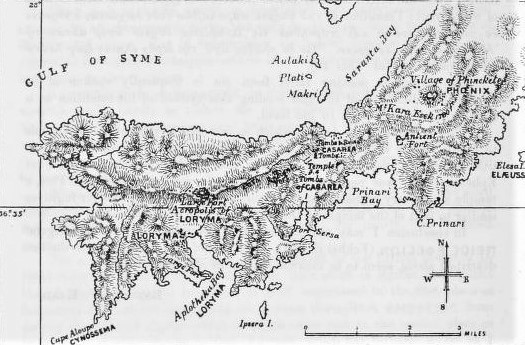

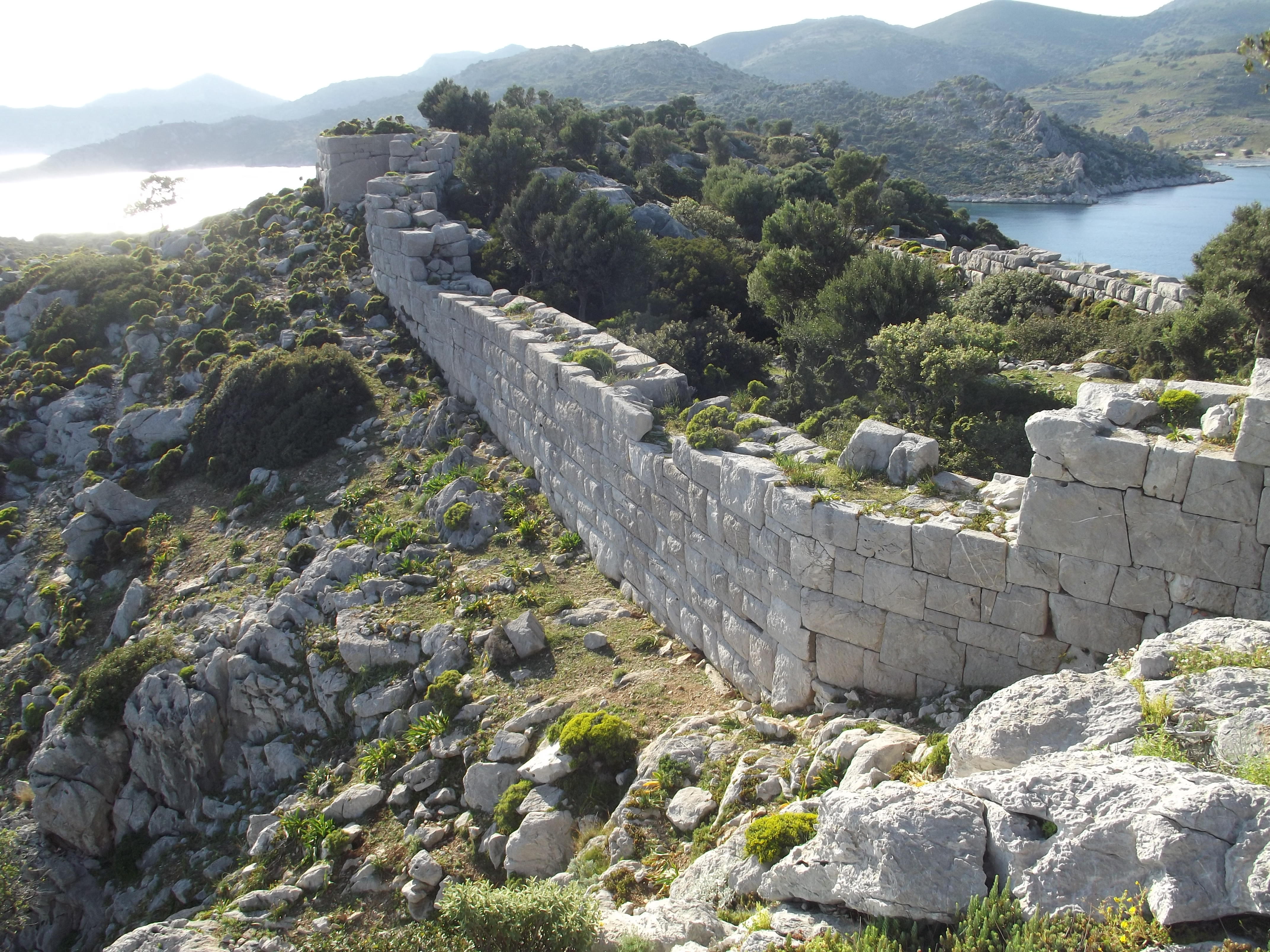
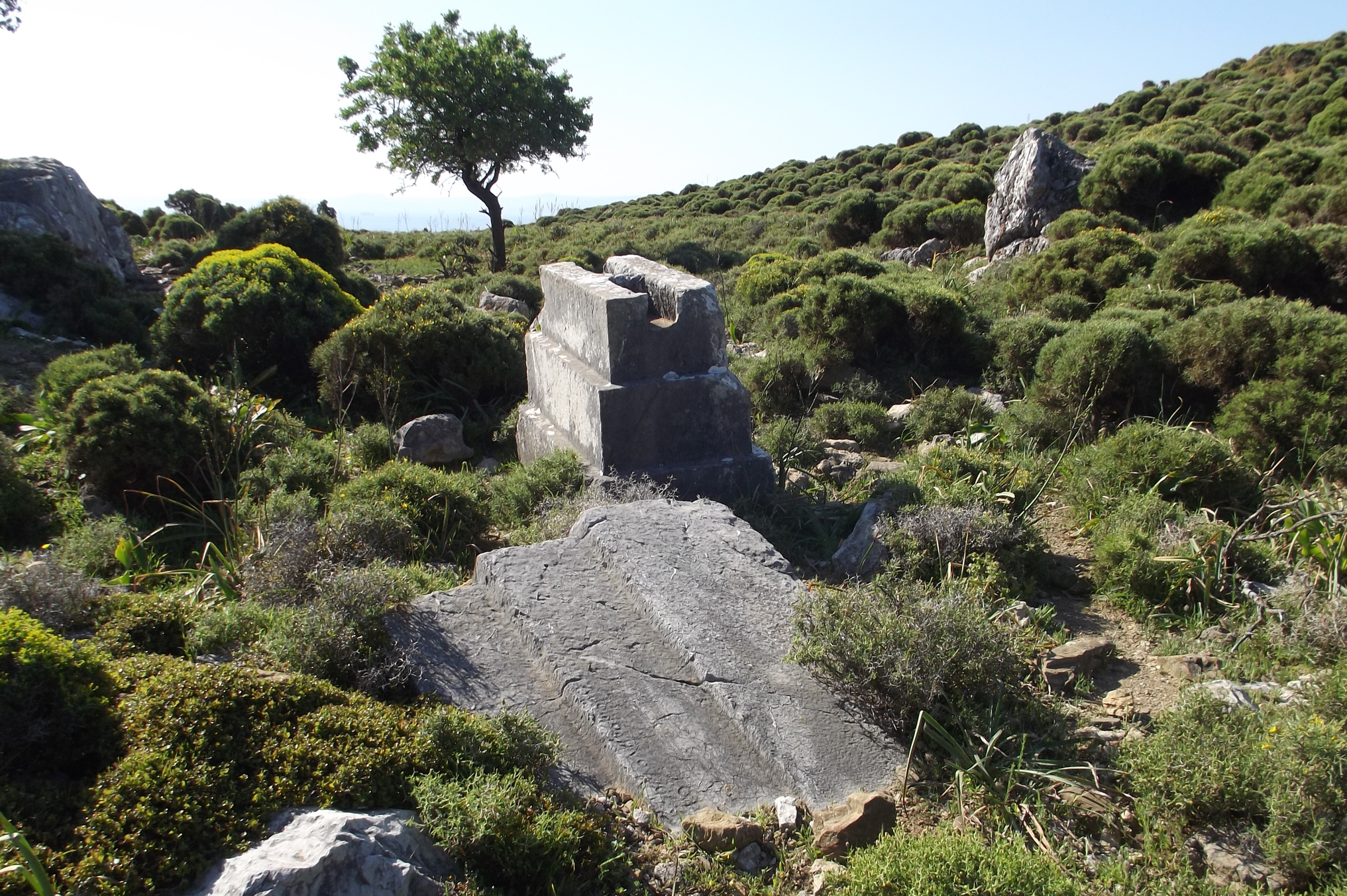
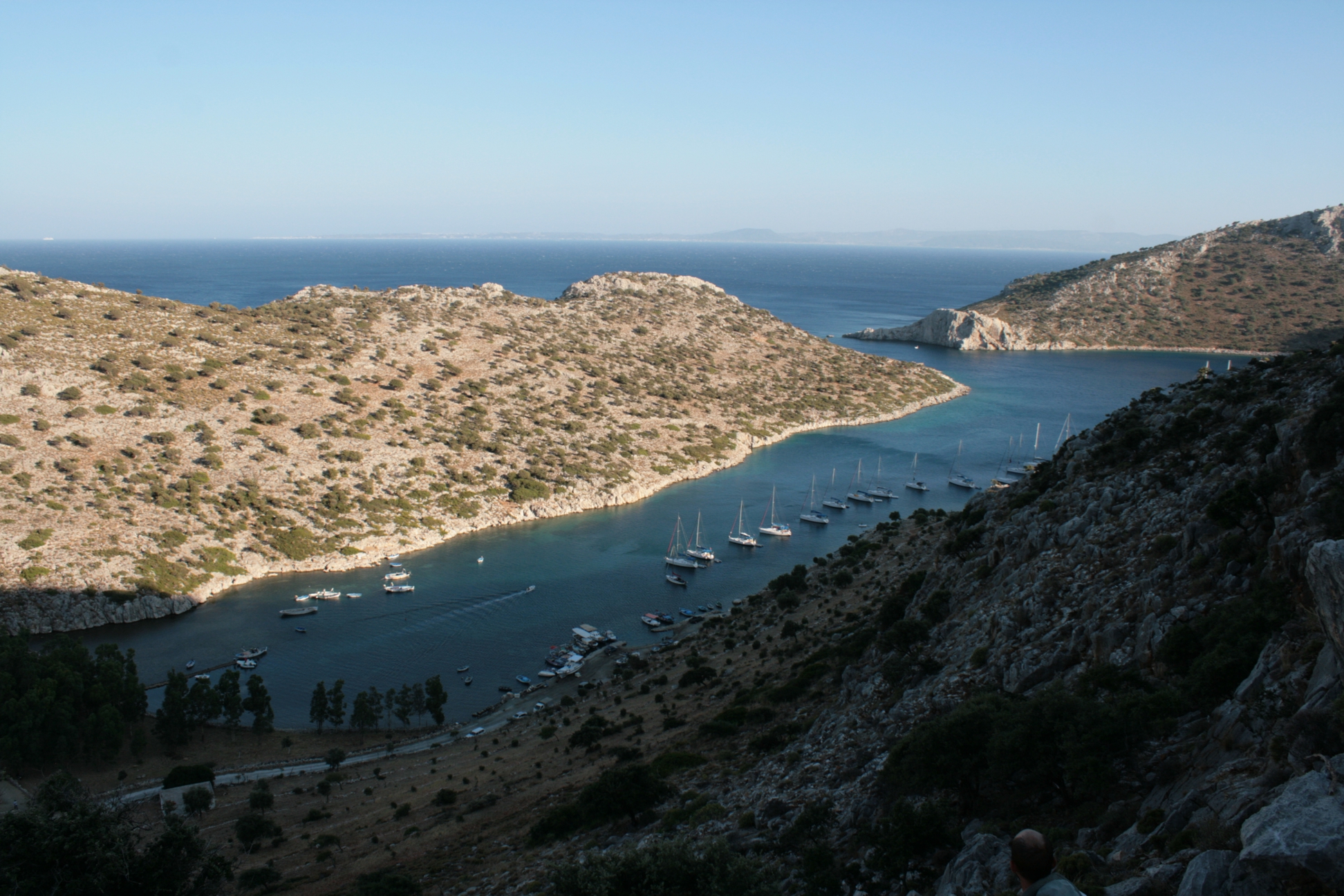
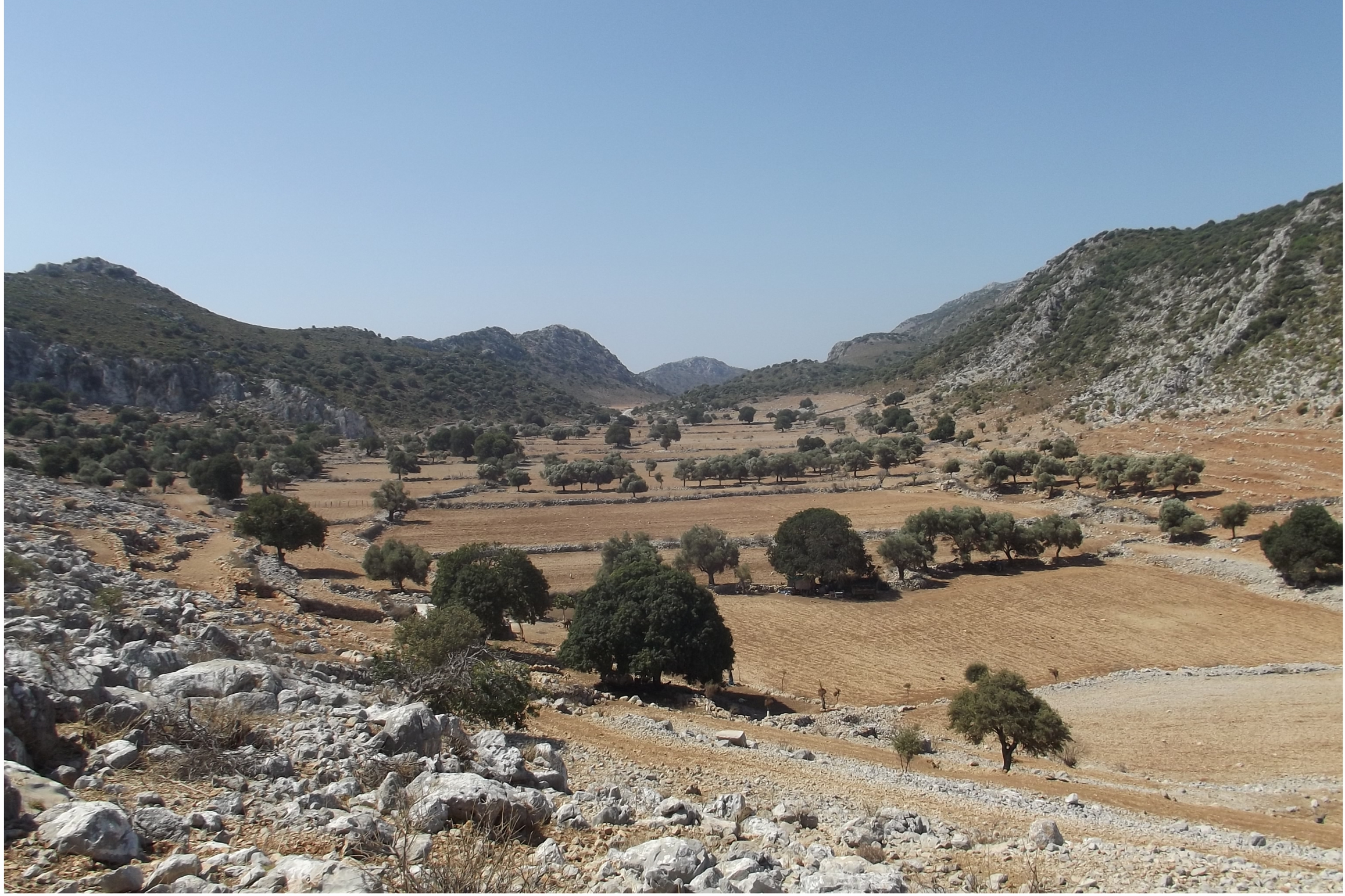
 Leave a comment or contact us about this article