The Bents – Great Friends of Kastellorizo

The Bents – Great Friends of Kastellorizo

Just before (Western) Easter 1888, the tireless British explorers  Theodore and Mabel Bent, on an extended cruise down the Turkish coast, had reached the small, thriving island of Kastellorizo – one more location to add to their twenty-year gazetteer; not a lot of people know that…

Wikipedia (03/09/2020) has plenty by way of introduction to this, perhaps the remotest of Greek islands one can step on via scheduled services:
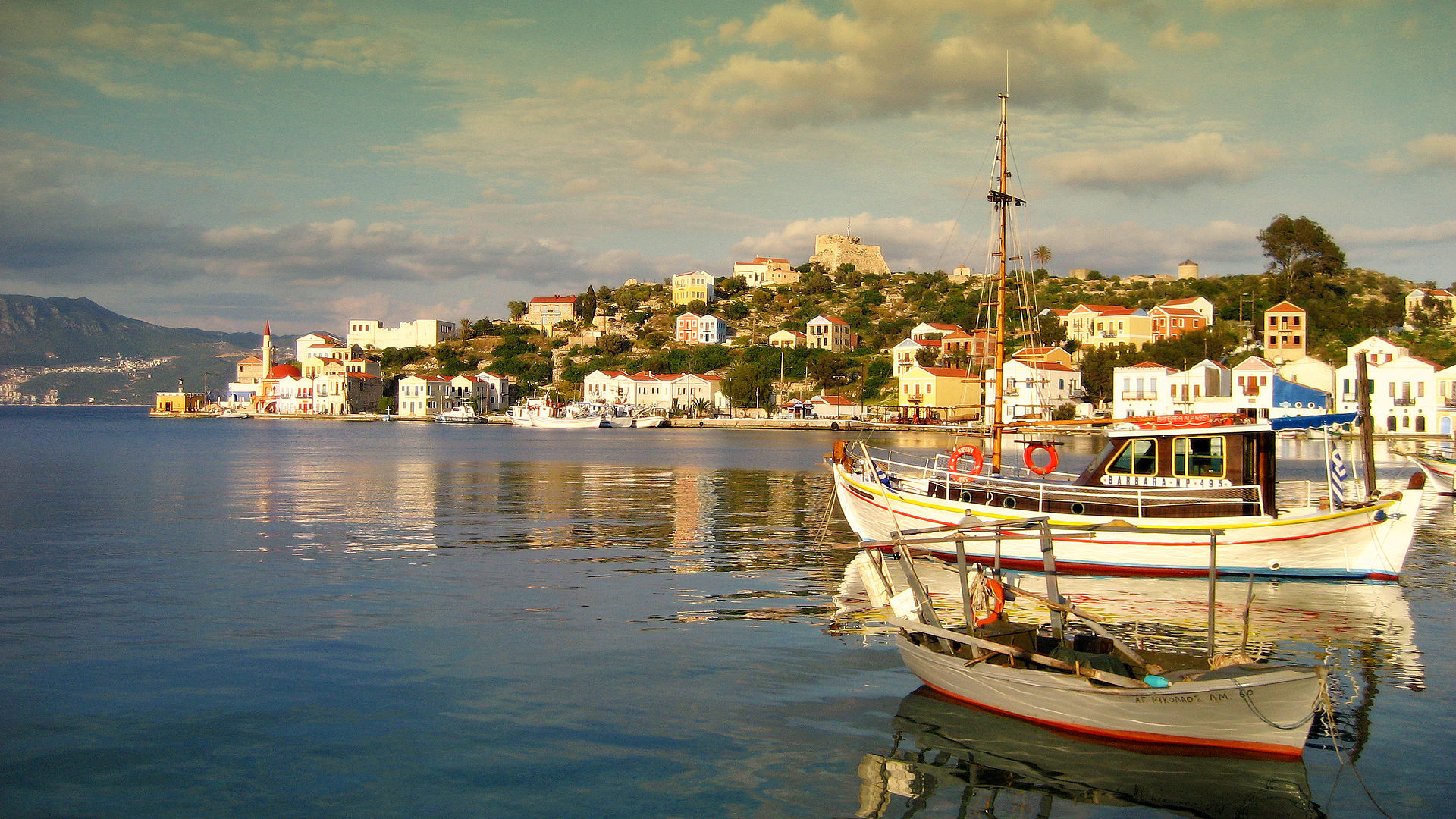
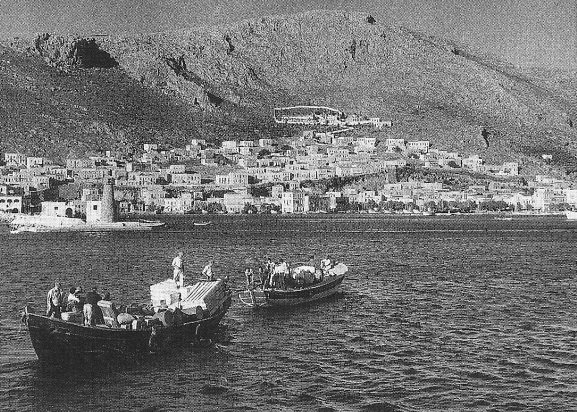
Kastellorizo harbour (wikipedia).

“Kastellorizo or Castellorizo (Greek: Καστελλόριζο, romanized: Kastellórizo), officially Meyisti (Μεγίστη Megísti), a Greek island and municipality of the Dodecanese in the Eastern Mediterranean. It lies roughly 2 kilometres (1 mile) off the south coast of Turkey, about 570 km (354 mi) southeast of Athens and 125 km (78 mi) east of Rhodes, almost halfway between Rhodes and Antalya, and 280 km (170 mi) northwest of Cyprus.”

The previous year (1887), our explorers, Theodore and Mabel Bent, had been excavating way up north on Thasos, finding some important marbles (including a fine statue they were not allowed to take home), which are now in the archaeological museum in Istanbul.  Denied their rightful gains (as they saw them), and never a couple to give up easily, the pair spent a good deal of the summer and autumn of 1887 trying to drum up enough support to have these marbles rescued from the Turkish authorities and cased up for London. Letters exist from Bent to the British Museum requesting their kind interventions (it all sounds very familiar): “We have indeed been unfortunate about our treasure trove but I have hopes still. I sent to Mr. Murray [of the BM] a copy of two letters which recognize the fact that I had permission in Thasos both to dig and to remove. These I fancy had not reached Sir W[illiam] White [our man in the City, see below] when you passed through Constantinople. Seriously, the great point to me is prospective. Thasos is wonderfully rich and I have some excellent points for future work and … I am confident we could produce some excellent results.”
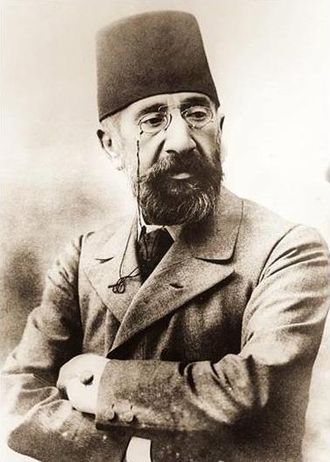
Osman Hamdi Bey (1842–1910) (wikipedia).

In January 1888, Theodore did receive a further grant of £50 from the Hellenic Society to return to Thasos to excavate, and the couple duly left for Istanbul. Unsurprisingly, the implacable, very capable Director of Antiquities in the Turkish capital,  Hamdi Bey, refused Bent a firman to carry out further investigations, not only on Thasos, but also implying that the Englishman was not welcome to use unauthorized picks and shovels on Turkish lands in general.
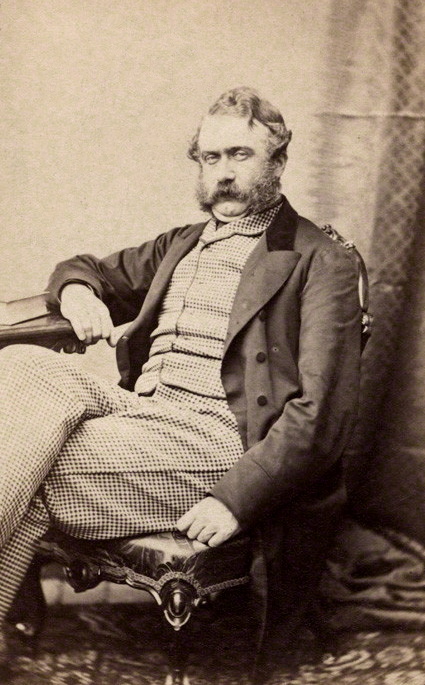
 

A friend indeed. William Arthur White (1824–1891), HM Ambassador at the Sublime Porte, but politely not prepared to assist the Bents in their piratical activities (wikipedia).

Despite various appeals to canny career diplomat, the Ambassador, Sir William White, he and Mabel were forced to change their plans. Theodore may well have been expecting this. In the Classical Review of May 1889, his friend E.L. Hicks reveals that when Bent was first digging on Thasos in 1887 he had employed a local man to “to make some excavations in the neighbourhood of Syme” (far down the Turkish coast, north of Rhodes) on his behalf. Obviously satisfied with the results, the couple, after an excursion to Bursa to see the fabled Green Mosque, decided to return to Cycladic Syros, where they chartered for about fifty days the pretty yacht Evangelistria (the Bents refer to her as “the ‘Blue Ship’ from the gaudy colour with which her sides were painted”), with “Kapitan Nikólaos Lambros” and her crew, under Greek papers; and they embark (Wednesday,  29 February  1888) on this fall-back plan that will take them with the winds and currents as far south as Levantine, if not Oriental, Kastellorizo, frozen just off the Turkish coast, as a map will show you, like a mouse under a cat’s paw.

Meanwhile Mabel, on Syros before embarking,  can be candid for her diary – they are to don pirate gear, “Theodore at once took to visiting ships to put into practice our plan of chartering a ship and becoming pirates and taking workmen to ‘ravage the coasts of Asia Minor’. Everyone says it is better to dig first and let them say Kismet after, than to ask leave of the Turks and have them spying there.” All, of course, reprehensible behaviour today. The couple also meet up here with their long-term dragoman, Manthaios Símos, who has sailed up from his home on Anafi , close to Santorini, to lend a hand.
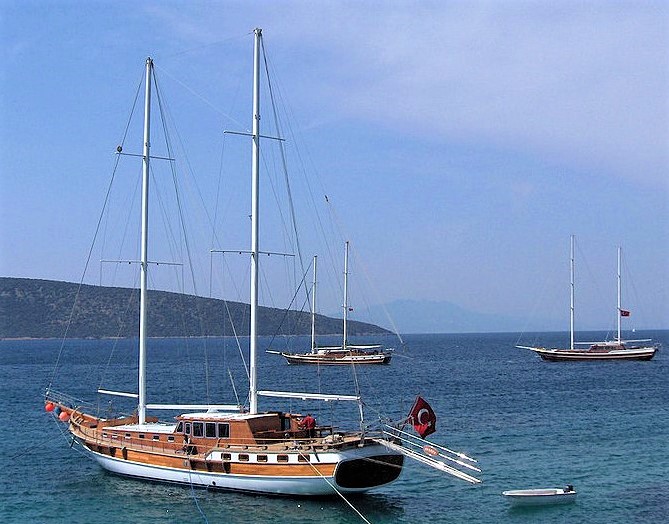
‘Gulets’ off Bodrum (wikipedia).

Thus, on a  sort of early tourist ‘gulet’ cruise (“There is a dog called Zouroukos, who was at first terrified… and the little tortoise, Thraki”), the couple’s investigations along the Asia Minor littoral (in particular the coastline opposite Rhodes) turned out fairly fruitful, and some of Theodore’s ‘finds’ from this expedition are now in London (see below). He briefly wrote up his discoveries of ancient Loryma, Lydae, and Myra for the Journal of Hellenic Studies (Vol. 9, 1888 – but a lengthier account was provided by E.L. Hicks (Vol. 10, 1889)), including transcriptions of over forty inscriptions and passages of text from Theodore’s own notebooks.

No doubt his notebooks were to come in handy when, a few years later, Bent is editing his well-known version of Thomas Dallam’s diary for the Hakluyt Society (1893), recounting the latter’s adventures in these same waters: ‘The 23rd [June, 1599] we  sayled by Castle Rosee, which is in litle Asia.’ (Incidentally, musical-instrument maker Dallam’s Gulliver-like exploits below the gigantic walls of Rhodes, not so very far away northish, are highly recommended.)

But back to the Bents, a popular account of the their 50-day cruise in 1888 – well worth a read for those who get off on the rugged coastline from Symi to Kastellorizo – was written by Theodore for The Cornhill Magazine, (Vol. 58 (11), 620-35), and entitled ‘A Piratical F.S.A.‘ (Bent had recently been made a Fellow of the Society of Antiquaries of London, and was indulging in shameful hubris.)
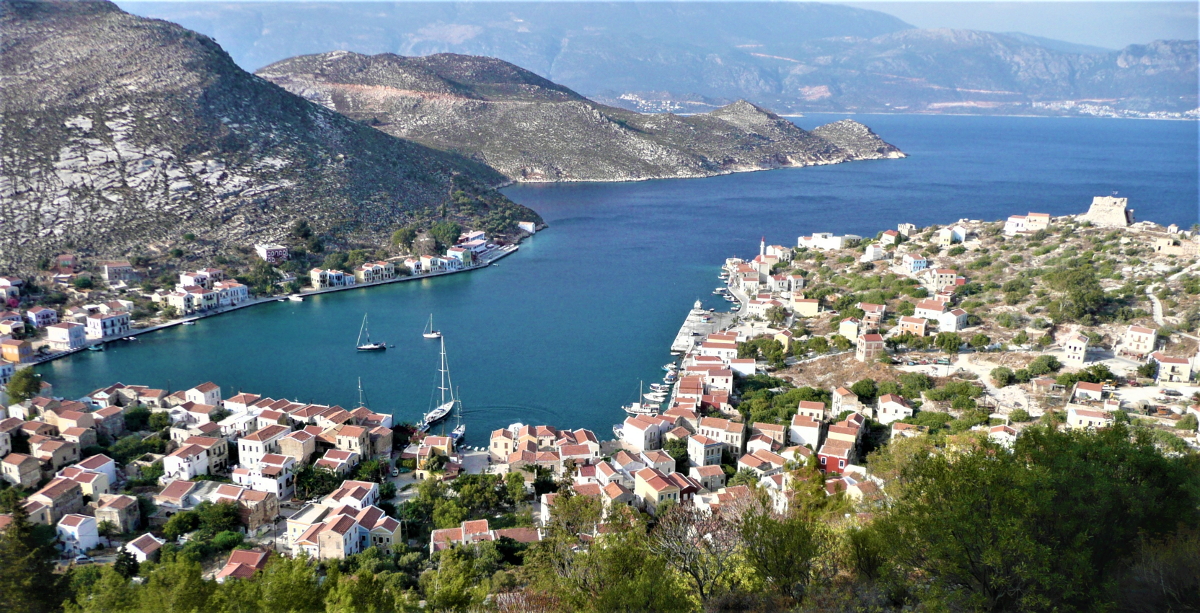
Kastellorizo harbour
The safe, not to say stunning, harbour of Kastellorizo with the Turkish coast 2km distant.

(For the rest of Bent’s articles on this coastal meander, see the year 1888 in his bibliography.)

After various adventures, the Bents reached the Kastellorizo offing on 30th March 1888. Theodore sets the scene: “Great preparations were made for the arrival of the ‘Blue Ship’ at the first civilised port she had visited since leaving Syra. One of the ‘boys’, it appeared, understood hair-cutting, and borrowed Mrs. F.S.A.’s scissors for that purpose; beards were shaved, and shaggy locks reduced with wonderful rapidity… Castellorizo was the port, and it is a unique specimen of modern Greek [sic] enterprise, being a flourishing maritime town, built on a barren islet off the south coast of Asia Minor, far from any other Greek centre – a sort of halfway halting place in the waves for vessels which trade between Alexandria and Levantine ports; it has a splendid harbour, and is a town of sailors and sponge divers.”

Half thinking of home, the Bents are in need of some fancy paperwork to ensure their acquisitions thus far are protected from the prying eyes of both Greek and Turkish customs officials. Mabel’s ‘Chronicle’ gives us a little more, beginning with a sketch of their plans:
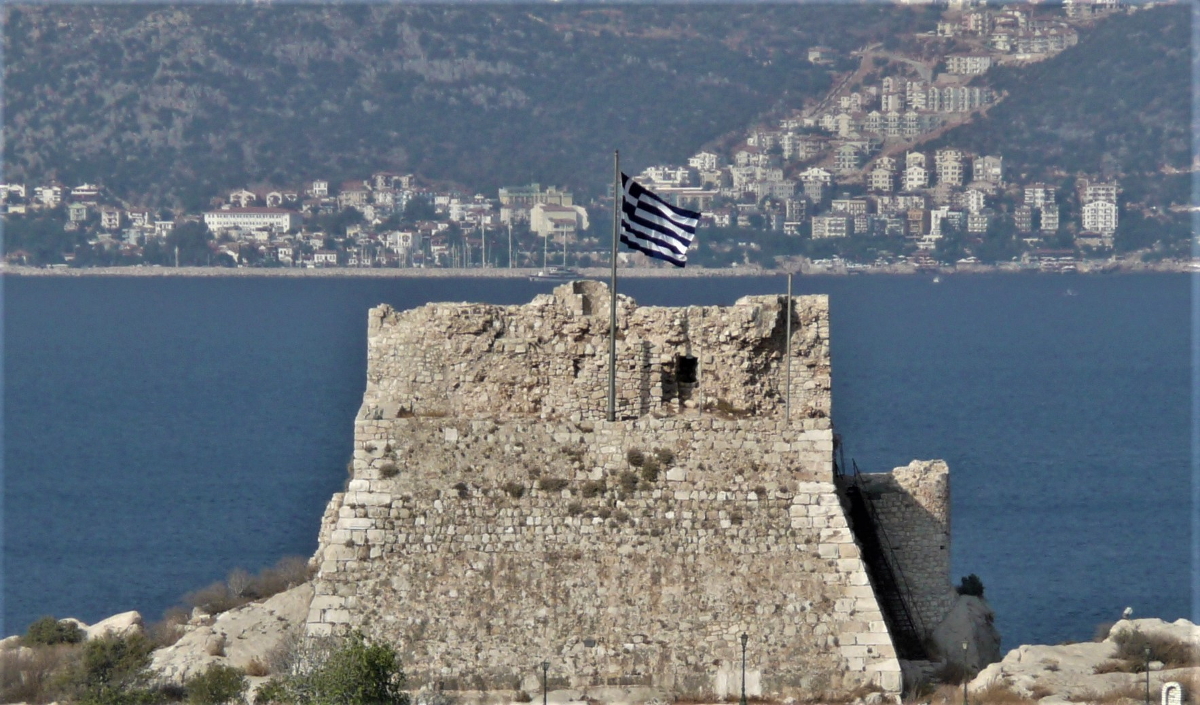
Kastellorizo castle
The ‘red fort’, after which the island is named, so called from its appearance at sunset, proudly asserts its nationality to the Turkish town of Kaş, 2km across the strait.

“First to go to the island of Kasteloriso, where there is a Greek consul, and have a manifesto made that we came from Turkey so that the Greeks may not touch our things in Syra… Now all was preparation for this civilized place. Theodore assured himself that his collar and tie were at hand. I hung out my best Ulster coat and produced respectable gloves and shoes… We really made a very tidy party when we reached our goal… We had a calm voyage. An average time from Myra to Kasteloriso is 6 hours; we took about 26. We did not land in the regular harbour. The captain said questions would be asked as to why there were 18 people in such a boat. We landed about 8. It is a flourishing looking little town, divided by a point on which rise the ruins of a red castle. The name should be Castelrosso, but first the Greeks have made it ‘orso’ and then stuck in an ‘i’. The Genoese or Venetians made it. Kapitan Nikólaos was greeted wherever he went by friends. He did not seem anxious to be questioned much, and once when asked where he had come from gaily answered, ‘Apo to pelago!’ (from the open sea). I was delighted at this answer and so, when some women, sitting spinning on rocks, called out, ‘Welcome Kyria,’ to which I answered, ‘Well met!’ and then asked, ‘Whence have you troubled yourself?’ ‘Apo to pelago!’ I smilingly replied and swept on round a corner where we could laugh, and who more than Kapitan Nikólaos…”
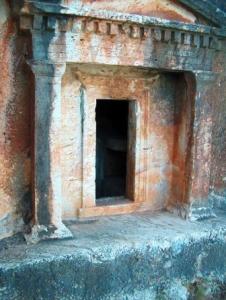
The iconic ‘Lycian tomb’ on Kastellorizo (4th century BC) (from Kastellorizo.online).

There is nothing in Mabel’s diary to suggest the couple made any sort of tourist excursion around the island, not even to the famous blue caves, which is a shame. Surprisingly, too, Theodore makes no mention of perhaps the most iconic ‘snap’ on the island, the Lycian rock-cut tomb (4th century BC), unique on Greek soil.

Mission accomplished, the next we learn is that the Evangelistria has reached the ancient site of Patara on the mainland: “Yesterday morning, Good Friday [March 30th], we had a very quiet voyage hither…”

Within days, Theodore and Mabel will be casting off for Syros once more, but, after 50 days in their gulet, they have had enough of open waters and decide to return to London the long way, overland, via  Smyrna – Istanbul – Scutari – Adrianople – Plovdiv – Istanbul – Nicea – Istanbul – Odessa – Berlin. All a far cry from ‘civilised’, Levantine Kastellorizo… and one wonders of their dreams.
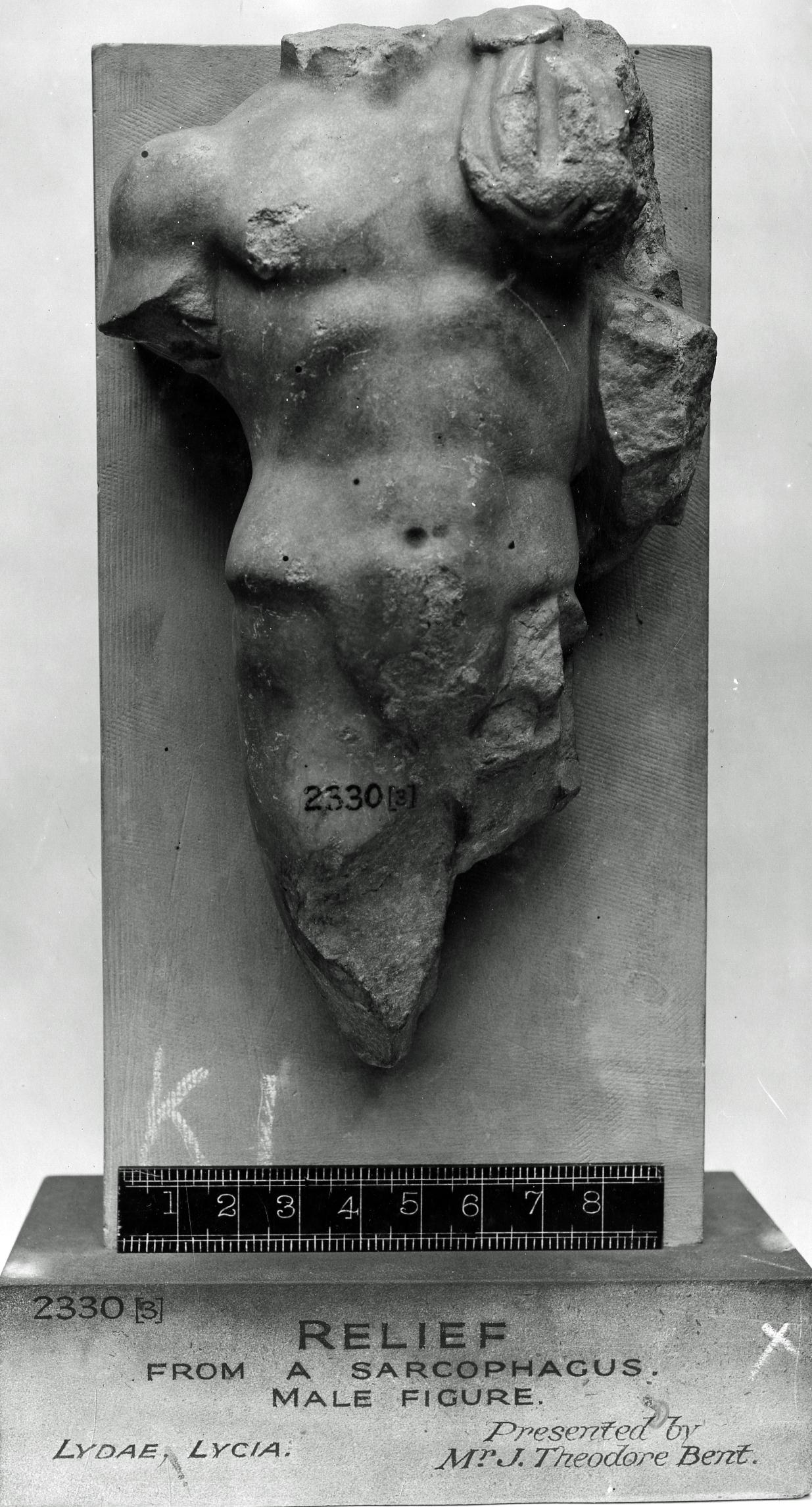
“Fragment of a sarcophagus: a heroic figure, perhaps Heracles, perhaps Diomedes wearing a cloak over his left shoulder. Made of Phrygian or Docimaean marble”. Acquired by Theodore Bent from ancient Lydae in 1888. Museum number: 1888,1003.4 © The Trustees of the British Museum.

“We stopped 2 nights in Berlin at the Central Hotel”, writes Mabel, “We had travelled from Saturday night to Monday night, the 14th, and nearly always through forests. We crossed from Flushing and on Thursday [17th May 1888] we safely reached home… All our marbles reached England soon after, and after spending some weeks here are housed in the British Museum.” (‘The Travel Chronicles of Mrs J. Theodore Bent’, Vol 1, Oxford, 2006, p. 260)

‘Here’ is the couple’s smart townhouse near Marble Arch, a vast magpies’ nest, with every tabletop, bookcase and cabinet showing off souvenirs from 20 years of travels in Arabia, Africa, and the Eastern Mediterranean, perhaps, too, some embroideries and large, distinctive chemise buttons (from the women Mabel chatted to on Kastellorizo), just arrived back in rough, pine crates, recently unloaded from the decks of the Evangelistria:

The distinctive chemise clips from the Kastellorizo region (from ‘An account of discoveries in Lycia, being a journal kept during a second excursion in Asia Minor’ by Sir Charles Fellows, 1841, London, J. Murray, p. 190).

“The women here all wear the dress of Kasteloriso: long full coloured cotton trousers, then the shirt fastened down the front with… large round silver buckles, and then married women wear a gown slit up to the waist at the side. The 2 front bits are often tied back as they become mere strings. Then a jacket with sleeves ending above the elbow and very long-waisted, and very low is wound a scarf. The girls do not wear the gown. They have a fez on the head and a turban round it or not…” (‘The Travel Chronicles of Mrs J. Theodore Bent’, Vol 1, Oxford, 2006, p. 246)

For more on the Bents generally in the Dodecanese, see Further Travels Among the Insular Greeks (Archaeopress, Oxford)


‘Theodore Bent’s Turkish embroidery bequest’ – The Harris Museum and Art Gallery, Preston

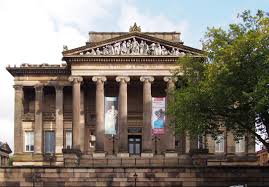
The Harris Museum and Art Gallery, Preston, UK (Wikipedia)

In the Collections Development Policy statement (2011) of the Harris Museum and Art Gallery (Preston, UK) there is a fascinating, and, for the Bent Archive, startling reference on page 30:

‘In the long term, the following areas of the collection have been identified as under-researched areas, but these would only be tackled in the context of potential for use and visitor engagement … […] Theodore Bent’s Turkish embroidery bequest.’

This casual aside makes the Harris Museum one of only four public collections in the world, to our knowledge, to hold a collection of textiles originally acquired by Theodore and Mabel Bent over the 20 years of their travels (the others being the Benaki Museum, Athens, London’s Victoria and Albert Museum, and the Metropolitan Museum, New York. We are not including here the few clothing and other items, some made of bark, that the Bents brought back from Great Zimbabwe that are now in the British Museum, etc.)

‘Theodore Bent’s Turkish embroidery bequest’ at the Harris Museum consists of four items (PRSMG: c. 1970.1-4; we are assuming they represent the entire ‘bequest’), and, thanks to the kind assistance of curator Caroline Alexander, we believe that this is the first time they have been ‘published’ (pers. comm. March 2019.

Detail from PRSMG 1970.2 (Harris Museum and Art Gallery, Preston)

The museum’s Accession Book refers to the pieces as ‘Turkish Embroideries’. In the 1880s, the decade the Bents spent mainly in the Eastern Mediterranean, the islands off the Turkish west coast belonged to Turkey, taken and held by the Ottomans from early medieval times until the early 20th century; the  Dodecanese islands were only returned to Greece in the 1940s.  Thus the Bents’ acquisitions of fabrics and costumes (some with the intention of selling-on to British collectors and institutions) reflect a wide blend of styles and influences – the distinctions between ‘Greek’ and ‘Turkish’ being generally moot points. Beautiful things, made painstakingly, to be given, worn, or displayed, remain beautiful things irrespective.

Detail from PRSMG 1970.4 (Harris Museum and Art Gallery, Preston)

The four items (1970.1; 1970.2; 1970.3; 1970.4) in the Harris Museum were donated in May 1970, rather mysteriously, by someone who introduced herself as ‘the great-niece’ of ‘Theodore Bent’. There seems to be no mention of the gift in the museum’s Donation Book, an interesting fact, nor does any name appear in the museum’s accession records unfortunately. The museum’s Accession Book includes the following handwritten note stapled to the relevant entries: ‘Query re T. Bent’s niece [sic]. No details of this donation in the donation book. Contact V & A to whom T. Bent donated embroidery.’

Theodore Bent had no siblings, but several cousins, who in turn had issue. There is a chance that one of these might be our donor, and there is a local connection. Theodore Bent himself had property just outside Macclesfield , and his uncle John was Lord Mayor of Liverpool in 1850.  The family were influential local brewers, and, indeed, Theodore was born in Liverpool (1852). Bent’s Brewery Co. Ltd remained in business until the 1970s, as part of Bass Charrington. The Bents can be traced back to the Liverpool region in the 1600/1700s. One branch were potters and brewers, another were medical men – James Justin Bent, Theodore’s great uncle, was the famous surgeon who amputated Josiah Wedgwood’s leg.

Detail from PRSMG 1970.3 (Harris Museum and Art Gallery, Preston)

Was it perhaps a member of this energetic and successful family who donated the embroideries in 1970? Somehow we doubt it. The Bents were great collectors (and dealers) in embroideries, etc., on their travels in the Eastern Mediterranean and Turkey in the 1880s, the period, we assume, when the four pieces now in the Harris were acquired by the exploring couple. On Theodore’s death in 1897 all his estate went to his wife Mabel, and they had no children. Just over thirty years later, on Mabel’s death (1929) all her  belongings, including her textiles, went, via her remaining sister, Ethel Bagenal, to her surviving nieces – Violet and Kathleen. However, neither of the latter had daughters (who would thus have been the ‘great nieces of Mrs Theodore Bent’. Of her nieces, only Kathleen Sweny/Swiny (née Bagenal) (1886-1974) was alive in 1970. (For the Anglo-Irish Hall-Dare family click here.)

We might therefore propose Kathleen Sweny/Swiny (or her agent) as the donor of the Bent textile bequest to the Harris. The mystery remains why the Harris? Kathleen’s family home was in Scotland (Arbigland, on the Solway Firth; for photographs of Kathleen and her house, scroll down through here); we know she was actively selling off her great-aunt’s textiles from the 1930s and retained some items for herself and other family members.

Detail from PRSMG c1970.1 (Harris Museum and Art Gallery, Preston)

In her lifetime Mabel exhibited some of her fabric collection – we know of two events, but neither seem to have included any of the four items donated to the Harris in 1970.

  • A lecture Bent gave to the Anthropological Institute of Great Britain and Ireland in 1886, during which his Mabel displayed a range of their textiles. These are published in ‘Insular Greek Customs’. The Journal of the Anthropological Institute of Great Britain and Ireland, Vol. 15 (1886), 391-403. [With an Appendix by ‘Mrs. Bent’].
  • At the 1914 embroidery exhibition at the Burlington Fine Arts Club in London, Mabel Bent showed a good part of her collection (see later in this contribution).

The Bent textiles in the Harris Museum, Preston

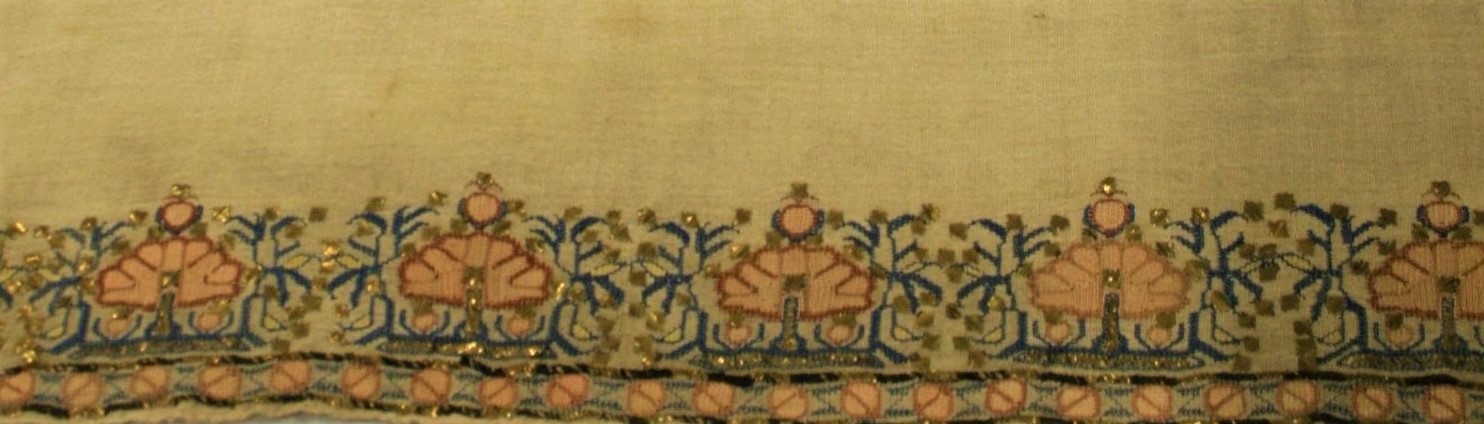
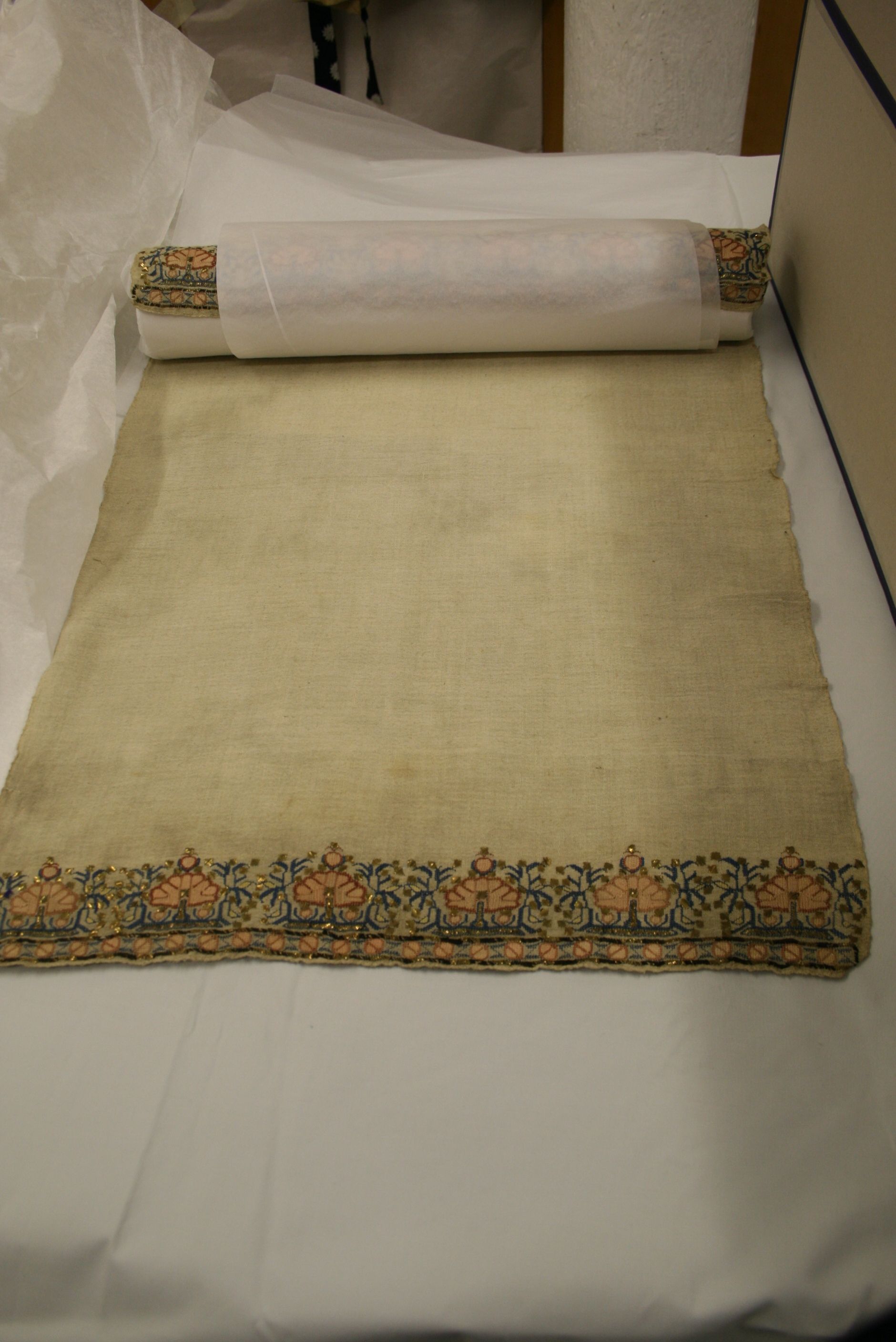
PRSMG c1970.1. ‘Fine linen cloth embroidered at both ends’ (Harris Museum and Art Gallery, Preston)

PRSMG: c1970.1 [Headed ‘Turkish Embroidery’ in the museum’s Accession Book]

Accession Book entry:  ‘Embroidered with silk and gold plate thread, at both ends. Repeating pattern of formal plant motifs. Pink, blue, gold and brown on natural linen.’ Acquired from: ‘The great-niece of Theodore Bent’ [sic]. Acquisition dated: ‘April May 1970′.

Digital catalogue entry: ‘Fine linen cloth [dimensions not provided] embroidered at both ends with intricate floral pattern of mainly peach and blue silk embellished with gold. Probably embroidered using a tambour. Possibly Turkish. Note: 2015, Asia from British Museum visited, said possibly Turkish with the use of flattened gold thread.’

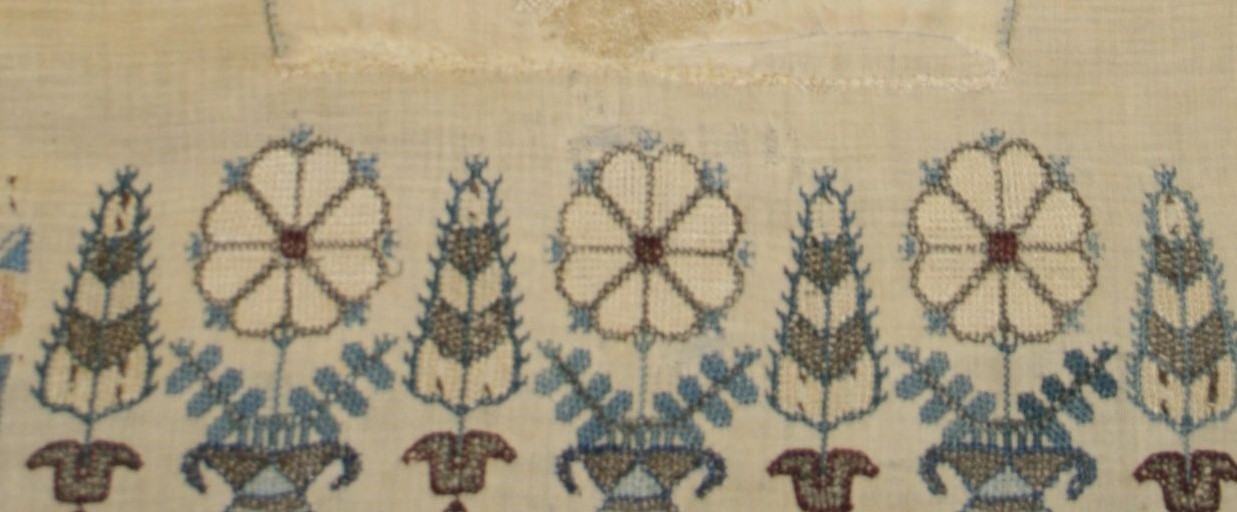
PRSMG 1970.2. ‘Embroidered panel of fine linen’ (Harris Museum and Art Gallery, Preston)

PRSMG: 1970.2 [Headed ‘Turkish Embroidery’ in the museum’s Accession Book]

Accession Book entry: ‘Short strip embroidered at ends with formal design of cyprus tress and flowers in urns. Embroidered patch appliquéd on.’ Acquired from: ‘The great-niece of Theodore Bent’ [sic]. Acquisition dated: ‘May 1970′.

Digital catalogue entry: ‘Embroidered panel [dimensions not provided] of fine linen. Embroidered both ends with motifs of pinecones and eight-petalled flowers in pots worked in blue, dark brown beige and cream threads. Probably machine worked as no evidence of starting or finishing. Machine worked down two edges. Also central panel later addition in pale blue, beige and cream floral motifs.’

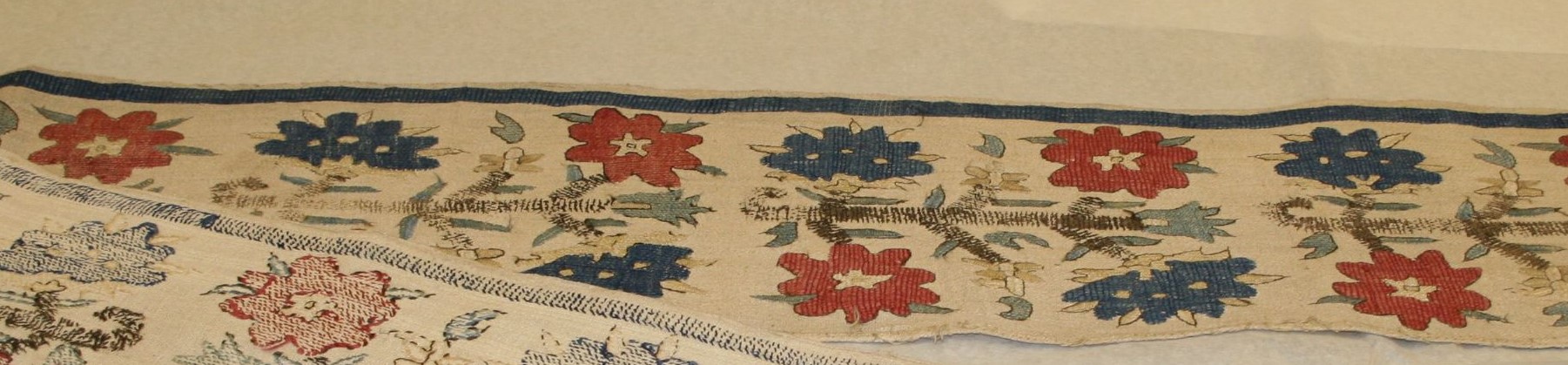
PRSMG 1970.3. ‘Embroidered panel of fine linen’ (Harris Museum and Art Gallery, Preston)

PRSMG: 1970.3 [Headed ‘Turkish Embroidery’ in the museum’s Accession Book]

Accession Book entry: ‘Long strip embroidered with flower motif repeated seven times. Red, brown and blue silk embroidery with blue border on three sides.’ Acquired from: ‘The great-niece of Theodore Bent’ [sic]. Acquisition dated: ‘May 1970′.

Digital catalogue entry: ‘Embroidered panel of fine linen [dimensions not provided]. Embroidered with floral motifs along length. Motif of red and blue flowers in repeated and alternating pattern. Appears to have been the edge of a larger panel. Believed Turkish c 19th century.’

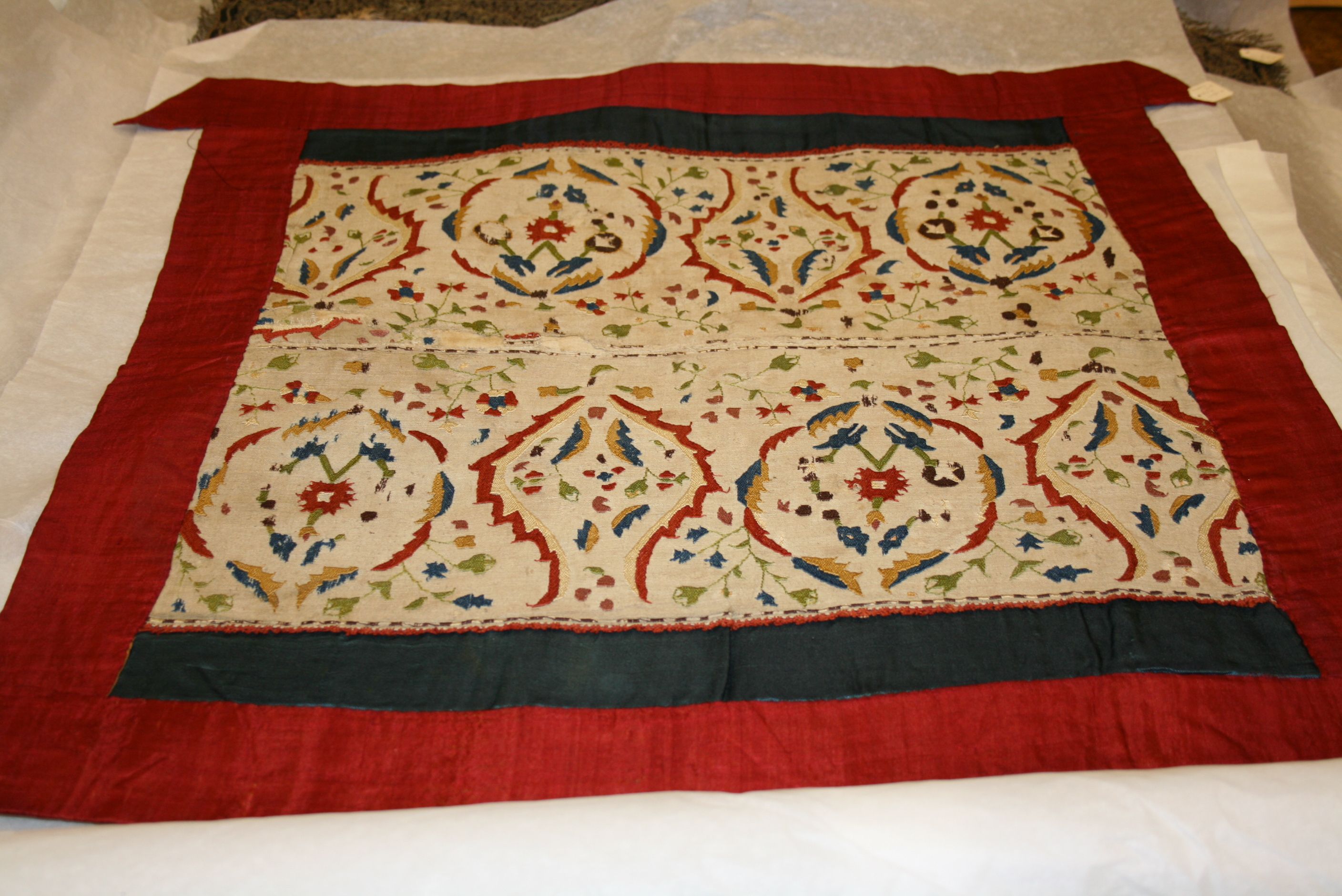
PRSMG 1970.4. ‘Embroidered panel of floral motifs on fine linen’ (Harris Museum and Art Gallery, Preston)

PRSMG: 1970.4 [Headed ‘Turkish Embroidery’ in the museum’s Accession Book]

Accession Book entry: ‘Red silk cloth square extended at corners. Two  embroidered panels joined to form centre piece, with blue silk strips on two sides. Floral design.’ Acquired from: ‘The great-niece of Theodore Bent’ [sic]. Acquisition dated: ‘May 1970’. [This entry in a different hand]

Digital catalogue entry: ‘Embroidered panel [dimensions not provided] of floral motifs on fine linen comprising two pieces joined in the centre. Primarily terracotta red, blue, green and mustard thread working arabesque floral design. Panel has terracotta coloured narrow lace edging. Panel has been mounted on dark red silk backing panel with sleeves top and bottom for hanging. Possibly Turkish. c 19th century.’

The 1914 embroidery exhibition at the Burlington Fine Arts Club, London

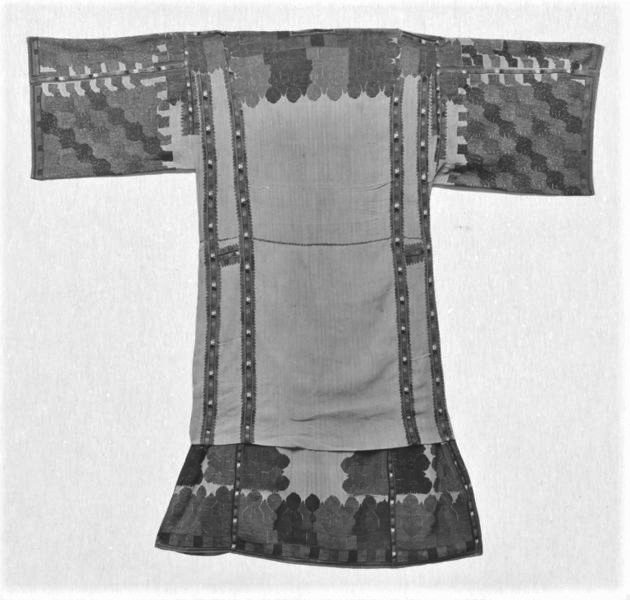
“Embroidered tunic and skirt of linen crepe with square sleeves, embroidered in tent and long cross stitches with various repeating patterns of debased floral and other forms arranged geometrically.” Now in the Victoria and Albert Museum, London (no: 346-1886; from Karpathos in the Dodecanese, acquired from the Bents (in 1886) after their visit to the island in early 1885) (Victoria and Albert Museum, London).

As mentioned above, Mabel Bent showed a good part of her collection at the 1914 embroidery exhibition at the Burlington Fine Arts Club in London. There is an an online catalogue. The prize exhibits were a collection of fine dresses from the Dodecanese, now in the Benaki Museum, Athens, and the Victoria and Albert Museum, London.  The exhibition cabinets displayed a wide range of Mabel’s other textiles, but none of the four items now held in the Harris Museum seem to have been shown to the public in 1914. (If any local Preston readers can provide information on the four Harris pieces before they entered the collection in 1970, we would be most interested to hear from them.)

Mabel Bent’s diaries are, occasionally, a useful primary source for information on the thousands of artefacts the couple returned with to London during the twenty years of their travels in the Eastern Mediterranean, Africa, and Arabia. There are hundreds of references to dress, costume, embroideries, fabrics, etc. Unfortunately, Mabel does not always give precise details of gifts and acquisitions and it has not been possible to identify the four textiles in the Harris bequest in her notebooks.

“This afternoon we have been to the doctor Venier, of a Venetian family. Dr. Venier showed us the hangings of a bed, in which King Otho slept when he visited Pholégandros. All gold lace, silver lace and the most beautiful silk embroidery on linen. The curtains were striped silk gauze with gold lace insertion. The pillows gold edged real silk. We were also shown lace-edged sheets and gold embroidery. It was a really splendid sight and fit for a museum.” (February 1884, Folégandhros in the Greek Cyclades; ‘The Travel Chronicles of Mrs J Theodore Bent’, vol 1, page 44, 2006, Oxford)

In conclusion, the four textile pieces discussed, once in the collection of Theodore and Mabel Bent and donated to the Harris Museum and Art Gallery, Preston, represent an important revelation, and are published, it is thought, for the first time here. If you have any comments on any aspect of this content, including the origins, or technical/stylistic features of the four textiles, do please write in.

‘“I am exceedingly glad to have them”: the acquisition of three Karpathos ‘frocks’ by Anthony Benaki’. Don’t miss this article by Ann French, in  the Scholarly Journal of the Benaki Museum 15-16-17 (2015-2016-2017), pp. 75-94. (Dr French brilliantly unravels at length the story of traditional dresses from the island of Karpathos in the Dodecanese; how they were acquired by the Bents in 1885; and how they eventually returned to Greece in the 1930s.)

Love in the Levant – archaeologist William Paton’s encounter with a Greek goddess – Kalymnos, 1885

Love in the Levant – the true story of an aristocratic British archaeologist and his profound love for the goddess he encountered on a remote Greek island – and Mabel Bent’s account of meeting her.

Another in our Greek island series: “The Bents – great friends of… ”

Love at first sight

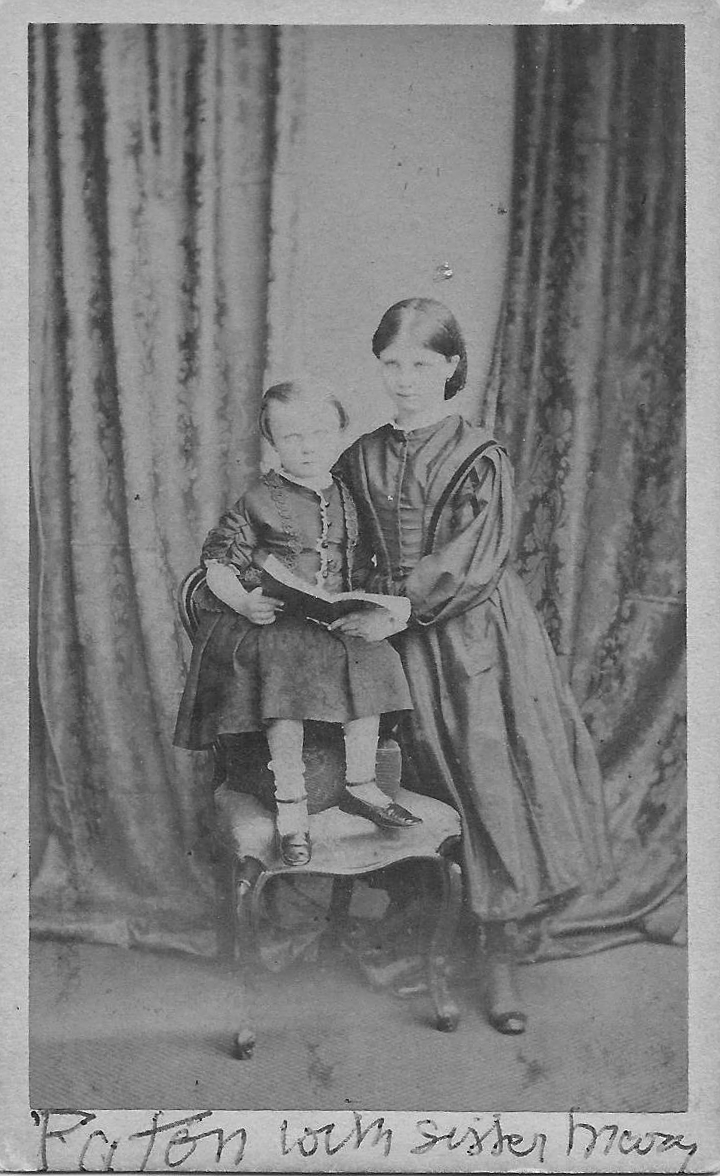
W R Paton with his sister Mary aged 2 or 3

William Roger Paton was born in Scotland on September 2nd 1857. He studied Classics at Oxford and London and moved on to law for a while in London. However, the legal world was clearly too staid for William, whose real interests lay further afield in literature and archaeology in the Eastern Mediterranean. One wonders whether Oscar Wilde had his friend William Paton in mind when he wrote “To live is the rarest thing in the world. Most people exist, that is all.”

On one of his trips to the region in the late summer of 1885, his ship anchored off-shore near the village of Pothia on the Turkish-controlled Greek island of Kalymnos. Standing on the deck of the steamer, he could not have known that his life was about to take a turn which would see him married within just 3 months and a father before a year had passed.

Few large ships called at Kalymnos in those days; there was no dock and such ships had to anchor well out to sea. As soon as a ship was spotted, a scramble of small boats would go out to meet it to take off alighting passengers and maybe to make a few piastre from the ship’s passengers. The local boys would hope to come back with a coin or two by entertaining the passengers with their diving skills as they retrieved coins thrown from the deck.

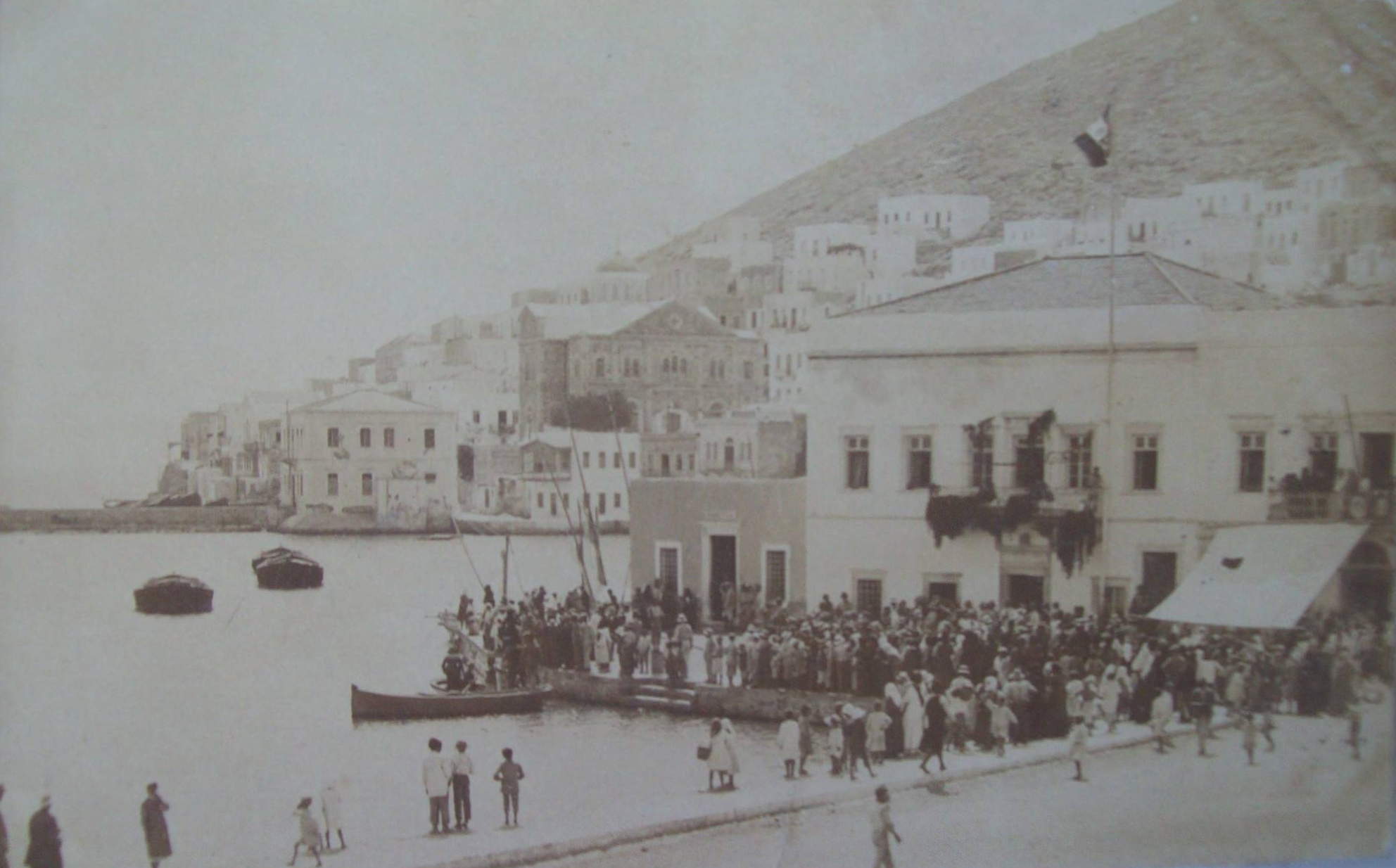
Pothia harbour
Pothia harbour as Paton might have seen it. One of the small boats used to embark and disembark passengers. Photograph taken from the deck of a ship anchored in the harbour (photograph courtesy of Manoli Psarra)

Leaning on the rail, Paton’s eyes were intractably drawn to one of the small boats. In it sat the young girl who would become his wife and the mother of his four children. His fate was sealed at that very moment in time.

He instantly made up his mind. Quickly getting his baggage together, he disembarked into one of the small boats. To the surprise of the boatman, in perfect Greek, he asked where he could find accommodation on the island. The boatman agreed to take ‘O Lordos’  note 1  to the most important man on the island, the Demarchos, or Mayor. As he rowed toward the shore, singing the praises of the Demarchos,  he added, with a nod of his head toward the boat which had so captivated Paton, “that young girl is his daughter.”

Emmanouil Olympitis - Demarchos of Kalymnos and Irini's father
Emmanouil Olympitis – Demarchos of Kalymnos and Irini’s father (photograph courtesy of Emmanuel Olympitis)

Paton got on well with the Demarchos, Emmanouil Olympitis, who very much impressed the younger Paton. He was successful in the sponge fishing industry, for which Kalymnos has always been renowned, and the family was much respected by the people of Kalymnos for the defiance that Emmanouil’s grandfather had shown toward the occupying Turks.

However well the two men got on, it must have been a bolt out of the blue the very next day when Paton proposed marriage to his daughter, Irini. People were outraged and, on a more lawless island, this might have been the end of Paton’s amorous advances, and his life to boot! But wise Emmanouil Olympitis was far above all that and countered by trying to delay on the basis that a trousseau needed to be arranged. With dogged persistence, Paton told him he would arrange everything and that he wanted Irini just as she was.

And what of Irini’s feelings in all of this? Of course, Emmanouil Olympitis would not have allowed his daughter to enter into marriage against her will. We learn from the autobiography of Irini’s daughter, Augusta, from later conversations with her mother, that Paton’s emotions were mirrored in Irini’s own; she described him as a ‘fair, blue-eyed god’.

Paton stayed in Kalymnos for a month and he and Irini grew ever closer – but he had to return to Britain leaving Irini in Kalymnos. While in Britain, he wrote her long letters every single day.

On Paton’s return to Kalymnos, two months later, signalled by tender telegram messages to Irini from each port of call along the way, they married in November 1885 – he 28 and Irini 16 years of age.

Paton and Irini at Rattray, his cousin’s home North of Aberdeen
Paton and Irini at Rattray, his cousin’s home north of Aberdeen (photograph courtesy of William Paton)

Shortly after their marriage and their honeymoon in Symi and Rhodes, they moved to Paton’s Scottish estate, but neither Paton nor Irini were happy in Scotland and both pined for Greece. From Mabel Bent’s diary entry, we know they were back in Kalymnos by March 1886. Later that year, in August, their first son George was born in Irini’s mother’s house on the Turkish coast at Gümüşlük near Bodrum.

Theodore and Mabel Bent visit Kalymnos

At the beginning of 1886, the British explorers Theodore and Mabel Bent were travelling around the islands of the eastern Aegean looking for likely sites to excavate, but they were constantly thwarted by the Turkish authorities to whom Bent was known.

Theodore and Paton were acquainted. It’s thought that they first met as a result of their connections with the British Museum or as members of the Hellenic Society. Their various papers on their respective archaeological excavations were published by the same journal, sometimes in the same issue. They each also had a close relationship with the classicist (and later Bishop of Lincoln) E. L. Hicks, who co-authored publications on ancient inscriptions from both Theodore and Paton. They would have been very well aware of each other’s work.

However, it seems that it was actually Mabel’s inquisitiveness which drove their decision to visit Kalymnos. She wrote in her diary:

“I am most curious to see a young lady of Kalymnos, aged I hear about 16 and just married to a Mr. William Paton of Granholme in Aberdeenshire. Her father’s name is Olympites, a sponge merchant and very rich. Everyone has heard of ‘O Ouiliermos’  note 2  in the neighbouring islands.”

They arrived in Kalymnos on Wednesday March 17th, 1886. The next day Mabel wrote:

“We were lucky enough to fall in with a clean little English steamer, lanthe, where we had a most comfortable flealess night and a very calm passage here. We started about 6 and arrived about ½ past 12 yesterday.

This is a very populous town of large houses filled with rich sponge fishers who have a reputation in these regions of being thieves, liars and cheats. We were sorry to hear that Mr. Paton had returned to England 2 days ago, leaving his wife at her father’s as she does not wish to undertake the long journey till the summer of next year.”

So Theodore missed meeting Paton in Kalymnos. Whether Theodore and Paton ever met on their overseas travels we don’t know – but they certainly trod in each other’s footsteps.

It would seem that Theodore and Paton had more than just a passing physical resemblance to each other. On Kalymnos, this created some confusion on the island:

“We were very much amused on landing to hear William has returned’. ‘No, it is his brother.’ ‘He is exactly the same.’ ‘How very like he is.’ ‘No, it is not him.’ And these sentences never cease to be buzzed round wherever Theodore goes. At the British Museum they have been taken for one another and a gentleman came and shook hands with him and said ‘When did you come’ and then ‘Oh! Excuse me. I thought you were the son-in-law of Olympidis’.”

Meeting Irini’s father Emmanouil Olympitis

But one man, at least, was not fooled by Theodore’s apparent likeness to Paton. He approached Theodore, saying in English:

‘This is the father-in-law of Mr. Paton and I am the brother-in-law of Mrs. Paton.’

Thus was Theodore introduced to Emmanouil Olympitis, the Demarchos of Kalymnos and the father of Irini, Paton’s wife. Mabel continues:

“So on invitation we entered the café and gave our history, in Greek, to the crowd. The brother asked us to come and take a walk in their garden, so we were removed to an orchard of young lemon and orange trees. Chairs were procured and we sat on ploughed beds, damp, so that one had never to forget to be always trying to sit on the highest leg of the chair for fear of overturning. He would talk English which we had constantly to help out with Greek so we sat silently for a long time till I shivered loudly and we were led silently home.”

Meeting Mrs Irini Paton

Mabel continues, but it should be stressed that she is writing her diary for herself and a small number of friends and family and, as such, her tone may at times seem to border on the insensitive and the rude:

“We announced that in an hour we would call on Mrs. Paton. Accordingly they prepared themselves. We entered a mud-floored hall littered with broken machinery; up dirty marble stairs with a rusty banister and reached a drawing room where some matting had been thrown down, but rolled up where it could not pass under the chest of drawers. A quantity of pieces of embroidery bought during the honeymoon to Simi and Rhodes were plastered round in an absurd way. The chest of drawers had a green table cover falling over the front of it, over that a large cotton antimacassar and on top a large pier glass smashed in 4 bits, some hanging out.

Mrs. Paton is a fine big girl who might pass for 20 but some say 14. She had a pretty new dress, quite out of keeping with the place, her wedding ring and a splendid diamond one on her middle finger and a pink coral one on the other middle finger. Her face is good looking but not very pretty. She was very quiet and very much more ladylike than her sister, a coarse rough girl with a dirty snuff-coloured handkerchief on her head, a loose black jacket and a green skirt, much too long in the front. She brought us coffee and jam and seemed very respectful to Mrs. Paton.”

Mabel’s comment that Irini was ‘a fine big girl’ was made without her being aware that, at the time, Irini was 15-16 weeks pregnant. How Mabel would have relished writing about that, had she known! This fact might partly explain why Irini was reluctant to travel back to Scotland with Paton in March 1886.

With Mabel’s inquisitiveness about Irini Paton sated, she and Theodore left Kalymnos for Astypalea on Saturday March 20th, 1886.

The Olympitis house
The Olympitis’ house where Paton and the family stayed while in Kalymnos (photograph courtesy of Emmanuel Olympitis)

The Olympitis’ ‘beautiful’ house on the quayside at Pothia where the family stayed while in Kalymnos and where Theodore and Mabel would have met Irini. Augusta wrote : ‘It was the biggest house with the best accommodation on the island and was situated on the quayside with only a large pavement between it and the sea, which, with its anchored coloured boats, full of sponges and brilliantly coloured fishing equipment, was a sight to gladden my heart.’

The house was demolished in the 1970s and the current Olympic Hotel was erected in its place – ‘the best accommodation on the island’. The hotel is still run by members of the Olympitis family.

Return to Scotland

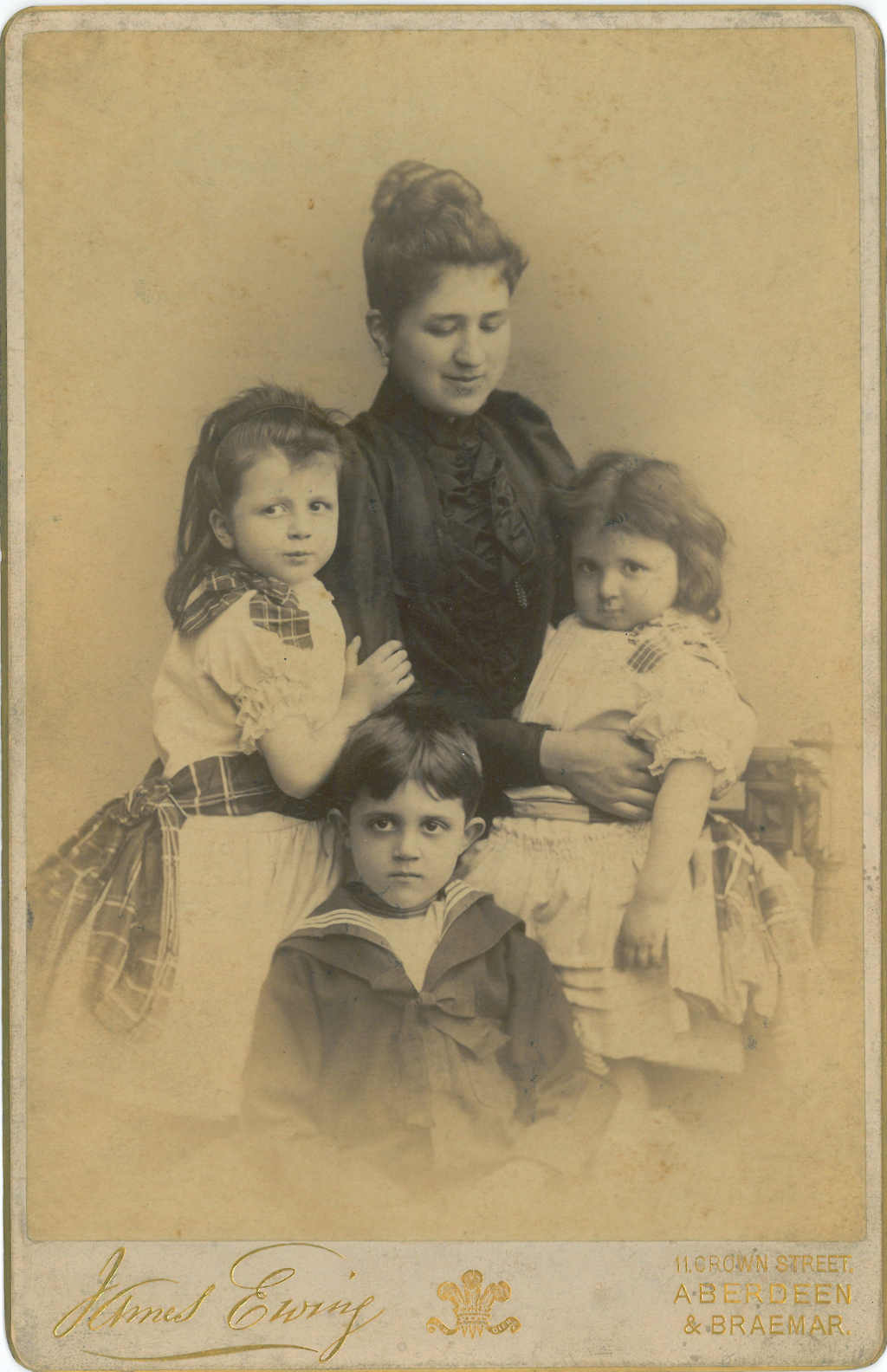
Irini with George, Thetis and John in Aberdeen before 1900

We know from Theodore and Mabel, and from the birthplace of Paton’s first son George, that Irini did not go back to Scotland in 1886, however, Augusta’s autobiography records them being there for much of the time during the first four years of their marriage. Their daughter, Thetis, was born in November 1887 in Aberdeen followed by a son John, in 1890, born at the family seat of Grandhome.

Irini always called Paton ‘Willie’, the name used by Augusta in her wrtings.

George, Thetis and John taken in Aberdeen
George, Thetis and John taken in Aberdeen (photograph courtesy of Emmanuel Olympitis)

Irini was a devout Orthodox and was unhappy not to be able to worship in her faith, there being no Greek Orthodox church in Aberdeen. She was also uncomfortable that her children were not ‘properly’ Christened in ‘that austere Presbyterian cathedral’ which she went through the motions of attending each Sunday, listening to Willie reading the lesson in his ‘carrying sonorous voice’.

The couple were still deeply in love and there were happy times in Scotland. Paton’s family and friends had welcomed Irini as its own. However, neither of them could stand the climate and Paton was never happy running the affairs of the estate. As soon as the children were old enough, he accepted an assignment for a new excavation in Asia Minor.

The house by the Aegean sea

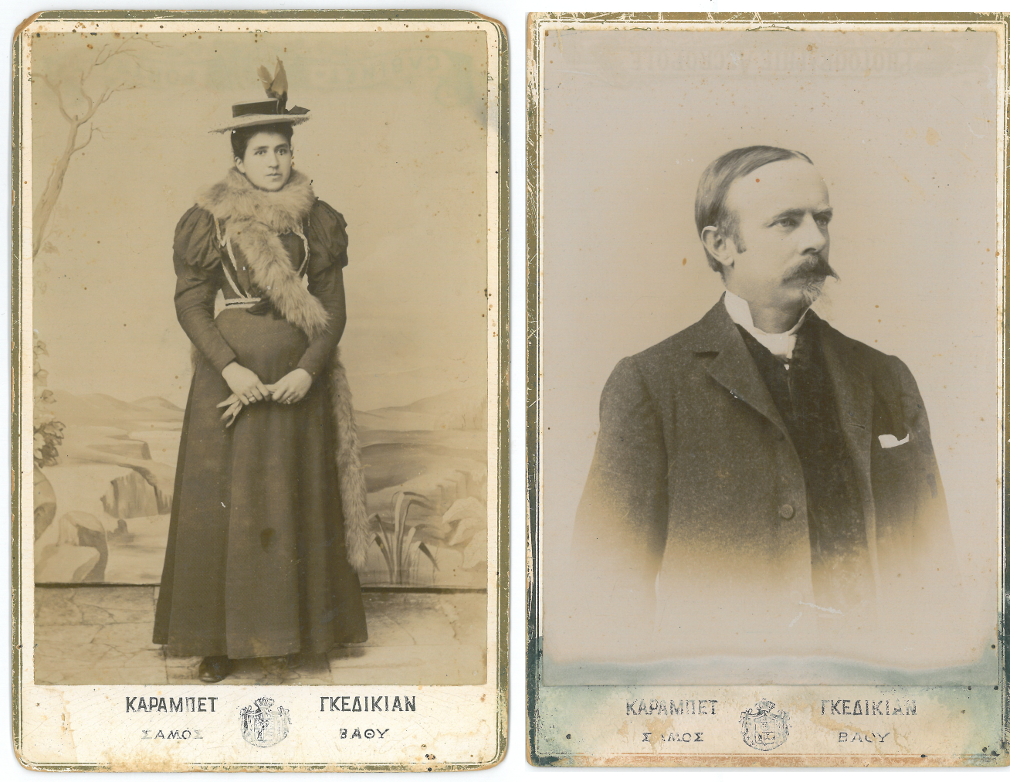
Irini and Paton in Samos
Irini and Paton from the same photo studio in Samos at around 1900 when the family were living in the house at Gümüşlük (photographs courtesy of Emmanuel Olympitis)

Irini’s mother, Palia, had a property on the Turkish coast at Gümüşlük near Bodrum, where Irini and Paton’s first son George had been born. Palia owned much of the land around and a simple house existed on the property, close to the sea. She’d built a small chapel on the hill for the few local Christians. The happiest years for all the Paton family were those spent at the house. Paton and Irini’s youngest child, Augusta, or Sevastie, was also born in the house and her first few years were spent there. For Paton it was perfect. He could take himself off, sometimes for many months, and immerse himself in his work while still being able to return home, at times, for Irini and the children. For the children, it was an idyllic adventure playground and Augusta writes evocatively of those ecstatic days.

Thetis - probably taken in Greece
Thetis – probably taken in Greece (photograph courtesy of Emmanuel Olympitis)

But Irini was doing other things while in Gümüşlük as well. Paton’s great-grandson, also William Paton, provides us with an insight from a publication by Paton, originally in French – “Myndos is a town which knows well how to hide its inscriptions. The inscriptions that I published in the ‘Bull. de corr. hell. (volume XIV)’ do not come from the town itself but from the surrounding area. The town and its cemeteries only provided two inscribed stones. The two that I added were found, in the final days, in the rubble of a church near the Halicarnassus Gate. We owe them to excavations carried out without my knowledge by Mrs. Paton.”

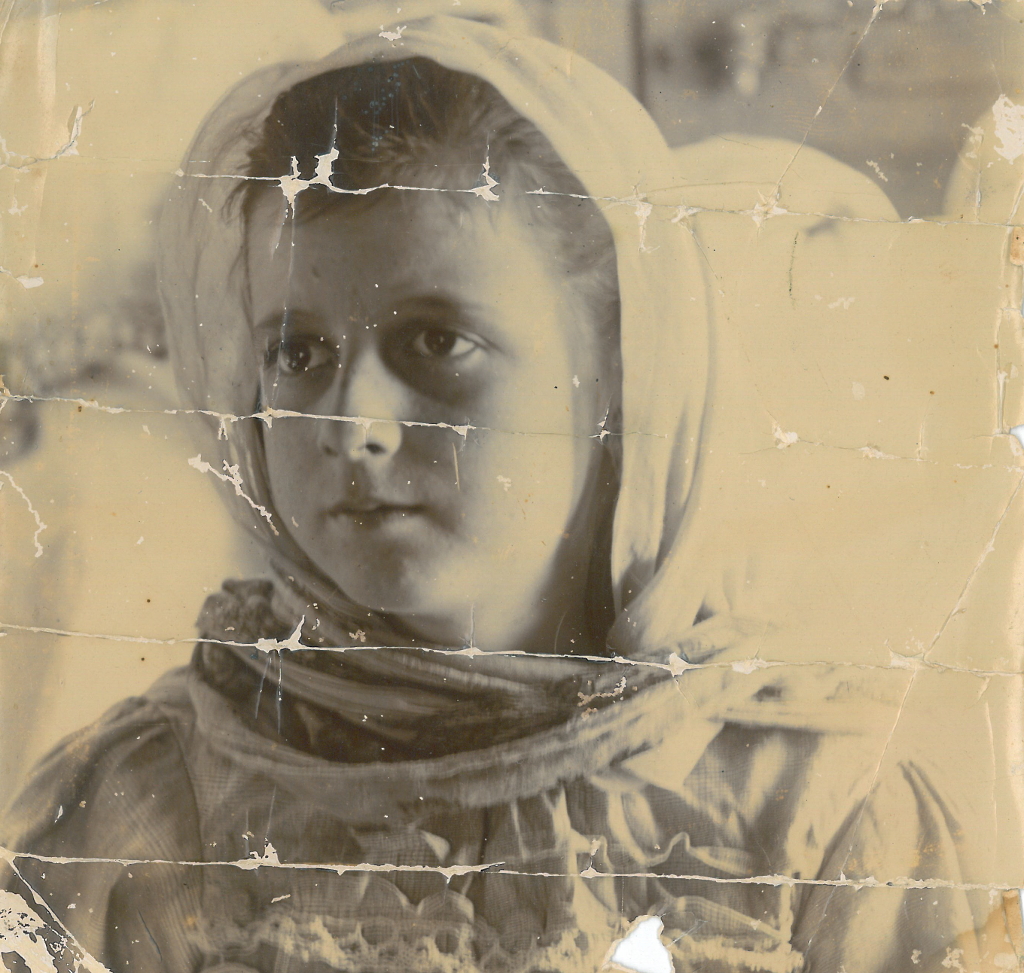
Mama and Augusta
“Mama and Augusta” – Irini with Augusta around the time of their departure from Greece (photograph courtesy of William Paton)

As Paton’s work in Asia Minor came to an end, the spectre of leaving Gümüşlük weighed heavily on Irini. The boys were approaching the age when boarding school in England beckoned – John had already spent time there. During the period the family were in Gümüşlük, George and John had attended a school in Kos while Thetis was schooled in Smyrna (present-day Izmir).

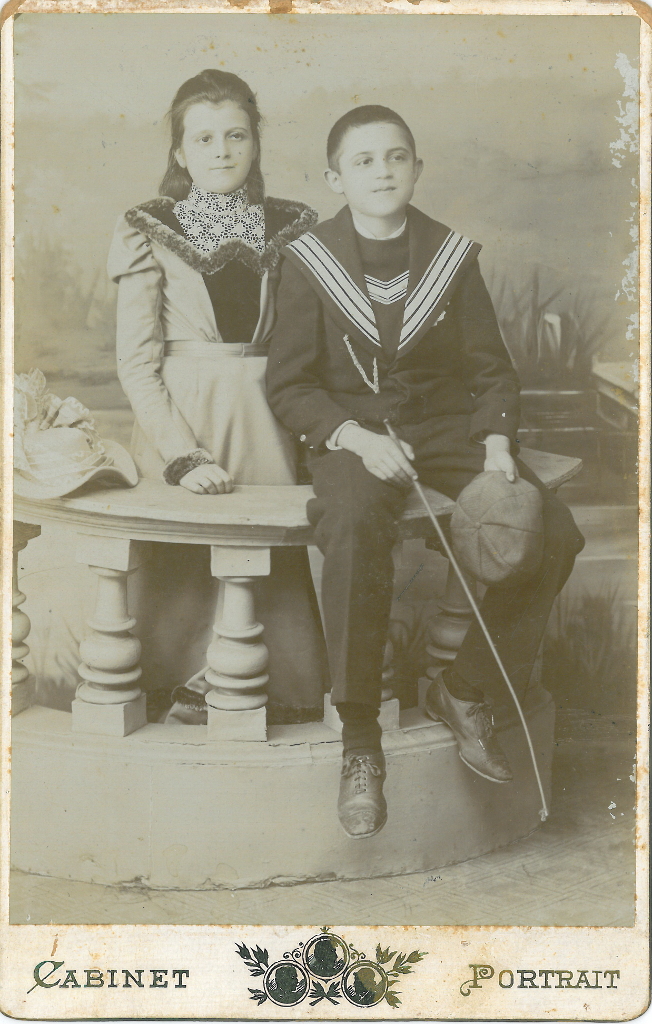
George and Thetis believed to have been taken in Greece (photograph courtesy Emmanuel Olympitis)
George and Thetis believed to have been taken in Greece (photograph courtesy of Emmanuel Olympitis)

Irini and Augusta left Gümüşlük to meet Paton and the boys in Kalymnos. Irini was heartbroken to leave the home where she’d been so happy. She was never to see the house again.

The family came together again in the Olympitis house on the quayside of Pothia in Kalymnos, where they celebrated Christmas 1905.

Paris

Thetis believed to have been taken while in France
Thetis believed to have been taken while in France (photograph courtesy of Emmanuel Olympitis)

But, for the ever-driven Paton, time was dragging in Kalymnos and, early in 1906, he uprooted the family in favour of the Parisian suburb of Viroflay, near Versailles.  There, Irini and Augusta learned French and made friends. Irini was happy that she could go to the church of St. Julien le Pauvre  note 3 . They were content with life in Viroflay.

Brittany

But, once again, Paton moved them on, this time to a villa by the sea on the coast of Brittany at Peros Guirec. Irini was never happy in the period she spent in Brittany.

A sad, sad ending

It was in Brittany that the first signs of Irini’s illness appeared; she was often in great pain. One of her kidneys was damaged and had to be removed. In October 1908, she was admitted to a hospital in Paris where the successful operation was carried out. Irini was free from the pain she’d suffered.

The day came to leave the hospital and Irini’s best friend, Delphine, was helping her to dress amid happy laughter while Paton was pacing around outside in the corridor. Suddenly Irini clutched at her chest and said in Greek ‘Pono’  note 4 . She collapsed into Delphine’s arms and died. She was 38 years old. Paton ‘went quite beserk’ and ripped his shirt to shreds in his uncontrollable grief.

William Paton in later life on Samos, (c) Endre Kemeny

The fairy-tale romance had ended. Paton was 51, George 22,  Thetis 21, John 18, and Augusta just 8. Irini had been the source of all the love that had brought happiness to Paton and the family since that first vision of her, all those years ago, in a tiny boat bobbing on the waters of Pothia Bay. William Paton was a broken man.

 
Mabel’s diary entries are taken from the book The Travel Chronicles of Mrs J Theodore Bent Volume I. ©2015 Gerald Brisch and Archaeopress. Reproduced by kind permission. Get the book or download the e-book.

● The author wishes to thank Emmanuel N. Olympitis for his enthusiastic assistance in providing material and invaluable information for this article.

● The author wishes to thank William Paton, Paton’s great-grandson, for his suggestions and contributions from the family archives.

● Some of the material for this article was derived from the autobiography of Augusta Paton (Kemény), William and Irini Paton’s daughter. The autobiography is currently available only in Hungarian. Read a short biography of Augusta Paton.

● The images used in this article may be subject to various copyright restrictions.

Notes

Note 1: O Lordos – literally ‘the Lord’ – used to describe a gentleman of high status.
Return from Note 1

Note 2: O Ouiliermos – The transliterated Greek phonetic spelling of ‘William’ with the masculine nominative ‘os’ ending added.
Return from Note 2

Note 3: St. Julien le Pauvre is actually a Melkite Greek Catholic church which has its roots in the same beliefs and rites as the Greek Orthodox Church.
Return from Note 3

Note 4: Pono (Πονώ) – I have pain.
Return from Note 4

Over the rainbow with the Bents

Ships played a central role in the lives of the Bents; they were as familiar and essential to the couple as planes and airports are to us.

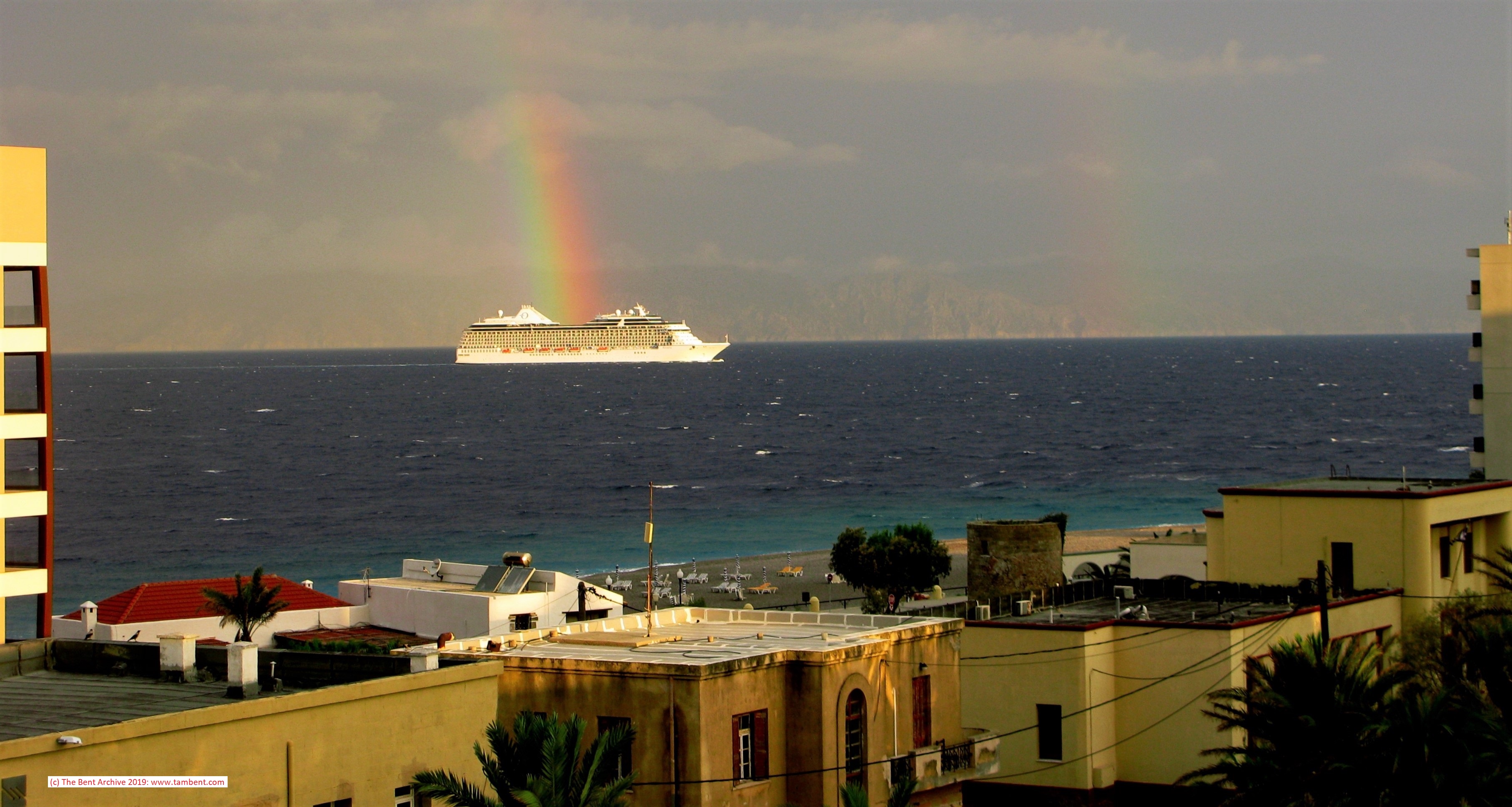
The Oceania cruise ship ‘Riviera’ shown in the rainbow (the photograph was taken from Rhodes, looking northish, and roughly from the area (‘Kum Burnú’) the Bents had their modest lodgings).

So let’s steam, then, into 2019 along one of the Bents’ favourite waterways – the narrow straits separating Rhodes from Marmaris and the Turkish coast – only the vessels they travelled on in their time were a little different than the Oceania cruise ship ‘Riviera’ shown in the rainbow (the photograph was taken from Rhodes, looking northish, and roughly from the area (‘Kum Burnú’) the Bents had their modest lodgings, in early 1885, being not allowed, as Christians, to overnight in the Old Town).

Mabel notes in her diary: “We are at a clean little inn in the separate village called Neo Marás, the Christian quarter quite close to the sandy and windmilly point Kum Burnú at the north of the isle. It is quite a little walk to the town where no one but Jew or Turk may remain after sun set… There are quantities of smooth black and white shingles which are extensively used for paving floors and court yards in all sorts of designs. The passage outside our door and the dining room too have very pretty patterns.” (‘The Dodecanese; or Further Travels Among the Insular Greeks’, Archaeopress 2015, page 108).

In early 1885, Theodore and Mabel Bent arrived in Rhodian waters, via these extended straits in the photograph, from Alexandria, on the Austrian Lloyd ‘Saturno’ (1845 tons, built in 1868, in service until 1910), and left a few weeks later on the much smaller steamship ‘Ρούμελη’ (297 tons, 155 feet), which linked the smaller islands of the eastern Mediterranean. Originally named ‘Operculum’, and Clyde built, she comes into view several times in Mabel’s diary pages. She was ultimately broken up at Savona in 1933, a few years after Mabel’s death. In another twist of fate, the ‘Operculum’ also covered the South Arabian seas between Aden and Socotra, the setting for one of the last journeys Theodore Bent was to make, in early 1897, months before his death. How wonderful these old ships were, although Mabel was not so fond of this one:

Well! The Roúmeli is a dirty little ship, and Theodore and I slept in the very smelliest cabin, destined for ladies by the English builders. As it was a passage room for all the passengers a quilt was hung across, but the steward was often within our side. At 11.30, two hours after we left Rhodes, we reached Simi and in the dark and by starlight I could see that we remained in a little land-locked bay for 2 or 3 hours. It looked lovely but no doubt by day it looks bare enough and like Chalki, which we got to about 7, a most hideous island, stony like Syra and not even the picturesque town to redeem it. We did not land there; there is a revolution about the tax on sponges and the Pasha of Rhodes was just going there so we came on to Nisiros, which we reached about 12.30.” (‘The Dodecanese; or Further Travels Among the Insular Greeks’, Archaeopress 2015, page 111).

All together, the Bents sailed over the rainbow here in these waters, between the tip of Rhodes and Marmaris, at least five times – check them out via the interactive map on our site.