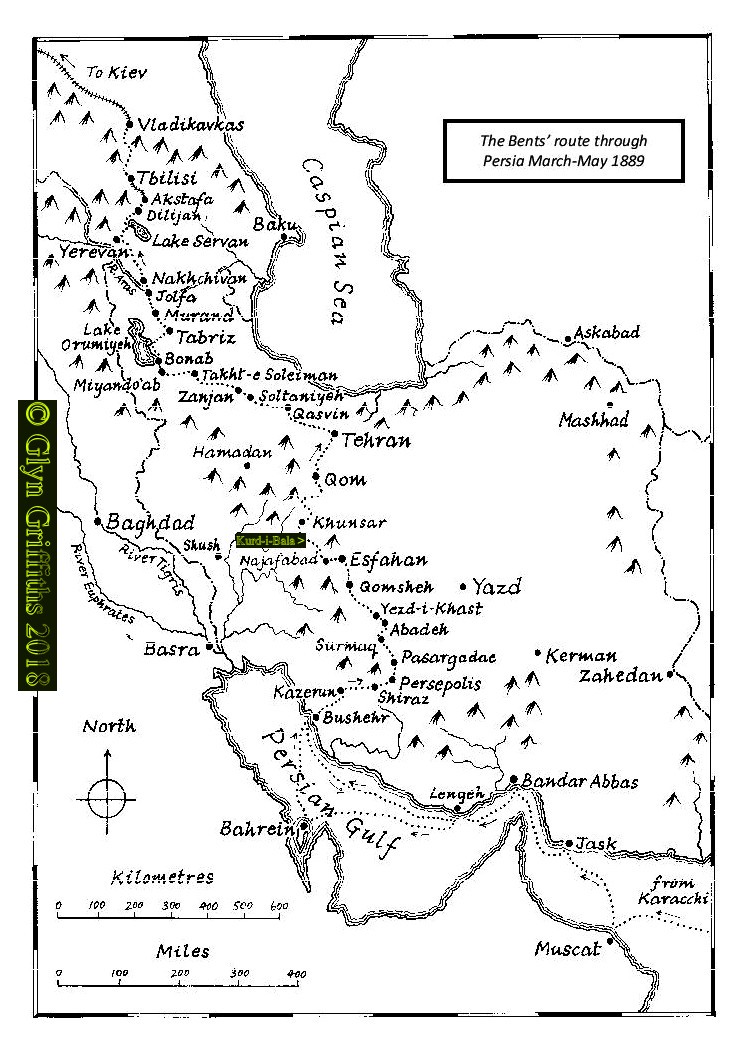
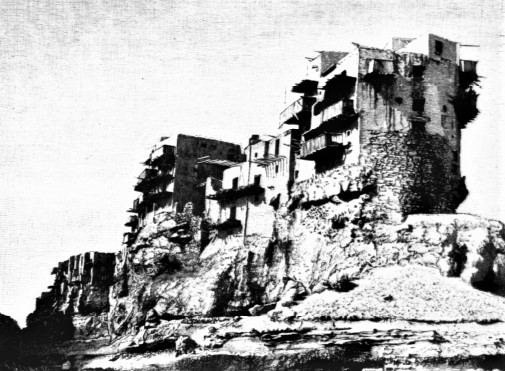
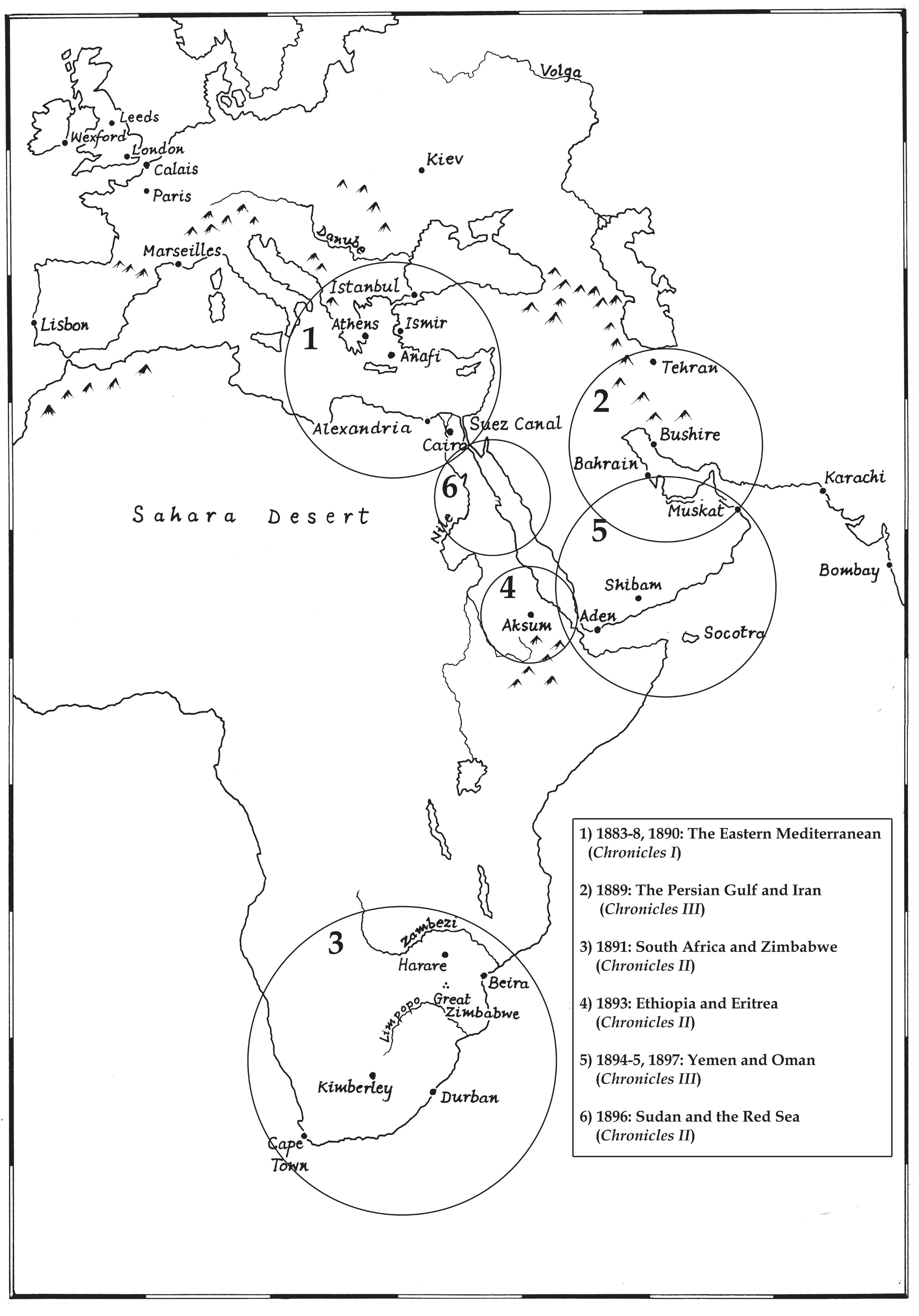
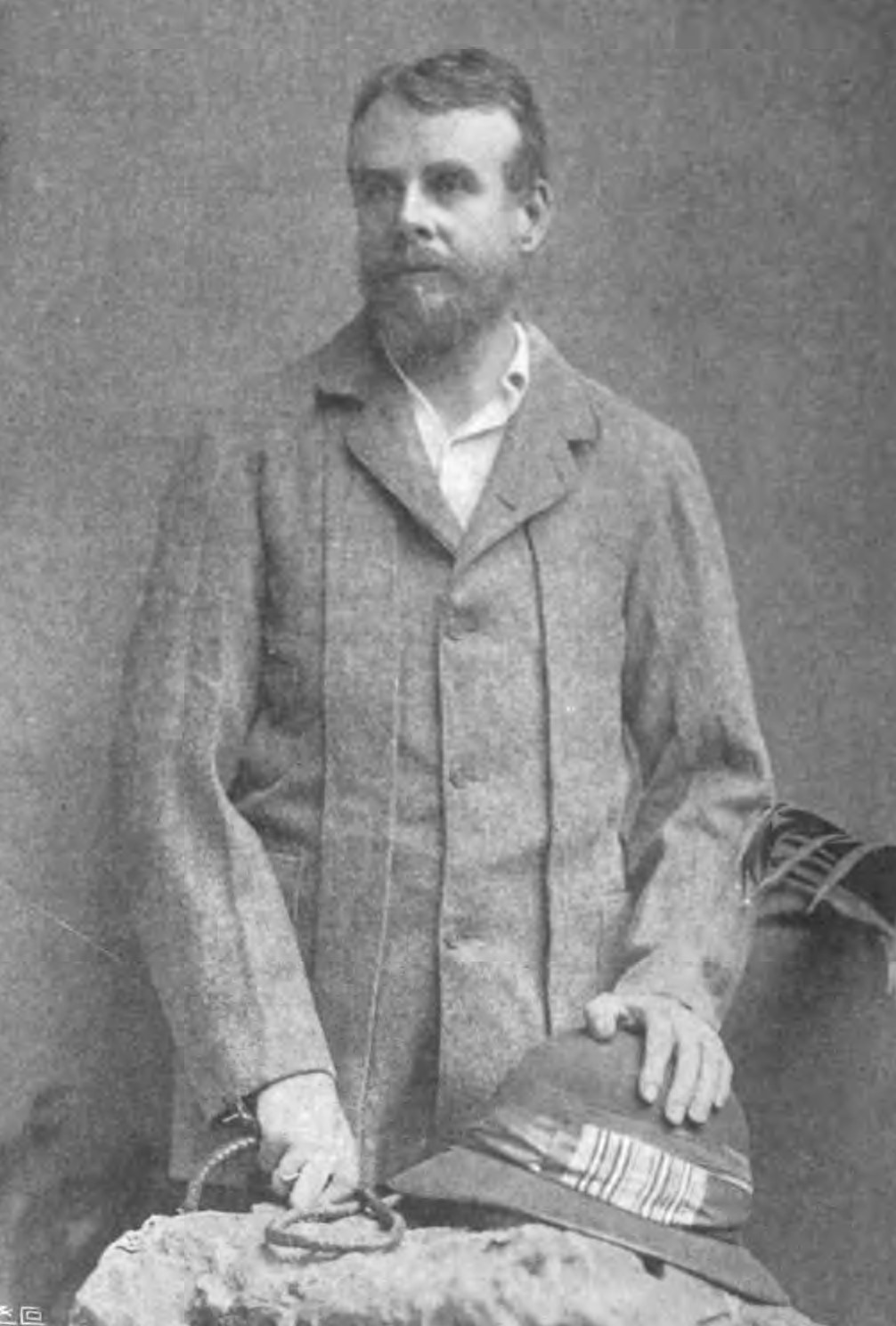
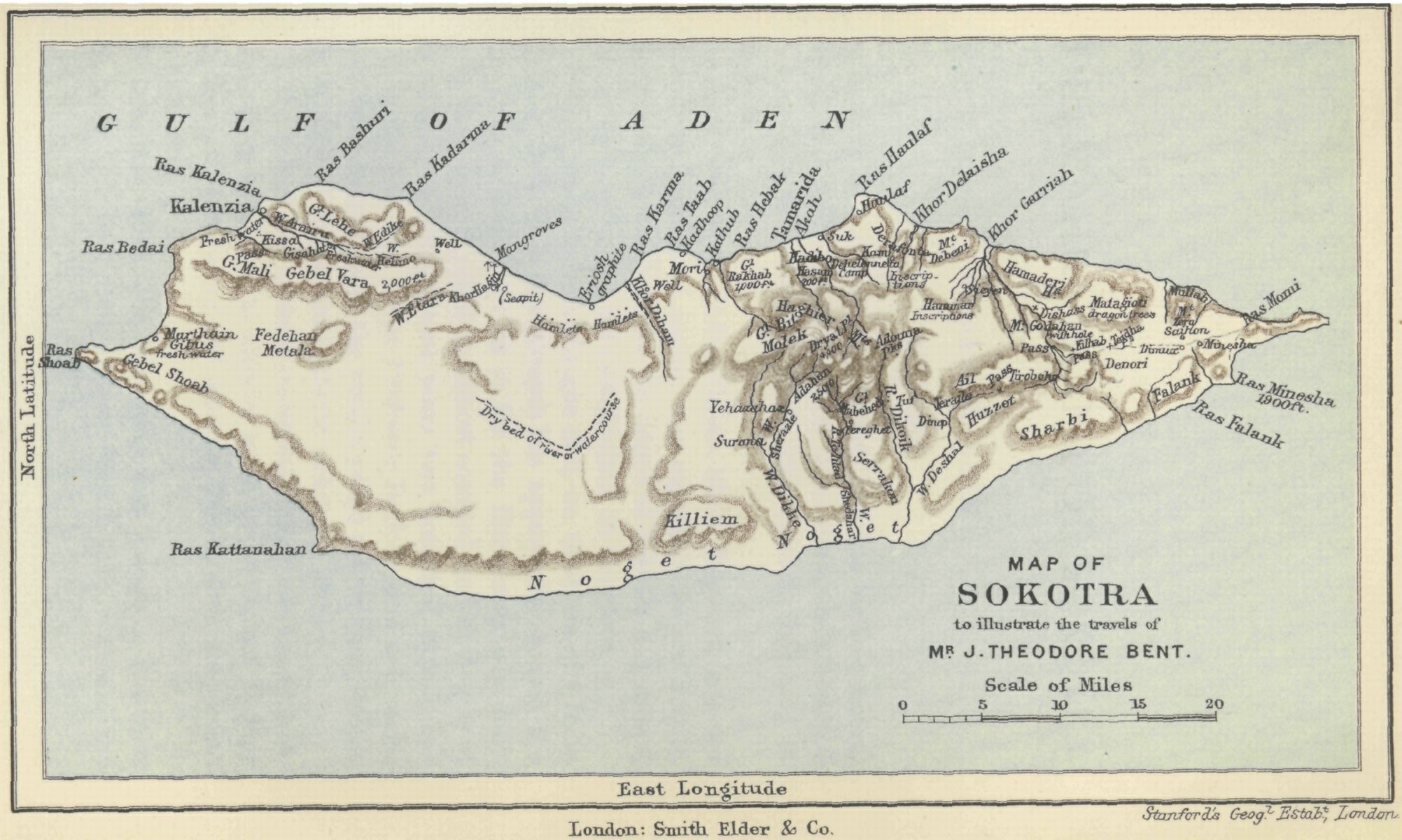
While travel for some in ‘Persia’ is still clearly so precarious, why not ride instead, south-north through Iran, with the Bents – on mules, ponies, camels, oxen, and in assorted carts and carriages?
Announcing: “‘Then and there’ – Theodore and Mabel Bent in Persia, 1889″ (forthcoming 2026)
Extracts will appear from time to time on this page
Mabel’s pond at Manzaria/Manzarieh, 30 km north of Qom, Iran (Google Maps).
Mabel writes in her Chronicle: Tuesday, 9 April 1889, Manzaria/ Manzarieh, 30 km north of Qom [34.89018460145364, 50.82060309976168]: “After this, let me say that we had a very pleasant afternoon of peace and contemplation of a round pond with a stone coping on which numerous travellers sat on their heels for hours and hours like so many big frogs just got out of the water…”
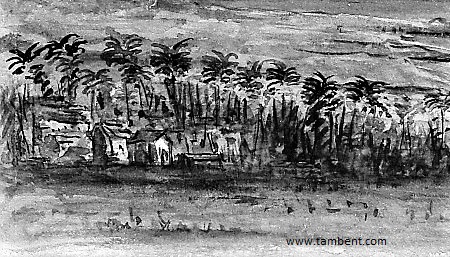
Bent’s imaginary sketch of ‘Old Basil’ (The Bent Archive).
“‘Why Old Basil Became a Monk’, by J. Theodore Bent, with illustrations drawn by E.H. Edwards, from Sketches by the Author, engraved by Del Orme and Butler” (being Bent’s fanciful story based on a picnic on Karpathos (1885), published in The Hour Glass, Vol. 1, March 1887, pp. 79-84).
The text and images here are from original 1887 material in the collection of the Bent Archive. The article has never appeared online before. You are free to reproduce the text here, which is our transcription, but are requested to acknowledge us – “Transcription: the Bent Archive, April 2025”.
(Some context: The celebrity explorers Theodore and Mabel Bent made a tour of some of what are now called the Greek Dodecanese islands in the Spring of 1885, inspired by the results of their travels in the Cyclades between 1882-1884. Their first stop was Rhodes, arriving from Alexandria, then there were short visits to Nisyros and Tilos before their extended stay on Karpathos. It will be Bent’s voice you hear next…)
Google map of Karpathos in the Greek Dodecanese. The arrow shows the general area of the Bents’ picnic in March 1885 (Google Maps).
HALFWAY BETWEEN CRETE AND RHODES lies a thin, attenuated island called Karpathos, unknown to travellers, unvisited; its inhabitants are semi-barbarous Greeks, rich only in their inheritance of superstitions; amongst them my wife and I spent three Spring months digging for antiquities and studying folk-lore. Nominally, Karpathos is governed by a Turkish official and a few soldiers; in reality each village governs itself, holds its own parliament in its own church, and the nominal rulers never interfere with this autonomy; for Karpathos is nigh unto Crete, and in consequence revolutionary.
It is a very lofty and lovely island, but the choicest spot of all is a gorge down by the sea called, from a church which is built therein, the gorge of Mrs. All-Holy, or of the Virgin Mary, as we call her in Western Christendom; this church is looked after by a monk called Basil, a very old tottering anchorite, whom we visited together with the Turks one day on muleback. The narrow gorge is clad with fir trees as it ascends the mountain, and with rank vegetation, myrtle, mastic, oleander, maidenhair, all closely interwoven as it approaches the sea; fantastic rocks peep out from amongst the verdure, and the rippling waves of the blue sea wash a narrow beach of silvery sand, just below the Virgin’s church. This church is Basil’s sole charge; at stated hours he rings the bell and chants the services with none to hear him; he takes care that the ever-burning lamps before the sacred pictures do not go out; three times a year he covers the edifice with whitewash; he lives on a few herbs, which he cultivates close around his cabin; he is a monk and hermit combined. Once a year the pious Karpathiotes come to this spot on a pilgrimage, and make merry on the shore; for the rest of the time old Basil lives there alone; for severe affliction has severed him for ever from the joys of this life; his only consolation now is the rigorous asceticism of solitary monastic life.
The church of Kyra Panagia, Karpathos (Alan King).
When we and our polyglot companions reached the gorge, old Basil was much bewildered; he stood at his cabin door, leaning on his staff, and silently inspected us as he crossed himself, then he stroked his long white beard and bade us welcome. His dress was that of a working monk, tattered and torn; his tall hat, which once was black, was now brown; his coat, which once was blue, had now much of the colour of earth about it; his pantaloons, which were tied round his knees, were of doubtful colour; his legs and feet were covered only by many sores. We entered his cabin, the furniture of which consisted of his bed of leaves, his basket of stale bread, his jug of water, a wooden stool, a few sacred pictures; beyond these he neither possessed nor wished for other worldly goods.
“We washed down our lamb with cream and generous wine ‘like the brigands of the mountains’…..” (Lamb ‘kleftiko’ from Wikipedia).
Despite the austere supervision of the monk, our al fresco meal was a great success. An Albanian soldier, whom the Turks had sent round by a mountain farm for a lamb, was our cook. We saw our victim slain and skinned; we watched it pierced with a new-cut wooden skewer, and with impatient eyes we looked on whilst it revolved before a smouldering fire of brushwood, for the process of basting with cream and salt produced such exquisite sensations on our nasal organs that our appetites became painfully keen. When ready, a table of sweet smelling herbs was spread, around which we squatted on our haunches, and no pressing was needed to induce us to take in our fingers the proferred [sic] joints; and I must candidly admit that the barbarous process of gnawing produced far more real enjoyment than the most exquisitely served repast of western civilization. We washed down our lamb with cream and generous wine “like the brigands of the mountains”, suggested our Albanian and we privately congratulated ourselves that it was unaccompanied by sensations which must spoil the repast of those who are compelled to eat thus against their will.
Old Basil, though at first affecting to despise our mundane appetites, was at length persuaded to drink from our gourd of wine; his eye grew brighter, the strings of his tongue were unloosed, and though we had heard his story from the villagers, we could not resist asking him to renew for us his tale of unutterable woe, and in acceding to our request he introduced us to many interesting glimpses into the inner life of these wild islanders.
Page 1 (p.79) of Bent’s 1887 ‘Old Basil’ article (The Bent Archive).
When young, Basil, like most men on Karpathos still do, had travelled far during the summer months in search of work, he had visited many of the coastal towns of Asia Minor, he had fought in several Cretan rebellions, and each winter had returned to his home. Being thrifty, and not without personal attractions, he was recognised as a desirable husband by the parents of one Penelope; he married, and in due course became the father of two sons and one daughter – Agape by name. Every summer he was absent, and every winter he spent with Penelope and his children, until the sons were old enough to go and earn their living abroad; and on Penelope’s death old Basil determined to stop at home and till his property, which he had got as a dower with his wife, and which was to be Agape’s portion when her turn came to marry. There is a curious, and very ancient, custom existing still in the remote Greek islands; the eldest daughter inherits everything, to the exclusion of her brothers and younger sisters. Agape would not only have her mother’s house and property, but her mother’s embroidered dresses, her mother’s grave in the churchyard, nay, even her mother’s slab in the church, on which she had inherited the exclusive right to kneel. This survival of a matriarchal system is productive of two evils, an enormous proportion of old maids, and an ambition to secure for the heiress a grand match; fathers and mothers to gain their object, will often leave themselves and the rest of their family in abject poverty, for the sole gratification of being able to speak amongst men of their daughter, the school-master’s wife, or of their son-in-law, the captain.
Page 2 (p.80) of Bent’s 1887 ‘Old Basil’ article. The illustration is based on a sketch by the author (The Bent Archive).
Basil shared with the other parents of Karpathos this keen ambition; by his private earnings he had greatly increased and improved his property; he was the owner of a farm on the mountains, and many flocks; all these, in addition to her mother’s portion, he carefully advertised would belong to Agape when the right man should come. As a natural consequence of this advertisement the right man was not long in coming, and what was more, he came from a rich neighbouring island called Chalki. He was a well-to-do sponge-fisher, “a man of substance, and the owner of a caique”, said old Basil, with the fire of his former ambition still lurking in him; his face was animated, and his gesture very unlike that of a monk anchorite, as he related to us the great triumph of his life, the marriage of his daughter.
Page 3 (p.81) of Bent’s 1887 ‘Old Basil’ article. The illustration is based on some sketches by the author (The Bent Archive).
He gave us a lively account of the wedding and its old-world semi-barbarous functions; nothing he had ever seen before exceeded the lavish waste of rice and comfits which the bystanders threw at the young people when the priests chanted the “Crown them in glory and honour” and the “Esaias dances”; and the gifts brought by the relatives, “the crowning gifts” as they call them, were exceedingly numerous, and doubtless by comparison costly, consisting, as is the custom there, of sheep, goats, honey, cheese, and other edibles for the wedding feasts; and for the space of eight days the village where Basil lived was the scene of continued dissipation.
Page 4 (p.82) of Bent’s 1887 ‘Old Basil’ article (The Bent Archive).
He entered very fully into the captain’s folly in not conforming to certain well-recognised superstitious customs, which brides and bridegrooms in Karpathos must attend to if they wish their married life to be a prosperous one. Before three days had elapsed, the captain actually dared to jump over a stream, and laughed at the old women who predicted that he would suffer from the baneful smile of the water nymphs, Nereids, as the Greeks still call them. Regardless of any warning, he insisted on pruning the vines and trees on his newly-acquired property before the lapse of the customary cessation from such labour for forty days after marriage, and furthermore by a promise of reward he had induced Basil’s two sons to assist him in this work.
“He was”, added Basil to extenuate his son-in-law’s folly, “a world-travelled man, and we world-travelled men are foolishly apt to scoff at ancestral traditions.”
The captain evidently cared but little for his wife’s relations; he must needs set off home with Agape to Chalki before the expiration of the mysterious forty days; the expostulations of the old women were in vain – even the wedding decorations were taken down hurriedly without a priestly blessing, and Basil told us how he parted from his daughter with a heavy heart, fearing misfortune, yet not liking to give expression to his fears.
After the lapse of a few months he visited his daughter in her new home; he told us much concerning the comparative grandeur of Agape’s house, almost anything would look grand after a Karpathiote hovel; she had glass in her windows; she had wooden floors, instead of pressed manure; she had in fact what old Basil generalised at the end of his catalogue by the one word “civilization”; and the summer passed at Chalki, whilst his sons were away, must have been to Basil the brightest speck in his long life ; and I imagine that, on his return to Karpathos, he must have been insupportably arrogant concerning his daughter’s magnificence, for even now, monk anchorite that he is, he cannot check his tongue when once loosened on this subject.
In the autumn the captain and his wife visited Karpathos, to gather in the vintage and other products of their property; and it was during this visit that the fatal compact was made between Basil’s two sons, Andrew and Paul, and their brother-in-law; they were to join him in his sponge-fishing expedition in the summer, instead of going to Smyrna in search of work; by this means both parties would be benefited, money would be kept in the family, and, as usual in Karpathos, the winter passed in revelry and idleness.
One day, early in May, news came that the captain’s caique was approaching Karpathos; so Basil and his two sons hurried down to the little harbour to greet their distinguished kinsfolk; a proud moment it was for the old man when the craft arrived, and his fellow-islanders with wondering eyes beheld the diving apparatus and improved fishing-tackle with which the captain’s caique was furnished; in poor benighted Karpathos there are no sponge-fishers, for they have no capital, hence these things were new to them; the captain was the hero of the hour, and much reflected glory fell on old Basil’s head.
After a few days of festivity and farewells, the three sponge-fishers started on their way, and Agape and her father went up to their home in the mountain village to pass the weary summer months, as best they could, and it was well on in the month of August before the blow came; old Basil was sitting basking in the sun, Agape was twirling her spindle and gossiping with her neighbours, when a messenger came to say that a Turkish steamer was in the harbour and that old Basil was wanted without delay.
Scenery around Kyra Panagia today. The path taken by the Bents would have led them through this wooded valley… (photo: Jennifer Barclay)
“I could not imagine”, said the old monk, “what the Turks could want with an old man like me; surely they did not intend to punish me for my participation in Cretan rebellions; and with terrible suspicions of some impending evil, I was rowed to the steamer and ushered into the captain’s cabin with an interpreter, who seemed to enjoy my anxiety, and to delay as much as possible arriving at the facts. ‘Is this the old man Basil?’ asked the captain, ‘the father of the young men?’ and from this I knew that it was about my sons I had been summoned, and my heart sank within me. Then they talked low and hurriedly for some time, and all I could gather with my slight knowledge of Turkish was that something terrible was going to be revealed to me. I could only pray to the All-Holy one for support.”
At this juncture the poor old monk’s voice grew shaky, and he wept a little; we felt rather sorry for having asked him to renew his grief, but then we could give him sympathy, a soothing antidote to woe, which must be rare in his dreary solitude. “How I was told I don’t remember”, continued he; “after some time I awoke as from a painful dream; I found myself lying on deck on a mattress, and on raising my head I saw that we were steaming past the northern promontory of Karpathos. I was alone, amongst the Turks, going I knew not whither. I had no means of asking if the horrible tale which forced itself on my recollection was true, yet I gradually felt sure that it was – that my three brave sons were dead – that my daughter was a widow, and that death had come upon them in a form which makes me shudder now every time I think of it, and every night I fancy to myself some new and horrible picture of the event which, though I never saw it, is more vividly before me than anything I have ever seen.”
Page 5 (p.83) of Bent’s 1887 ‘Old Basil’ article. The illustration is based on a sketch by the author (The Bent Archive).
Upon this Basil grew very rambling and very heart-broken, poor old man – so I will relate in fewer words than he did the events as they happened. The three fishermen had been very successful; they had sold, to merchants in Kalymnos, their sponges, and were starting again in quest of further gain, when a boat overtook them, manned by eight men from the island of Amorgos, one of the last strongholds of petty piracy in these seas; these men had learnt in Kalymnos that the three men had money with them, and looked upon them as a desirable prize. Basil’s son-in-law was shot dead whilst attempting to offer resistance; the pirates boarded his caique, and after transferring everything of value to their own, they tied Basil’s two sons to the mast, scuttled the boat, and left the two young men to be swallowed by the waves. Another fishing boat, which chanced to be near, having witnessed this wholesale murder and robbery, hurried back to Kalymnos and gave notice to the authorities; divers were sent to verify the account; the dead bodies of Basil’s two sons were recovered and conveyed to Kalymnos, whilst, with a promptitude unusual in Turkey, a government steamer was summoned by telegram from Chios, and the pirates were captured. Such was the story that old Basil learnt on the steamer which conveyed him to Kalymnos to identify the bodies of his sons; as for the captain, Agape’s husband, his remains were never found – he never received consecrated burial.
Page 6 (p.84) of Bent’s 1887 ‘Old Basil’ article. The bizarre illustration is possibly by the author from another source (The Bent Archive).
Sad and sick at heart, after burying his two sons at Kalymnos, old Basil returned to Karpathos, where scenes of lamentation and death wails served doubtless to render his grief more poignant; and there is something more especially melancholy in the wails that these islanders hold in honour of the dead who have died [away?] from home; though the corpse is not in their midst, as is usually the case, the hired mourning women and the relatives think it a duty incumbent on them on such occasions to indulge in more heartrending dirges, and to tear their hair and lacerate their faces and arms with the greater vehemence. These deathwails [sic], too, last for forty days; every day the mourners meet for an hour or so to give way to their extravagant grief; again and again are the virtues of the deceased recorded; again and again is the loneliness of the survivors pitied – and I feel sure that poor old Basil had many genuine sympathisers, for his bereavement was bitter indeed. The sentiment of having the remains of the departed reposing near is not much felt in Greece, for after the lapse of a year the coffinless body is always exhumed, and the bones, tied up in an embroidered bag, are consigned to the family charnel house. When we were in Karpathos, owing to heavy rains, many of these private bone-houses were in ruins, and never shall I forget the ghastly spectacle afforded by the deceased family of the chief priest – his parents, his cousins, his sisters, and his aunts were all rolling about in grim confusion around the ruins of the bone-house; this painful sight, at least, old Basil was spared.
The listing of Bent’s ‘Old Basil’ article in the March 1887 issue of ‘The Hour Glass’ (The Bent Archive).
By degrees, from Agape’s heart the grief soon fled, a grief which, perhaps, if the truth were known, had its alleviations. In twelve months after the loss of her husband and brethren, she listened to the wooings of another lover, from another island, who carried off his bride without festivities, and without her father’s blessing, but with the same ample dower that had won for her the captain from Chalki. On her departure old Basil’s cup of bitterness was full. Alone in the world and bereft, he sought the kindly solitude of the secluded gorge, where, shut off from the world by a screen of mountains, he could devote himself to asceticism for the brief period of life that still remained to him.
As evening was coming on, we quitted old Basil; we did not insult his feelings by offering him the remnants of our feast; we simply left them to his discretion, and we hope his comfort.
………………………………………………………………………………………
Vol. 1 of ‘The Hour Glass’, 1897, in which Bent’s article appears. In a competitive market, it lasted a year (The Bent Archive).
The above, obscure article by Theodore Bent appeared in The Hour Glass in March 1887. It is one of his more fictitious pieces, perhaps based on some tales and customs (including funeral rites) he heard in the islands: research in the media of the time might turn up an account of the murders related. Mabel makes no mention of the monk Basil/Vasili in her charming chronicle describing the picnic – which did take place in March 1885 and tallies with Theodore’s setting (and elaboration to include ‘Vasili’) in his later, extended, account of the couple’s stay on the island (‘On a far-off island’. Blackwood’s Edinburgh Magazine, Vol. 139, Feb. 1886, pp.233-44). For Mabel’s first-hand account of Karpathos, see The Travel Chronicles of Mabel Bent, Vol. 1, 2006, Oxford, pp.85-6).
Bent was remunerated for his stories in the popular journals (e.g. Blackwood’s Magazine) for which he wrote, and this may explain why he decided to expand the ‘Old Basil’ idea. Perhaps he had had positive feedback on the episode from third parties. Perhaps over the summer of 1886 (or earlier) he was aware of the proposed new Hour Glass magazine and made his submission (including his sketches) in time to proofread it before leaving for the Eastern Mediterranean in the last week of January 1887. Given how busy he was with all his other ‘serious’ publications, lecturing, and preparing for the next expedition, he obviously took pleasure in giving his imagination free rein now and then, taking time off from his more academic pursuits. (Some of Bent’s other fanciful pieces are listed below.)
The final page (p.84) of the original article shows a bizarre engraving of a (Western) monk, perhaps by Bent (a monogram bottom right ‘JTB’ ?) or another artist (The Bent Archive).
The three illustrations in the piece are based on Bent’s Karpathos sketches – he was never without his sketchbook and there is no end of references to his art in Mabel’s notebooks. In the village of ‘Mesochorio’ (Mesochori) we know that Theodore drew a likeness of Papas Manolis (or Manoulas) and, who knows, perhaps he presented this to the Hour Glass as ‘Old Basil’ and it is his likeness we see at the top of this present article? Where the originals are is unknown, but unpublished albums of Bent’s sketches are hidden away in Ireland and Zimbabwe, hopefully to appear in public one day. The person responsible for interpreting Bent’s sketches was E.H. Edwards, who does not seem to appear online; the engravers, however, are the well-known partners Del Orme and Butler. The final page (p.84) in the original has a bizarre engraving of a (Western) monk perhaps by Bent (a monogram bottom right ‘JTB’ ?) or another artist.
The Hour Glass was gone in the time it took for the sand to run through it: it lasted 12 months. The new periodical was announced in December 1886: “Ready in a few days, ‘Hour Glass’; threepence monthly. The new illustrated magazine contains short articles by the best writers on topics of the Hour…” (The Globe, Friday, 10 December 1886). Bent’s issue (March 1887) was advertised, inter alia, on 28 February (Freeman’s Journal and The Globe) and again on 4 March (The Globe).
The publishers took pride in its low price, 3d, and it seems, ultimately, that the sums just didn’t add up.
Among Bent’s other Greek ‘fictional’ articles are:
Happy Birthday greetings to celebrity explorer Theodore Bent (30/3/1852, d. 1897), who just so happens to share the day with one Vincent Van Gogh (30/3/1853, d. 1890), who, of course, had a brother called Theo…
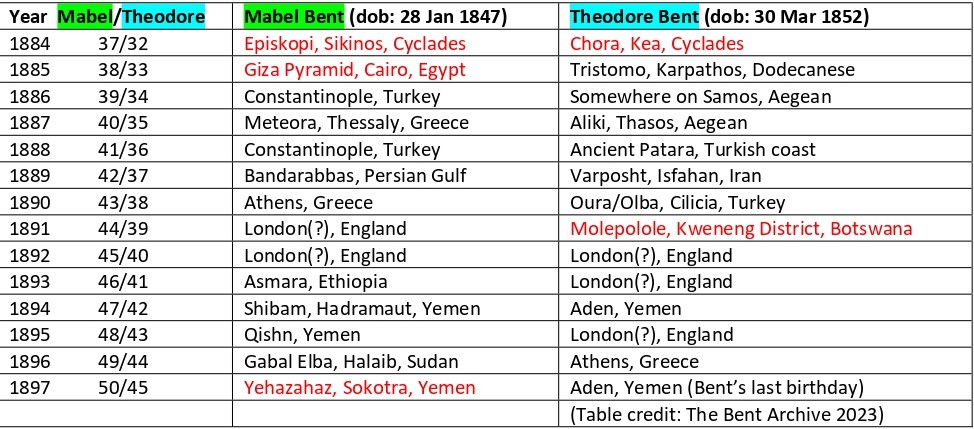
The trouble with travel … is that you miss your birthdays – just look where Theodore was on 30 March for these frantic years of the Bents’ travels together: 1884 = Kea (Cyclades); 1885 = Karpathos (Dodecanese); 1886 = Samos; 1887 = Thasos; 1888 = Patara (Antalya province, Turkey); 1889 = Kurd-i-Bala, Iran; 1890 = Mersin area, Turkey; 1891 = en route for ‘Great Zimbabwe’; 1892 = UK; 1893 = Aksum area, Ethiopia; 1894 = Aden, Yemen; 1895 = UK; 1896 = returning from Athens to UK; 1897 (his 45th and last) = Aden, Yemen.
As an example of what he was up to, we have this extract from his notes of 30 March 1889, written up and presented a couple of years later. Taken from Theodore and Mabel’s cavalcade through Iran, south-north, we have Persia with all her fascination; it is written in his best, jaunty style: illustrative, informative, energetic, engaged and engaging. Classic Bent.
“Certainly, Persia, off the main line of route, is as different as possible from the Persia that the ordinary traveller sees. For two days after leaving Nejifabad we passed through villages nestling in fertility. Each village is, or rather was, protected by its mud fort, built on a hill, around which the cottages cluster – cottages which dazzle the eye with their continuity of mud domes and brown walls. Wapusht looked like a nest of cottage beehives stuck together. Within, the houses were comfortable enough, and bore every appearance of prosperity, for here they are off the routes which soldiers and governors of provinces pass over, and when free from Government extortions Persia prospers.
“On ascending to higher ground we came across a cold and barren district; the howling wind from the snow mountains made us again love those furs which we had considered unnecessary burdens when leaving Ispahan. These sudden changes of temperature are the bane of the Persian traveller, and woe to those who are not provided with artificial warmth. On reaching Kurd-i-Bala [March 30, 1899. The settlement is near modern Varposht, n-w of Najafabad], the first of the manna villages, we found ourselves in Armenian society. Of late years the Armenians in Persia, by foreign intervention, have had their condition greatly ameliorated, and if this state of things is allowed to continue they are likely once more to become the most prosperous of the Shah’s subjects. I was glad enough to warm myself by taking a brisk walk on reaching our destination, and accepted gladly the offices of the Karapiet, the Reis or headman of the village, and our host, who volunteered to take me up the mountain side and show me the manna shrub.
“In the fields around the village the Armenian women were tilling the ground. On their heads they wore tall head-dresses, with flat crowns and silver chains dangling therefrom – very uncomfortable gear for purposes of husbandry – and beneath their bright red skirts peeped drawers with embroidered edges. Armenian women hide only the lower part of the face, deeming it unseemly that the mouth should be shown to members of the opposite sex.
Bala khana at Yezd-i-Khast. Etching by H. Gedan, based on a Persian photograph by Mabel Bent, in J. T. Bent’s article ‘New Year’s Day in a Persian Village’. ‘English Illustrated Magazine’, 1890, Vol. 76 (Jan), 326-31 (private collection).
“Kurd-i-Bala is a great village for manna, the ‘gez-angebeen’, as the Persians call it. About twenty minutes’ walk brought us to a gorge in the mountains where acres of the shrub grow. The ‘gez’ tree is a low and parasol-shaped plant of the Tamarisk tribe, never reaching more than 3ft. in height; its leaves are small and sombre in colour, and it has all over it long prickly thorns. On these leaves there comes a small insect, which is red at first, like a harvest bug; later on it turns into a sort of louse, and finally becomes a tiny moth, which, before it flies off, produces a thin white thread, about half an inch long, which hangs on the bushes. This is the manna collectors shake off on to trays, which are put below for the purpose, and the material thus collected they call ‘gez’. They say the insect appears fifteen days before the hot weather begins, and disappears fifteen days before the cold season sets in. Every third day during a term of forty days about August they collect this species of honey from the trees, which forms itself into a white gelatinous mass, and the leaves become covered again with surprising rapidity…”
(From: J. Theodore Bent, Village Life in Persia, ‘The New Review’, 5:29 (1891/Oct.): 355-359)
Happy birthday Theodore!
A review of Bent birthdays based on Mabel Bent’s Chronicles, 1884-1897
The accompanying interactive map below plots these birthdays: Mabel in green, Theodore in blue. (NB: London [13 Great Cumberland Place] stands in for unknown locations in Great Britain; the couple could have been away visiting family and friends in Ireland or England, including at their property ‘Sutton Hall’, outside of Macclesfield.)
There were 28 Bent birthday events (2 x 14) between 1884–1897 (the years covered by Mabel Bent’s diaries). Of these 28, only 5 (18%) were not spent in the field, and only 7 times (25%) does Mabel refer to a birthday in her notebooks directly. In the above Table, column 1 gives the year and ages of the Bents on their birthdays; columns 2 and 3 give their birthday locations. Events in red are when Mabel refers directly to their birthdays. ‘London’ is standing in for unknown locations in Great Britain. If not at their main residence (13 Great Cumberland Place), the couple could have been visiting family and friends in Ireland and England, including at their property Sutton Hall, outside of Macclesfield.
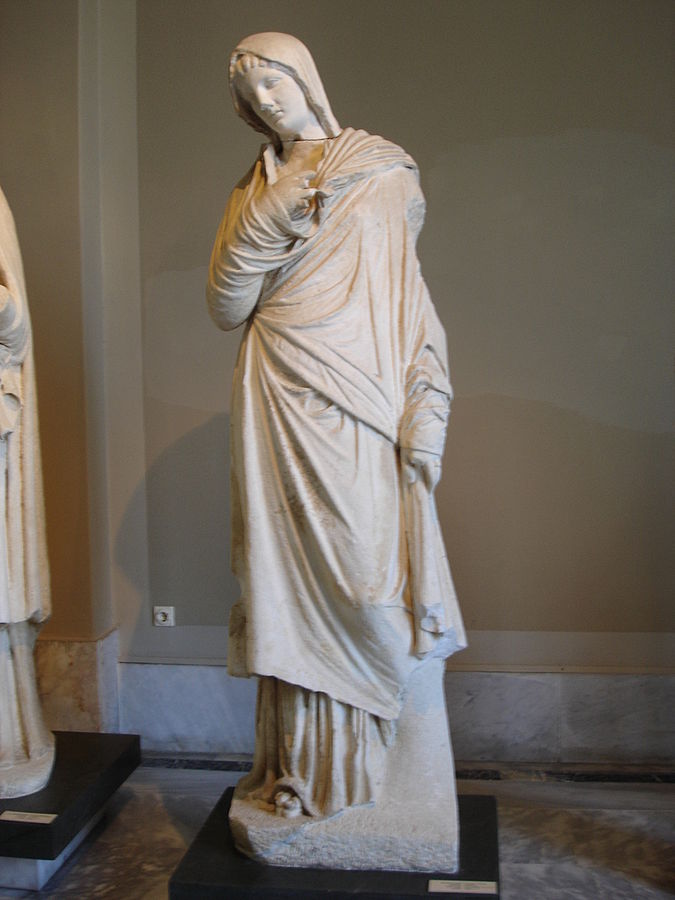
Istanbul Archaeological Museum, the Bents’ statue of Vibia Sabina from Thasos (3rd century CE). Photo G. Dallorto (Wikipedia Creative Commons).
Sunday, 20 March 1887: “Yesterday morning we turned over a pedestal and found this inscription: ‘Good Luck. The Elders to the most excellent Archpriestess Floueivia Savia of unblemished ancestry, their own mother, the first who ever enjoyed equal honours with the Elders’.”
Introduction
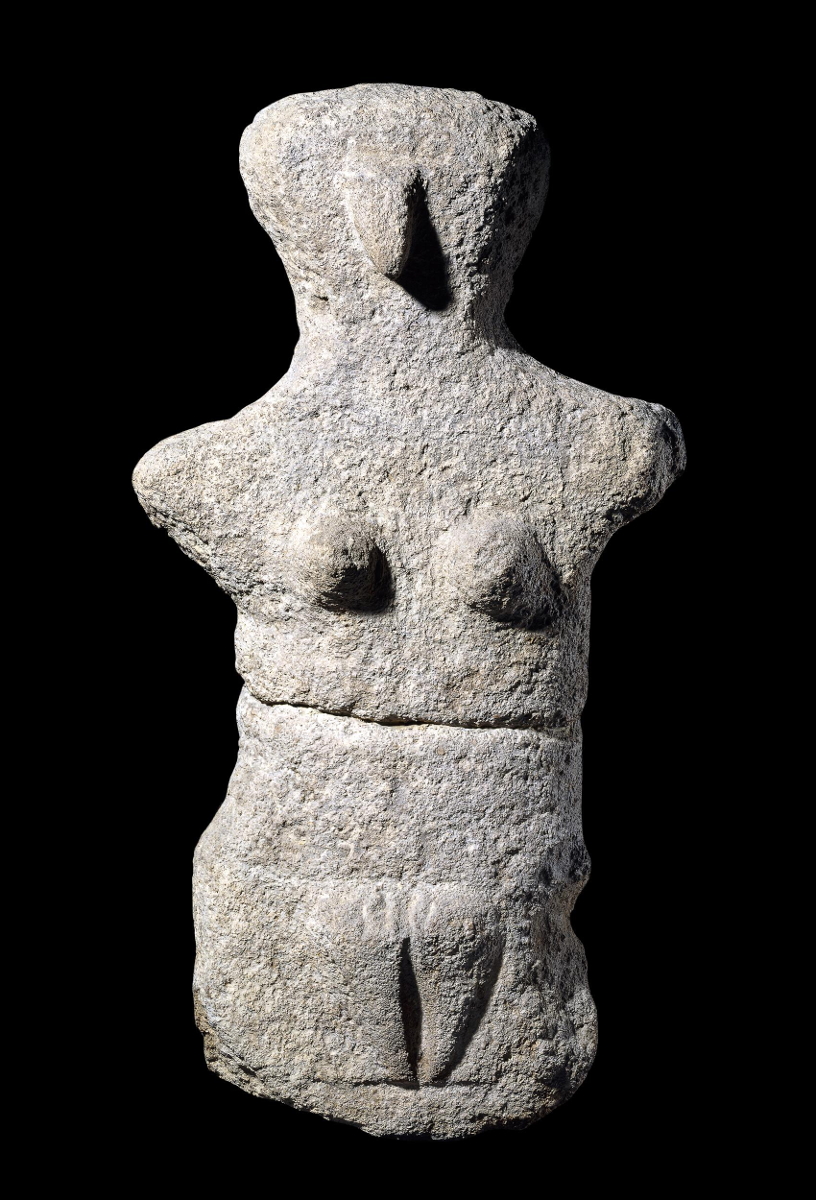
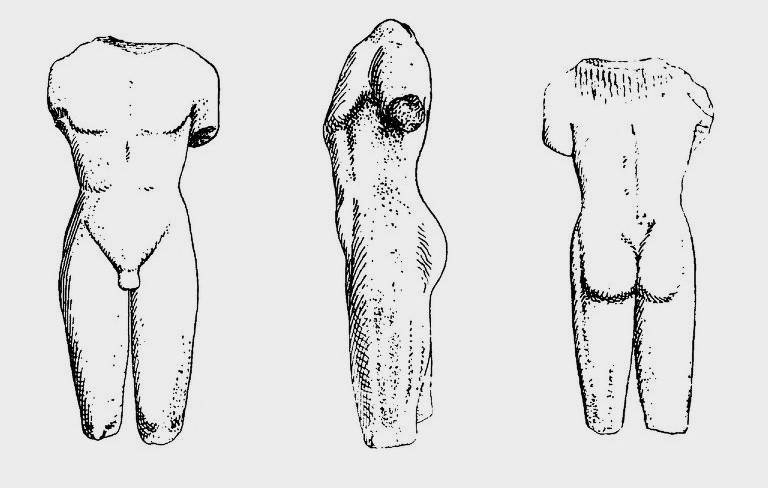
Among all their other ‘finds’, three distinctive statues stand proud in the Bents’ list of Aegean trophies – all from islands. They could not be more different. The earliest is the bizarre, ostensibly prehistoric, limestone cult figurine (?) from Karpathos in the Dodecanese, now famously known as the ‘Karpathos Lady’; the next, chronologically, is the ‘Bent Kouros’ (6th c. BCE) from Aliki, Thasos. (See below, where both are illustrated note 1 .) The third, the subject of this short article, and also from Thasos, is the 3rd-century CE local grey marble statue of Fulvia Vibia Sabina (83-136/137 CE) – inter alia, noble Roman empress, priestess, wife, and second cousin once removed of the Emperor Hadrian.
The Greek island of Thasos, c. 17 nautical miles south of Kavala in the northern Aegean. The port of Limenas, the findspot of the Bents’ statue of Vibia Sabina, is on the northeast coast (Google Maps).
Our setting is a central area in the ancient harbour town of Limenas, on the northeast corner of Thasos, an island c. 17 nautical miles south of Kavala, modern Greece, but in Turkish hands when the British celebrity explorers Theodore and Mabel Bent visited between early March and early May 1887. The Bents have been busy ‘investigating’ (which seems to have included some blasting!) a complex of Roman remains. They discover a large statue, and it is love at first sight for Mabel, who provides some (sentimental) details in her diary:
Saturday, 19 March 1887: “… we turned over a pedestal and found this inscription: ‘Good Luck. The Elders to the most excellent Archpriestess Floueivia Savia of unblemished ancestry, their own mother, the first who ever enjoyed equal honours with the Elders’… We then became aware that the lady was lying underneath and then, of course, great and careful cleaning of the earth took place, a road cut in the great bank we had thrown up, and, finally, she was revealed; she had fallen headlong on her face, fortunately on sand and was very little broken. Her right hand and the tip of her nose were broken ‘then’, as the workmen say, and are missing. A ship’s captain was called to our aid and with great yells and screams and counter advice, she was hauled safely out. People were addressed as ‘infant’, ‘baby dear’, ‘beloved’, and ‘brother’, including Theodore and [Mustapha] Bey. Poor little man, I have talked so sensibly to him about not letting the holes be filled up and he is so well-meaning that I feel sure he would like to begin a museum with Floueivia. But we want her home…
Mabel Bent’s original ‘Chronicle’ entry for 20 March 1877, referring to the crosses ‘scribbled’ on the statue of Fl. Vibia Sabina (Hellenic Society Archive, London, Creative Commons).
“Today [i.e. Sunday 20 March] we found that children had scribbled crosses with sharp stones on Floueivia so that I sat by her while Theodore fetched the Bey and he desired a zaptich [officer], Vasillikos, to live and sleep by her. It being piercingly cold he was not pleased, but at last it was decided to remove her at once to the ‘konak’ – the Bey’s palace. Accordingly, no wheeled vehicle existing here, a forked tree was formed into a sledge with logs across and the lady tied on and then three yokes of oxen attached and away went Floueivia across a stream first, under the olive trees, with a gaily dressed and very picturesque crowd of various nationalities, and the chief rejoicers following behind.
“With the grey statue on the yellow and orange sledge, the whole scene was one of the prettiest triumphal processions any archaeologist ever beheld. It was so strange and mysterious to know her name and a scrap of her history and not yet to know what her face was like, and she was lying in such a helpless way with her head a little lower than her feet, one wondered why she did not help herself up and she looked so pretty and young and as I sat cross legged on her inscription imploring care for her head, I wonder why she had ever been so honoured and thought how glad she must be to come out after being trodden on and ploughed over for 2000 years – I should have liked to have a good comfortable cry.” (The Travel Chronicles of Mrs J. Theodore Bent, Vol. 1, Oxford, 2006, p. 200-202)
Site – The ‘Arch of Caracalla’, Limenas, Thasos
The find-site, the general area of Agora, on Thasos was a complex jumble of large stone blocks discovered by Theodore in a field owned by one Mr Sponti. Further discoveries, including inscriptions, revealed that Theodore had actually uncovered a monumental ceremonial arch dedicated to the Emperor Caracalla (ruled 188-217 CE) by grateful Thasians, with the statue of Fulvia Vibia Sabina forming part of it, located by one of the entrances. The local grey limestone could well have provided the figure, or she might perhaps have been commissioned from overseas, judging by the quality of the workshop. Theodore is credited with the unearthing of the remnants of this enormous site, and he later contributed several articles about his discoveries, including his ‘Arch of Caracalla’ and the statue of Fulvia. In one of these articles he gives his account of finding the statue:
Limenas, Thasos, reconstruction of the ‘Arch of Caracalla’ discovered by the Bents in 1887. The statue of Vibia Sabina stands in front of the second pier from the right (J.-Y. Marc, ΑΕΜΘ 7 (1993), fig.2 (public domain).
“In front of the northern columns nearest to the city, and consequently in the place of honour, stood a prettily adorned pedestal 6 ft. 9 in. high [2.06m], with an inscription which tells us that the statue which surmounted it was erected by the senate ‘to their mother Phloueibia Sabina, the most worthy archpriestess of incomparable ancestors, the first and only lady who had ever received equal honours to those who were in the senate.’ The statue we found at the foot of the pedestal, luckily preserved by falling into a bed of sand, so that only the tip of the nose and the right hand were missing; the left hand, which hung by her side, is adorned with a large ring, and the whole body is covered by a gracefully hanging robe; the face is that of a young and lovely woman. Although not resembling statues to the same person, it is highly probable it was erected to the honour of the Empress Sabina, wife of Hadrian…” (J.T. Bent, ‘Discoveries in Thasos’. Athenæum, Issue 3113 (Jun), p. 839)
The Inscription
Fulvia’s inscription was found by the Bents on a limestone base, c. 2 m high, and probably 1 m + in width and depth. Investigations are being made to trace it – very likely still in situ or in the newly renovated Thasos Museum.
Theodore and Mabel provide various interpretations of the inscription on the statue’s base. The first we have is from Mabel’s notebook (see illustration above), obviously an on-the-spot translation from the Greek made by the couple: “Good Luck. The Elders to the most excellent Archpriestess Floueivia Savia of unblemished ancestry, their own mother, the first who ever enjoyed equal honours with the Elders.” (The Travel Chronicles of Mrs J. Theodore Bent, Vol. 1, Oxford, 2006, p. 200)
Bent’s account in the Athenæum (as previously mentioned) informs that the statue “was erected by the senate ‘to their mother Phloueibia Sabina, the most worthy archpriestess of incomparable ancestors, the first and only lady who had ever received equal honours to those who were in the senate.'”
A further version is provided by the eminent philologist, and friend of Bent, Edward Lee Hicks (1843-1919), later Bishop of Lincoln (UK). He published many of Bent’s inscriptions from Thasos and elsewhere over a five-year period in the late 1880s, e.g. ‘Inscriptions from Thasos’, in The Journal of Hellenic Studies (1887, Vol. 8, 409-438).
This was a joint article with Bent, in which Hicks allocates the number 31 to the inscription. Bent provides some further information on the arch and the statue:
E.L. Hicks’ transliteration of the inscription on the plinth supporting the Bents’ statue of Fl. Vibia Sabina, part of the Arch of Caracalla, discovered in the spring of 1877 in Limenas, Thasos (Bent and Hicks, ‘Inscriptions from Thasos’. ‘The Journal of Hellenic Studies’, 1887, Vol. 8, 426) (archive.org).
“The Roman arch we found in the town occupied a conspicuous position on what appears to have been the central street, the site being only indicated by a stone about three feet out of the ground, the rest being buried in some twelve feet of soil. The arch was 54 feet in length, and rested on four bases—the northern and southern columns being alone perfect—4 feet 8 inches square at the base, 9 feet 5 inches high, and having a small pattern down the outer edge. The two outer entrances were 6 feet 2 inches in width, the central expanse being 20 feet, and the whole structure rested on a raised marble pavement 6 feet 11 inches in width… In front and behind the two central columns of the arch were four pedestals, three with inscriptions… That to the front and to the right was 6 feet 9 inches high [just over 2 m], and had inscription No. 31; just below it lay the statue which had surmounted it, in perfect condition save for the tip of the nose and the right hand. It represented a female figure 6 feet 3 inches high [just under 2 m], enveloped in a long cloak, the left hand by her side being adorned with a large ring; the face was that of a young and graceful lady, and the drapery hung much more gracefully than it did on fragments of the statues which we found close to the other pedestals…” (pp. 437-438)
In a summary of ongoing research in Greece in 1886/7, the eminent archaeologist E.A. Gardner refers to the Bents’ statue (p. 284):
Plan of the ancient capital of Thasos. The Bents’ ‘Arch of Caracalla’, in the general area of the agora, arrowed (Wikipedia).
“Mr. and Mrs. Theodore Bent are now exploring in Thasos. They seem not as yet to have come across any of the archaic sculptures or inscriptions for which the island seemed so promising a field. But the agora has been found, and a triumphal arch with an inscription in honour (apparently) of Caracalla… In front of the arch were two bases. One of them held a statue, more than life size, which has been recovered. It is a female portrait, and on the basis is the following very curious inscription, calling Flavia Vibia Sabina μητέρα γερουσίας, and stating that she was the first and only woman from all time that ever shared equally in the privileges of the senators.
“Flavia Vibia Sabina seems to have been an ancient and successful champion of the political rights of her sex: and if, as may be hoped, her statue be transported to London, it should not in these times miss its due honour…”
Happily, she is never, however, to travel to the foggy London of the late 19th century, for she is coveted by the mercurial Turkish polymath, and first director of the Istanbul Archaeological Museum.
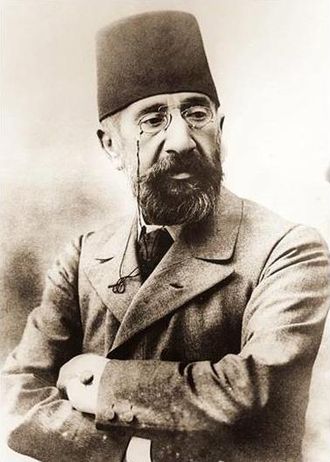
Osman Hamdi Bey (1842-1910)
The Bents’ great nemesis, Osman Hamdi Bey (1842-1910) (Wikipedia).
At the time the Bents were ‘active’, modern Turkey, like modern Greece, was well aware of its cultural assets and soon placed tight restrictions on amateur, independent excavators – whether the Bents saw themselves as ‘archaeologists’ or not. Rights to dig were, in a way, licensed to the newly formed archaeological institutions in Greece (e.g. The French School at Athens – 1846; German Archaeological Institute at Athens – 1874; American School of Classical Studies at Athens – 1881; British School at Athens – 1886; etc.), and Turkey was about to do the same. In Istanbul, the official overseeing Turkey’s clampdown on illegal handling of cultural assets was Osman Hamdi Bey. Previously, in 1884, this remarkable artist/intellectual oversaw the initiation of regulations prohibiting historical artifacts from being smuggled abroad (‘Asar-ı Atîka Nizamnamesi’). Naturally enough, he soon became an implacable foe of the Bents, who, at last, by 1889, were forced to ‘work’ in lands where any restrictions on their explorations were minimal if non-existent, i.e. Bahrain and other regions where the British Empire held sway.
While on Thasos, the couple undertook their investigations under the watchful and approving eye of a local ‘Bey’, who clearly kept Istanbul informed of Theodore’s major finds. Consequently, he was unable to return to London with anything more then his rolls of paper ‘squeezes’ of the inscriptions he uncovered.
To the Bents’ great regret, Fulvia Vibia Sabina was post haste crated up and despatched to the Turkish capital and its new museum (see Gustave Mendel, Catalogue des Sculptures Grecques, Romaines et Byzantines I, pp. 347-348, no. 137 (Constantinople, 1912), museum inv. no. 375).
On a later trip to Constantinople in February 1888, Mabel paid a visit to Fulvia, obviously still bitter: “We also went to the museum and saw our statues exposed to the weather, planted in mud and really we carefully looked and saw nothing so good of their kind. No wonder Hamdi won’t give them up. He would like a few things out of our own little museum [i.e. the Bents’ London home] for he has some rubbish in his. How angry he’d be if he knew of our digging at Vourgounda in Karpathos! [in 1885]. Well, we hope to be even with him yet for robbing us.” (The Travel Chronicles of Mrs J. Theodore Bent, Vol. 1, Oxford, 2006, p. 230)
For an amusing retelling of Theodore’s (almost) love-hate relationship with Osman Hamdi Bey, see the former’s article ‘Hamdi Bey’, first published in the Contemporary Review in 1888 (Vol. 54, 1888 (July/Dec), pp. 724-733).
Those scratches
“Today we found that children had scribbled crosses with sharp stones on Floueivia.” One of the crosses still just visible on the statue today in Istanbul’s archaeological museum.
Mabel was clearly mortified by the crosses she found scratched into ‘her’ statue: “Today we found that children had scribbled crosses with sharp stones on Floueivia…”
How Mabel could be certain that children were to blame she does not say – it could easily have been any Orthodox believer trying to ‘de-paganise’ the Roman archpriestess. The crosses remain just visible on ‘Floueivia’s front today – obviously intended to be seen, and thus, as it were, reclaimed by the Church.
Note 1: The Bents’ two other remarkable statues
“The Karpathos Lady”. Acquired by the Bents from Karpathos island in 1885 (Trustees of the British Museum).
The other notable statues in the Bents’ trio of statues are the Neolithic (?) limestone cult (?) figurine from Karpathos in the Dodecanese, the ‘Karpathos Lady‘, which the couple were able to spirit off the island in 1885 – they had purchased it from a local and resold it to the British Museum.
The ‘Bent Kouros’ from Aliki, Thasos (see Gustave Mendel, ‘Catalogue des Sculptures Grecques, Romaines et Byzantines’, Vol. II. p.215, inv. no. 517, Constantinople, 1914; image: archive.org).
1877: ‘Discoveries in Thasos’. Athenæum, Issue 3113 (Jun), 839. [Reprinted in ‘Archæological News’, by A.L. Frothingham, Jr., The American Journal of Archaeology and of the History of the Fine Arts, Dec., 1887, Vol. 3, No. 3/4 (Dec., 1887), 446-455]
2012: Sheila Dillon, ‘Female Portraiture in the Hellenistic Period’, in S.L. James and S. Dillon (eds) A companion to Women in the Ancient World, pp. 274-275, London: Wiley-Blackwell.
Map and title page of Bent’s bestseller on the Cyclades (1885) (archive.org)
2025 brings the 25th anniversary of our researches into the lives and travels of celebrity explorers Theodore and Mabel Bent, studies that began with a reprint (Oxford, 2002) of Bent’s The Cyclades (now 140 years old in 2025).
Over these twenty-five years of following the Bents (five more than they were granted for their travels together) in the Levant, Africa, and Arabia, a number of questions remain unanswered – awaiting the discoveries of future explorers. Our want list in fact:
No. 1) The Missing Chronicle – Ethiopia 1893?
Mabel Bent’s ‘Chronicles’ in the archives of the Hellenic Society, London. All except for the missing notebook covering the Bents’ trip to ‘Abyssinia’ in 1893 (the Bent Archive).
“When I returned, after inspecting the convent, to my dismay [Mabel] was gone, and what happened she thus tells in her Chronicle…”
Where is Mabel Bent’s missing travel diary (‘Chronicle’) covering the couple’s journey to ‘Abyssinia’ in 1893? We know from Bent that it provided material for his book on the area – The Sacred City of the Ethiopians (1893, see especially pp. 45, 47 for the quote above; and see Travel Chronicles of Mabel Bent, Vol. 3(Oxford, 2012, pp. 175-207)). It consists, probably, of a single notebook as the couple’s trip there was curtailed; it is the only one apparently not with the others in the archives of the Hellenic Society, London (presented before or after Mabel’s death (1929) by her niece Violet Ethel folliott (1882-1932)). Its interest to students of the region cannot be overstated, but the chances are as slim as Mabel’s notebooks themselves that it will ever turn up, but who knows?
No. 2) The fabled clay ‘Bethel Seal/Stamp’?
The clay stamp/seal acquired by the Bents in the Wadi Hadramaut in 1894 (Bent Archive).
Where is the fabled clay seal/stamp bought by the Bents in the Wadi Hadramaut in 1894, and which possibly Mabel later concealed at ‘Bethel’ (Beitin, West Bank, 5 km northeast of Ramallah) in the early 1900s in Theodore’s honour? For Mabel, Bethel represented the terminus of one of the frankincense trails from Yemen and Oman, via the Wadi Hadramaut, regions that inspired the couple from 1894 until Bent’s death in 1897. What more appropriate gesture by his grieving widow than to bury the seal (presumably a trader’s mark on a consignment of resin) as a tribute and private memorial (see their Southern Arabia (1900, London, Chapters VI-XXII) and Travel Chronicles of Mabel Bent, Vol. 3 (2010, Oxford, pp. 129-237)). Found (or its double), by archaeologists in the 1950s, where is it now?
No. 3) When Mabel met Theodore?
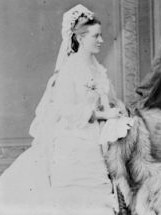
Mabel Bent in her wedding dress, by T. Fall, 9 Baker Street, Portman Square, London. (If the photo predates the August 1877 ceremony, unlikely, she would still be Mabel Virginia Anna Hall-Dare) (Bent Archive).
“Before she was married she travelled in many countries including Spain and Italy, and met her husband in the Arctic region – i.e., Norway; from her earliest years having a wish to see those distant lands where the ordinary traveller fears to tread, ‘And how fortunate that my husband’s tastes should be exactly the same as my own,’ said Mrs. Bent, as we talked of the days when she had no idea her wishes would be so fully gratified.” (The Gentlewoman – The Illustrated Weekly Journal for Gentlewomen, No. 175, Vol. VII, Saturday, 11 November 1893, pp. 621-622)
How, when, and where exactly in Norway did the young Theodore and Mabel meet? They were distant cousins via the Lambarts of Yorkshire and County Meath. No documentation has surfaced, we only have a throwaway line from Mabel saying that’s where they set eyes on each other first. It would have been in the early 1870s, Theodore having come down from Oxford. They were married fairly soon thereafter in the little church of Staplestown, Co. Carlow, Ireland, on 2 August 1877, and began their 20 years of travel together (Levant, Africa, Arabia) with a honeymoon in Italy.
No. 4) Bent’s unpublished watercolours?
‘Kalenzia, Isle of Socotra, 1897’. Watercolour (detail), by Theodore Bent (private collection, reproduced with permission).
How can the known, but unpublished, Bent watercolours (of ‘Mashonaland’, the Greek Islands, Arabia, etc.) be preserved and exhibited? Important historical records, they should be made accessible to the scholar-traveller. They do turn up from time to time. One, of a scene from Socotra, was auctioned recently and is now in a private collection and reproduced with kind permission.
No. 5) Mabel’s photographs?
A unique photograph (1890) taken by Mabel Bent in Cilicia. It was found inside one of her notebooks (The Hellenic Society).
Where are all Mabel’s photographs? Beginning in 1885, Mabel was the expedition photographer on the couple’s adventures. Of the thousands of plates/prints, all that remain are the images reproduced in Bent’s three monographs (1892, 1893, 1900) and some few of his published articles. Mabel’s work did get transferred to lantern slides for Bent’s lectures and they were stored in the archives of the Royal Geographical Society, London, before being discarded in the 1950s, being (then) beyond the powers of conservation – a huge loss. Tantalizingly, there is a paper print of a monument from Turkey’s western coastal area, tucked inside one of Mabel’s notebooks.
No. 6) ‘The Bent Turkish Embroidery Bequest’?
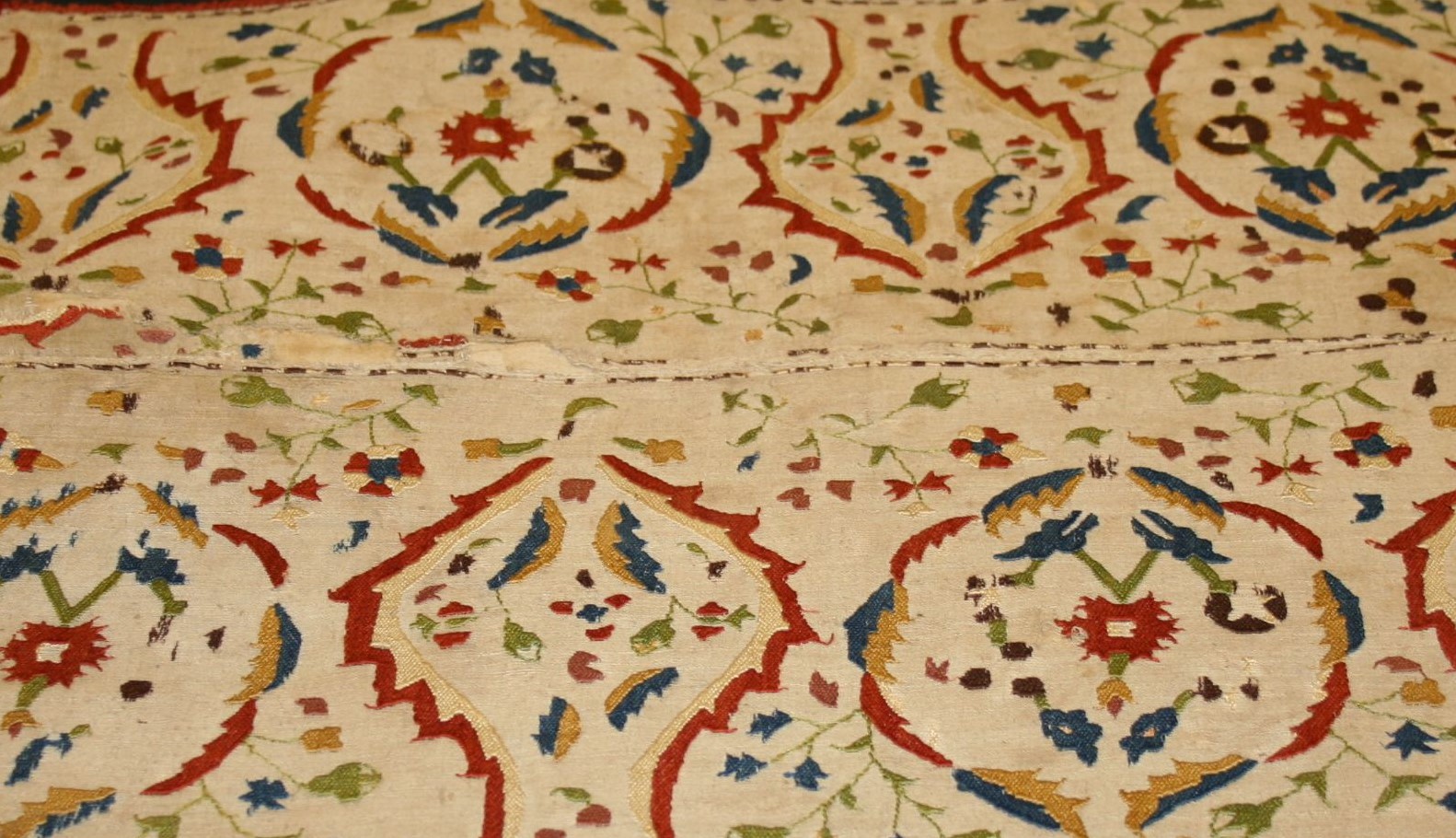
Detail from Bent Collection embroideries – PRSMG 1970.4 (Harris Museum and Art Gallery, Preston).
The Bents were great collectors of costumes, fabrics, and embroideries (to keep or sell). A mystery today is the provenance of the ‘Bent Turkish Embroidery Bequest‘ (more modest than it sounds) in the Harris Museum and Art Gallery, Preston (UK). It would be fascinating to discover how the items found their way from the Eastern Mediterranean to Lancashire. (Only 80 km southeast of Preston is the Bents’ country house – Sutton Hall, Sutton; perhaps an answer lies in this direction.)
Tuesday, 18 December 1883: “Met Mr. Swan who more than fulfilled our warmest hopes.” (Travel Chronicles of Mabel Bent, Vol. 1 (p. 21; Oxford, 2006). Is there a photograph anywhere of the Bents’ great friend Robert M.W. Swan? The couple met the latter when he was a mining engineer on the Cycladic island of Antiparos in 1883. In 1891 he joined the travellers for their investigations at Great Zimbabwe, where he undertook surveying duties, contributing a chapter to Bent’s Ruined Cities of Mashonaland (1892) (and see Travel Chronicles of Mabel Bent, Vol. 2 (2012, Oxford, pp. 17-175)). A decade later he was working for various mining companies on the Malay Peninsular, only to die of complications following liver surgery in Kuala Lumpur in 1904 (c. 45 years, the same age as Bent on his death coincidentally). No archive seems to have a likeness of this driven, capable Scotsman and we would like very much to see him, or learn of his final resting place.
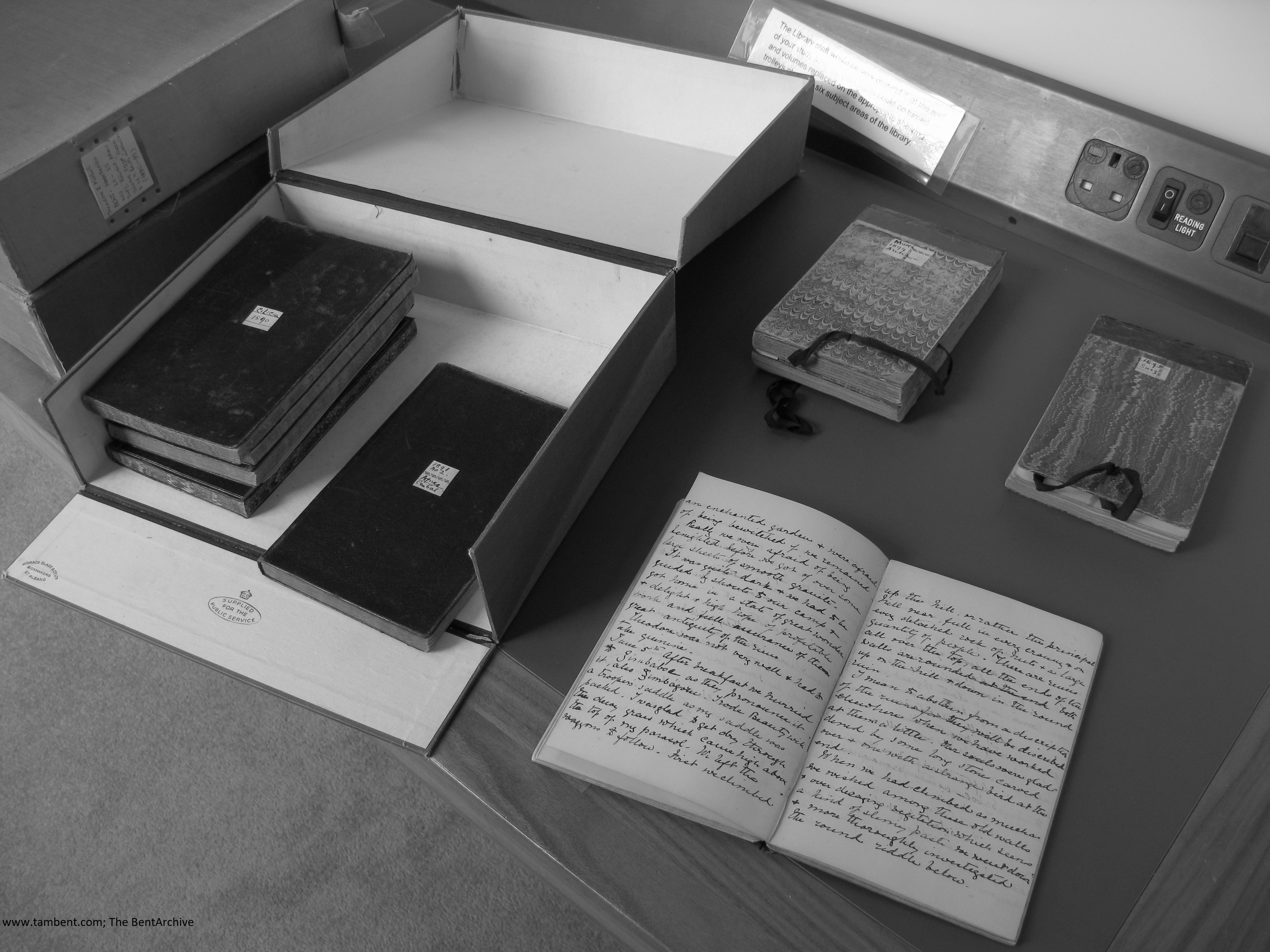
Some of Mabel Bent’s ‘Chronicles’ in the archive of the Hellenic Society, London (photo: the Bent Archive).
[Unless otherwise referenced, original Mabel Bent material courtesy of The Hellenic Society/School of Advanced Study, University of London (reproduced under Creative Commons: Attribution-No Derivative Works 4.0)]
The Hellenic Society’s holdings of the notebooks and Chronicles of celebrity explorers Theodore and Mabel Bent have now been digitised and are available here via the School of Advanced Study, University of London.
The Bents had almost twenty years of travel adventures together (1877-1897), being interested in many fields of ethnology, archaeology, and geography in the Levant, Africa, and Arabia.
What follows is a quick glance at the subfusc covers of Mabel’s diaries (or ‘Chronicles’ as she called them) 1883-1897. Not all of them, however, i.e. her (alas lost?) diary of the pair’s trip to Ethiopia in 1893, and Mabel’s solo journey to Egypt in 1898, as a widow, depressively labelled by her: ‘A lonely useless journey’. (Click for the full itineraries and details of all the couple’s travels together.)
Mabel Bent’s travel notebooks:
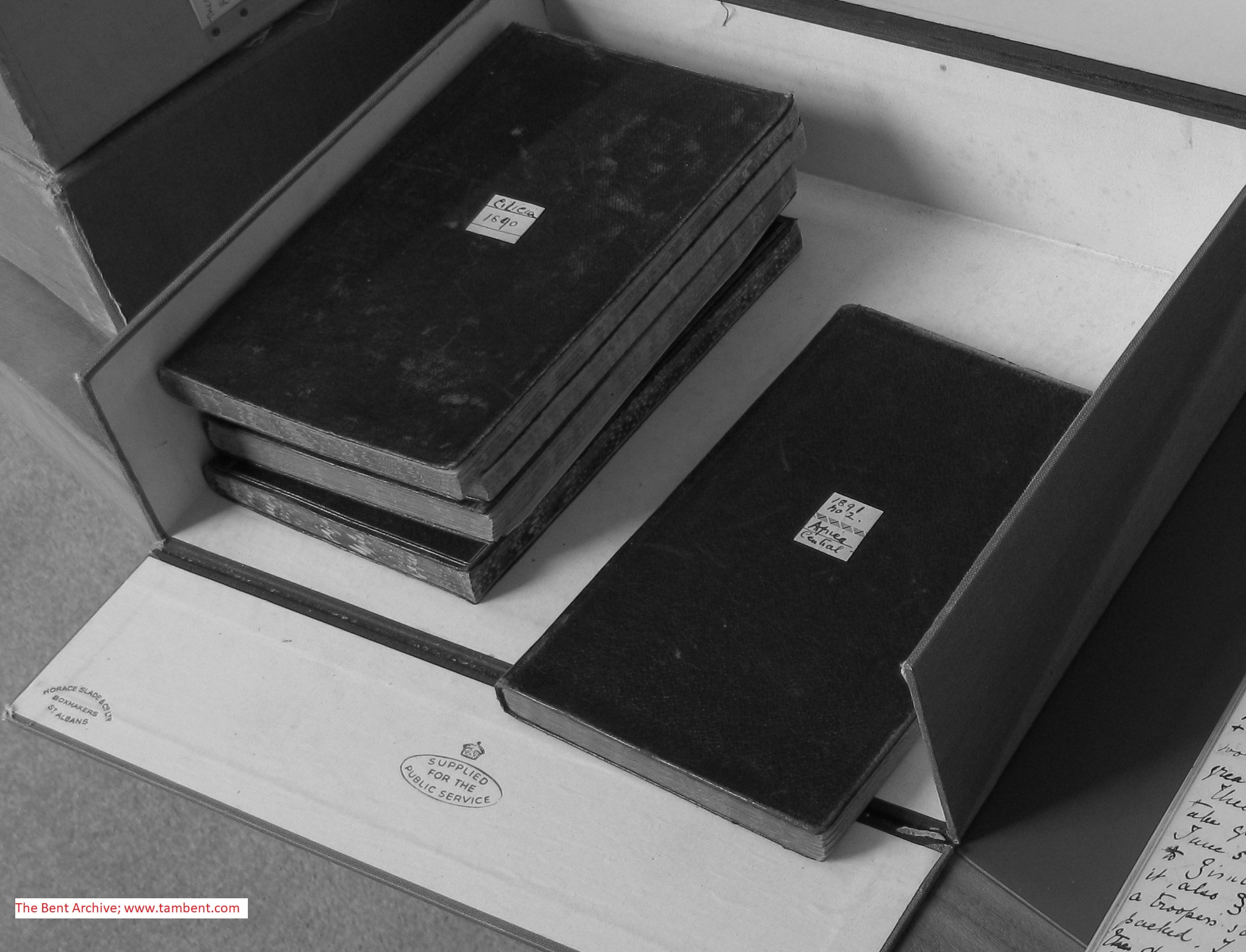
Plate 1: Mabel Bent’s ‘Chronicle’ covers: 1883/4 to 1897 (upper: 1, 2; lower: 3, 4) (The Hellenic Society).
1) The Cyclades: beginning “Mabel Bent, her Chronicle in The Kyklades 1883-4. Dedicated to my Sisters and my Aunts”, the first of Mabel’s Chronicles (and the only one not to have a pasted front label) is written in a dark-red leather, lined and columned, accounts book (£.s.d.); it has marbled endpapers and edges and measures 175 x 110 mm. Mabel completes 94 of its 130 leaves. note 1
2) The Dodecanese: beginning “Mabel V.A. Bent her Chronicle in the Sporades, etc. 1885”, the second of Mabel’s Chronicles is written in a blue marbled, board covered notebook (185 x 120 mm) with marbled endpapers and edges. Mabel’s initials are inked on the front. There are 170 lined pages and Mabel fills 115 of them. The pasted cover label reads: ‘Egypt Greece 1885 –’.
3) The Eastern Aegean: inexplicably beginning “My Fourth Chronicle 1886”, the third of Mabel’s travel diaries is written in a dark-red leather notebook (180 x 115 mm) with marbled endpapers and edges. near the edges of the covers there are two parallel and scored lines. There are 192 lined pages and Mabel uses all but 10 of them. The pasted cover label reads: ‘Istambul [sic] Greek Islands 1886 –’. note 2
4) The Northern Aegean: beginning simply “1887”, Mabel’s fourth Chronicle is written in a dark-red leather notebook (180 x 115 mm) with marbled endpapers and edges. near the edges of the covers there are two parallel and scored lines, the corners including a stylized clover design. There are 85 lined pages and Mabel has covered 75 of them. The pasted cover label reads: ‘Greece 1887’. note 3 Plate 2: Mabel Bent’s ‘Chronicle’ covers: 1888 and 1889 (upper: 5, 6; lower: 7, 8) (The Hellenic Society).
5) The Turkish coast: beginning “My fifth Chronicle” (the correct numbering is restored), Mabel’s 1888 diary is written in a dark-red leather book (180 x 115 mm), with gold lines on the spine and covers; the endpapers and edges are marbled. Near the edges of the covers there are two parallel and scored lines. There are 192 pages of lined paper, of which Mabel has used 182. This expedition involved a happy cruise along Turkey’s south-western shores – “…a paradise for archaeologists and tortoises…” The pasted cover label reads: ‘Turkey Russia 1888’.
6, 7, 8) Bahrain and Iran (in 3 vols): beginning “Persia 1889”, this adventure, including a marathon ride, south-north, through present-day Iran, and well deserving of a documentary on its own, necessitated three notebooks. Mabel adds in the third volume (8) that it is her 6th Chronicle. Notebook 6 is plain and bound in dark-red leather (180 x 115 mm). The endpapers and edges are marbled; near the edges of the covers there are two parallel and scored lines. There are 148 lined pages, of which Mabel has used all, including the endpapers. Notebook 7, perhaps from the same retailer, is also a plain, dark-red leather volume (180 x 115 mm); the endpapers and edges are marbled; there are 148 pages, of which Mabel has used all, including the endpapers. Notebook 8 is from a different source; it is a plain, dark-red, leathered-covered book (170 x 110 mm); there are 184 pages, plus endpapers, of which Mabel has used 50; the edges are speckled with blue wavy lines. The three pasted cover labels read: ‘1889 no 1 –’; ‘Persia 1889 (2)’; ‘1889 No. 3’. note 4 Plate 3: Mabel Bent’s ‘Chronicle’ covers: 1890 and 1891 (upper: 9, 10; lower: 11, 12) (The Hellenic Society).
9) Turkey: beginning “My Seventh Chronicle ‘Rugged Cilicia’ 1890”, this Chronicle is written in a dark-red leather book (185 x 120 mm). The endpapers and edges are marbled. The paper is lined; there are 90 pages and Mabel has filled 89 of them. Near the edges of the covers there are two parallel and scored lines. The pasted cover label reads: ‘Cilicia 1890’. note 5
10, 11) South Africa: beginning “1891. My Eigth [sic] Chronicle To Zimbabye in Mashonaland”, Mabel uses two notebooks for the couple’s notorious 1891 travels to and from South Africa, occupying the energetic duo for most of 1891. Notebook 1 (10) is a plain, dark-red leather volume (180 x 120 mm). The endpapers and edges are marbled. The paper is lined; there are 180 pages, plus endpapers, of which Mabel has used all. The volume ends in early August 1891 as the party approaches the year-old Fort Salisbury (modern Harare, where Theodore’s watercolours of the trip are now seemingly inaccessible in the Archives). The second notebook narrates the homeward journey, via Umtali (Mutare) and the Pungwe River to Beira in Mozambique. The second volume (11) does not quite match its predecessor; it is plain and in dark-red leather (175 x 115 mm). The endpapers and edges are marbled. The paper is lined; near the edges of the covers of both books are two parallel and scored lines. There are 164 pages, of which Mabel has used all but six. The pasted cover labels read, respectively: ‘Central Africa No 1’ and ‘1891 No 2 Africa Central’. note 6
[Mabel’s notebooks, for what would have been her ‘9th Chronicle’, relating their subsequent expedition in 1893 to Ethiopia, are, alas, lost]
12) Wadi Hadramaut (Yemen): beginning, defiantly, ‘Hadramout’, with no Chronicle number (it would be No. 10), Mabel uses two notebooks to narrate their famous 1893-4 travels to the Wadi Hadramaut in Yemen, Southern Arabia (the start of a trio of ill-fated expeditions). The first volume includes the party’s preparations in Aden (December 1893). It is a plain, dark-red leather volume (180 x 115 mm); near the edges of the covers of both books are two parallel and scored lines. The endpapers and edges are marbled. The paper is lined; there are 146 pages, plus endpapers, of which Mabel has used all. The pasted cover label reads: ‘Hadramaut 1893 to 94 No 1 A’.
Plate 4: Mabel Bent’s ‘Chronicle’ covers: 1894 to 1897 (upper: 13, 14; lower: 15, 16) (The Hellenic Society).
13) Wadi Hadramaut (Yemen): beginning “Continuation of My Chronicle in the only very moderately Blest Arabia 1894”, Mabel’s second notebook here concludes their curtailed trek into the Wadi Hadramaut, and sees the pair reach London again in April 1894. It is a plain, dark-red leather volume (180 x 115 mm). The endpapers and edges are marbled. Near the edges of the covers there are two parallel and scored lines. The paper is lined; there are 146 pages, of which Mabel has used just 34. The cover label reads: ‘Hadramaut – no 2. A 1894 -’. (It appears that the year has been altered from ‘1884’.)
14) Muscat and Dhofar: beginning just “Saturday 15th December, 1894. The Residency, Muscat”, Mabel again gives no Chronicle number (it would be No. 11) to this notebook covering the couple’s aborted and dispiriting expedition into the Wadi Hadramaut, this time from the east. It is a dark-red leather volume with gilt bordering (180 x 115 mm). The endpapers and edges are marbled. The paper is lined; there are 172 pages, plus endpapers, of which Mabel has used just 68, indicating a frustrated expedition. The pasted cover label reads (confusingly): ‘1894-5 Hadramaut’.
15) Red Sea (west coast): beginning “1895 The Chronicle of my Thirteenth Journey”, although in fact, and ominously, it should be referenced her as her twelfth, this penultimate adventure has the couple travelling from Suez, south to Massowa (Mitsiwa) and back, by dhow. On the way home, via Athens, they attend the first modern Olympic Games. Mabel keeps her diary in a lined, dark-red leather book (175 x 115 mm), near the edges of the covers there are two parallel and scored lines. The endpapers are marbled; there are 152 pages in the notebook but Mabel only completes 62. The cover label reads: ‘1895-6 Suez Kourbat Athens’. note 7
16) Sokotra, Aden: Beginning (with the ‘c’ altered to a ‘k’) “The Island of Sokotra 1896-7”, Mabel’s unnumbered diary (it is, in fact, the unlucky 13th Chronicle) details the couple’s final journey together, and is to witness them at the end both desperately ill with malaria (Theodore dies in London a few days after their return in May 1897, ending nearly twenty years of hitherto inseparable travel). The notebook is a dark-red leather volume (180 x 115 mm), with gold edging to the spine and covers. The endpapers and edges are marbled. The paper is lined; there are 178 pages, plus endpapers, of which Mabel has used 146. The pasted cover label reads: ‘Isle [of] Socotra 1896-7’. note 8
Notes
Four of Mabel’s opening flourishes to her ‘Chronicles’. The 1895 notebook was actually the account her 12th journey, making the ‘Sokotra’ journal her unlucky 13th – Theodore died of malarial complications a few days after returning to London, 5th May 1897. (The Hellenic Society).
Note 1: The Bents had first toured the Eastern Mediterranean, and some of the Greek and Turkish islands, including the Cyclades, in early 1883, but it seems Mabel did not keep a travel diary at that time, more’s the pity, although her later diaries make reference to it (i.e. see The Travel Chronicles of Mabel Bent, Vol.1, 2006, Oxford, p.52). Mabel’s first diary notebook was, in fact, one of Theodore’s, he has written in the back ‘J.T. Bent. Acct. Book. Oct. 13th 1871’: he would have been nineteen and about to go up Wadham College, Oxford, to read history. Perhaps, just before setting out for their second trip to Greece in November 1883, one of the couple hit upon the idea that Mabel should keep a record of the trip, and a simple, dark-red leather notebook that has been lying around for twelve summers is the first thing that comes to hand. But from this inconsequential idea flows a nearly twenty-year stream of travel diaries, unparalleled in their scope, and addictive in their appeal. Return from Note 1
Note 2: Still inside this volume is a letter from Mabel’s friend, Mrs H.R. Graham, who writes: “Why oh why don’t you publish it? It simply bristles with epigrams and I am certain would be a great success! You ought to blend the Chronicles into one and I am sure everyone would buy it.’ (This is now possible of course.). The H.R. Grahams were old friends, Graham seconding Theodore’s application for election as a Royal Geographical Society Fellow on 16 June 1890. Return from Note 2
Note 3: Included in the little volume remains a melancholy letter from the unhappy wife of a minor functionary in Skopje. She implores Mabel to visit: ‘Monday morning. My dear Madam, You would really do me a great favour if you would spend an hour or two with me today. Ours is rather a rough kind of home, but I can offer you a cup of tea. I think if you only knew how hard it is for an educated woman to be in exile at such a place as Uskub [Skopje], without either congenial society or habitual surroundings, you would come out of charity. May I fetch you about 4? With compliments to your husband, Faithfully yours, Florence K. Berger’”. Presumably by the end of tea Mabel would have learned that Mrs Berger was herself, in fact, a published author, having written about an earlier stay in Bucharest – A Winter in the City of Pleasure(London, 1877). Return from Note 3
Note 4: The first in the trilogy of notebooks elucidating the Bents’ journey from London, via Karachi and Bushire, to Bahrain; then their extraordinary overland ride, zigzagging north-south, through Persia (Iran). The second volume is a record from just north of Persepolis as far as modern Tabriz. Inside the cover Mabel has written her name and address (as she does for most of her notebooks): “Mabel V.A. Bent, 13 Great Cumberland Place, W., 1889”, and has the following note: “The state of the edge of this book is caused by a mule’s rolling in the saddlebags, which broke the butter tin so that the melted butter got into everything.” It seems that Mabel only set out with these two notebooks; aware of space problems, she contracted her usually neat handwriting, making the transcription of these volumes difficult in places. The third volume tells of the journey home – from Tabriz to London. This third book was bought locally (in Tabriz) and is of poorer quality than the other two that came from London. The binding is poor and some sheets are loose. Tucked into this book is a miscellaneous bill from the ‘Hôtel de l’Europe’, Vladikavkas (capital of North Ossetia-Alania, Russia). Return from Note 4
The ‘Mandragora’ leaf (M. officinarum) Mabel pins to a page within her 1890 notebook (her 5th Chronicle) during the couple’s travels along the Turkish littoral. (The Hellenic Society)
Note 5: This was another of the Bents’ enjoyable, carefree even, expeditions (1890, in which they famously discover the ancient site of Olbaalong the way). On several occasions in this Chronicle (but in no other within the 15-year series) Mabel has leaves occasional spreads of blank pages “for meditations”, suggesting rare hints of intimacy, girlishness too – “Theodore says I can keep the pages I have left out for meditations!” As an example, a ‘mandragora’ leaf remains pinned to one of her pages: “This is said to be a leaf of mandragora or mandrake. I have been given some roots and seen a good many, which are certainly most extraordinary, but I cannot help thinking they are helped into their human form with a knife and then earthed over. Some say after being cut they are planted again to grow a little but as they grow very deep I do not think that likely. I shall believe in them better when I have seen one dug up.” Importantly, this notebook also has tucked within it an extremely rare paper print from one of Mabel’s photographs in the field; no others have appeared to date. Return from Note 5
An extremely rare paper print of a photograph taken in 1890 by Mabel Bent at the site of an inaccessible inscription near Olba in Cilicia; it was tucked into her notebook of that year: “A ladder was needed to read this [inscription], so one had to be built and very cleverly it was managed… a couple of trees were cut and notches cut in the back of them and then some large sticks just laced on with one loop which hitched into the notches. As one side was about a foot and a half longer than the other it had a queer and dangerous twist.” (‘Travel Chronicles of Mabel Bent’, Vol. 1. Oxford, 2006, p.281) (photo: The Hellenic Society).
Note 6: This notebook records the couple’s homeward journey from Great Zimbabwe, via Fort Salisbury (modern Harare) and the Pungwe River to Beira in Mozambique. The volume differs from its predecessor; it was perhaps obtained from a stationer’s en route. The top of page two is stained and Mabel has written next to it ‘Hydrochloric Acid’ – presumably part of the photographic paraphernalia from her mobile ‘darkroom’; she was again expedition photographer. Return from Note 6
Note 7: By ‘Kourbat’ Mabel is referring to the Wadi Kurbab district on the southern Sudanese coast, including the so-called Halaib Triangle. Appointed by the British authorities in Cairo to keep an eye on the expedition was the young Capt. N.M. Smyth (1868-1941) (later Major General Sir Nevill Maskelyne Smyth, VC, KCB). Also with the party, paying his way, was Hugh Alfred Cholmley (1876-1944) of Place Newton, Rillington, Yorkshire; Hugh was a shooter on the trip – photographs and wildlife, especially birds: “While here [near Sawakin al-Qadim] we got a few Sand-Grouse, two young Shrikes, and an Egyptian Goatsucker. One day while near the sea I saw two black Ducks, which I am sure were Velvet Scoters – the large yellow beak and black plumage showed distinctly, but they were too far off for a shot.” (Cholmley, A.J. (1897). ‘Notes on the Birds of the Western Coast of the Red Sea’, Ibis 39(2): 196-209). The last four pages of this diary narrate the couple’s short stay in Athens on the way home, including a visit to the first Olympic Games of the modern era (April 6–15, 1896). The notebook has its cost price written in pencil in the front: one shilling (c. £2.50). Return from Note 7
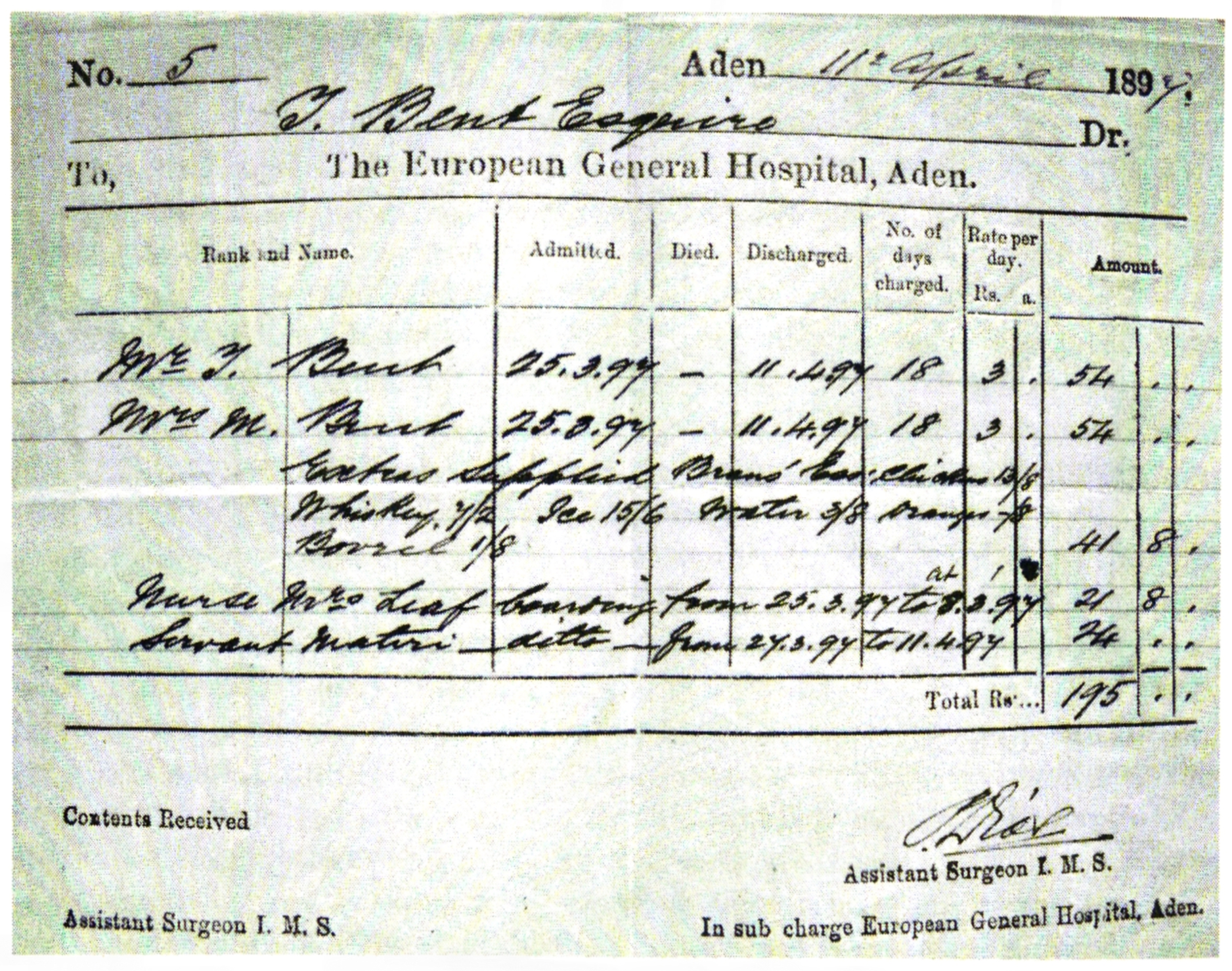
The Bents’ hospital bill from Aden, 1897. Folded into her notebook of that year, it is signed by their Goanese physician, Dr Dias (The Hellenic Society).
Note 8: Also, as a (paying) guest, on this trip to Sokotra was (later Sir) Ernest Nathaniel Bennett (1865-1947), academic, politician, explorer and writer; he made the sensible decision not to join the party’s onward trek into the Aden hinterlands. Assisting the Bents on this journey was their long-term dragoman, and friend, Mathew Simos from the Cycladic island of Anafi; from the time they met (the winter of 1883/4) there were only three adventures in which he did not take part: 1889 (Persia), 1891 (Great Zimbabwe), and 1895 (the Bents’ second visit to the Hadramaut). Noteworthy in this Chronicle are several rare inclusions: a unique ‘contract’ for the party’s passage from Socotra back up to Aden; a hospital bill; and a letter from the Aden authorities regarding their onward journey. Mabel was too ill to update her diary for their last few days east of Aden, but she made an effort, the relaxed style of the experienced traveller in the Sokotra sections contrasting with the feverishness and despair of what she was able to write. Her last diary entry in the field was 16 March 1897. She concluded her memoir later, but does not indicate where or when, ending her final journey with Theodore with the lines: “At last a M.M. [steamer] came from Madagascar with room for us, so one afternoon I was taken up and an ambulance litter was brought beside my bed and I was laid in it and carried down to the sea…” Return from Note 8
[A note on the labels pasted on the front covers. All Mabel’s Chronicles shown above, except for the 1883/4 volume (The Cyclades), appear to be cut from printed paper featuring a distinctive, narrow strip of zigzags. This is curious (as the notebooks cover a period of fifteen years or so), suggesting perhaps that the labels were pasted on at a later date – at around the same time? The handwriting could be Mabel’s, or that of her niece Violet Ethel ffolliott (1882-1932), who gave the notebooks to the Hellenic Society (Mabel died in 1929), or even a cataloguer at the Hellenic Society.]
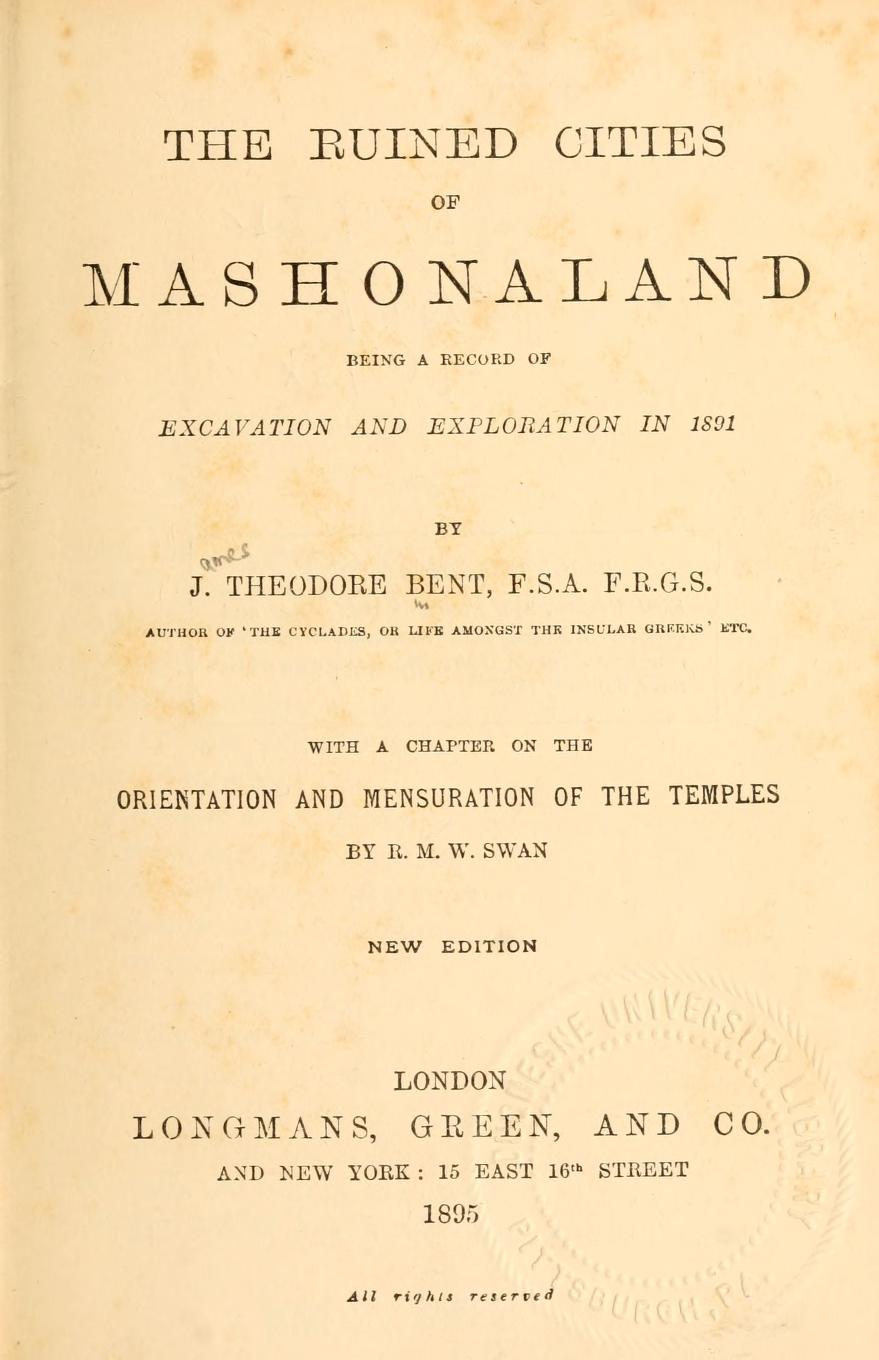
“Swan was a big Scotchman, rather quiet and not a bad kind of chap” (L.C. Meredith, quoted from R.H. Wood, ‘Llewellyn Cambria Meredith 1866-1942’, in Heritage of Zimbabwe 16 (1997), pp. 55-66)
Our temporary (we hope ) stand-in for the Bents’ friend R.M.W. Wilson Swan (an anonymous silhouette from a late 19th-century group of prospectors in Rhodesia).
Tuesday, 18 December 1883: “Met Mr. Swan who more than fulfilled our warmest hopes.” (Travel Chronicles of Mabel Bent, Vol. 1 (p. 21; Oxford, 2006), writes Mabel Bent after the couple met Swan when he was a mining engineer on the Cycladic island of Antiparos in 1883. They hit it off immediately, and later (in 1891) he was invited to join the Bents for their investigations at Great Zimbabwe, where he undertook surveying duties, contributing a chapter to Bent’s monograph on the remains: The Ruined Cities of Mashonaland (1892). A decade later he was working for various mining companies on the Malay Peninsula, only to die of complications following liver surgery in Kuala Lumpur in 1904 (c. 45 years, the same age as Bent on his death coincidentally). He appears to have been the General Manager of the Malaysian Company Ltd. at the time of his death.
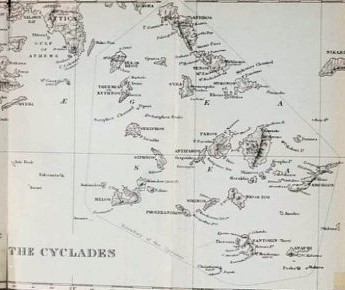
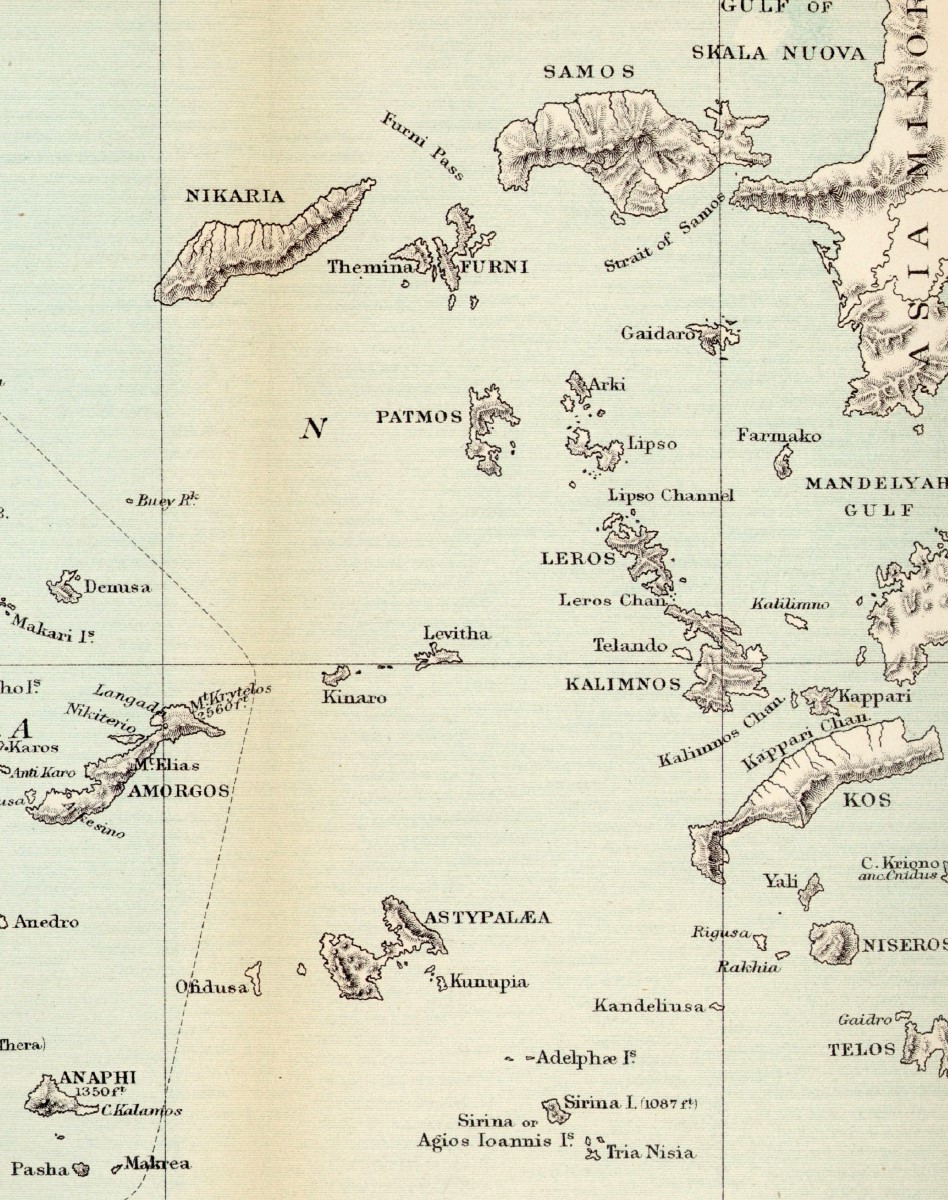
A detail from Bent’s map of the Cyclades taken from his 1885 book of the same name.
It appears that Swan was mining in the Cyclades on behalf of his father’s company, David Swan & Co., Glasgow, perhaps in conjunction with a French mining concern in Greece from the early 1880s, it was his first major responsibility (his brother John joining him) after a period of further training in Spain. By 1882 he had travelled enough in the region to compile a minerological report which appeared in The Glasgow Herald (Tuesday, November 21, 1882) – we see he has also been appointed ‘Consular Agent’ (he was 25 years old): “Mr Consular Agent Swan, at Antiparos, reports on the minerals in the Cyclades (Greece) as follows:- ‘The Cyclades are more remarkable for the number than value of their mineral deposits, and in nearly all of the islands ores of several of the commoner metals are found. In Macronisi calamine has been found, and from Zea and Thermia I have got samples of galens and carbonate of copper. In Siphnos, famed among the ancients for its production of gold, a concession has lately been granted for mining lead and zinc. Calamine is believed to exist in quantity there, and in a similar manner to that in which it occurs on the mainland at Laurium – viz., at the contact between marble and mica-schist. The large deposits of iron ore (haematite and magnetic oxide) in Ser[i]phos have been worked in open quarries, but operations there have been discontinued for some years. Milo is famed for its millstone and sulphur mines, and traces of copper, and recently also manganese oxide, have been found. In Polykandro, Sikino and Santorin veins of galena and carbonate of copper have been discovered, but I am aware that these ores exist there in workable quantities. From Anaphe I have got samples of asbestos, but of poor quality. Naxos is also well known for its production of emery, which mineral has also been found, but in small quantity, on the coast of Paros. Mining in modern times has been more extensively carried on in Antiparos than in any other of the Cyclades.'”
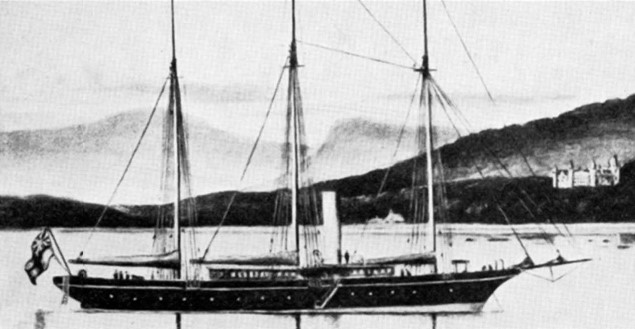
The Duke of Sutherland’s Yacht ‘Sans Peur’ on which R.M.W. Swan sailed to Siam in 1888 (archive.org).
After leaving Greece in the mid 1880s, the next reference we have for Swan is in a memoire by Florence Caddy, To Siam and Malaya in the Duke of Sutherland’s Yacht ‘Sans Peur’(London, 1889). Swan is in the Far East, it seems acting as an engineer, surveyor for various railway companies. On Monday, 13 February 1888 he is in Singapore with a friend from Cyprus called Cobham (p.222). The latter knows Sutherland, apparently, and the pair hitch a lift on the Sans Peur – in which Florence Caddy is also a guest: ‘Mr. Cobham, one of Her Majesty’s commissioners in Cyprus, whom the Duke had invited to travel with him, came on board with his friend, Mr. Swan, the engineer who was to accompany his Grace to Siam to consider the country for the proposed railway there’. The book has several references to the engineer, in which he comes over as a dapper, man-about-town, perhaps even flirtatious: ‘We lunched at the Raffles Hotel, where a Malay luncheon had been ordered for us. Mr. Swan, who knew Malayan customs, told us what to choose and how to eat it, and peeled mangosteens for us.'” (p.279) Florence is sorry to leave him behind: ‘Farewell to the Sultan, princes and datos, and to Mr. Swan, who is going to remain behind constructing Malayan railways. We shall miss him much. Friends may come and friends may go, but we go on for ever, we feel, as the Sans Peur weighs her anchor, and “we go on our way, and we see them no more”… The last we have heard of Mr. Swan was by letter, wherein he mentions his cook having been eaten by a tiger.’ (p.263)
It was in the Far East that Swan took and interest in neolithic finds. He donated a collection of stone implements from the Malay Peninsular to the British Museum in the early 1900s, one of which is illustrated below. There note on him reads: “Engineer. Educated Glasgow University. Worked in Spain and Greece, as well as Western Australia, Tasmania, Siam (Thailand), and the Malay Peninsula. Accompanied Royal Geographical Society expeditions to Africa.”
No archive seems to have a likeness of this driven, capable Scotsman and we would like very much to see him, or learn of his final resting place. If you can help, please get in touch.
“Robert Macnair Wilson Swan died at Pahang in the Malaysian Peninsula in January, 1905 [sic]. He was born February 8, 1858, at Maryhill, near Glasgow, Scotland, and, without regular technical education, began work in May, 1876, sampling and assaying ores in various parts of Spain for D. Swan & Co., at which he continued until February, 1878. From September, 1878, to February, 1885, he was engaged in managing Calamine mines in the Island of Antiparos, Greece, for the same concern. From April, 1888, to May, 1894, he was examining mining properties in Mashonaland for the Magar Syndicate. May, 1894, to September, 1896, found him Manager of the Glasgow Mashonaland Syndicate and the Northern Gold Fields of Mashonaland; and from September, 1896, to May, 1897, Manager of the Glasgow Explorers’ Syndicate in Western Australia. During parts of 1897-98 he was reporting on mines in Siam for the Areacan Co., of London, and in 1900, when he joined this Institute, he was Manager of the Malaysian Co., of Bombay, engaged in directing operations at their mine on the Tui, in Pahang, and in exploring mines for them elsewhere in Malaysia and Siam. He was still in the management of this company’s practical affairs at the time of his decease. Mr. Swan, besides his connection with the Institute, which began in 1900, was a member of the Chemical Society, the Geological Society, and the Royal Geographical Society, all of London.” (Bi-monthly bulletin of the American Institute of Mining Engineers, 1905, pp. 871-2, New York, N.Y. : American Institute of Mining Engineers)
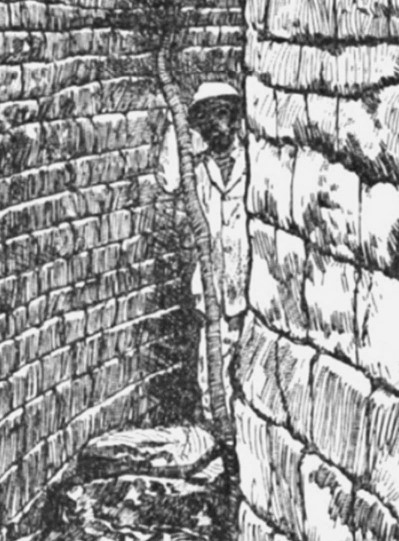
A curious image chosen by Swan to illustrate his article on Great Zimbabwe for the Glasgow Archaeological Society (1893). It may well be based on a photograph taken by Mabel Bent and it might even represent Swan himself (archive.org).
“Swan, R.M.W. [Robert McNair Wilson]: We regret to record the death, which took place on March 26th [sic] last, of Mr. R. M. W. Swan, well known for his share in the earlier investigations of the ruins of Mashonaland. Mr. Swan was born in 1858, and after receiving a technical training in Glasgow University and in the laboratory of Mr. R. Tattock, went out to Spain in 1878 in the capacity of a mining expert. In 1879 he went to Greece, and the next seven years were spent in mining work, principally in Antiparos and neighbouring islands. In addition to his professional employment, he devoted much attention to archæology, publishing several papers on his researches, and sending many specimens to the British Museum. It was during this period that he first made the acquaintance of Mr. and Mrs. Theodore Bent, whom he accompanied during their visits to several of the islands, afterwards taking part in the expedition to Mashonaland, carried out by them in 1891, for the examination of the Zimbabwe and other ruins. During this expedition he undertook the cartographic portion of the work, executing for the first time a careful plan of the ruins, besides mapping the country along the routes followed, and fixing the positions of a number of points astronomically. When, after his return to this country, Mr. Bent described the results of his journey before the Society, Mr. Swan added some notes on the geography and meteorology of Mashonaland, and subsequently contributed to the “Proceedings” (May, 1892), a short paper on the orientation of the ruins, showing in a striking way the close connection which existed between the arrangement of the structures and the astronomical phenomena to which, as sun-worshippers, their builders had paid so much attention. The subject was more fully discussed in the section which he contributed to Mr. Bent’s “Ruined Cities of Mashonaland”. The theory which he developed was subjected to some criticism; but on returning to South Africa to continue his investigations, he collected “data”, which, as he claimed, fully bore out his ideas. During this journey, carried out in 1893, he examined various ruins, till then undescribed, besides doing something to improve the mapping of the country along his route, which led inland by way of the Limpopo.
“This visit to South Africa lasted about two years, spent in part in geological and mining work. In 1896 he examined the mining districts of Western Australia and Tasmania, and in 1898 went to Siam with a similar object, leaving again, after a short visit to this country, for the Malay Peninsula, where he was engaged in mining work until his death, which took place at Kuala Lumpur after an operation for abscess of the liver. Here, as in South Africa, he did much careful cartographical and geological work.
“Mr. Swan was an expert linguist, and from his residence in Greece had acquired a great love for the classics. He possessed a large store of knowledge on varied subjects, which he was always anxious to share with others. He was a Fellow of the Geological and Chemical Societies, as well as of our own, which he joined in 1893, having received the Murchison Grant in 1892. “(Royal Society’s Journal, May, 1904)
The title page of J.T. Bent’s “Ruined Cities of Mashonaland” (3rd edn, 1895), featuring Swan’s contribution.
“Anthropology has… to regret the loss during the past year [March 1904] of the following workers and pioneers in unexplored fields, who, although they were not actually Fellows of the Institute, have done much to further the interests of the science which the Institute represents in the country:- Mr. R. M. W. Swan was well known for his researches in Mashonaland. In 1891 he accompanied Mr. Theodore Bent, and undertook the topographical part of the work, the maps and plans of the ruined cities being due to his researches. Shortly before his death, which took place in Malacca, he contributed to the Institute a paper on Stone Implements from Pahang, which appeared in Man.” (Report of the Council for the Year 1904. (1905). The Journal of the Anthropological Institute of Great Britain and Ireland, 35, 2-5; the paper referred to is: Swan, R. M. W. (1904). 34. Note on Stone Implements from Pahang. Man, 4, 54-56)
Supplement to the Perak Government Gazette, 1st July, 1904, p.1 (originally in “Preliminary Report”, No. 4, Kuala Lumpur, 15th May, 1904): “Pahang has suffered a severe loss in the death of Mr. R.M.W. Swan, the Manager of the Malaysian Company’s property. How far Mr. Swan’s death will affect the gold-mining industry in Pahang may not be realised for some time; meanwhile, the loss of one who had at heart so truly the welfare of the State, of one who in spite of failure worked on confident of ultimate success, will be keenly felt. My acquaintance with Mr. Swan was but of brief duration; yet, although I do not wish to emphasize my own sorrow while knowing that others feel his death as bitterly, I must add that apart from his personal charms, his enthusiasm for geological study was such that the loss of his co-operation will be greatly regretted. Before I left Lipis, it had been arranged that we should at a future date work over certain areas together; and it was on his way to join Mr. Warnford Lock and myself in an expedition to Tui that Mr. Swan was first taken ill. As the pioneer of geological study in Pahang; and as one who, having formed his conclusions from the observation of natural features, did not hesitate to attempt to turn them to account. Mr. Swan will always be remembered by me with respect.” (John Brooke Scrivenor, F.M.S. (1876-1950))
The Straits Echo of Friday, 1 April 1904, also records Swan’s passing: “Kuala Lumpur, 26 Mar. – Mr R. M. W. Swan, F.C.S., F.G.S., F.R.G.S., General Manager of the Malaysian Company, Ltd., Sepan, Pahang, died here today, the cause of death being abscess of the liver.” [He was 46 years old]
Journal of the Anthropological Institute of Great Britain and Ireland, 1905 (page 3)
“Anthropology has also to regret the loss during the past year of the following workers and pioneers in unexplored fields, who, although they were not actually Fellows of the Institute, have done much to further the interests of the science which the Institute represents in this country :—
“Mr. R. M. W. Swan was well known for his researches in Mashonaland. In 1891, he accompanied Mr. Theodore Bent, and undertook the topographical part of the work, the maps and plans of the ruined cities being due to bis researches. Shortly before his death, which took place in Malacca, he contributed to the Institute a paper on Stone Implements from Pahang, which appeared in Man.”
Select Bibliography
1892: Orientation And Mensuration Of The Temples, in J. Theodore Bent, The Ruined cities of Mashonaland, London, 1892, pp. 141-178
1904: Note on Stone Implements from Pahang, in Man(4): 54-56 (Royal Anthropological Institute of Great Britain and Ireland).
An early issue of ‘Blackwood’s Edinburgh Magazine’ (Wikipedia).
Bent’s scores of published articles can be usefully divided into three main categories: 1) Academic (written for his peers, i.e. archaeologists, geographers, ethnologists, anthropologists, inter alia); 2) middlebrow (catering to an educated market, but penned to engage and entertain); and 3) popular (aimed at the general reader, light in tone and readily accessible – the author was not beyond including fictitious elements, and this needs to be borne in mind when enjoying them).
Falling into the second category were the four pieces Bent wrote for Blackwood’s Edinburgh Magazine, a well-respected journal launched by the publisher William Blackwood in Edinburgh with an April issue in 1817. In 1905, after Bent’s time, the magazine transferred its main office to London and, rebadging as Blackwood’s Magazine, continued publishing right up until 1980 – boasting of remaining within Blackwood family hands for its entire existence.
William Blackwood, in charge of the firm during Bent’s dealings with them, primarily in the 1880s (Wikipedia).
At the firm’s helm at the start of Bent’s submissions to the company was founder William Blackwood’s son, John (1818-1879), and at the time of Bent’s death, 1897, another William, John’s nephew. Bent never addressed his letters to any particular individual, and the names of the various junior editors responsible for regular correspondence with our celebrity explorer require further delving.
For references, David Finkelstein has published a monograph: The House of Blackwood. Author–Publisher Relations in the Victorian Age (Pennsylvania State University Press, 2002); and there is an earlier account by Margaret Oliphant and Mary Porter – Annals of a publishing house: William Blackwood and his sons, their magazine and friends (published by Blackwood’s themselves in three volumes: Vol. 1 = 1897; Vol. 2 = 1897; Vol. 3 = 1898).
Much of the company’s archives is now curated by the National Library of Scotland (NLS; see below for references); there are over 30 known letters (1878-1892) surviving from Bent to the firm. The contents are typical of dealings between author and publisher, i.e. submission ideas, editorial advice, chasing for replies and payment, returning proofs, etc. It is clear that Bent was in the habit of approaching several publishers at the same time with the same article – hoping that if one rejected, another might accept. (Bent’s own papers, with copies of his dealings with his many publishers, alas, have never surfaced.) The correspondence with Messrs Blackwood ends in 1892, possibly because the editors turned down Bent’s ‘Mashonaland’ material (including what was to be his bestselling monograph) and the explorer then thought better of submitting anything in future. Perhaps the competition paid better too! We will never know, but the Edinburgh firm was to miss out on Bent’s most sensational work.
Many of the issues of Blackwood’s Edinburgh Magazine are freely available online. Their contents were often syndicated abroad, i.e. the link to Bent’s ‘Patmos’ article above leads to the Littell’s Living Age version (USA, Vol. 173 (1887), pp. 243ff).
Not to Blackwood’s but a specimen of Bent’s letterhead, 13 Great Cumberland Place, London, from a letter to Rider Haggard. Sutton Hall was the Bents’ country residence, outside Macclesfield (Bent Archive).
What now follows are short summaries of Bent’s correspondence with Messrs Blackwood between 1878 and 1892. Here and there, a line or two of Bent’s text is included to bring him directly into the picture. The NLS shelfmarks are provided throughout. We are extremely grateful to Dr Kirsty McHugh and Lynsey Halliday of the National Library of Scotland for their kind help in this research and for permission to quote from the correspondence.
Key: e.g. “(1878) NGS MS.4368 ff.149-150: 6 Dec 1878 (from Florence)” = letter year; NLS shelfmark/reference; date of letter; sent from
Page 200 from Bent’s “San Marino” (1879), one of his own sketches. Blackwood’s turned the book down (archive.org).
(1878) NLS MS.4368 ff.149-150: 6 Dec 1878 (from Florence): Bent offers his first monograph (on San Marino) to the firm; it is rejected and subsequently published (1879) by Longmans. “For reference I may state that my name appears in the Honour school of History, Class II, Oxford, Mods, 1875… I have a series of watercolour sketches [done] on the spot if you think them desirable.”
(1885) NLS MS.4466 ff.266: 12 Jul 1885 (from GCP): Returning from what are now the Greek Dodecanese, Bent offers an article ‘On a far-off island’ [Karpathos]. “I wonder if you would care for a short paper on modern Greek life and folklore as compared with the antient?”
(1885) NLS MS.4466 ff.270: undated, after 12 Jul 1885 (from GCP): Bent chases firm for a reply and they obviously accept the article. On Bent’s original letter is a notable (and quotable) editorial comment in another, anonymous, hand: “Very readable & interesting. I don’t think any good description of Karpathos & its people has ever appeared before. The customs are primitive and quaint in the interior; and although the writer has evidently not a keen sense for the picturesque, the paper is sure to be read & quoted.” One might take issue; Bent, presumably, never saw the note.
Bent’s friend from the British Museum, Sir Charles Newton (Wikipedia).
(1885) NLS MS.4466 ff.268: 14 Nov 1885 (from GCP): Bent is returning the proof of his Karpathos article. He makes a reference to his eminent acquaintance Sir Charles Newton (1816-1894): “It was with a view to excavating and collecting folklore that Mr. Newton advised me to go to Karpathos last winter.”
(1886) NLS MS.4481 f.34: 11 Feb 1886 (from Constantinople): Bent sends thanks for payment (cheque) for his Karpathos article; the amount unspecified (see below, MS.4495 ff.235-6: 29 Jun 1887). The article (Bent’s first of four with BEM) appeared as: ‘On a far-off island’ ( Vol. 139, Feb 1886, pp. 233-244).
(1886) NLS MS.4481 f.36: 26 Sep 1886 (from York): Bent offers an article on Samos and refers to an earlier one on Astypalaea that he sent “about 2 months ago” (this letter untraced). “My dear Sir – I have put together a paper on some of our experiences on the island of Samos, which I think would go very well with the paper I sent you on Astypalaea about 2 months ago.”
Detail from Bent’s map of the Cyclades from his 1885 guide showing the isles of the Eastern Aegean, including Samos, Patmos, and Astypalaea (Bent Archive).
(1886) NLS MS.4495 ff.240-1: 28 Sep 1886 [NGS have it filed as 1887] (from GCP): Clearly with no reply to his previous letter (26 Sep 1886), Bent submits the Samos article he refers to anyway (see NGS MS.4481 f.36: 26 Sep 1886). He suggests a pair (later a trio) of articles (Samos, Astypalaea, Patmos). The final sentence in the following passage indicates that Bent had flexible arrangements with his other publishers: “I send you herewith the paper on Samos; my idea was that perhaps that you might be able to publish one or two of my Greek articles consecutively, as when spread over many magazines they rather lose their point. I wish I had sent you one I wrote on Patmos but if you saw your way to publishing consecutively I think I could get it back… I daresay you would not object to publishing my name with the article as I have rather associated myself with Greek exploration when working for the British Museum & Hellenic Society. I send for your inspection a few of the photos my wife took during our last tour under extreme difficulties.” The Samos and Astypalaea articles were declined; the Patmos one was ultimately accepted (see below, MS.4495 f.227: 15 Jan 1887). The reference to Mabel Bent’s photographs is intriguing, as almost none of her original prints seem to have survived or surfaced. Very unfortunately, the prints Bent is referring to are not catalogued within the Blackwood archive at the NLS (pers. comm).
(1886) NLS MS.4495 f.244: 18 Nov 1886 [NGS have it filed as 1887] (from GCP): Still hearing nothing, Bent writes to chase news of his Samos and Astypalaea articles. “I should be obliged to hear from you respecting the two articles of mine you have.”
(1886) NLS MS.4481 ff.38-9: 2 Dec 1886 (from GCP): Doggedly, Bent chases yet again, this time including the MS of his Patmos article, which he must have retrieved from another publisher (see NGS MS.4495 ff.240-1: 28 Sep 1886 above). “I send for your perusal the third article [of a proposed trio] on Patmos which I proposed, if you see your way to publishing the 3 [on] Greek life on Aegean islands: (1) The Principality of Samos; (2) Revelations from Patmos; (3) Astypalaea. This will cover the whole of our tour last winter & it would be preferable to me to have them consecutively printed. I should be much obliged for an early answer…”
(1886) NLS MS.4481 f.40: 23 Dec 1886 (from GCP): Bent has still not had a reply, five months after submitting his first proposal. “I should be much obliged if you will let me know what your opinion is with regard to the 3 articles I sent you on Samos, Patmos and Astypalaea.” It seems, finally, that BEM did agree within weeks (over Christmas and the New Year) to publish Bent’s Patmos article, but not the other two. As for Samos, Bent had already published six articles with other journals (see Bibliography) referring to this island and BEM probably thought this was enough. (The Bents first visited Samos over the winter 0f 1882/3.) The Astypalaea piece did appear in The Gentleman’s Magazinein March 1887 (Vol. 262, pp. 253-65).
(1887) NLS MS.4495 f.227: 15 Jan 1887 (from GCP): Bent asks for a proof of his Patmos article quickly as the couple are about to start another expedition soon (to the Eastern Mediterranean) to indulge his “anthropological propensities”. He regrets his trio of Greek articles will not appear. “I am sorry you do not see your way to publishing the 3 papers consecutively… My work this year is taking me to Salonika & some of the Turkish towns on the Macedonian coast, where I hope I may come in contact with people which will give a wider field for my anthropological propensities.”
(1887) NLS MS.4495 f.229: 25 Jan 1887 (from GCP): Bent has been asked to add some detail to his Patmos article, he does so. BEM’s policy was generally not to print the author’s name at the article’s end, Bent asks them to make an exception, and they do so. “I have as you suggest added a few things respecting the books in the library & the legendary life of St John on Patmos… I think as you are only publishing one of my papers you will not refuse to put my name at the end of it, as I have more or less associated myself with the subject I prefer its being known who has written the article.” (Bent was not acknowledged in his Karpathos article, but he was for the other three BEM pieces.)
(1887) NLS MS.4495 ff.231-2: 2 Jun 1887 (from GCP; Bent’s headed stationery here is black-lined, the deceased is unknown): Bent writes chasing payment for his Patmos contribution and seeking a copy of the relevant issue. He again mentions that he is preparing an article on the Jews of Salonika (see NGS MS.4495 f.227: 15 Jan 1887 above). “I have just returned home from Greece & not finding a copy of the March magazine or a cheque for my contribution I conclude you have acted more wisely than some others & awaited my return to send them.” The article (Bent’s second of four with BEM) appeared as: ‘Revelations from Patmos’ (Vol. 141, Mar 1887, pp. 368-379). [A further Patmos article – ‘What St. John Saw on Patmos’ – appears in The Nineteenth Century, Vol. 24 (142) (1888, Dec), pp. 813-821.]
(1887) NLS MS.4495 f.233: 16 Jun 1887 (from GCP. Bent’s stationery is black-lined, the deceased is unknown): Bent is again asking, perhaps tetchily, for payment for his Patmos article. “I wrote to tell you the other day that I have received no cheque for the article I wrote in your March number. As I have only just returned from the East there is always a fear of its having got lost so I should be much obliged if you would let me know if one has been sent or not.”
(1887) NLS MS.4495 ff.235-6: 29 Jun 1887 (from GCP): Bent has received payment for his Patmos article but still not a complimentary copy. Surely he must have acquired a copy elsewhere but is just making his point! His payment was £14 (c. £750 today), which we can assume was around the going rate; the article was c. 8500 words (see also NGS MS.4546 f.241: 3 Nov 1890 and NLS MS.4546 f.241: 3 Nov 1890).
(1887) NLS MS.4495 f.237: 25 Jul 1887 (from GCP): Despite having no reply to his offer of an article on the Jews of Salonika (see MS.4495 ff.231-2: 2 Jun 1887), Bent sends his text in nevertheless. It is rejected but appears as ‘A Peculiar People’ in Longman’s Magazine in November 1887 (Vol. 11 (61) (Nov), pp. 24-36).
(1887) NLS MS.4495 f.238: 27 July 1887 (from GCP): Speculatively, as is his wont now it seems, Bent submits an article stemming from their Spring 1887 trip to the Northern Aegean, including substantial excavations on Thasos and a tour of Samothraki. “I send you herewith a paper on some of our Greek island experiences of last spring. I have made it short & only introduced material that I thought would interest. If you would care for it longer I could easily extend it.” BEM decline, but Bent publishes five scholarly pieces on Thasos and his more general article on ‘Samothrace’ was accepted by The Gentleman’s Magazine in 1888 (Vol. 264 (Jan), pp. 86-98).
(1887) NLS MS.4495 f.242: 30 Sep 1887 (from GCP): Remarkably prolific, Bent submits a further piece. “My excuse for sending you another Greek Island paper must be that I think this Teliote [Tilos] wedding therein related the most interesting of all our adventures in the Aegean Sea.” BEM, perhaps wisely, turned it down. This article was a tour-de-force of imagination and one of the main indicators we must cite when illustrating that Bent did not always report on what he actually saw. The account of this wedding outlasts the time spent on the island, as recorded in his wife’s diary, and neither does she refer to it. The episode is made up of extant Greek wedding practice and custom, but Bent never witnessed them on Tilos. Nevertheless, the article was published as ‘A Protracted Wedding’ in The Gentleman’s Magazine in October 1888 (Vol. 265 (Oct), pp. 331-341. Intriguingly, a slightly different version was to appear under the same title in the English Illustrated Magazine years later, in June 1891 (Vol. 93 (Jun), pp. 672-677), while the Bents were in South Africa!
Portrait of John Covel by C.L. Guynier (1716). Bent was responsible for bringing Covel’s diaries to public attention (Wikipedia).
(1887) NLS MS.4495 f.246: 1 Dec 1887 (from GCP): As noted, Blackwood’s were also book publishers and Bent now tries to interest them in the important diaries of John Covel (1638-1722) – English ambassador in Constantinople. “In the British Museum I came across a voluminous M.S. being the diary of Dr. Covel, chaplain to our ambassador at Constantinople 1670-7. This diary has never been printed.” The firm decline it. Bent published an introductory article, ‘Dr. John Covel’s Diary’, in The Gentleman’s Magazine in 1890 (Vol. 268 (May), 470-489). The work was successfully edited by Bent and published in 1893 as ‘Extracts from the diaries of John Covel (1870-1879)’ in Bent’s Early voyages and travels in the Levant (London: Hakluyt Society, pp. 99-287). The work is still available.
(1888) NLS MS.4511 f.156: 1 Jan 1888 (from GCP): Bent writes for a reply to his proposal to publish John Covel’s diary (see previous letter, MS.4495 f.246: 1 Dec 1887).
(1888) NLS MS.4511 f.158: 1 Aug 1888 (from GCP): Bent submits an article based on their Spring 1888 explorations along the Turkish coast. “Last winter I undertook for 2 societies excavations in Turkey & being unable to get satisfactory terms from the govt I made this cruise of which the enclosed is the account.” BEM turn it town, but the piece, among Bent’s most enjoyable, was published in November 1888 as ‘A Piratical F.S.A.’ in the Cornhill Magazine (Vol. 58 (11), pp. 620-635).
(1889) NLS MS.4528 f.236: 31 Jul 1889 (from GCP): Bent submits an article based on their visit into Armenia (as they were riding south-north through Persia in the Spring of 1889).
(1889) NLS MS.4528 f.238: 4 Oct 1889 (from GCP): Bent chases for a reply to his letter 31 July 1889 concerning an article on Armenia.
(1889) NLS MS.4528 f.240: 5 Dec 1889 (from GCP): Again, Bent chases for a reply to about his Armenia piece. BEM are clearly not interested. It is not until 1896 that an article on Armenia does appear, published in the Contemporary Review as ‘Travels amongst the Armenians’ (Vol. 70 (Jul/Dec), pp. 695-709). This is a good example of Bent’s tenacity and his loathness to ‘waste’ a perfectly good article – and a source of income.
(1889) NLS MS.4528 f.242: 17 Dec 1889 (from GCP): Bent submits his article ‘Under British Protection’ based on their visit to Bahrein in the early months of 1889. BEM turn it down and it is published in 1893 by The Fortnightly Review (Vol. 60 (54) (Sep), pp. 365-376). See comment above about Bent’s tenacity – are there perhaps articles of his that never saw the light of day?
(1890) NLS MS.4546 f.237: 7 Aug 1890 (from GCP): Bent sends an article on Tarsus, following their explorations in the area in the Spring of that year. BEM agree to publish it and it will be Bent’s third article for them: ‘Tarsus Past and Present’ (Vol. 148 (Nov 1890), pp. 616-625).
Bent’s map of some of the area of the Turkish littoral visited by the couple in 1890. Plate XII, J.T. Bent, ‘A Journey in Cilicia Tracheia’, ‘The Journal of Hellenic Studies’, Vol. 12, 1891 (archive.org).
(1890) NLS MS.4546 ff.239-40: 12 Oct 1890 (from GCP): Bent returns his Tarsus proof and other material to support an idea for a further piece: “I return the proof of “Tarsus past & present” corrected herewith… I am also sending you a reprint of the paper I read before the Geographical Society in the summer. It occurs to me that perhaps you would like a popular article on our wanderings & adventures amongst the nomads of the Taurus.” A BEM editor has written a note on Bent’s letter: “A very popular paper might be made out of Mr Bent’s reports to the Geographical & Hellenic Societies. I would invite him to submit to us a paper giving a brief general account of the condition of Cilicia, and accounts of his wanderings, and a description of the more striking natural features of the country, especially the Corycian caves, the passes, the Taurus range and the rivers. The Yuruk tribes are interesting and should be fully dealt with. The article should wind up with a general survey of the archaeological results, [word illegible] with reference to the history of the Province.” This suggestion is to result shortly in Bent’s fourth article for BEM: ‘Archæological Nomads in Rugged Cilicia’.
(1890) NLS MS.4546 f.241: 3 Nov 1890 (from GCP): Bent writes with thanks for the fee of £12 (c. £500 today) for his Tarsus article, which appears later in November. He confirms that he has finished his article on “the nomads of the Taurus & have sent it to be type written” (a reference to recent advances in publishing technology!).
(1890) NLS MS.4546 f.243: 6 Nov 1890 (from GCP): The Taurus article is back from being typed up and Bent sends it off. “I send you herewith the paper on our wanderings in the Taurus. I am not quite sure that I like the title perhaps you could suggest a better one.”
(1890) NLS MS.4546 ff.245-246: 5 Dec 1890 (from GCP): Bent returns his Taurus proofs and makes a reference to a possible expedition to ‘Mashonaland’: “I have received a joint overture from the R.G.S. and the British South Africa Company requesting me to undertake the examination and excavation of the recently discovered ruins in Mashonaland… The matter requires a little more thought etc. but I fancy will end in our going, in which case we shall be away 8 or 9 months but shall have material of a decidedly novel nature to communicate. I have not mentioned the fact to any other publisher, thinking perhaps you might like to undertake an account of that country either in journal or book form.” This letter is of genuine significance. Information on the early background to the Bents’ famous expedition to Great Zimbabwe in 1891 is scanty. The offer of a publication is noteworthy, as the eventual monograph, published by Longman’s, was a bestseller. Blackwood’s turned it down, as did John Murray (NLS MS.40087 f.101: 19 Feb 1892).
(1891) NLS MS.4566 ff.206-207: 13 Jan 1891 (from GCP): The preparations for ‘Mashonaland’ have been completed in a matter of weeks – a huge achievement given the scale of the project. Bent asks whether BEM would care to pay for his Tarsus piece before they set sail. “I am starting for Mashonaland on the 29th of this month [January 1891] & if it in no way interferes with your arrangements I should deem it a favour if you will send the cheque for my article [‘Archæological Nomads in Rugged Cilicia’, Vol. 149 (Mar 191), pp. 377-391] before then as I understand postal arrangements will be very difficult.” There is a note on Bent’s letter confirming that a cheque was posted to Bent on 15 Jan 1891; the amount is not specified.
(1892) NLS MS.4584 ff.156-157: 6 Feb 1892 (from GCP): The Bents are back from South Africa, again Bent enquires whether the firm would be interested in his material from this expedition. Cleary he had not contracted it to another publisher at this date. “We have returned from our trip to Mashonaland & our excavations at Zimbabwe both which though far longer than anticipation [sic] have been attended with highly satisfactory results… I am going to ask if you would care to give me an offer for my material, a portion to run through your magazine and the bulk to be produced in a well-illustrated volume… I am anxious if possible to come to an arrangement of this sort with one publisher and not to scatter my material as I have done before… Of course, having only been home a week or 10 days I have nothing ready to place before you, but hope soon to have my ideas collected & start work… An early reply will oblige.” This letter (and see NGS MS.4546 ff.245-246: 5 Dec 1890) is of genuine significance. Information on the early background to the Bents’ expedition to Great Zimbabwe in 1891 is scanty. Bent writes to John Murray (NLS MS.40087 f.101) on 19 Feb 1892 (and perhaps others as well) enquiring whether they might be interested, but the eventual monograph, The Ruined Cities of Mashonalandis published by Longman’s in 1892, and is an immediate bestseller. Bent’s Mashonaland material is subsequently disseminated in a score of articles – academic, middlebrow, and popular (see Bibliography).
The Blackwood’s archive in Edinburgh has no further Bent correspondence, it seems, after 6 February 1892, and the celebrity explorer placed his articles with other periodicals. It is speculation, but perhaps Bent was disappointed or upset with Blackwood’s response to his South African findings, which soon brought him considerable fame and provided a platform for his last great sphere of activity (and cause of his early death) – Southern Arabia.
– * –
It is to be hoped that the archives of some of the other periodicals Bent wrote for can be traced and accessed. The archives of one of his book publishers, Longmans, Green & Co., are today with the University of Reading, Special Collections (Berkshire, UK) (ref: GB 6 RUL MS 1393). The material contains production and sales information but not actual correspondence, apart from, and uniquely, Bent’s signed contract (ref: MS 1393/3/1974) for his The sacred city of the Ethiopians (1893).
The famous soapstone bird the Bents discovered at Great Zimbabwe (From “The Ruined Cities of Mashonaland” (1892).
The three major fields of research (between 1880 and 1900) for celebrity British explorers Theodore and Mabel Bent were the Eastern Mediterranean, Arabia, and Africa. We recently asked Mike Tucker, author behind zimfieldguide.com (delivering historic, cultural and wildlife information for Zimbabwe), if he had an angle on the Bents’ 1891 explorations of Great Zimbabwe and other sites, and he very kindly provided the following essay. Thank you Mike.
James Theodore Bent and Mabel Virginia Anna Bent gave many artefacts to the British Museum from Southern Rhodesia (present-day Zimbabwe) collected during and after their excavation at Great Zimbabwe in 1891.
Introduction
A section of Theodore’s map in southern Africa (The Bent Archive).
The story of the Bents’ excavation at Great Zimbabwe is told in the article ‘The Bent’s archaeological expedition to Great Zimbabwe in 1891 and the prominent part played by Mabel Bent’ under ‘Masvingo Province’ on the www.zimfieldguide.com website. Theodore Bent wrote over 150 articles, papers and lectures, comprehensively listed in the Bibliography section of the website devoted to the couple. Both Theodore and Mabel Bent were prolific authors and their books are also listed on the website. Other information and details of their journey come from Theodore Bent’s book The Ruined Cities of Mashonaland (1892), written very rapidly on their return home to 13 Great Cumberland Place, London – it proved very popular and ran to five editions. Finally, I used facsimile copies of Mabel’s notebooks housed at the Hellenic Society Archive, University College London.
The Bents’ excavations at Great Zimbabwe
In 1877, Theodore Bent married Mabel (née Hall-Dare, 1847-1929) who became his constant companion, photographer, illustrator and diarist on all his travels and from the time of their marriage they went abroad nearly every year.
Peter Garlake (1973) gives a number of quotes that are relevant to these first excavations carried out at Great Zimbabwe and are repeated below. Bent approached the question of Great Zimbabwe believing, like almost everyone, that its origins must lie with a civilised and ancient people from outside Africa and he had in fact been chosen to undertake the project because of his prior archaeological work on the Phoenicians.
But as far as the Phoenicians were concerned the excavations were showing little evidence of their presence. “Now, of course it is a great temptation to talk of Phoenician ruins when there is anything like gold to be found in connection with them, but from my own personal experience of Phoenician ruins I cannot say that [the Great Zimbabwe ruins] bear the slightest resemblance whatsoever” (Garlake 1973: 66). Every local resident they met was keen to perpetuate the Phoenician myth as was their patron, the British South Africa Company, and the Bents soon saw that the archaeological evidence was contrary to this idea, “the names of King Solomon and the Queen of Sheba were on everybody’s lips and have become so distasteful to us that we never expect to hear them again without an involuntary shudder”.
In June 1891 their excavation work around the Conical Tower within the Great Enclosure soon disproved the theories that Great Zimbabwe was ancient and of foreign origin. “We found but little depth of soil, very little debris, and indications of a native occupation of the place up to a very recent date” and Bent is quoted by his local guide C.C. Meredith as saying, “I have not much faith in the antiquity of these ruins, I think they are native. Everything we have so far is native.”
Great Zimbabwe – Aerial view of Great Enclosure and Valley Complex, looking west (Wikipedia, with site locations added).
To quote directly from Peter Garlake, “Work in the elliptical building [Great Enclosure] was abandoned within a fortnight and excavations started in the eastern enclosure of the Hill Ruin [Hill Complex] ‘because it occurred to us that a spot situated on the shady side of the hill might possibly be free from native desecration.’ This was not to be. Throughout the deposits there were great numbers of household objects: sherds from hand built vessels, pottery spindle whorls, iron, bronze and copper spearheads, arrowheads, axes, adzes and hoes and gold working equipment such as tuyères and crucibles. Most of these still seemed indistinguishable from contemporary Karanga articles.” (Garlake 1973: 67)
Yet Bent still continued to be focussed on Phoenician origins. In the Great Enclosure were found four birds carved in soapstone on monoliths and flat soapstone dishes with abstract patterns or animals carved around the edges, small carved cylinders that looked like phalli and an ingot mould: objects unique to the site. Had similar objects been found elsewhere? Bent theorised the birds might copy stelae from Assyria, Mycenae, Phoenician Cyprus, Egypt and Sudan: the patterns on some of the objects resembled Phoenician motifs, the mould resembled one found in Cornwall and thought to be Phoenician.
Similarly with the architecture. The shape of the Great Enclosure resembled the temple of Marib in Southern Arabia, the Conical Tower looked like a Phoenician temple on a Byblos coin as well as structures in Assyria, Malta and Sardinia. The birds might symbolize gods or goddesses, the disc patterns indicate sun worship, the soapstone monoliths and phalli were “grosser forms of nature-worship” (Garlake 1973: 68) and so on.
From his above muddled ideas Bent decided there was, “little room for doubt that the builders and workers of the Great Zimbabwe came from the Arabian Peninsula… a prehistoric race built the ruins… which eventually became influenced and perhaps absorbed in the… organisations of the Semite…a northern race coming from Arabia…closely akin to the Phoenician and Egyptian…and eventually developing into the more civilised races of the ancient world.”
His final conclusions, “that the ruins and the things in them are not in any way connected with any known African race” seem extraordinary in view of all the artefacts excavated by the Bents in 1891.
The Collection of Bent artefacts from Great Zimbabwe at the British Museum
The numbers of objects donated below represent only those listed on the British Museum’s online collection, there may well be others in storage and not yet listed.
In all, the British Museum lists on their online collection 583 objects given by Theodore Bent. Those from present-day Zimbabwe number 272 objects (i.e. 47%) the remainder come from their archaeological excavations in Greece, the Turkish coast, Ethiopia, Arabia, etc.
Mabel Bent gave a further 155 objects. Those from present-day Zimbabwe number 26 objects with the remainder from Iran, Yemen, Arabia, Greece, etc. Her final donation to the museum was in 1926, three years before her death, suggesting that the artefacts possessed great sentimental value, reminding her of her twenty years of travel with her husband, who died at the early age of 45 in 1897.
For the purposes of this essay, I have only shown below a representative sample of the objects that the Bents collected or excavated on their 1891 expedition to present-day Zimbabwe.
Plate 1: A selection from the 100s of artefacts acquired by the British Museum from the Bents following their expedition to present-day Zimbabwe in 1891 (The Trustees of the British Museum).Plate 2: A selection from the 100s of artefacts acquired by the British Museum from the Bents following their expedition to present-day Zimbabwe in 1891 (The Trustees of the British Museum).Plate 3: A selection from the 100s of artefacts acquired by the British Museum from the Bents following their expedition to present-day Zimbabwe in 1891 (The Trustees of the British Museum).Plate 4: A selection from the 100s of artefacts acquired by the British Museum from the Bents following their expedition to present-day Zimbabwe in 1891 (The Trustees of the British Museum).Plate 5: A selection from the 100s of artefacts acquired by the British Museum from the Bents following their expedition to present-day Zimbabwe in 1891 (The Trustees of the British Museum).
References:
Garlake, Peter S. 1973. Great Zimbabwe. London: Thames and Hudson.
Bent, J. Theodore 1969. The Ruined Cities of Mashonaland. Bulawayo: Books of Rhodesia, Gold Series, Vol. 5 [first edition 1892, Longman, Green & Co., London].
… and one further curio from Mashonaland:
Cane snuff-box with incised line design (Af1892,0714.99) (Trustees of the British Museum).
“After leaving Chipunza’s kraal, and crossing the River Rusapi, a ride of two hours brought us to Makoni’s kraal… Most of the men had very large holes pierced in the lobes of their ears, into which they would insert snuff-boxes of reeds, decorated with black geometric patterns, and other articles” (The Ruined Cities of Mashonaland, 1892, pp. 354-5). Bent acquires one and it is now in the British Museum (Af1892,0714.99.a), with its original label from 14 July 1892.
J. Theodore Bent in field attire. A favourite studio portrait of his wife’s and the one selected for several of his obituary notices in 1897.
“Mr. Theodore Bent possessed a singular charm of manner, and an eager intelligence. His own object in travel was mainly archæological, but he was keenly anxious to assist any other branch of science to which he could be of use.” (From an obituary, possibly by Bent’s friend and Kew Director, William Thiselton-Dyer himself, in Bulletin of Miscellaneous Information [Royal Botanic Gardens, Kew], Vol. 1897, No. 125/126 (May – Jun., 1897), p. 206).
Starting in the 1890s with their trips to Africa and Arabia, celebrity explorers Theodore and Mabel Bent, either formally (with the assistance of RBG Kew and the Natural History section of the British Museum, inter alia), or informally (collecting at random themselves), started to make botanical and zoological collections to return to England with, very much in the tradition of contemporary scientific enquiry: their acquisitions would then be passed on to interested institutions, or go on show in their London townhouse at 13 Great Cumberland Place, a stone’s throw from Marble Arch.
Occasionally they would encounter some plant or creature ‘new to science’, and a search online for ‘bentii’ will reveal a handful of species named after the couple, hence the theme of this article!
Botanical Finds
The Old Wing of the Kew Herbarium. Many botanical specimens collected by the Bents are kept there (Wikipedia).
No better place to start than the famous Herbarium at Kew Gardens, London, where the atmospherically controlled cabinets are the repositories of several plant species bearing the Bent name – often in the original pressing medium undertaken in the field, and still with the contemporary labelling – thrilling objects still.
A quick search on the Kew site will reveal these exotic names, and clicking the links will bring up photographs of the actual examples (or similar) that returned with the explorers to London from Southern Arabia (helped by the skills of Kew botanist William Lunt (1871-1904) who adventured with the Bents).
The species of interest to us include: Justicia bentii; Ceropegia bentii, Echidnopsis bentii, Pentatropsis bentii; Strobopetalum bentii; Trichodesma bentii; Anogeissus bentii; Terminalia bentii; Kalanchoe bentii; Kalanchoe bentii subsp. bentii; Kalanchoe bentii subs. somalica; Kickxia bentii; Linaria bentii; Nanorrhinum bentii; Andropogon bentii.
Of these discoveries, perhaps the Kalanchoe is the most often referred to, particularly due to the account, perhaps apocryphal, that seeds from the Bent expedition plant eventually flowered at Kew (in June 1900).
“Kalanchoe Bentii is a fine new species from the Hadramaut district of Southern Arabia, where seeds were collected [1893/4] by the late Mr. J. Theodore Bent.” (Wikipedia)“Kalanchoe Bentii is a fine new species from the Hadramaut district of Southern Arabia, where seeds were collected by the late Mr. J. Theodore Bent. Its flowers are an inch and a half long, white, with pink on the unexpanded corolla-lobes. The Kew plant has a stem three feet high. Its leaves are thick, dagger-shaped, spreading and recurved, in form differing from all other species.” (Bulletin of Miscellaneous Information [Royal Botanic Gardens, Kew], Vol. 1901, No. 172/174 (Apr. – May, 1901), p. 114)
In his touching obituary, Kew director William Thiselton-Dyer outlines the scope of Bent’s collecting for the institution: “The interesting botanical results of their memorable journey to the Hadramaut (in 1893-4), on which they were accompanied by Mr. William Lunt, a member of the staff of the Royal Gardens, are given in the Kew Bulletin for 1894 (pp. 328-343). Those of their second journey in Arabia Felix in 1894-5, were published in the Kew Bulletin for 1895 (pp. 180-1860. The materials they obtained brought out clearly the relations of the Flora of Southern Arabia to Africa on the one hand, and to Western Asia on the other. They returned last winter to the same region, visiting in addition the island of Sokotra. But the plants they obtained have not yet been worked up.” (Bulletin of Miscellaneous Information [Royal Botanic Gardens, Kew], Vol. 1897, No. 125/126 (May – Jun., 1897), p. 206)
Having left Sokotra towards the end of January 1897, Bent wrote to Thiselton-Dyer at Kew from their base in Aden:
“My dear Dyer… I got your letter on our return from Socotra where we passed two months. I botanized for you as I thought we might be able to add some trifle to Balfour’s and Schweinfurth’s collections but I felt diffident in my work having 2 experts before me and moreover I had to throw a good many specimens away owing to mould after excessive damp. However we have a fair number and a few seeds as well and Mrs Bent photo’d a good many of the quaint trees… We start on Saturday for an expedition to the Yaffi country from here. It is reported one of the most fertile districts of Yemen. I hope to continue collecting. We shall hope to be back in England for the end of April if the plague does not cut Aden off from steamer communication before then, which is just now the topic engrossing everyone here. Mrs Bent joins me in kind regards…Yours sincerely, J. Theodore Bent” (23 January 1897; Kew Archives: Directors’ Correspondence, Vol. 179/7, KADC0308)
Bent’s friend, Kew Director Sir William Turner Thiselton-Dyer (1843-1928) (Wikipedia).
This letter is worth a few quick notes: 1) Balfour and Schweinfurth were the two great contemporary botanists for the area (Bent was amateur of course); 2) We learn from Bent of the problems of keeping the botanical specimens in good condition; 3) Bent makes a reference to Mabel’s photography – sadly very little of her work survives; 4) Warning bells go off for us in terms of Bent’s references to what is to prove his final trip into the field: his obsession with South Arabia is his undoing – not the ‘plague’, but malaria.
Full accounts of the botanizing Bents are to be found in Mabel Bent’s Southern Arabia (London, 1900) and volume three of her “Travel Chronicles” (Oxford, 2010).
Molluscs
“The British Museum is much indebted to Mrs. Bent for the donation of this valuable collection.”
On their final trip together, to Sokotra and east of Aden, in early 1897, the Bents made efforts to bring back to London, inter alia, various marine and land snails. Although faced with having to handle all her melancholy duties following Theodore’s death in May 1897, Mabel was determined to fulfil her obligations to those institutions interested in their collections as swiftly as possible. One such was the Zoology Department of the British Museum (now the Natural History Museum).
The Bents’ map of Sokotra (‘Southern Arabia’, 1900).
And yet, just a matter of months before, the couple were happily embarking on their exploration of the remote island off the Horn of Africa. In her notebook covering Sokotra, Mabel records (Tuesday, 22 December 1896) that the “Butterfly, Botanical, Shell, and Beetle collections have been started”, and on Christmas Eve (Thursday, 24 December 1896): “We shall have been here a week this evening. The camels are roving round and it is said that the baggage shall be bound in bundles this evening and that we shall start tomorrow after prayers, even a little way. Yesterday we had a delightful day. We started after breakfast with luncheon, gun, butterfly net, photography, shell box, beetle box and flower basket.” (The Travel Chronicles of Mabel Bent, Vol. 3, pp. 288-9, Oxford, 2010)
Later, in her 1900 book Southern Arabia (Appendix II) there is a reference to this collection (‘A LIST OF THE LAND AND FRESHWATER SHELLS COLLECTED IN SOKOTRA BY MR. AND MRS. THEODORE BENT’) by Edgar A. Smith, F.Z.S., Assistant Keeper of Zoology, British Museum:
“Previous to the researches of Mr. and Mrs. Bent, only forty-eight land and freshwater molluscs had been recorded from Sokotra. In addition to twenty-three of these species, they were fortunate in obtaining eleven new forms, some of them very remarkable. These have been described and figured by the writer in the ‘Journal of Malacology,’ vol. vi., pp. 33-38, plate v., figs. 1-9. and in the ‘Bulletin of the Liverpool Museum,’ vol. ii. No. 1, p. 12. The British Museum is much indebted to Mrs. Bent for the donation of this valuable collection.”
“An illustration of several views of ‘Lithidion bentii’ from ‘The Natural History of Sokotra and Abd-el-Kuri’.” One of the Socotran molluscs donated by Mabel Bent in 1897 (W.R. Ogilvie-Grant and H.O. Forbes, ‘The Natural History of Sokotra and Abdel-Kuri’, Liverpool, 1903, p.148 (archive.org)).
More specifically, Smith writes: “The most recent account of the terrestrial and freshwater Mollusca of the island of Socotra is that published by Mr. Crosse in the Journal de Conchyliologie, 1894, pp. 341-375… Since this catalogue appeared, nothing has been added to our knowledge of the island. During the present year [1897] the British Museum has received from Mrs. Theodore Bent a series of land and freshwater shells collected by herself and her late husband whose devotion to exploration was unfortunately terminated by death. This collection contains the majority of the known species and several others new to science. The fact that as many as nine new forms were discovered by Mr. and Mrs. Bent would appear to indicate that many new species have yet to be found in unexplored parts of the island.” (Journal of Malacology, 1897, vol. vi. pp. 33-38, plate v., figs. 1-9)
Smith allocated two new shell species to the Bents: Buliminus bentiiand Lithidion bentii (unclick ‘marine only’ top right on this WoRMS site).
Edgar Albert Smith (1847-1916), British zoologist and a malacologist (Wikipedia).
Under the entry (3) for Buliminus (Passamaiella) bentii, n. sp., Edgar Smith writes: “The only two specimens collected by Mr. and Mrs. Bent are in a bleached condition, exhibiting traces of horny or brownish colour only towards the apex. The form of this very interesting species is very remarkable and at once distinguishes it from other allied species. The great contraction of the aperture is very peculiar, it is also remarkable in that the parietal callus does not actually join the extremities of the peristome, but is separated both above and below by a slight notch of channel. It is a melancholy pleasure that one feels in associating this very curious species with the name of the late Mr. Bent.” (Journal of Malacology, 1897, vol. vi. pp. 33-38, plate v., figs. 1-9)
The Bents’ molluscs are still neatly arranged and labelled in their cabinets and drawers within the Natural History Museum, and available for consultation by researchers on request (if you ever see them, let us know). The NHM collections can be searched and their online page for Lithidion bentiireveals a wonderful dataset, including an image of the NHM accession log (page 61, dated 21 July 1897) in which all the Mabel Bent Sokotran collection is inventoried.
Arachnids
Scorpions
Map of the Bents’ 1894 expedition to the Wadi Hadramaut, Yemen (from their book ‘Southern Arabia’, 1900).
Scorpions are tricky things, best handled with care, including when it comes to classification.
In a letter to her family, posted from the Hadramaut, Mabel intends to shock: ‘I had a scorpion in my glove the other day. I dragged it out of the finger with my nail and shook it into my hand. Fancy the horror of seeing a black scorpion 1½ inches long.’ (Mabel’s family letter, 13 January 1894, archived (rgs243954) at the Royal Geographical Society, London)
‘Scorpions are tricky things, best handled with care, including when it comes to classification.’ A plate of scorpions (‘Journal of the Linnaean Society 25’: 292-316, 1895; archive.org).
When it came to telling the story for her book Southern Arabia (1900, p. 107), she goes into more detail: “As we were leaving Haura [Hawra], just standing about waiting to mount, I felt something hard in one finger of my glove which I was putting on. I thought it was a dry leaf and hooked it down with my nail and shook it into my hand. Imagine my terror on lifting my glove at seeing a scorpion wriggling there. I dropped it quickly, shouting for Mahmoud [the expedition’s zoological collector, see below] and the collecting-bottle, and then caught it in a handkerchief. This was the way that Buthia Bentii introduced himself to the scientific world, for he was of a new species.”
Zoologist Reginald Innes Pocock (1863-1947), the scientist who first classified Mabel Bent’s Hadramaut scorpion as a new species in 1895. It has since been reclassified (Wikipedia).
Or so Mabel thought when she was writing. Her scorpion had indeed been classified as new species in 1895 by the respected British zoologist Reginald Innes Pocock (1863-1947) at the reading of his paper to the Linnaean Society in London on 7 March 1895 (and subsequently published the same year as: ‘On the Arachnida and Myriapoda obtained by Dr. Anderson`s collector during Mr. T. Bent’s expedition to the Hadramaut, South Arabia; with a supplement upon the scorpions obtained by Dr. Anderson in Egypt and the Eastern Soudan’. Journal of the Linnaean Society 25: 292-316.
In his paper, Pocock makes two references to Mabel’s specimen (p. 316), although ‘B. Benti’ never seems to have been published directly: “Butheolus thalassinus is new to the British Museum”, he writes “and the acquisition of seven specimens has filled up an important gap in our series of Scorpions. Moreover, it has enabled me to compare the species both with Buthus Benti and with Nanobuthus Andersoni.” This suggests that Mabel’s scorpion was part of the British Museum’s collection at the time, but it was subsequently not accepted as a new species, being reclassified as the known Butheolus anthracinus. (There seems to be no record of Mabel’s find now in the NHM; it was probably discarded, or it rests with the museum’s grouping of B. anthracinus, or Mabel might even have wanted to keep it herself as a memento of her ‘horror’ in 1894. Those curious to see an image of B. anthracinus, and thus how Mabel’s specimen might have looked, can click here.)
Insects
There are two insects especially closely associated with the Bents in relation to their 1893/4 expedition to the Hadramaut; they were published in 1895.
Polyclada is a genus of beetles belonging to the family group Leaf beetles, but for more on this creature we turn to C.J. Gahan, who read a paper to the Linnean Society in London on 7 March 1895, about a year after the Bents returned from Southern Arabia, in which he spoke ‘On the Coleoptera obtained by Dr. Anderson’s Collector during Mr. T. Bent’s Expedition to the Hadramaut, South Arabia’, his paper was subsequently published (Journal of the Linnean Society of London, Zoology, 1895, Vol. 15, pp. 285-291).
An example of ‘Polyclada benti’ (Gahan 1895), named after the Bents, who returned from the Hadramaut with the original specimen (Wikipedia).
Gahan’s description of Bent’s beetle (p. 291) is rather difficult to follow as it is written in Insect, e.g.: “Head almost entirely reddish testaceous in colour; somewhat finely and closely aciculate-punctate above. Prothorax pale testaceous, marked above with six black spots, of which two are close to the anterior margin, while the remaining four are arranged in an arcuately transverse series close alongside the basal margin…”
Ectrichodia Andersoni (Hemiptera) – but we prefer Ectrichodia Benti
Before Gahan’s paper (7 March 1895, see above), W.F. Kirby read his ‘On the Insects other than Coleoptera obtained by Dr. Anderson’s Collector during Mr. T. Bent’s Expedition to the Hadramaut, South Arabia’, and this paper, too, appears in the Journal of the Linnean Society of London, Zoology, 1895, Vol. 25, 279-285.
Kirby (p. 279) begins by being critical of the way some of these insects from the Bent expedition were collected: “Many of the specimens, too, were bleached by spirit, which ought never to be used for collecting any insects except hard-shelled and smooth Coleoptera, Hemiptera, etc., which are not liable to be discoloured by it, and have no hair to be matted or delicate exposed wings to be torn.”
“I have named this new species after Dr. Anderson, to whom we are indebted for its discovery.”
Of the large collection of essentially non-beetles brought back by the Bents, Kirby writes that “[one] species I have ventured to describe as new to science; and two or three I am at present unable to determine with certainty, from want of sufficient material” (p. 279). This new species he arbitrarily decides (p. 284) to name after John Anderson (see below) rather than the Bents, whose expedition it was, not Anderson’s. Thus we are reclaiming it for the Bents – Ectrichodia Benti.
The lizard named after Theodore Bent, classified as ‘Uromastyx bentii’ (Agamidae) (Wikipedia).
There is a Yemeni lizard named after Theodore Bent, classified as Uromastyx bentii. To trace it, we should consult Mabel’s diary:- “In the little directions provided for the zoological collection we read, ‘Little is known of the reproduction of lizards, so special attention, etc.’ Well, Mahmoud [assistant for zoological collection] brought me 2 lizards’ eggs, quite white and very fragile. I put them in a matchbox with tow, packed them in a box and one day found a live and a dead lizard, and as we have two more eggs, now all in a bottle, we feel pleased.” This is a quote from Mabel Bent’s Travel Chronicles (1894, Vol. 3, p. 174), and Mabel drew a small circle in her text here to suggest the lizards’ eggs, and then left a space between two points with the word ‘length’, perhaps suggesting that the dead lizard was measured on her page.
Original page from Mabel’s Yemeni chronicle (late Jan, 1894). The circle suggests a lizard’s egg, followed by a space between points with the word ‘length’, perhaps suggesting that the dead baby lizard was measured on the page (Hellenic Society Archive, SAS, University of London)
When, after Theodore’s death, she was compiling Southern Arabia (p. 138) she used her notebook at this point to write: “In the little book of directions for zoological collectors we saw, that ‘little is known of the reproduction of lizards, so special attention is to be paid,’ &c. Mahmoud had brought me two little fragile eggs to keep, about half an inch long, and I had put them in a match-box with tow and packed them in my trunk, and on my return to Al Koton I found two little lizards about 1¼ inch long, one alive and the other dead. Both had to be pickled, as we did not understand how to bring so small a lizard up by hand. They proved to be new to science, as was also a large lizard we had found near Haura, whose peculiarity is that he has no holes along his legs to breathe by, like other lizards. His name is Aporosceles Bentii. The first lizard’s egg I had I was determined should not slip through my fingers; but alack! and well-a-day! my fingers slipped through it.” (Mabel might be confusing this lizard with the creature found actually near Al-Mukalla.)
Today, Aporosceles Bentii (Aporoscelis Bentii) does not produce much online but the Yemeni lizard named after Theodore Bent is classified variously now within the Agamidae family as Uromastyx bentii (it has a CITIES reference incidentally). (See also the Reptile Database entry.)
Colleague of the Bents, Scottish anatomist and zoologist John Anderson (1833-1900):
The Bents’ reptiles from the Hadramaut (1894-6) were later published by the eminent Scottish anatomist and zoologist John Anderson (1833-1900): “Six examples of [a] handsome lizard, three males and three females, were captured on Mr. Bent’s expedition to the Hadramut by my collector, who, owing to the courtesy of Mr. Bent, was permitted to accompany him throughout his journey. They were obtained near Makulla, below the plateau.”
“Mr. and Mrs. Bent, however, started [their 1894 Hadramaut expedition] accompanied by a qualified botanical collector [see ‘Botanical Finds’ above], Mr. Lunt, from the Kew Gardens; and by an Arab zoological collector provided by myself, and to whom I had given full instructions regarding the importance of keeping an accurate record of the locality in which each specimen was collected; but unfortunately he failed to attend to this, and I am therefore not in a position, except in one or two cases, to say more than that the specimens were collected between Makallah and the Hadramut Valley, and between that and the coast as far east as Shehr.” (Anderson 1896: 14-15)
The Bents’ actual lizards (1946.8.11.68-72) from the Hadramaut are still preserved in the Natural History Museum, London, and there is an image available as well as full NHM classification data.
On her husband’s death, John Anderson’s widow presented all his zoological collection to the British Museum (later spun off into the famous Natural History Museum), including “the series of specimens obtained by the late Mr. Theodore Bent in the Hadramaut district of Arabia”. Although indeed acquired on Bent’s exploration in 1893/4, the specimens were collected on Anderson’s behalf, who financed the assistant responsible, and thus they were published and retained by Anderson. (The Philatelic West and Camera News, August 1903, Superior, Nebraska, USA (no page numbers). That this journal is published in Nebraska indicates the interest in, and awareness of, Bent’s many expeditions.)


 Leave a comment or contact us about this article