
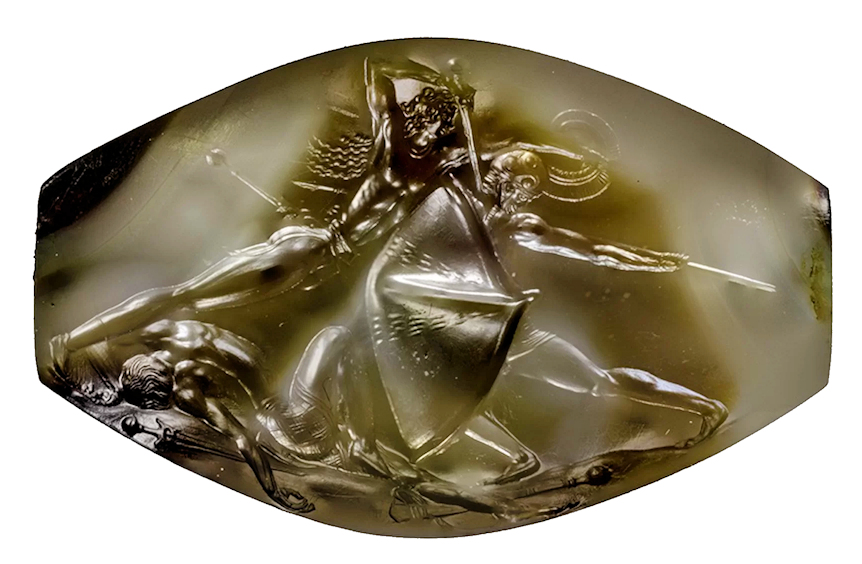
Celebrity-explorers Theodore and Mabel Bent didn’t excavate in the Greek Peloponnese in the 1880s – they would never have been given permits.
The recent state-of-the-art excavations and discoveries at the ‘Griffin Warrior’ tomb, Pylos, Peloponnese, and the present (June 2026) exhibition of its spectacular finds in Athens, give a chance to reflect on the methods employed elsewhere in the Aegean by the Bents in the 1880s: the island of Karpathos (Dodecanese), for instance (and professional archaeologists might like to look away at this point).
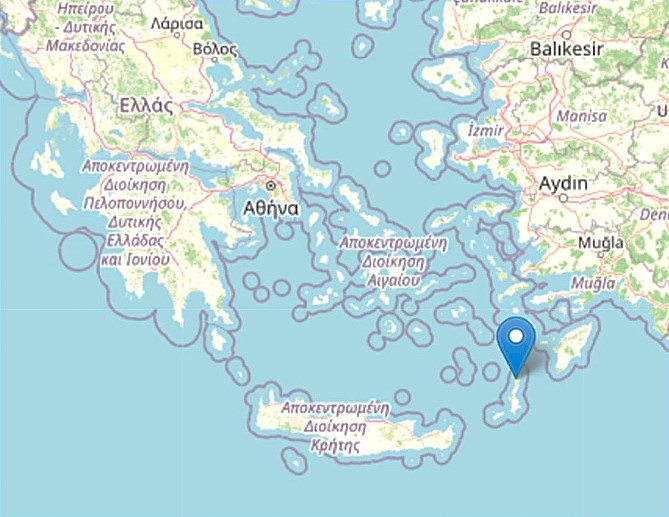
The Bents were on Karpathos after 5 March until before 21 April 1885, some seven weeks, arriving from Tilos (where they found little, camping, ironically, in the old monastery that now acts as bulwark to the new museum, on whose information panels they, inexplicably, go unmentioned).
The couple ride far and wide over Karpathos, before reaching the distant north-western tip and the once notable city of Vrykous (modern Vroukountas (various spellings) [35.80167678950954, 27.16483337973251]). A site busy with people from neolithic times to the 19th century CE, it was one of the island’s important centres in antiquity (see, e.g., Nigel McGilchrist’s imaginative treatment, in McGilchrist’s Greek Islands #16: Southern Dodecanese: Astypalaia, Tilos, Karpathos, Kasos, Kastellorizo (London, 2011).

Arriving from Olympos, via today’s Avlona, the Bent party camped at Vroukountas between 30 March and 2 April 1885, pitching a tent, typically topped with a ‘Union Jack’ it seems, in the level area directly in front of what is now referred to as the cave-church of St John – a strange sight for modern August festival-goers to contemplate no doubt: the Bents washed themselves in the cave’s stone basins and struggled with an unruly tent; their long-suffering dragoman, Mathew Simos from Anafi (in the Cyclades, not very far away to the west) slept outside…
Unaware of these campers, McGilchrist (see above) describes the setting: “At the northern extremity of the promontory, steps lead down into a spacious natural cave deep within the headland… To the left was the spring which served the settlement in antiquity; it is possible that the sanctuary of the Nymphs was here, from which a relief showing Hermes and the Nymphs, formerly immured in the forecourt of the Church of the Koimisis in Olympos, once came. The cave is now organised as the shrine of Aghios Ioannis Theologos, whose screen, font and altar are all composed of various ancient spolia.”
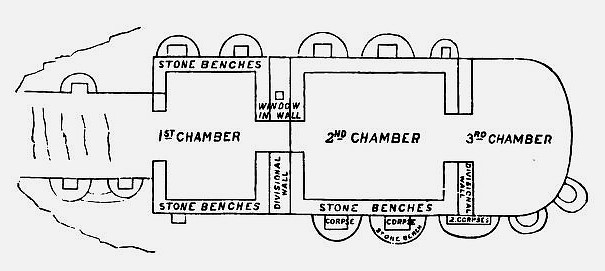
Forty-two years after Ludwig Ross (Ross 1845) had visited the island, without reaching Vroukountas due to bad weather, Bent wrote a lengthy article on his researches for The Journal of Hellenic Studies (1885, Vol. VI: 233-242) and sets the scene: “Brykountios was apparently the most considerable town during both the earlier and later occupations, and as it was situated at the extreme north of Karpathos, about two hours distant from the Elympos, and several days’ journey from the Konak, we were able to pitch our tent there and excavate unmolested… The chief interest connected with the pottery I brought back is that it is the first to come from Karpathos and from these rock-cut tombs. But the tombs themselves were extremely interesting, and the great variety of periods of pottery found in close juxtaposition would suggest that the graves had been used again and again, just as the graves of the Karpathiotes [are] now…” (Bent, J.T. 1885: 236, 237) (Bent kept notebooks of his researches but unfortunately they all seem to have been lost apart from those of his final journey to Socotra and Aden in 1897.)
(Two further interesting characters besides Ross can be introduced here: the swashbuckling Charles Thomas Newton (see later below), who never visited but acquired important Roman antiquities from Karpathos now in the British Museum; and the aristocratic William Roger Paton, Bent’s friend, who did explore the island’s southern region a year or so after the Bents and acquired fine Mycenaean wares there, also now in the BM (Paton 1887; 1889)
Mabel Bent’s account of their stay at Vroukountas, before Easter 1885
Mabel Bent devotes several pages in her ‘Chronicles’ to what was clearly a happy stay at this campsite, which included Theodore’s 33rd birthday, some notable finds, a few memorable meals, and the arrival of family letters (with belated news of the death of General Charles Gordon at Khartoum on 26 January 1885).
Mabel begins her account:
“You must excuse these smudges as I am sitting cross-legged on Theodore’s bed in our tent and was just interrupted by a man who came for two candles Theodore had sent for that he may explore a cave.
We are encamped for four days at Vourgounda. We came here yesterday [30 March 1885] with two mules and two workmen to make excavations on the site of an ancient city. We only took our medicines, without which we never move, necessaries of clothing, and books for four days, food and bedding; but I had so much to sit on that I had to hold with both hands all the way. As I did not fall off I was pronounced an excellent rider by the men.
There is a long rocky point jutting into the sea on the west of Karpathos, far north, near Tristomo and covered with ruins. Here everyone lunched at noon and then Theodore set the men to work and I went to the end of the point and had the tent pitched by a high rock, which shelters us from south winds. As Sunday night was the only rainless one we have had this long time, the ground was dry and by great good luck we have a level, gravelly floor.

Neither Mathew nor the other two men had ever seen a tent before, so beginning with turning right side out I had to lead by example and prompt and instruct them in everything; all in Greek too. Do not think I had only to cause the pegs to be driven into the ground and put the eyes or guys, or whatever you call the ropes, over, no, only one peg is done like that. No two ropes are the same, either as to length or the angle from the tent: some are under rocks, some are round rocks, some are over rocks, and one had to be strung through a hole in a rock… I was tired enough in my tongue and limbs when, after hoisting the Union Jack, I sat down to survey the tent, and, really, the ropes all dancing have a very funny effect. The sun was hot outside but it was hotter still setting up the beds inside, ‘tromero sesti’ as they said.
After that I went to the workmen, who had discovered the pavement of a Byzantine church. We turn up our noses at anything ‘tis Vizantines epoches’, so Theodore took them elsewhere.
Soon after our arrival, a messenger came and brought us two letters, the first we have had for more than five weeks and our first news of poor General Gordon’s death. As soon as we had joyfully read them we began to lament the many more that had been lost, but two or three hours later another man came with 23, and two newspapers, February 7 being the latest, and March 9 the latest letter.
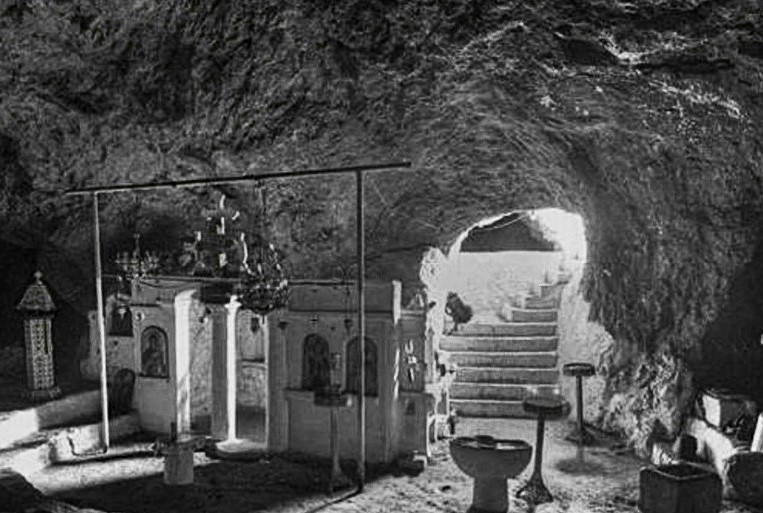
When the sun set we scrambled home. Next to our tent is a little hut built against the wall as a kitchen for pilgrims who come to a little chapel in the cave beneath. A very steep path leads to the small round entrance and several flights of steps lead down into a large cave. The holy place is shut in by a low wall and some pillars which do not touch the roof. Holy water drips into two little stone troughs and thither we hie with our sponges and towels to wash. The workmen sleep among the rocks; there are plenty of caves about. When it got dark we went to the kitchen to dine. It was Theodore’s birthday.
The sacks of my bed and the tent were laid as a tablecloth on the soft wet earthen floor. We sat on two stones. Theodore leaning against the middle post supporting a lambskin full of water, and I, as I found afterwards, very few inches from the lamb of the period. Mathew built a table and seats next day. All the rocks and stones around were full of food and pots and a candle stuck by its own wax to one of them shed a dim light, except once when it tumbled down and went out.
We had a soup of lamb’s head and a lot of herbs picked by the wayside, onions, and a handful of peas someone had given to Theodore to eat raw. Then the brains and tongue boiled. Then the liver fried; a bowl of sheep’s cream and sugar. Some wine from Samos and coffee. We then strolled on the rocks by moonlight and complained to each other that we did not feel at all excited at the idea of our first night in a tent – indeed, I think all we felt was satisfaction at the idea of a clean, dry shelter.
Mathew spread his bed on brushwood in the kitchen. I undressed outside that I might bring in no fleas. As I had spread all our bedding in the sun, for once it was dry and our clothes in the morning were quite dry too. It rained in the night and Theodore had to go out about two to loosen the guys, and the north wind came on in the morning, so they had to be tightened again.
It is a cold dark day and the sea wild and black. We breakfasted outside. Theodore has gone to dig graves today and I am remaining at home enjoying great peace, nooked in where no one can stare. I am just going to have another read of the letters.
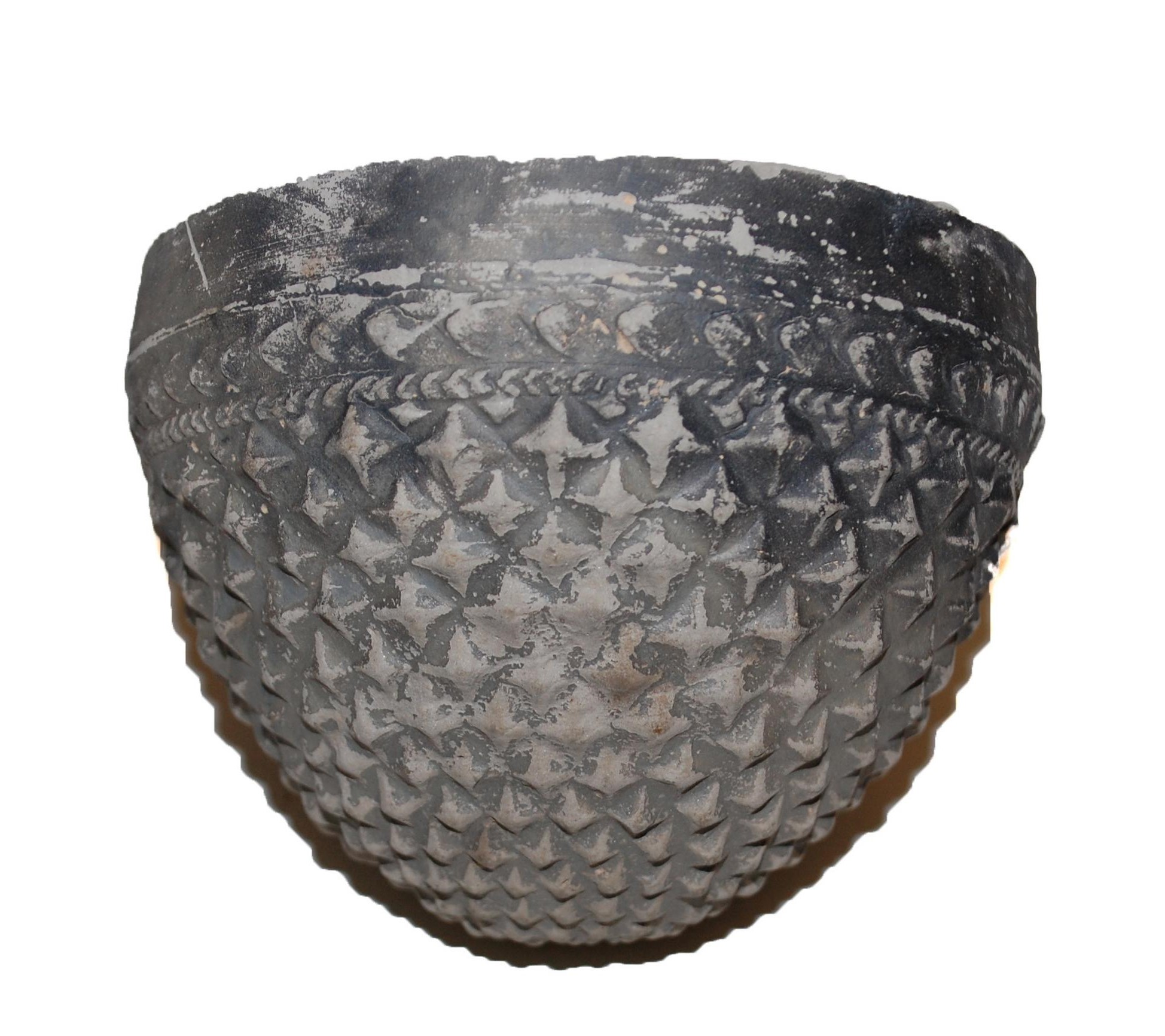
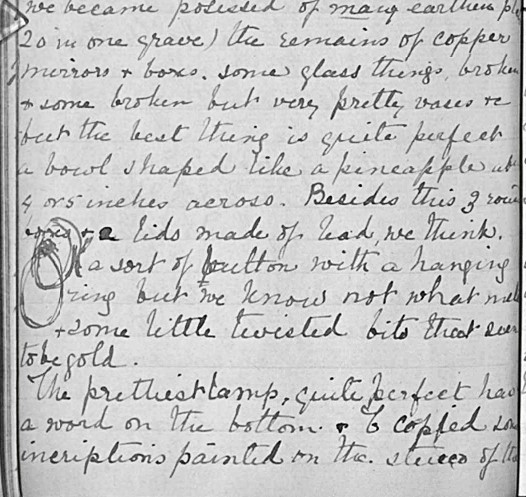
In the afternoon, or rather about 10, I went and with difficulty found the diggers, as they were in catacombs whose openings were quite invisible from above. They had already begun to find things, though many of the graves had evidently been opened in the Byzantine times. Most things were broken but still there were many whole and during the whole time we became possessed of many earthen plates (20 in one grave), the remains of copper mirrors and boxes, some glass things broken, and some broken but very pretty vases, etc. But the best thing is quite perfect – a bowl shaped like a pineapple about 4 or 5 inches across. Besides this, three round boxes and two lids made of lead, we think, a sort of button with a hanging ring, but we know not what metal, and some little twisted bits that seem to be gold. The prettiest lamp, quite perfect, has a word on the bottom and Theodore copied some inscriptions painted on the stucco of the vaults. We are altogether very much pleased with our success, and if we do not find things on Saría may return…
On Thursday morning (March 31st, I mean April 2nd), I did not go at all to the digging. To get there one must climb up, down, or over 17 walls, and as I did this three times the day before, besides wandering in search of tombs, I am sure I had a good deal of climbing. I was not much use as the men preferred grouping themselves round me when Theodore’s back was turned, talking to me, looking at my eyeglass, scissors, gloves, never before seen in Karpathos I am sure, and asking innumerable questions. In vain I suggest they should work but when the ‘aphentiko’, as they address Theodore, comes it is different.
Besides there was much to do in cleaning out the earth from the pots with very little water. I had to mind the camp while Mathew went to seek a meal in the sea. I had a visit from five women and girls who, without any ceremony, called me nothing but Verghinía. This is the first time I have not been called Kyria Verghinía, but I suppose these people really never have seen anyone superior to themselves and their only idea of a ‘Kyria’ must be the Blessed Virgin. They said ‘come with us Verghinía and we’ll give you cream’, but they terrified me by playing with the pots and I gave them no encouragement to remain and was glad when they left.
I packed our personal possessions and the more delicate ‘finds’ and after luncheon Theodore went off again and I broke up the camp with Mathew, though Theodore had sent me a man, which I told him was quite unnecessary. The man was busy all the time turning a lamb into food, which I fortunately did not find out till he was dead. By the by, Mathew had not slept a 2nd night in the kitchen, which was really as airtight as a nutmeg grater, but taken refuge in a cave about 30 feet above our heads.
We had three mules as we had two huge baskets of pots and seaweeds. About 4 pm, Theodore and his men came and everything was carried about three-quarters of a mile and they and I were loaded on the mules and we reached Elymbo by dark. Sunny day.
Good Friday was a fine sunny day and we unpacked the panniers, for we were quite too tired to look at anything on our arrival. It is very exciting work digging – first finding something, then is it whole? Then have we all the pieces? The men grind the edges trying to fit them, and any metal they cut with their knife. Fortunately they never saw the little boxes. Theodore found and pocketed them.
We cleaned as much as our limited means would allow (a milk jug and a Russian wooden bowl such as grocers have with 2 lbs of tea). We packed the pots into three boxes, all except a very large earthenware jug, two of which were found whole and one of which Theodore gave away. It is to be carried loose all the way home and now we empty our bowl into it. These two days before Easter are employed making bread and cakes with red eggs stuck into them and every oven is smoking…” (Bent, M.V.A. 2006: 99-125)
(We leave the Bents here; they now return to Olympos for the Easter celebrations…)
The Bents’ collections from Karpathos
Restrictions on the unauthorised removal of antiquities from Greece were already in force when the Bents were active in the Aegean (1880s). The position for Turkish areas was arguably more fluid, but from Mabel Bent’s notes in her diaries it is clear that had their ‘finds’ from Vourgounda been inspected on the waterfront, contemporary warehouses can still be seen at Pigadia, they would have been confiscated immediately. Just a few years later, the couple had considerable difficulties along the Turkish littoral, exiling them to distant regions (Africa, Arabia) under ‘British Protection’ where they could excavate freely.
The many crates, cartons and sacks containing the Bents’ acquisitions from Karpathos (including some very important village embroideries) left with the couple on the steamer Roúmeli on 21 April 1885. Mabel records in her diary: “The next excitement was getting the things at Pegadhia. I decided to remain on board and became a perfect queen-bee. I gave up moving at last for I was always followed. I eagerly watched the proceedings on shore. Mathew set off to run to the house where was a very hideous statue, more than the size of a baby, half a mile off. Theodore and the Turks sat down at the café… We mean to deposit it in bond at the customhouse of Syra with all the cases and things we do not want.”
Fierce storms forced the Roúmeli to seek shelter (as St Paul is said to have done) at Kali Limenes, southern Crete, before continuing via Kythera to Syra: “At Kythera a ‘manifesto’ was made and signed by the captain, saying he had picked us, and our cases, up in Turkey, and by the Kythera customs people to say we had not started from there… And now Thursday [23 April 1885] we are at Syra, all the things are in the customhouse, the great jars tied up to the wall.”
With, according to Mabel, all their acquisitions and paraphernalia (via Messina and Malta): “We reached home via Millwall Dock in safety with our 24 pieces of the most varied luggage, and I am more convinced than ever that there is no place like it.” Unfortunately she does not add a date, but it will have been around the middle of May 1885 – too late for them to attend the Hellenic Society meeting of 7 May, but Theodore did speak about the Karpathos finds at the Annual Meeting on 25 June (Bent, J.T. 1885: xlv). (For all Mabel Bent’s diary entries, see Bent, M.V.A. 2006: 99-125)
From Syra, Bent wrote a candid letter dated 24 April 1885 to Sir Charles Newton (see an earlier reference to him above), at that time Keeper of the Department of Greek and Roman Antiquities at the British Museum. The use of the word ‘plunder’ is jarring : ‘We returned from Karpathos yesterday and had hoped to catch a steamer which would have brought us and our things straight to England. Unfortunately we shall have to wait a week at least, and as we have so much plunder we cannot take the Marseilles route… We were fairly successful in Karpathos, finding a large number of rock cut graves unopened which have produced pottery, etc., which, if not of the highest order, offer a good deal which I believe to be of a new character. I have likewise got a good-sized statue of one of those quaint figures which I got at Antiparos last year; it is of stone and nearly a yard long. It is decidedly uglier than any which have yet come to hand. Of quaint manners and customs I have got a fine collection, also of old Karpathiote dresses and jewelry… We had rather a rough time of it, Karpathos being very far behind the world in comforts, and decidedly we enjoyed ourselves best when living in our own tent. Mrs. Bent survives and is well and begs her kind regards. Yours very truly, J. Theodore Bent” (Archive of the Department of Greek and Roman Antiquities, British Museum)
Items from Vroukountas purchased by the British Museum from Theodore Bent in 1886 (* = on display at the BM as of June 2026)
‘Grave 1’
- 1886,0310.13: kantharos, black-glazed ware. Attic, 325 BCE – 310 BCE. Grave 1, purchased 1886 from JTB.
- *1886,0310.12: oinochoe, red-figure ware. Attic, 370 BCE – 350 BCE. Grave 1, purchased 1886 from JTB.
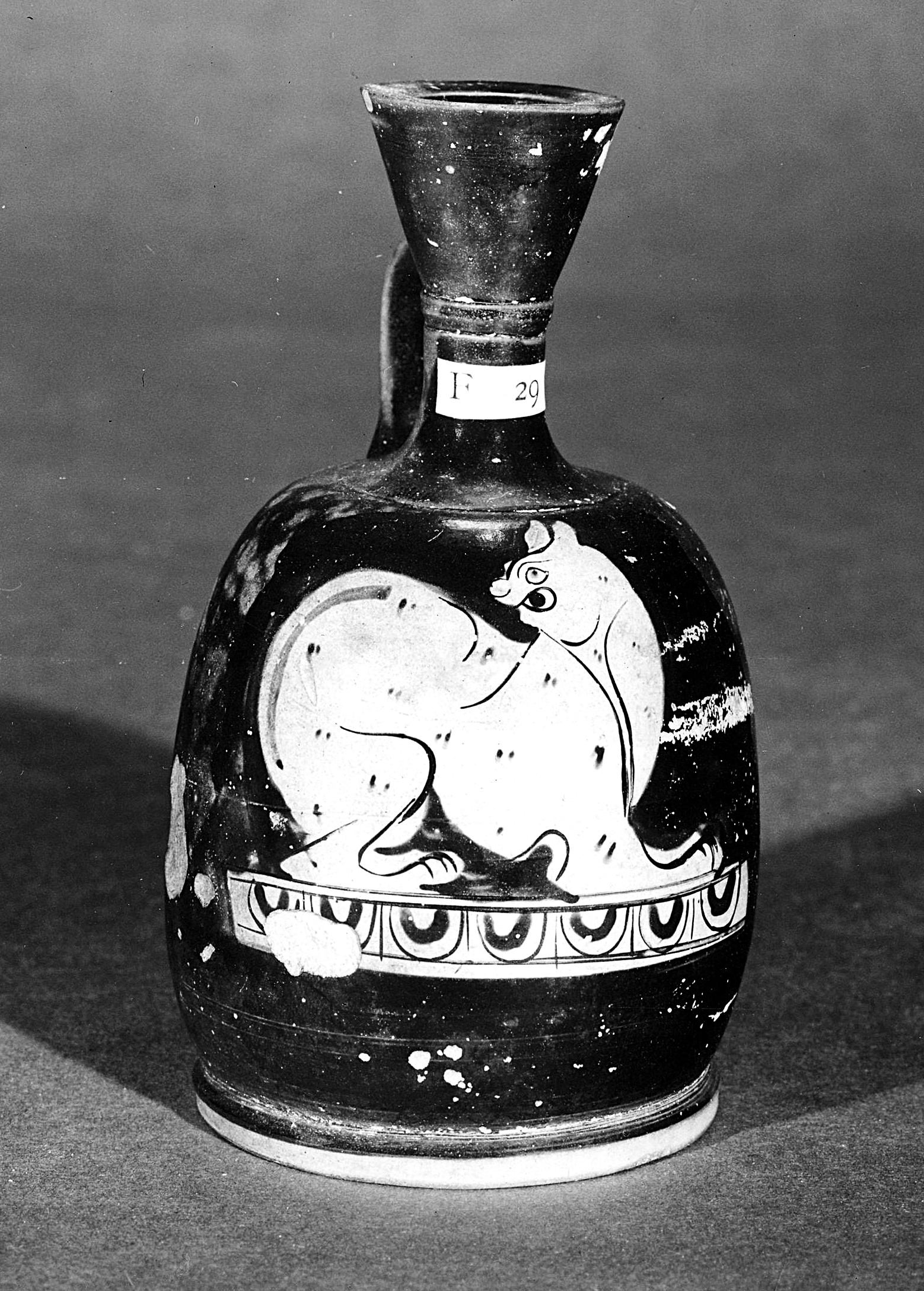
- *1886,0310.15: squat lekythos, red-figured ware. Attic, 430 BCE – 400 BCE. Grave 1, purchased 1886 from JTB.
- 1886,0310.14: drinking-cup, black-glazed ware. Classical, 425 BCE – 400 BCE. Grave 1, purchased 1886 from JTB.
- 1886,0310.4: lebes gamikos, decorated red and black. Hellenistic, ca. 3rd c. BCE. Grave 1, purchased 1886 from JTB.
‘Grave 2’
- 1886,0310.5: hydria, red-painted, buff paste. Hellenistic, 4th c. BCE – 1st c. BCE. Grave 2, purchased 1886 from JTB.
- 1886,0310.6: Megarian bowl, black ware. Hellenistic, 3rd c. BCE – 1st c. BCE. Grave 2, purchased 1886 from JTB.
‘Grave 3’
‘Grave 4’
- 1886,0310.16: hydria, plain ware. Hellenistic, 3rd c. BCE – 2nd c. BCE. Grave 4, purchased 1886 from JTB.
- 1886,0310.17: kantharos, black-glazed ware. Attic, 325 BCE – 310 BCE. Grave 4, purchased 1886 from JTB.
Unspecified graves
- 1886,0310.9: lamp, worn black slip. East Greek, 150 BCE – 51 BCE. No grave specified, purchased 1886 from JTB.
- 1886,0310.8: wheel-made lamp, black slip. Hellenistic, 200 BCE – 76 BCE. No grave specified, purchased 1886 from JTB.
- 1886,0310.2: lekythos, white ground. Corinthian, ca. 500 BCE – 450 BCE. No grave specified, purchased 1886 from JTB.
- 1886,0310.20: amphora handle, light-pink/brown. Hellenistic (Rhodian), 230 BCE – 160 BCE. No grave specified, purchased 1886 from JTB.
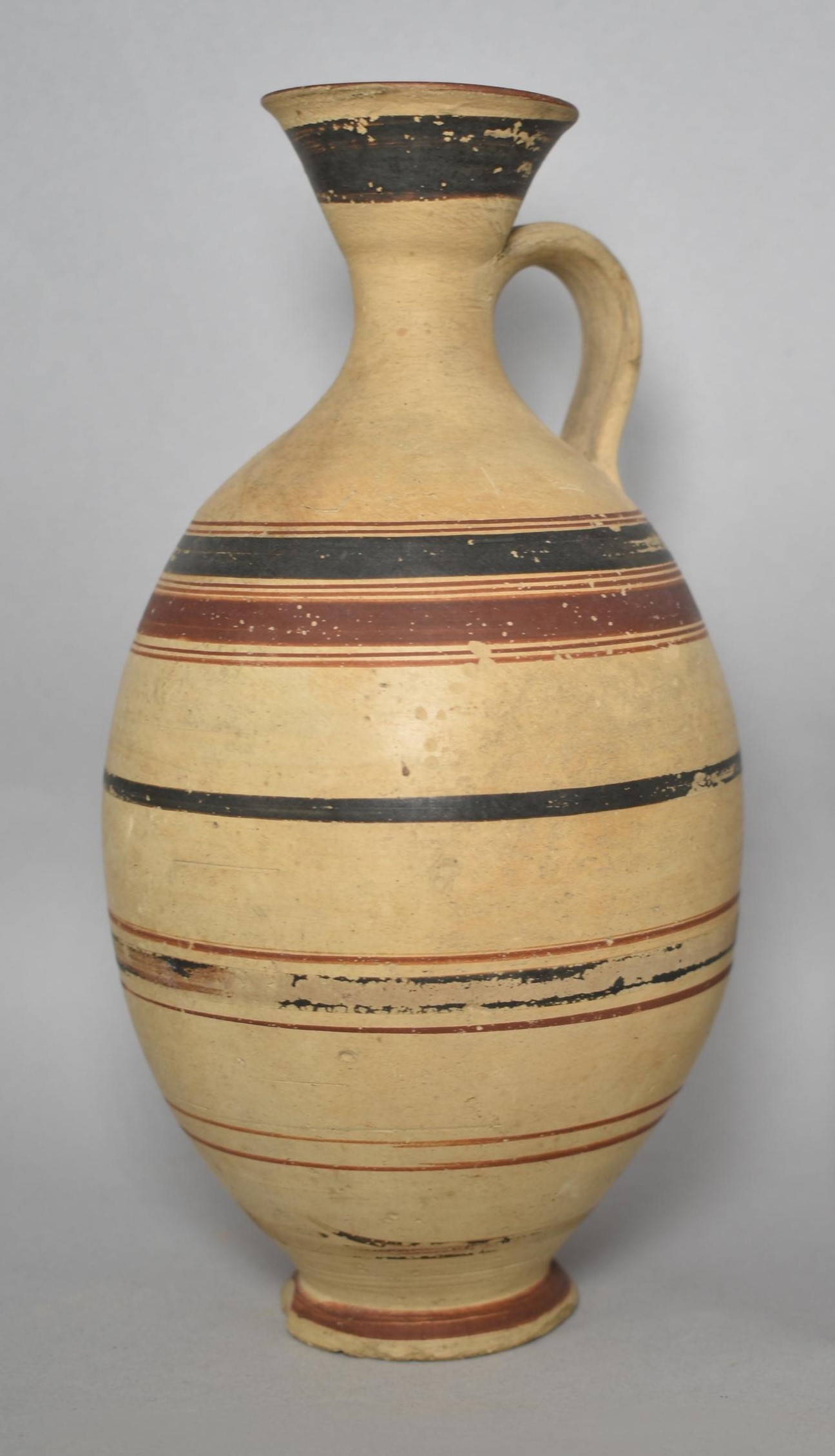
- 1886,0310.3: unguentarium, decorated, white and red. Hellenistic, 3rd c. BCE – 1st c. BCE. No grave specified, purchased 1886 from JTB.
- *1886,0310.18: ‘Lamp-filler’, Athenian black-glazed ware. Attic, ca. 5th c. BCE. No grave specified, purchased 1886 from JTB.
(The Bents returned to London from Karpathos in May 1885, i.e. suggesting a period of deliberation and negotiation by both parties. Many finds referred to by Mabel in her diaries, and Theodore in his article for the Hellenic Society, i.e. the mysterious ’20 plates’, the large pithoi, etc., did not go to the BM and are presumably in various other collections today, unprovenanced. Over the centuries, how many other adventurers have come and gone among such islands, removing similar artefacts?)
Items from Vroukountas donated by Mabel Bent to the British Museum in 1926
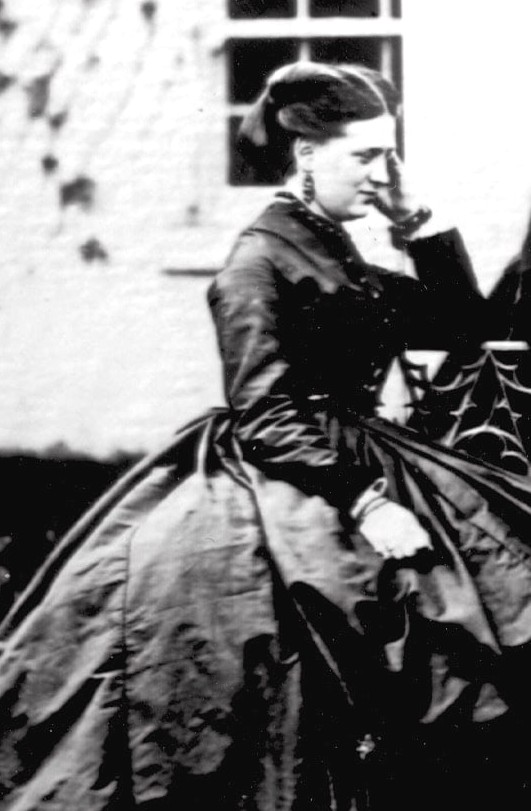
The Bents leased a fine townhouse near Marble Arch, London, at 13 Great Cumberland Place; Mabel continued to live there until her death in 1929. It was a veritable museum, if not a treasure chest, of decades of collecting and inherited items and clearly she wanted to hold on to certain souvenirs of her travels with Theodore, or items that were particularly decorative – including some discoveries from Vroukountas made during that obviously happy spring of 1885. Towards the end of her life she was inevitably thinking of what was to happen to her collections (alas, creating some sort of permanent home for them does not seem to have been considered). In her will, everything was left to her surviving sister, Ethel Bagenal (or effectively her two daughters, i.e. Mabel’s nieces). However in 1926 Mabel presented to the British Museum a large number of artefacts from all the regions they had travelled to, including the following Vroukountas pieces (they lack specific grave numbers):
- 1926,0410.42: kantharos, black-glazed ware. Attic, ca. 4th BCE. No grave specified, donated 1926 by MVAB.
- 1926,0410.41: kantharos, black-glazed ware. Attic, ca. 4th BCE. No grave specified, donated 1926 by MVAB.
- 1926,0410.40: salt-cellar, black-glazed ware. Hellenistic, ca. 3rd c. BCE. No grave specified, donated 1926 by MVAB.
(For an overview of the Bents’ collections see this summary)
The ‘Karpathos Lady’
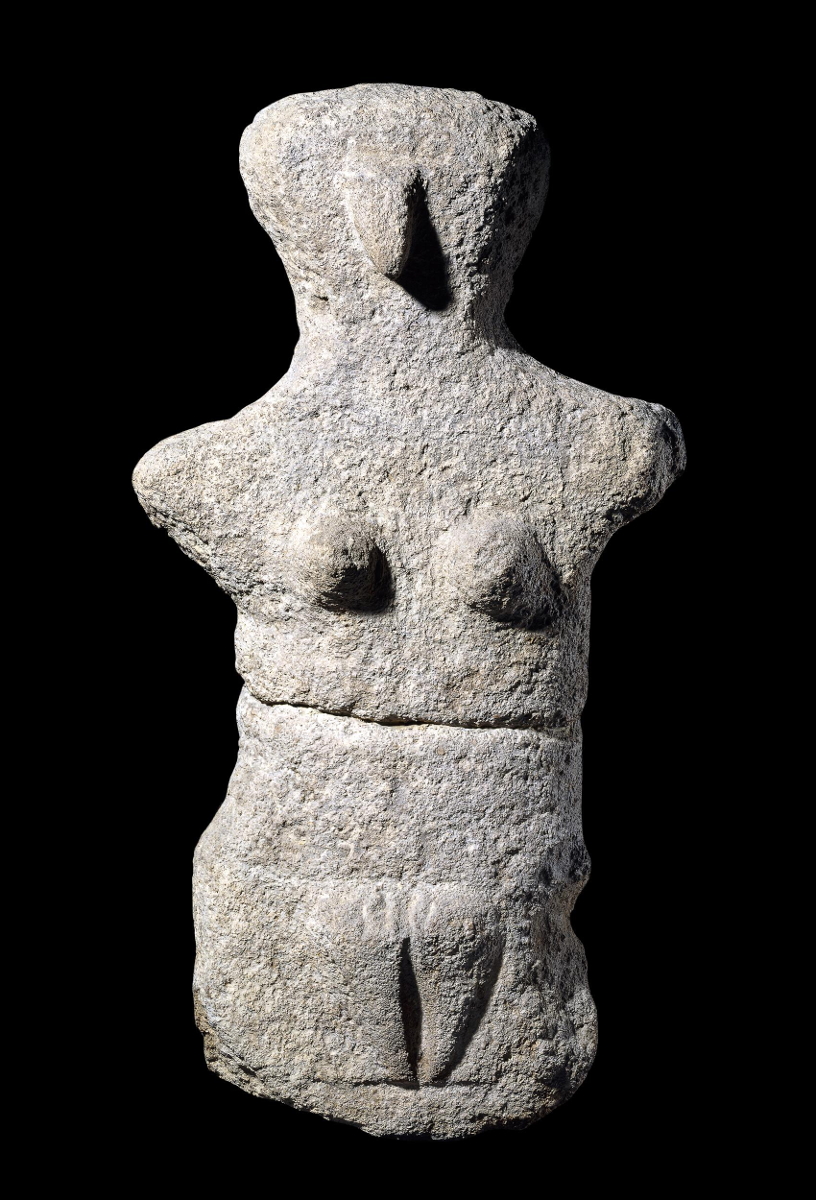
“[At] Pegadia or ‘wells’ … there are evidences of pre-historic inhabitants, the graves of whom I was unfortunately unable to open owing to the presence of the Turkish authorities, but I was able to obtain a large stone figure of a female idol, similar to the smaller ones I found at Antiparos…” (Bent, J.T. 1885: 235)
This is the most bizarre of all the Bents’ acquisitions from any of their travels – an enigmatic stone figurine, still without a known parallel. The British Museum’s data record its findspot as Vroukountas, but the Bents purchased it from the Pigadia area; it left Karpathos whole, clandestinely in a blanket, but now is shown mended (in two parts).
Not currently exhibited (June 2026), it is a much travelled object, having featured in loan exhibitions to the Far East. (How Bent can think it resembled one of the marble figurines he recovered from Antiparos in 1884 is hard to explain.)
Bibliography
Bent, M.V.A. (1885) Her Chronicle in the Sporades &c., 1885, Archive of The Hellenic Society, London.
Bent, M.V.A. (1900) Southern Arabia, London.
Bent, M.V.A (2006) The Travel Chronicles of Mrs J Theodore Bent, Vol. 1, Oxford: 99-125.
Bent, J.T. (1885) ‘The Islands of Telos and Karpathos’. The Journal of Hellenic Studies, Vol. VI: 233-242.
Paton, W.R. (1887) Vases from Calymnos and Carpathos. Journal of Hellenic Studies, Vol. 8: 446-460.
Paton, W.R. (1889) Mycenaean tombs in Carpathos. The Classical Review, Vol. 3: 333.
Ross, L. (1845) Reisen auf den griechischen Inseln des agäischen Meeres, Vol. 3, Stuttgart: 50-69.
Further reading
Bent was very much taken with elements of Karpathian life and wrote several articles:
-
- ‘Rock-Cut Tombs of Carpathos’. Athenæum, 1885, Issue 3002 (May): 606.
- ‘The Carpathiote Dialect’. Athenæum, 1885, Issue 3011 (Jul), 48.
- ‘Idyls of Karpathos’. The Gentleman’s Magazine, 1885, Vol. CCLX (Jan-Jun): 185-190.
- ‘A Christening in Karpathos’. Macmillan’s Magazine, 1886, Vol. 54 (May/Oct): 199-205.
- ‘On a far-off island’. Blackwood’s Edinburgh Magazine, 1886, Vol. 139 (Feb): 233-244).
There are several (June 2026) spectacular videos of the location on YouTube, e.g.:
 Leave a comment or contact us about this article