
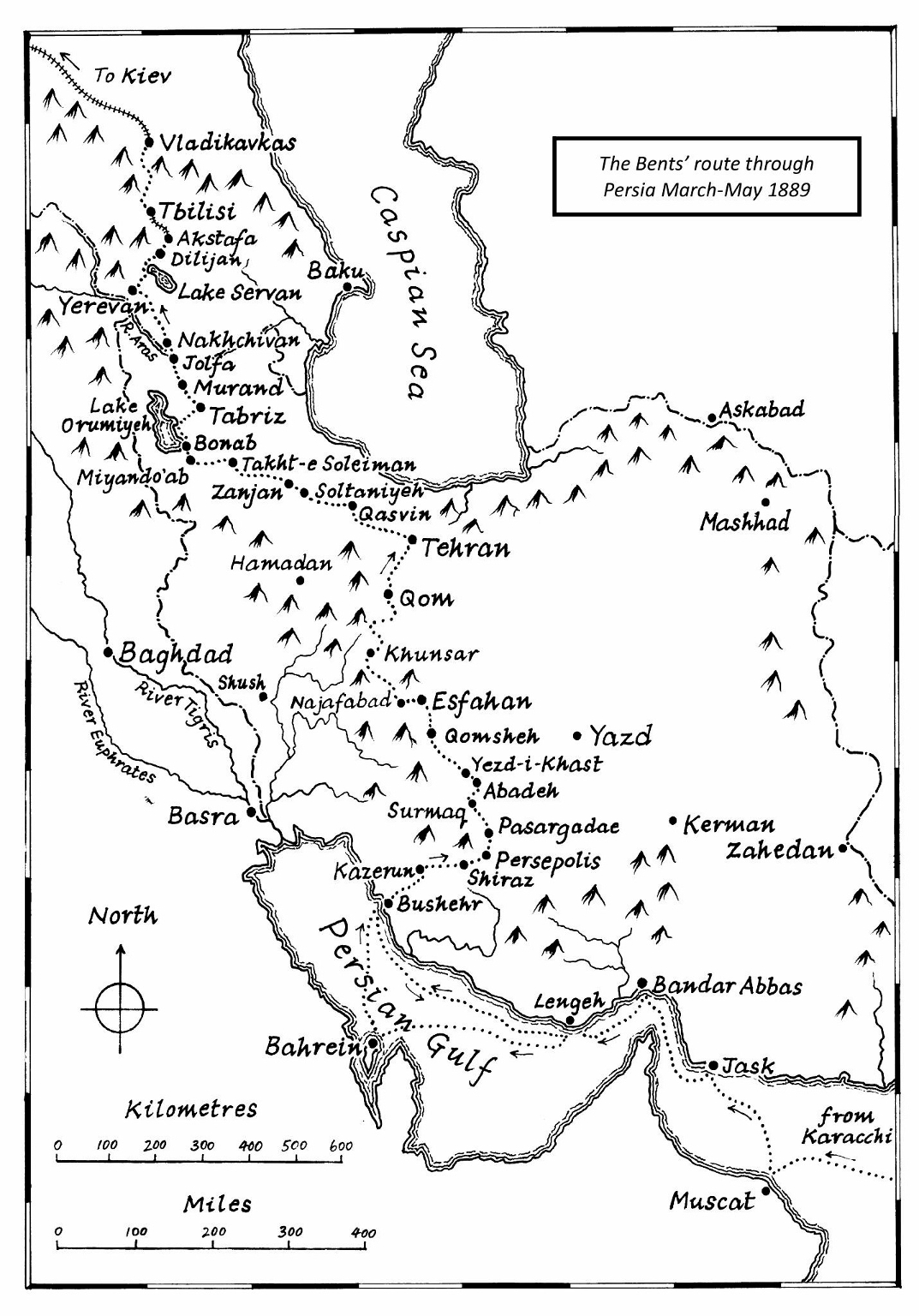
Celebrity explorers Theodore and Mabel Bent marked the Persian New Year (No-Rooz) of March 1889 at Yezd-i-Khast, south of Isfahan. The couple were on a famous ride, south-north almost the whole length of Persia, returning to London from Bahrain.
Mabel’s account of the ride from her diaries is transcribed in The Travel Chronicles of Mabel Bent, Vol. 3 (Oxford, 2012), whereas Theodore wrote to articles about the trip, the second being the account of New Year as Yezd-i-Khast, transcribed below.
- ‘How H.M. The Shah Travels When at Home’. The Fortnightly Review, Vol. 52 (46) (Jul), 71-6. [Reprinted in Littell’s Living Age, 1889. Vol. 182 (1889), 457 ff.]
- ‘New Year’s Day in a Persian Village’. English Illustrated Magazine, Vol. 76 (Jan 1890), 326-31.
New Year’s Day In A Persian Village, by J. Theodore Bent

Several motives induced us to stop at Yezd-i-khast for the Persian New Year’s festival or Aid-i-No-Rooz, as they call it there. Firstly, we were personally very tired of our caravan journey up through this country of mountain and desert; secondly, our muleteers, without positively refusing to go on, made it understood that they would consider it a great favour to do so; thirdly, Yezd-i-khast is one of the most extraordinary places in Persia, a paradise for the sketcher and photographer, and here in the midst of this primitive life, quite the oldest of New Year’s customs could be with advantage studied.
Curiously enough we had reached our destination almost exactly at the hour at which the Persian New Year was commencing, namely, at one o’clock on the 25th of March, the moment when the sun entered Aries, and it was amusing to see how excited every one became at this juncture; how on the firing of certain guns, which announced the propitious moment, every man saluted his neighbour with a kiss, saying as he did so, ‘May your New Year be happy’; how they strove to have money in their hands or something of value, that the New Year might produce for them much of it. This is the origin of that funny present of coins given by the Shah on New Year’s day to his Ministers and foreign Ambassadors, gold and silver coins, which are not taken in circulation, but are made by the recipients into ornaments for their wives.
Whilst we are unpacking our beds and making ourselves as comfortable as circumstances will permit in a room closely resembling an outhouse in a farmyard, let us for a moment ponder over the obscure origin of this Persian New Year festival. It is perhaps the oldest festival celebrated in the world. The Persians themselves, with their love of the fabulous, will tell you that their mythical hero, Jemsheed, instituted it, he who built Persepolis and entered it on New Year’s day, he who invented the plough, the fairy godmother in fact of Iran. He divided time into two kinds of years, civil and religious, and instituted the feast of the New Year to commemorate the event, a feast which in those long-past ages lasted only for six days, but which in these degenerate days has been extended to thirteen, during which time everything in Persia is more at a standstill than usual, so that you can hardly obtain the ordinary necessaries of life in the bazaars.
All that is certain about the festival is its extreme antiquity. Centuries ago the Persian poet, Firdousi, describes it in his verses as a time of protracted feasting and idleness much as it is now, and though the moon is made to govern the present official year of the Persian, the sun still governs the agricultural; the farmer of to-day speaks of the reaping month, the sowing month, the ploughing month, he does not understand names of so modern an invention as the early Mussulman conquest, he goes back to the days when the sun governed everything in the land, and the now almost extinct influence of the sun-worshipping Parsee was supreme.
Hence the festival of the No-Rooz is a distinct survival of the days of sun-worship, it marks the commencement of a new life in nature, it attributes the bursting forth of Spring, the return of warmth, to the rays of the deity, and the existence of such a festival in a Mohammedan country is a concession from the new order of things to the past, a concession which is further recognizable in the calls to prayer from the minaret at sunrise and sunset, the universal prostrations just before and after the rising and setting of the great heavenly luminary, and many other little acts of daily life, which have survived from sun-worshipping days in Persia.
The No-Rooz is distinctly the ‘Christmas’ of the Persians, the great family feast, at which everybody gives and receives a present; the heads of families keep open house, and the women in their harems consume an unconscionable amount of sweets. Wherever we had stopped for weeks before, each household was busying itself in preparing its No-Rooz sweets, and in such towns as Yezd and Ispahan enormous quantities are manufactured three months before and dispersed for sale over the country by caravans. Eggs are collected for weeks beforehand and hard boiled, coloured red and yellow, exactly like our Easter eggs, pointing to the same origin-the commemoration of springtide, and the resurrection of nature from its grave. In their season fruits of all kinds, melons, grapes, apples and pomegranates are cunningly preserved and stored away for consumption during the festival of No-Rooz.
At the Shah’s court the system of New Year’s gifts is carried on to an alarming extent. His Majesty, if he wishes to reward a faithful servant, sends him into the provinces to collect these New Year gifts; he is authorized to get for himself what perquisites he can, and, as usually happens, the middleman gets the lion’s share. At this festive season coats of honour are sent to governors of provinces, mayors of towns and leading dignitaries, the price to be paid for receiving the honour being usually stipulated beforehand. The very common Persian word of ‘pishkesh’ (present), a word by no means confined to this season of the year, is on everybody’s lips from the Shah on his throne down to the humblest individual in the village. The dervishes are perhaps the worst beggars of all. At No-Rooz they get from their chief, the dervish bashi, their orders, and are billeted, so to speak, on stated individuals. With their ragged clothes, knobbed stick, wallet, and horn they duly appear at their victim’s door, without cessation blowing their horn and screaming ‘Yahák, Yahák!’ until their New Year’s gift is brought. If this does not satisfy them, they pitch their tent at his door and blow their horn, until they have reduced the householder to order.
Two hundred feet above us towered the lofty rock on which the town is perched. Its tiny wooden balconies hang over space and look terribly insecure; here live the inhabitants, and from here they cast their offal to the terror of those below; beneath, in caves cut in the rock, live the flocks, and from amongst the fields around spring up uncanny looking boulders, which at various times have been detached from the rock above. The aspect of the place is quite awe-inspiring, and as we wandered on the mud roof of our home above the stables we thought we knew not a place in the world with which to compare it.
The village, or town I suppose we ought to call it, is built on the top of a long, lofty rock, rising up in the centre of a narrow ravine-a truly historical ravine – which in bygone ages was a portion of the boundary line between the two kingdoms of the Medes and Persians, and which now divides the two provinces of Persia of Fars and Irak Adjemi, the scene of many a bloody conflict, even within the memory of man.
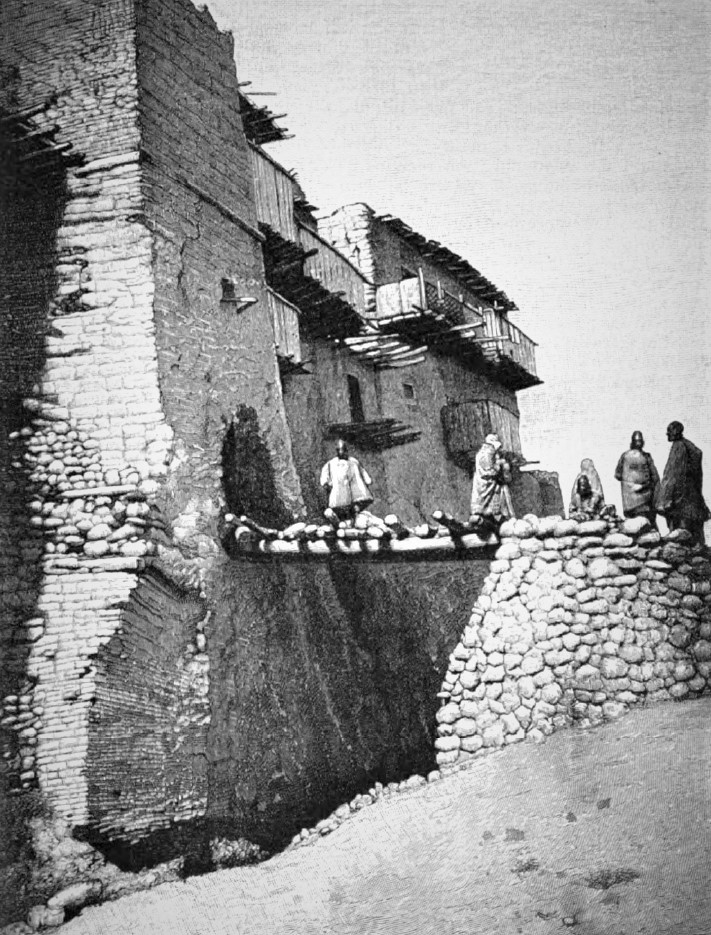
There is a gradual ascent in a southerly direction from the post-house, which is situated at the northern end of the rock; we passed by enclosures for the cattle of the community and deep caves, where the newly-born of goats and sheep were skipping and bleating, until at the south end of the rock a spot is reached where the ground is so high that by a rickety bridge you can cross a chasm, and enter the town through a hole in the wall; in former years there was a drawbridge, now there is only a frail thing made of trees, which requires a good head and firm step to cross. This is the only approach to the town.
Just before you step on to the bridge there is a small square enclosure for public prayers, it is the great meeting place of the town, and towards sunset on the first day of the year it was so crowded by worshippers that there was not nearly room for them all, and they had to make their prostrations in their turn. Everybody appeared to be dressed in new clothes, for no Persian however poor would enter on a new year without some new garment, and they all looked particularly clean, for it is the custom on the day before the feast for everyone to go to the bath, to have his hair dyed black and his nails dyed yellow with henna.
I never saw a more dismal spot in my life than the interior of Yezd-i-khast. One long street like a tunnel, with occasional glimpses of the upper air, runs from one end of the rock to the other; as you enter the gateway the chilly atmosphere of a vault strikes upon you. The gatekeeper was in his hole to the right, behind the door which he shuts at night – a hole not large enough to lie down in. He was crouching over a charcoal brazier, on which simmered a coffee-pot; he is a blear-eyed, ragged old man, who looks as if he was in a perpetual shiver, and as if he was immured alive in a tomb, which any respectable corpse would reject with scorn. As we stumbled along in the dark, we nearly fell over an old woman selling dried grapes and other luxuries, using as weights round stones and shells in a pair of scales which any inspector would condemn at first sight. They took us to see the mosque, a tumble-down structure, with worm-eaten screens and pulpit, walls all over scribblings and pictures, we presumed, by local artists; to the left of the mosque is an open platform built over space and affording an alarming view into the abyss below. Into the walls of this sacred edifice are built several fragments from an ancient temple-probably a fire-temple of the old Zoroastrian days; on the hills all round are ruins of temples of this ancient cult. This neighbourhood was in the very heart of the fire-worshippers’ region, so without doubt so conspicuous an eminence as Yezd-i-khast must also have had its temple.
Our first visit next day was to the Mayor, who gave us a very cordial welcome at the top of his stairs. He was very grand indeed to-day, in his coat of honour (kalat), a beautiful quilted coat of white cashmere embroidered with red. On reception days the Mayor must always wear this mark of honour, about which we were not a little curious, and learnt that the Prince Governor of Shiraz had given it to him on New Year’s Day, two years ago, and he told us furthermore how he had had to go two stages on the road to meet it with the best retinue he could muster, and how he had had to give a sum equivalent to £50 for the honour, fully twice as much as it was worth. This sum had been fixed beforehand, and he had had to sign a written document to the effect that he had received the coat and had given so much for it; so mercenary have honours become in Persia. Now, the Mayor of Yezd-i-khast is entitled to the title of khan, having at the same time received a firman or letters patent, which he had to wear in his cap for three days so that all the world might know the honour which had befallen him, and any one refusing to acknowledge his position would henceforth be liable to be punished capitally.
The Mayor’s room was dingy, but of festive appearance, the mud-floor was spread with carpets, the brass ‘samovar’ or tea-urn was hissing pleasantly, trays of nuts, dates, and various kinds of dried fruits were spread around, and in solemn circle squatted on their haunches all the notables of the place were smoking their water-pipes. As each guest came in, he greeted the Mayor and wished him a good New Year; equals kissed him on both cheeks, inferiors only took his right hand in theirs, and after giving it an affectionate squeeze raised it to their lips to kiss.
After taking leave of the Mayor we were pounced upon and carried off to the residence of the mollah, or parish priest. His reverence was seated on his carpet, with a clean white turban and new flowing robes. His water-pipe was bubbling away and placed on a dish in which seeds had been sown some weeks ago, so that they might grow up green and fresh for the New Year’s festivities. This is a common custom in Persia. Every good housewife will have a dish of green corn ready for the feast of No-Rooz. It is a sort of symbol of the return of spring, an offering to Demeter, a survival of paganism; this dish is kept in the house for the thirteen days of feasting, and the corn is then thrown away. Also they will take a lump of young wheat from the field, roots and all, and this they will stick over their doors and not pull it down till it is withered.
Next we visited the cemetery of Yezd-i-khast, which is gathered around a little sacred tomb containing the remains of one Imam Riza, of holy memory. It is quite a plain building of red bricks, with a dome, around which on this festive occasion many people were gathered. The most devout kissed with avidity the walls of the tomb; the more callous walked past and chatted gaily; the more sentimental went and had a wail at the tombs of their departed relatives, and then joined the gay and festive concourse again. It is the fashion for all the world to go to the tombs on New Year’s Day, and it was a curious scene. We stood at a little distance and watched, until we became aware that our presence was not appreciated by the multitude; sundry stones were cast at us, angry voices were raised, the volleys increased in intensity, actually falling within a few feet of us, so we felt obliged to beat as dignified a retreat as we could ‘under fire’.
We thought it necessary to let the ket-khoda know that, though unhurt in body, we were hurt in mind at the indignity we had suffered, whereupon a deputation of the chief men of the place waited upon us, begged us to believe that the casters of the stones were some ruffians from another village whom they had no means of punishing as they deserved, and implored us to say nothing about the matter at Ispahan, or else they, our best and dearest friends, who would not for worlds that a hair of our heads should suffer, would have a heavy fine to pay, and get into discredit at head-quarters; for the Zil-es-Sultan, the Shah’s eldest son, and governor of Ispahan, is only too anxious to get hold of similar causes of complaint, to visit villages in his district with a punishment which would fill his own pockets. Magnanimously we consented to be appeased, and with the interchange of fulsome compliments the deputation departed.
All Yezd-i-khast was out that afternoon, strolling about its ravine and making merry. Here and there a luti, or travelling buffoon, performed odd antics to an admiring audience; dervishes sang quaint ditties in their harsh, sepulchral tones, which with certain ventriloquistic effects were odd enough to listen to. One horrible black-faced dervish perpetually dogged our footsteps, and sang a comic song at the expense of unbelievers, which made us a little nervous after the stone episode of the earlier afternoon; but he left us at last, and pursued more profitable victims. Women were out in great numbers too. Every one seemed gay and intent on holiday-making, and the little town on its rocky perch was almost emptied of its inhabitants.
Next morning early we were in the saddle again; the ket-khoda and chief men of the town were all assembled to bid us farewell and to intreat us once more to say nothing about the episode of the stones; and before the ice had melted on the puddles we were on our weary way once more, and three days saw us in Ispahan.
 Leave a comment or contact us about this article