
 “Much of the excitement of archaeology has come from the discovery of long-dead languages or their decipherment. The Rosetta stone; the Dead Sea Scrolls; Linear B are all phrases associated with great discoveries and, in some cases, great academic quarrels. Few of these, however, have been more intriguing than the controversy which arose from the discovery in 1957 of a fragment of a stamp seal, during excavations at Bethel, not far from
Jerusalem.” (I. Blake, ‘The Bethel Stamp Seal: A Mystery Revealed?’, The Irish Times, 16 August 1973)
The mystery begins

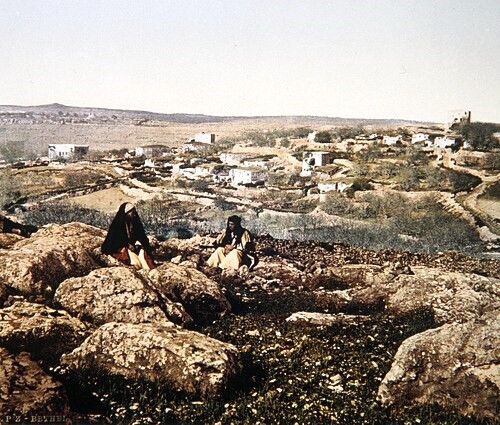
In 1957 an inscribed, and seemingly insignificant, lump of pottery was found by the archaeologist James Kelso, 1.90 m below surface level while excavating at Tel Beitîn, the important Biblical site of Bethel, about 20 km north of Jerusalem, which was first explored by William Foxwell Albright in 1934, a few years after Mabel Bent’s death in London in 1929. This modest clay find, best described as originally a rectangle c. 10 cm long and 7 cm high, inscribed, and with the remains of a ‘handle’ on the reverse – but found with the top left-hand corner broken off – was soon recognized as a stamp or seal, used presumably by a merchant for designating ownership, or contents, of traded merchandise, let’s say frankincense from Yemen.
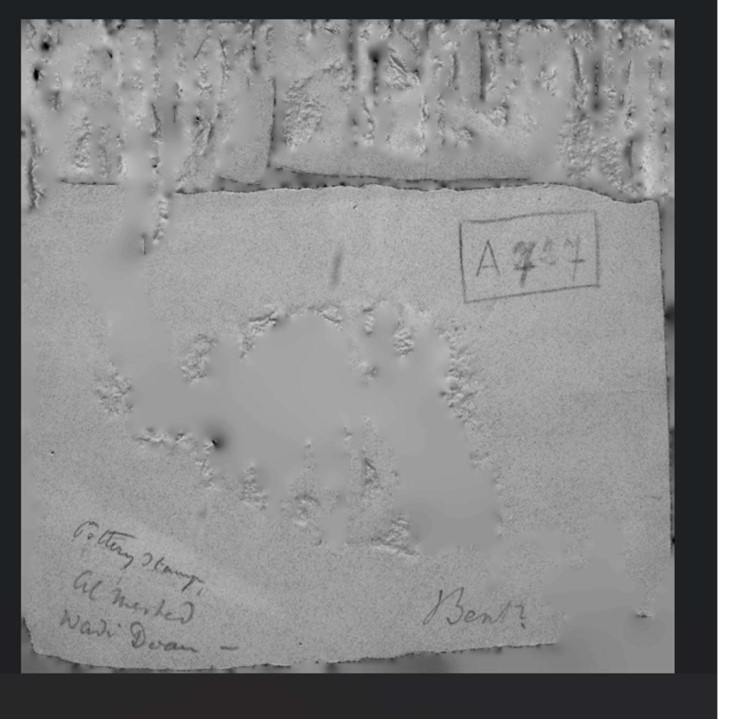
It was soon also recognized that the find was far from insignificant and very possibly far from home. Two scholars, Gus Van Beek and Albert Jamme, published the find a year later. note 1 In 1960 Jamme made a major discovery of his own that was to bring Mabel Bent into the story. While looking through a collection of paper ‘squeezes’ (papier-mâché impressions), note 2 Jamme had one of those flashes of association and recognized the startling similarity of the impression with the clay stamp dug up from Bethel a few years previously. He published his discovery with Van Beek in 1961, note 3 being of the ‘opinion that the two seals are identical, yet distinct’ and that the ‘South-Arabian character of the stamp… is beyond any possible doubt’ and totally ‘excludes the possibility that it was introduced in modern times’. To Van Beek and Jamme the seal proved an early link between the spice and luxuries routes of South Arabia, beginning some 2000 km to the south, and linking South Arabia with Palestine, King Solomon with the Queen of Sheba – a thesis that would have delighted Theodore Bent beyond measure. ‘We are of the opinion that the two seals are identical, yet distinct.’
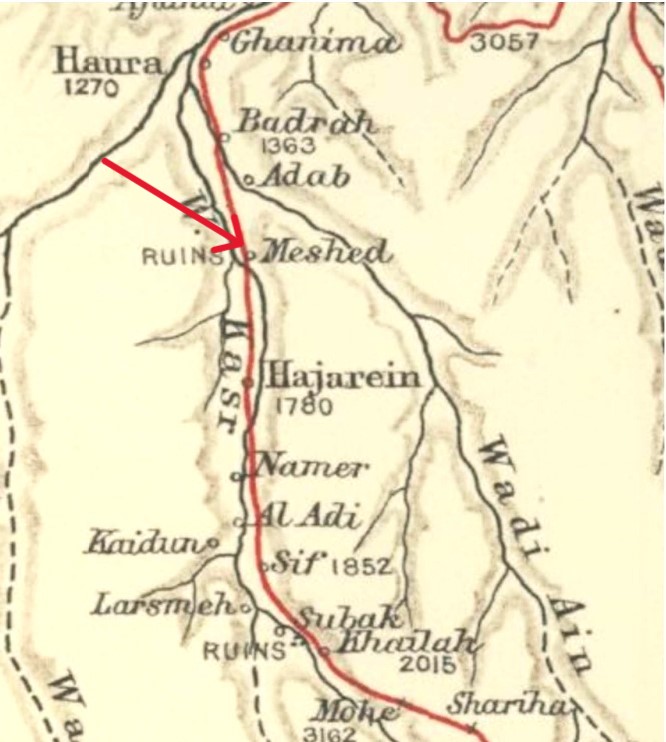
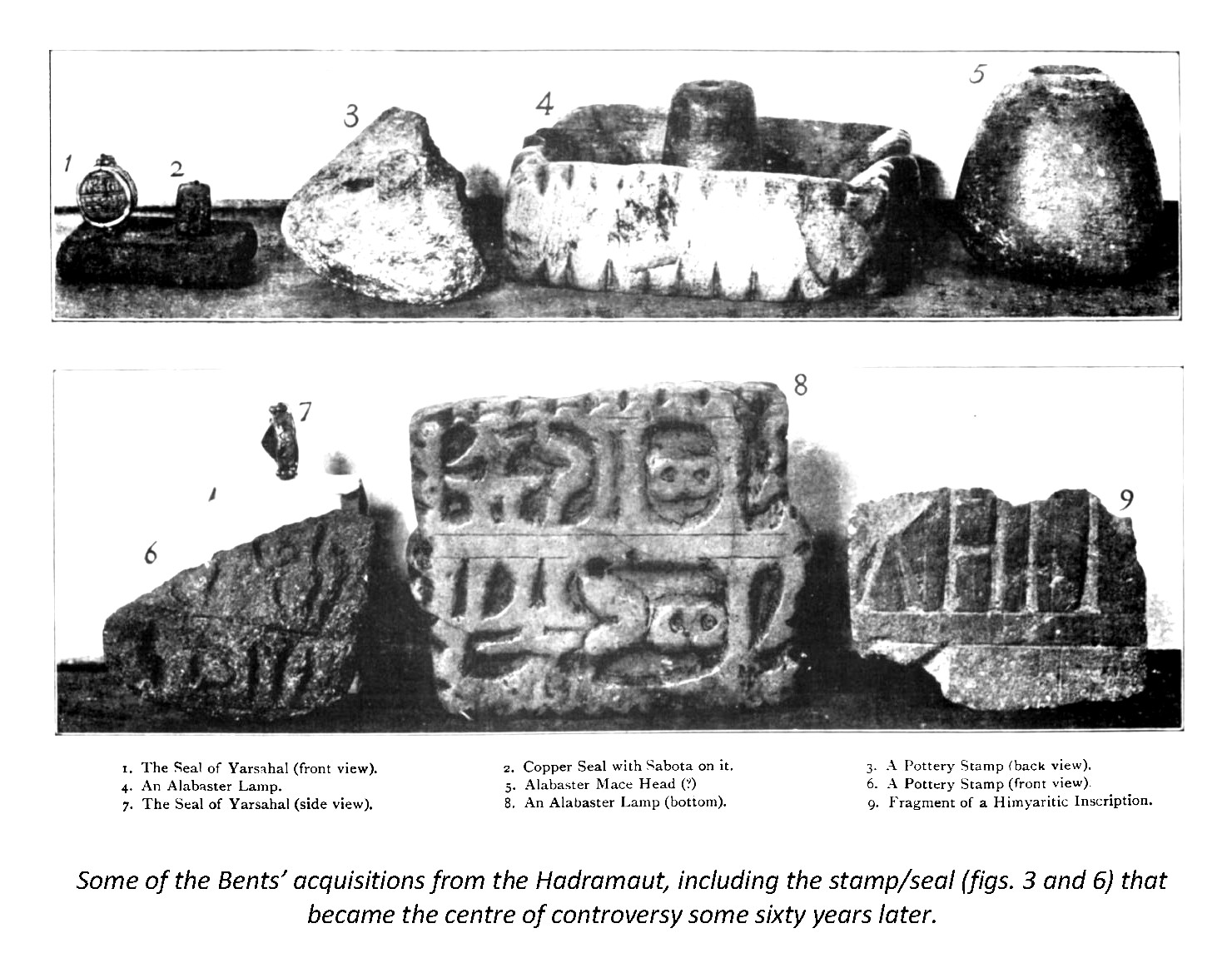
Two seals? Kelso’s 1957 find and Glaser’s squeeze A 727 – the latter representing none other than Theodore’s find from the Al-Mashad region of the Wadi Doan in the Hadramaut, and the object illustrated (items 3 and 6) in the top image here (reproduced in Southern Arabia, opposite p. 436). Unfortunately it is not clear from Mabel’s diary, her Chronicle, where and when they acquired the object; its relative insignificance may be the reason – in contrast to the two other stamps/seals of copper and gold the couple also acquired in the Hadramaut.
For the Israeli scholar Professor Yigael Yadin the seals were too close for comfort, and in his 1969 paper note 4 he declares they are ‘but one and the same’ and therefore Van Beek and Jamme’s conjecture about the historical, even Biblical, link between the frankincense routes of the south and Bethel and beyond to the north was overstated and weakened. The gist of Yadin’s argument is that there is but one stamp, and that the Bents’ find had somehow arrived later at Bethel; indeed the similarities are so close that opinion still remains divided today – aggravated by the fact that the whereabouts of the stamp (or either stamp) are uncertain.
In 1970 Van Beek and Jamme, note 5 and also Kelso, note 6 replied in further contributions to the debate, the tone of which grows cooler as the debate heats up. How was it possible that a stray find from the Hadramaut could reappear in ancient Bethel? ‘The coincidence, therefore, of the seal being lost at Bethel, one of the three temples citied in ancient Israel in which such a seal would likely be found because of their connections with incense trade, is altogether unbelievable… Since there were two identical but distinct stamps, the historical, economic, and cultural significance of the Bethel stamp remains as we originally described.’
Yadin’s torch, however, was picked up three years later, understatedly and brilliantly, by Ray Cleveland (1973), note 7 who put two and two together, hypothesizing that Mabel Bent might well have taken the stamp to Bethel and buried it there. Cleveland, in part, based his theory on Mabel’s note in her very odd little tract Anglo-Saxons from Palestine note 8 that she was in the course of writing while in in the region. He also suggested that, badly missing Theodore, her mental state was distressed. A reporter for The Irish Times (1973) note 9 quickly realized the human interest of all this – especially its associations with a prominent Irish family – and published easily the most accessible account of what was turning from a controversy into a melodrama.
For some reason Jamme does not seem to have countered confidently until 1990, note 10 even though his strongly-held views on the significance of the two stamps were under fire. But when he did reply he did not pull his punches, disregarding Cleveland’s paper as groundless in terms of Mabel’s fragile mental state and assuming that Cleveland was accusing her of simple fraud: ‘Such an accusation of fraud – unique in the annals of archaeology, levelled against a lady respected by everyone interested in ancient South Arabia and who, having died on July 3, 1929, could not defend herself – was shocking in itself.’ And thus: ‘Mrs. Bent’s memory was and remains unblemished and unscathed in spite of Cleveland’s charge. But the latter’s unprovoked, unsubstantiated indictment based on the uncalled-for intrusion upon the intimate, affective life of a widow has become the first true mystery of the whole affair because the reader cannot even remotely fathom what the reason behind such an irresponsible accusation of fraud might have been.’
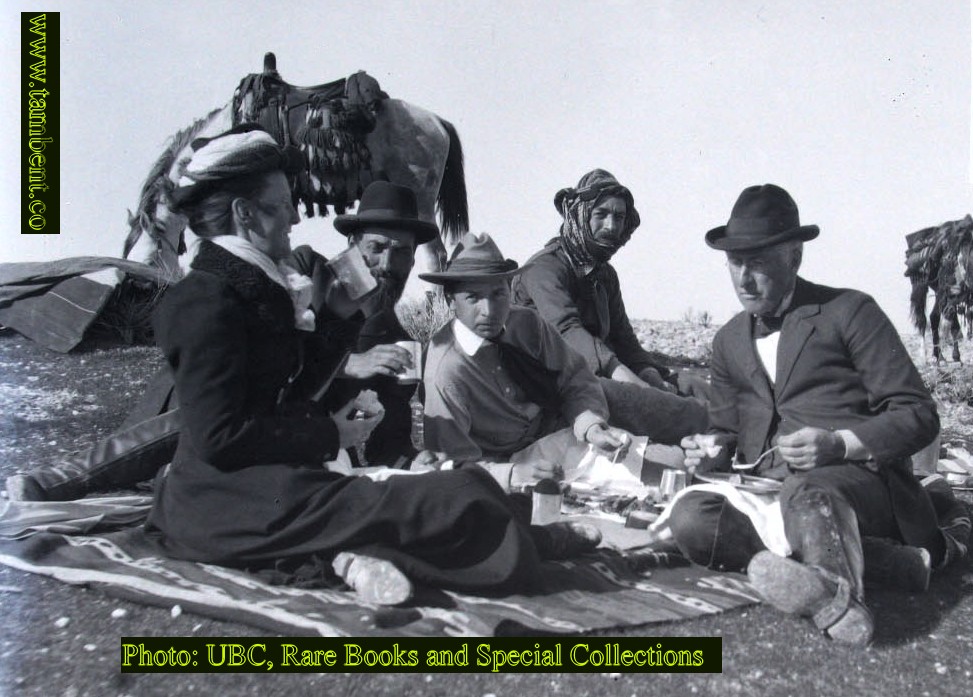
What Jamme, and Cleveland, were unaware of was that Mabel was a frequent traveller to Jerusalem and Palestine in the first decade of the 1900s (and after Theodore’s death), and she soon began to demonstrate apparently irrational behaviour, taking sides in a romantic squabble between two British residents in Jerusalem. On another occasion, now over 60, she rode off mysteriously and alone into the countryside, falling off her mount and breaking her leg. note 11 A convert to British Israelitism, she became involved in the committee of the ‘Garden Tomb’ (Jerusalem), note 12 and began the bizarre Anglo-Saxons from Palestine referred to above which attempted to identify a tribal connection between the Jews and the British.
It seems apparent that Mabel believed that Theodore’s twenty years of travel and work were ultimately little valued by the establishment. She must have been disillusioned by the Royal Geographical Society both overlooking her husband and implicating her in the row over women RGS Fellows there. Stinging too, was the gradual unravelling of Bent’s theories on the history of the ruins at Great Zimbabwe. She must also have been hurt at some of the criticism aimed at Southern Arabia, the now-classic monograph Mabel assembled after Theodore’s death (from her Chronicles and his notebooks and articles). There are enough indicators that Mabel was fast becoming an outsider.
Returning to the ‘Bethel Stamp’, Jamme’s earlier claim that it represented a clear link between Solomon and the Queen of Sheba is not supported today, although it is important evidence of South Arabian contacts. The coincidence of two identical seals may be just that, a coincidence. After all, was it not possible that there was a sort of ‘mass production’ of these items going on from a prototype, with the stamp prone to breaking along a common fault and then being discarded? note 13 Kelso’s rational comment in 1970 (p.61) is still persuasive: ‘it seems reasonable to assume that [the stamp] was lost or deliberately abandoned by some incense caravan in the ninth century B.C.’
However, if Mabel was unhappy at Bethel, is it not also rather easy to imagine her in a lonely moment in the early 1900s dropping a broken clay stamp from the Hadramaut into a hole and covering it up – speaking the while to her dead husband, with whom she had travelled such landscapes for nearly twenty years, about how she had brought him, at last, to the end of the frankincense trail, among ‘the arrant spices of the sun’? What could be more forgivable – not deliberate archaeological fraud but, rather, fondness. And, indeed, there are three seals she mentions in Southern Arabia – where did she drop the other two? Jerusalem, Hebron, Mizpah? There is hope.
Albright and Kelso note 15 avoid any reference to the Bents, it would start too many hares, in their otherwise comprehensive account of the Bethel excavations. The chances of there being two arguably identical seals are so remote that the theory of Mabel Bent’s deliberate placing of her Hadhramaut stamp at the site is extremely persuasive. Again, it is worth mentioning that the stamp (stamps?) is lost. Much of the speculation on this delicious artefact presented in page 89 of Albright & Kelso 1968 would then sit uncomfortably:
‘In the 1957 campaign only commonplace objects were found… There was one important exception which was a unique pottery seal (ninth century B.C.)… found in mixed debris just outside the W wall of the city. It was used to seal the incense bags shipped out of Arabia and sold at Bethel and Jerusalem. The seal was so unique that its study was given 7½ pages in BASOR, No. 151, pp. 9-16. Its significance is well summarized in the last paragraph of that report. “The importance of this stamp for South Arabian and Palestinian studies can hardly be overstated. As perhaps the earliest South Arabian inscription known (except for rock inscriptions), it provides an invaluable peg for the study of South Arabian palaeography. Of equal importance is the light it sheds on relations between Palestine and South Arabia. Since it is the earliest (probably even the first) South Arabian object found in Palestine, it proves that contact had already been established between Israel and South Arabia early in the first millennium B.C., no more than two centuries and possibly only a few years after the visit of the ‘Queen of Sheba’ to Solomon. While this substantial historicity of this event has been increasingly accepted in recent years, this object carries us closer to that period than most scholars had dared hope. Moreover the fact that it was found at the temple city of Bethel enables us to define the nature of this contact with reasonable probability.”
‘An almost identical seal was found by A. Jamme in the famous Glaser collection of squeezes in Tübingen. It had been found in the central Hadhramaut. Thus we have two business documents by the same company covering sales territory between South Arabia and Palestine. BASOR, No. 163, pp. 15-18.’
Sources
Southern Arabia = Theodore and Mabel Bent, Southern Arabia, London, 1900.
Chronicle = The Travel Chronicles of Mrs. J. Theodore Bent, Vol.3, 2010, Oxford: Archaeopress.
And see also a previous article on this site: Mabel and the vanished ‘Bethel Seal’
Footnotes
Return from Note 1
Return from Note 2
Return from Note 3
Return from Note 4
Return from Note 5
Return from Note 6
Return from Note 7
Return from Note 8
Return from Note 9
Return from Note 10
Return from Note 11
Return from Note 12
Return from Note 13
Return from Note 14
Return from Note 15
 Leave a comment or contact us about this article