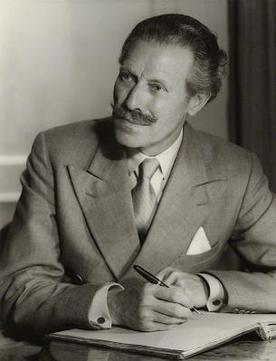
Mabel Virginia Anna Bent. Reproduced from ‘Hearth and Home’, 2 November 1893. From the Studio of H.S. Mendelssohn, South Kensington (private collection).
Mabel Bent died at her home at 13 Great Cumberland Place, London (near Marble Arch) on 3 July 1929; it is the 90th anniversary of her death. Her doctor recorded ‘myocardial failure’ and ‘rheumatoid arthritis (chronic)’ on her death certificate. Theodore Bent had died in the same house on 5 May 1897. A few years before her death, Mabel, or her relatives (her niece Hilda was with her when she died), had wrapped the few souvenirs that remained of her travels with her husband Theodore, and presented them without fuss to the British Museum. There is a family myth that she was confused in her final months and died in the street and was destined for a pauper’s grave before being claimed – but there is no evidence for this. In her will she bequeathed ‘all the contents whatsoever of 13 Great Cumberland Place to my sister Ethel Bagenal’. Ethel survived her by a year and a half; by then all Mabel’s and Theodore’s memories of travel had been dispersed (some wonderful and unique things are lost or out of sight) and the explorers themselves were somewhere else.
‘Nature’ of 13 July 1929, page 65, marked her in passing: “The death of Mrs. Theodore Bent on July 3, at the age of eighty-three, has removed a striking personality for many years familiar in literary and scientific circles in London. She was the widow of Theodore Bent, whom she married in 1877. Of Irish extraction, she preserved to the end of her life some of the characteristics of her nationality, notably readiness in conversation and a sharpness in repartee… Mrs. Bent accompanied her husband and gave him valuable assistance in his many journeys of archæological exploration… Journeys to Asia Minor in 1888 and to the Bahrein Islands in the Persian Gulf in 1889 were followed by their best-known expedition in 1891, when they visited South Africa to study the ancient ruins at Zimbabwe in Mashonaland, then examined and measured systematically for the first time. The results of the expedition were embodied in ‘The Ruined Cities of Mashonaland’ which appeared in 1892. Bent held the view that the builders of Zimbabwe were a northern race from Arabia, and for the rest of his life – he died in 1897 – their expeditions had as their object to discover traces of such a race… Mrs. Bent was an experienced photographer, as well as an accurate observer, as was shown by the book ‘Southern Arabia’, published in 1900, which was written mainly by her with the aid of her husband’s journals.”
The obituary might well have ended “Ní bheidh a leithéid ann arís – Her like will not be seen again”, the Irish epitaph later selected for Mabel’s great-niece Evelyn Booth, 1897-1988, born in the year Theodore died (Scannell, M.J.P. and Nelson, E.C. (1990). ‘Obituary: Evelyn Mary Booth 18971988’, The Irish Naturalists’ Journal, Vol. 23 (No. 5/6, Jan-Apr), 169-73.)
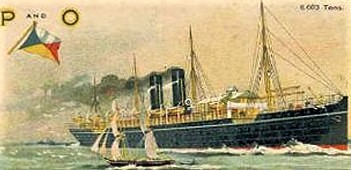
A 4-master, 2-funnel P.&O. liner of the type that ran via Suez at the time of Mabel’s trips to Palestine (www.simplonpc.co.uk)
The Homeward Mail from India, China and the East for Saturday 19 December 1908 lists Mrs Theodore Bent among the passengers of the “S.S. Britannia, from London, Dec. 24, 1908 and Marseilles Jan 1., 1909; for Gibraltar, Marseilles, Port Said, Aden, and Bombay….” The P.&O. Britannia (6525 tons) was in her last year, having been launched in 1887. Disembarking at Port Said, Mabel is on her way to Palestine again; the Holy Land being almost exclusively her focus after the death of her husband, the explorer Theodore Bent, in 1897.
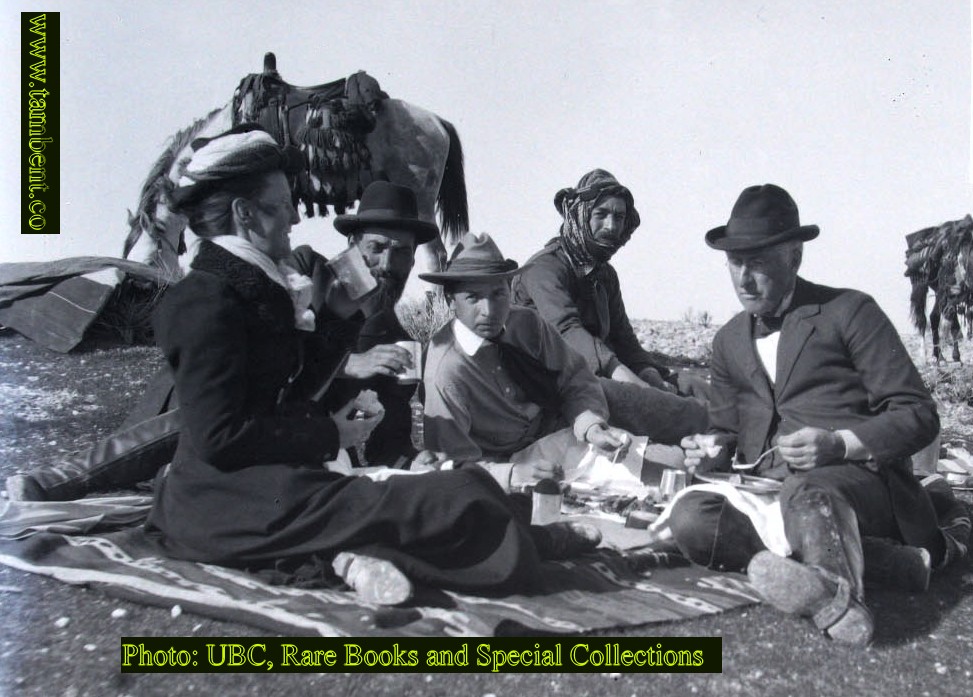
Mabel Bent taking tea with Moses Cotsworth and party in the Palestinian hinterland in 1900/1 (Moses Cotsworth collection, unknown photographer. Photo reproduced with the kind permission of Rare Books and Special Collections, Irving K. Barber Learning Centre, University of British Columbia).
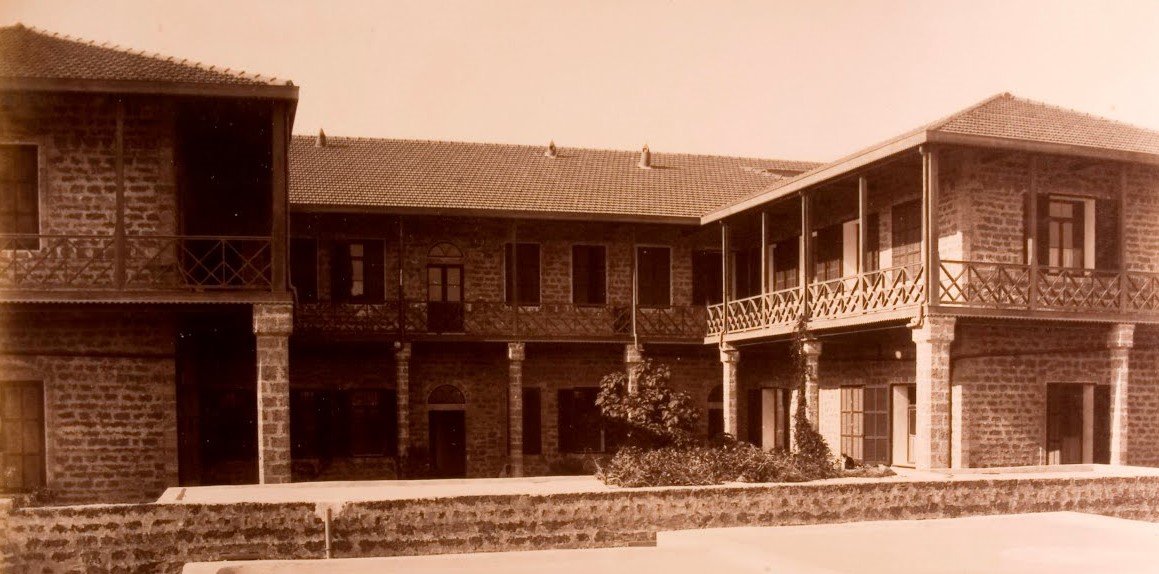
On a visit to Jaffa during this trip (still beautiful and peaceful then, nestled in the ‘plain of Sharon’), Mabel has a tour of the English Hospital there – in Ajami Street (now Yefet Street), opposite the Tabeetha School. She was visiting shortly after the death of the co-manager, Constance Newton, daughter of Charles E. Newton, the wealthy Derbyshire banker and landowner. Founded in the 1870s, the “Jaffa Mission Hospital was owned and operated by Mildmay Missions, an organisation which worked in conjunction with the Church Missionary Society. Constance [Newton] together with another missionary, Miss Mangan were responsible for running the facility with the help of a Syrian physician Dr Keith Ghoreyeb. After Miss Mangan’s death in 1885, the hospital was rebuilt into a functional medical facility. In 1892, Mildmay Missions bequeathed the Jaffa Mission Hospital to Constance Newton and Edith Eleanor Newton for full ownership and operation. After Constance became ill, the hospital was run by Edith and Dr. Ghoreyeb. Following her death on 19 August 1908, Constance left behind an endowment of £10,000 for the running of the hospital.” (Wikipedia) The hospital was left to the care of the Church Missionary Society and in 1944 had 160 beds and served nearly 3000 patients. A doorway survives.
A modern view of Jaffa Harbour (unattributed).
One of the nursing sisters at the hospital, Sister Marie, has left an account of Mabel’s visit; it is a rare article, emphasising the celebrity status of this irresistible force. From this lengthy article in The British Journal of Nursing (Vol. 42, March 13, 1909, pp. 213-215), the paragraphs relating to Mabel are included here, under their heading “Our Foreign Letter: Under the Syrian Sun”, finding the impressionable Sister Marie carried away by the magic of the Levant and an ‘ardent lover of the East’; she loads her pen with purple ink:
The English Hospital, Jaffa, 1900s (?) (Google Arts & Culture/Istanbul Research Unit).
“Picture to yourself an interminable garden of orange, pomegranate, and palm trees, with the plain of Sharon and the blue hills of Judea in the distance, this on one side, and on the other the sea, shining and sparkling as if the crest of each wave were studded with a thousand diamonds! … At nine the doctors come, and everything must be straight and tidy as in English hospitals back home… The doctors were late, and some of the children were getting impatient, when, instead of doctors, several travellers appeared in the corridor, one of whom was a lady, and, if she will pardon me the proclamation, may I add a very charming one? It was Mrs. Theodore Bent, who, as everyone knows, is an ardent lover of the East. After excusing herself for calling so early, she was taken round the wards, where she chatted gaily with the patients in their own language. This delighted them very much, and one woman declared she must be an Arab lady to speak so well. Before the visitors left the ward I noticed a small boy getting out of his bed, and making his way to Mrs. Bent. I looked at him and said…’Go back to your bed, Nuchly’. He paid no heed, but walked up to Mrs. Bent and said in broken English, ‘I see you one very nice lade, you come with me and I show you one very nice box in ze corridor, you will put money in, not so?’ and the Sister will buy for us one very nice muzeeka.”’ I felt so embarrassed, and wished my poor little at Jericho, especially when he added: ‘Why you looking cross, Sister? You teach me how to say it, in English, French, and Arabic. “Would you like to put somezin in the box?” You say I must sat that to all ze travelling ladies and gentlemen.’ I was much relieved when Mrs. Bent very kindly added her donation to the box, and we could pass on to another ward without the persistent little Nuchly. Through the kindness of many friends, we have our music box now, it is such a nice one, and plays ten tunes; it is a great pleasure to the patients, and had helped many of them to forget their aches and pains for a time. The women love it, and sometimes the children dance to it.”
Death of a noted Baildonian – Theodore Bent, 5 May 1897
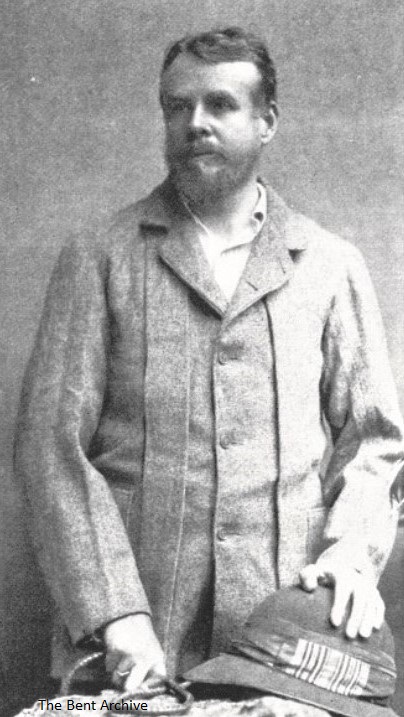
James Theodore Bent.(1852-1897). Photograph (date unknown) from the ‘Illustrated London News’ 15 May 1897 (private collection).
Theodore Bent died on this day (5 May) in 1897. The adventurer was susceptible to malarial infections ever since his visit to Andros in the Cyclades in 1884. The diary of his wife Mabel, his permanent travel companion, records this initial event: “Wednesday [12 March 1884, Gavrio, Andros]. I did not go to bed or undress last night. I had no bed to go to and T’s temperature was a little over 104. I rolled myself up in my fur cloak and screwed myself up on the corner of the bed and would have been more comfortable if there had been no fleas. The doctor came last night and this morning. He says it is from cold. I don’t know what it is… The doctor, who constantly strolled in and screamed at T, is only an old man with some knowledge of herbs. He wanted to give T kina and was not at all satisfied that quinine was the same thing.” [The Chroniclesof Mabel Bent, Vol. 1, 50-51, Archaeopress 2006]
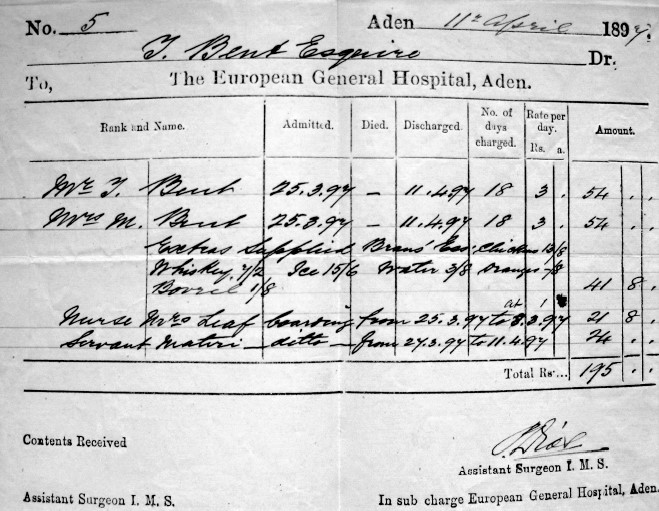
The Bents’ hospital bill from Aden, 11 April 1897. Note the extras, among which are those colonial staples: whiskey, ‘Bovril’, and ‘Brands Essence of Chicken’. If the charges were in £UK, the amount today would be around £10k (Hellenic Society and the Joint Library of the Hellenic and Roman Societies, London).
This predisposition did not prevent Bent from risking his health in dangerous conditions in the Levant, Africa and the Middle East for the next 13 years, until, on his last explorations, he and Mabel found themselves malaria victims and stretcher-cases east of Aden in the spring of 1897.
The Bents’ travel companion on their final trip, Ernest Bennett, gives an early warning of trouble ahead: “One of our party [Theodore] had no less than four attacks of [malarial] fever during two months; and even if we escaped actual fever, we invariably experienced… a miserable feeling of lassitude and debility”. (‘Two Months in Sokotra’, Longman’s Magazine. v. 30 (May-Oct. 1897), p.408.
Mabel’s book Southern Arabia (1900) has the full, and very sad story. Thanks to their long-term Anafiote dragoman, Matthew Simos, the couple were taken by boat back to Aden, where they recovered somewhat in the infirmary there (their hospital bill has outlasted them both).
After a few weeks they were fit enough to travel, and an unnamed steamer took them via Suez to Marseilles. It seems that southern France disagreed with Theodore and his malarial symptoms returned. Alarmed, Mable rushed with her patient by train and ferry to their London home, where he died a few days later on 5 May 1897. On Theodore’s death certificate, Dr A. Elliot M.D. registered that the cause of death was “Malaria 6 weeks, Pneumonia 5 days”. The recurrence of fever as the predominant symptom tends to suggest that Theodore’s illness on his final tour was more likely to have been malaria rather than other diseases such as pneumonia or dysentery, although it would be consistent with other infections such as typhoid: there would seem to be no reason to question the diagnosis.
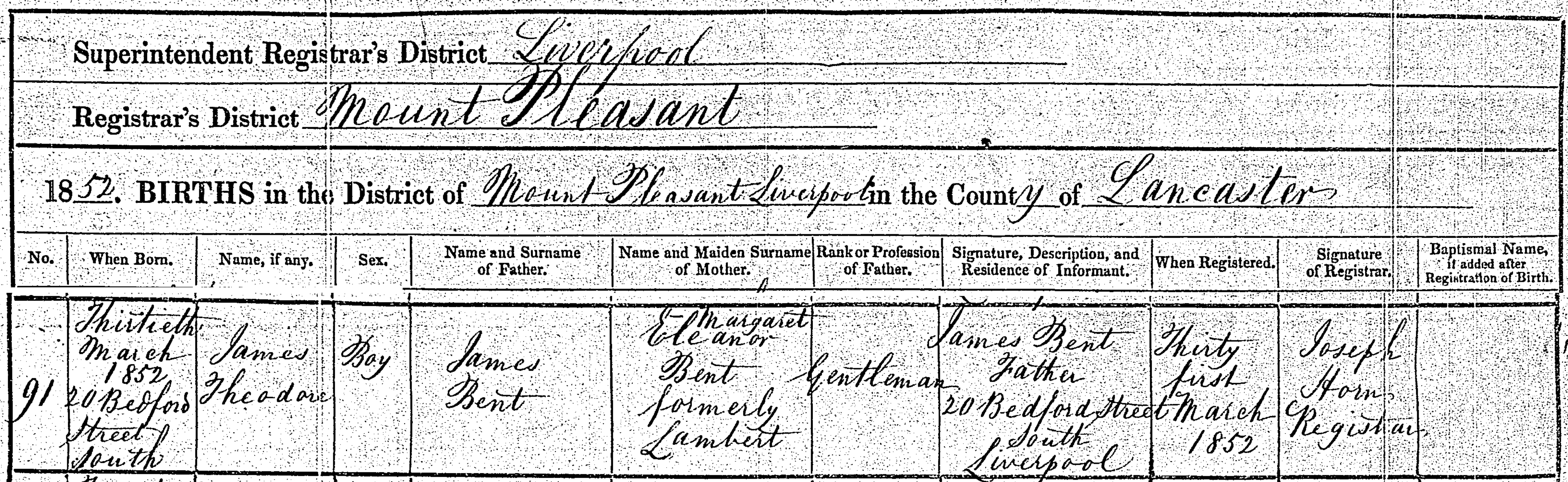
Theodore Bent’s (1852-1897) birth certificate (30 March 1852), confirming his birth place as Liverpool (an uncle was Lord Mayor). Several sources incorrectly cite Baildon in Yorkshire as his place of birth (Crown Copyright).
His early death (he was just 45) prompted eulogies in America and Europe, such was his reputation as a cavalier explorer and archaeologist. His many achievements can be seen via this link. It seems appropriate to quote from (among dozens of obituaries) the following from his local newspaper, The Shipley Times of Saturday, 15 May 1897 (the town of Shipley is a few miles from Bradford and Baildon, where Theodore grew up; the paper also misinform us of Bent’s place of birth incidentally):
“Death of a noted Baildonian – The death recently took place at his house in Great Cumberland Place, London, of Mr Theodore Bent, the well-known traveller and archaeologist. He was the only son of the late Mr James Bent, of Baildon, and was born in 1852 in the house at Low Baildon now occupied by Mr Smith Feather. Mr Bent was educated at Malvern Wells, Repton School, and Wadham College, Oxford, where he took his honours in the history school. After his marriage, in 1877, to Mabel, daughter of the late Mr Robert Westley Hall-Dare, D.L., of Newtonbarry House, County Wexford, and Wennington House, Essex, he, with his energetic and accomplished wife, spent several months each year in exploring little known districts and sites, from which he never failed to reap a rich harvest of geographical and archaeological knowledge. Mr Bent was an excellent linguist; he spoke modern Greek like a native. One of his earliest visits was to the Republic of San-Marino, on which he wrote an interesting little volume. He travelled extensively in Greece and Asia Minor, and in 1885 published a volume on “The Cyclades; or life among the Insular Greeks”. He afterwards visited the Bahrein Islands, on which he contributed a paper to the Royal Geographical Society. Perhaps he is best known by his investigations of the Zimbabwe ruins in Mashonaland, which he and Mrs Bent visited in 1891. The narrative of this interesting expedition has gone through several editions. In 1893 they visited Abyssinia, and made some valuable investigations among the ruined cities of that country. The last and fatal visit was the third visit to Southern Arabia, where Mr Bent succeeded in adding considerably to our knowledge of the Hadramut country. In 1895-96 the western shores of the Red Sea and the north of Suakim was the scene of Mr and Mrs Bent’s explorations, and here amongst the coast some remarkable remains of old Roman gold workings were discovered. Thus year after year Mr Bent continued to do good work for archaeology and geography, and he has at last fallen a martyr to his zeal. Mr Bent’s death will be a great shock to a wide circle of friends, to whom his kindly, genial, unaffected disposition had greatly endeared him. He was a Fellow of the Society of Antiquaries and of the Royal Geographical Society; of the latter he had been a member of Council. On October 11th, 1894, Mr Bent delivered a lecture to the members of the Bradford Philosophical Society on his travels in Arabia.”
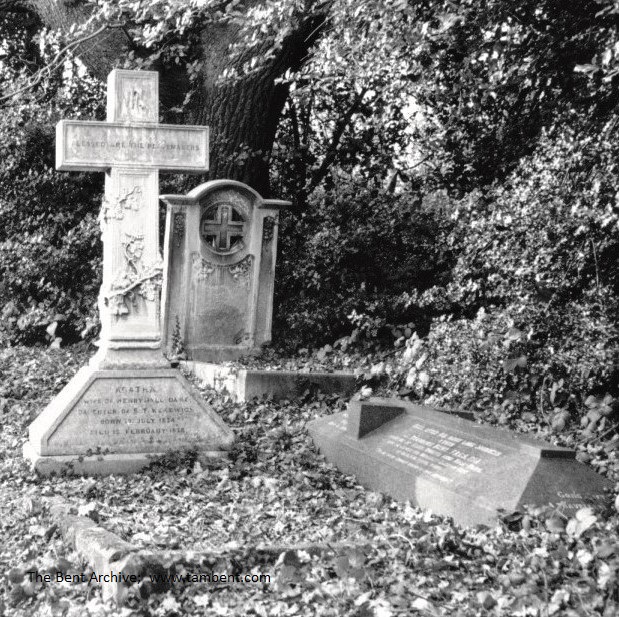
Theodore and Mabel’s grave and memorial (on the far right) in the churchyard of St Mary’s, Theydon Bois, Essex.
Mabel was devastated by the loss, and her own full potential as an explorer and photographer was never to materialise; she died in 1929. The couple are buried together in the Hall-Dare (Mabel’s Essex and Irish family) plot in St Mary’s, Theydon Bois. Go visit, take some flowers.
It seems Theodore Bent visited Cycladic Amorgos, briefly, twice, once for Orthodox Easter in 1883 (April 28 – 1 May, Old Style) and then again in February the following year. Mrs Bent presumably joined her husband for the first visit (although Mabel does not make this clear), after they had been to Tinos for the “great pilgrimage on the Greek March 29th, that is in the beginning of our April 1883”. There are no first-hand accounts of Amorgos in Mabel’s Chronicles, but she makes clear in her 1884 diary that “During the last week of my stay [on Antiparos], T went to Amorgos. I was not well and remained for further rest. I joined [him] on the steamer Eptanisos at Paroikia on Ash Wednesday, February 27th, after having waited a day and a night as the weather was stormy”. Theodore chose to end his great book on the Cyclades (1885) with an account of these two visits, suggesting how much he/they enjoyed this lovely and fascinating island that acts as a stepping stone between the distinct styles of the Cyclades and the Dodecanese.
Bent’s Amorgos chapter in The Cyclades, or Life Among the Insular Greeks is well known and can be easily found freely on line. Less well known is the article he wrote first for Macmillan’s Magazine, Easter Week in Amorgos (1884, Vol. 50 (May/Oct), 194-201; reprinted in Littell’s Living Age, Vol. 162 (1884), 402ff), and on which he generously based his chapter, no doubt supplementing the latter with material from his second visit (a Cycladic figurine he acquired there is in the British Museum). Thus a longish, edited, extract from the Macmillan’s piece follows, and will, we trust, entertain and perhaps inspire an Easter visit next year!
(For the mystery of whether Mabel accompanied Theodore to Amorgos on his first visit in 1883, see the article Amorgos Amigos.)
Before reading on – why not get in the mood with the video of the Amorgos ceremonies in a closely associated site linked to our editors!
EASTER WEEK IN AMORGOS – J. Theodore Bent
“This, the remotest island of the Cycladic group, and the bulwark, so to speak, of the modern Greek kingdom, would well repay a visit at any other time than Easter week, for its quaint costumes and customs, and unadulterated simplicity; but Easter week is the great festival of Amorgos, and is unlike Easter in other parts of Greece, for the Amorgiotes at this time devote themselves to religious services and observances, which now scandalise the more advanced lights of the Hellenic Church, and greatly annoy the liberal-minded Methodios, Archbishop of Syra, in whose diocese Amorgos is situated, and who cannot bear the prophetic source for which this island is celebrated, and would stop it if he dared; but popular feeling, and the priests, who gain thereby, prevent him.
“The steamer now touches here once a week a dangerous enemy, indeed, to these primaeval customs, but pleasanter than a caique so we availed ourselves of it, and carried with us a letter of introduction to the Demarch of Amorgos from the head functionary in these parts, the Nomarch of the Cyclades. It is seldom calm between Amorgos and her neighbours; the full force of the Icarian sea runs into a narrow channel which separates her from some smaller islands. This fact, again, prior to the advent of the steamer, tended to keep the Amorgiotes to themselves.
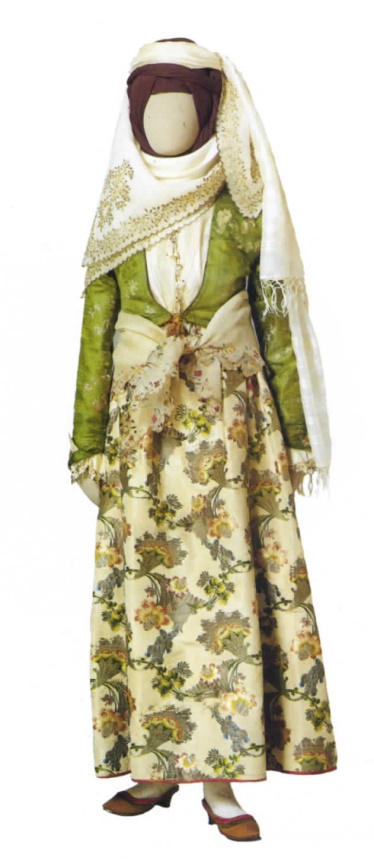
Traditional costume from Amorgos (image from National Historical Museum, Athens)
“The first object which struck us was the costume of the elderly women; that wretched steamer has brought in western fashion now, so that the younger women scorn their ancestral dress, but the old crones still seem to totter and stagger beneath the weight of their traditional headgear. There is a soft cushion on the top of the head, a foot high at least, covered with a dark handkerchief, and bound over the forehead with a yellow one; behind the head is another cushion, over which the dark handkerchief hangs half way down the back, and the yellow handkerchief is brought tightly over the mouth so as to leave only the nose projecting, and is then bound round so as to support the hindermost cushion. This complicated erection rejoices in the name of ‘tourlos’, and is hideously grotesque, except when the old women go to the wells, and come back with huge amphorae full of water poised on the top of it, plying their distaffs busily the while, totally unconcerned about the weight on their heads. Naturally a head-dress such as this is not easy to change, and the old women rarely move it until their heads itch too violently from the vermin they have collected within. We only saw the rest of the old Amorgiote costume on a feast day; with the exception of the ‘tourlos’, the silks and brocades of olden days are abandoned in ordinary life.
“The demarch received us rather gruffly at first; he was busy with the weekly post which had arrived by our steamer. He distributes the letters, there being no postman in the island. But when his labours were over he regaled us with the usual Greek hospitality, with coffee, sweetmeats, and raki, and then prepared to lay out a programme for our enjoyment. ‘Papa Demetrios’, said he, ” is the only man who knows anything about Amorgos.” So the said priest was forthwith summoned, and intrusted with the charge of showing me the lions of Amorgos. ‘We had better visit the points of archaeological interest first’, said he. ‘Next week we shall be too busy with the festival to devote much time to them.’ So accordingly the three next days were occupied in visits to remote parts of the island, old sites of towns, old towers and inscriptions, whilst the world was preparing for the Easter feast.
“I do not propose to narrate the usual routine of a Greek Easter, the breaking of the long fast, the elaborately decorated lambs to be slaughtered for the meal, the nocturnal services, and the friendly greetings of these everybody knows enough; but I shall confine myself to what is peculiar to Amorgos, and open my narrative on a lovely Easter morning, when all the world were in their festival attire ready to participate in the first day’s programme.
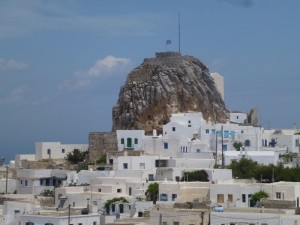
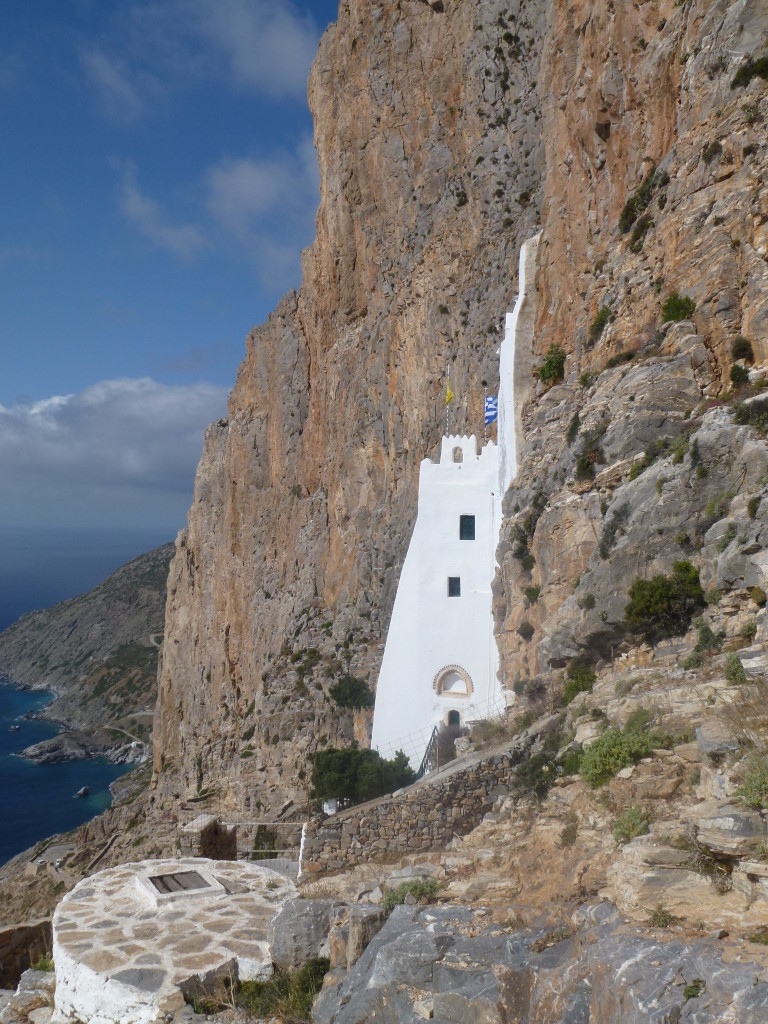
Chozobiotissa, Amorgos (inAid Ltd)
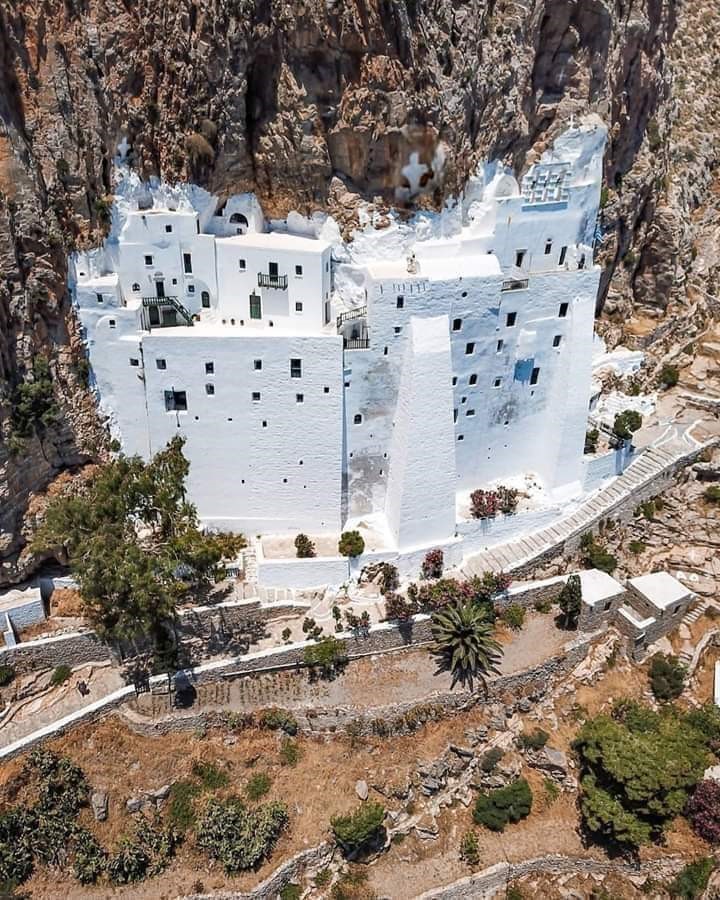
“First of all I must take the reader to visit a convent dedicated to the Life-Saving Virgin (Chozobiotissa), the wonder of Amorgos. It is the wealthiest convent in Greece next to Megaspelaion, having all the richest lands in Amorgos and the neighbouring islands, besides possessions in Crete, in the Turkish islands, and elsewhere. The position chosen for this convent is most extraordinary. A long line of cliff, about two miles from the town, runs sheer down 1,000 feet into the sea; a narrow road, or ledge, along the coast leads along this cliff to the convent, which is built half way up. Nothing but the outer wall is visible as you approach. The church and cells are made inside the rock. This convent was founded by the Byzantine emperor, Alexius Comnenus, whose picture existed until lately, but they suffer here frequently from rocks which fall from above, one of which fell not long ago and broke into the apse of the church and destroyed the picture of the emperor.
“We entered by a drawbridge, with fortifications against pirates, and were shown into the reception room, where the superior, a brother of the member for Santorin, met us, and conducted us to the cells in the rock above, to the large storehouses below, and to the narrow church, with its five magnificent silver pictures, three of which were to be the object of such extraordinary veneration during Easter week. The position of this convent is truly awful. From the balconies one looks deep down into the sea, and overhead towers the red rock, blackened for some distance by the smoke of the convent fires; here and there are dotted holes in the rock where hermits used to dwell in almost inaccessible eyries. It is, geographically speaking, the natural frontier of Greece. Not twenty miles off we could see from the balcony the Turkish islands, and beyond them the coast of Asia Minor. Our friendly monks looked too sleepy and inert to think of suicide, otherwise every advantage would here be within their reach.
Chozobiotissa, Amorgos (image from Facebook, we will be delighted to fully acknowledge the photographer)
“Three of the five silver eikona in this church were to be the object of our veneration for seven days to come. One adorns a portrait of the Madonna herself, found, they say, by some sailors in the sea below, and is beautifully embossed and decorated with silver; one of St. George Balsaniitis, the patron saint of the prophetic source of Amorgos; and the other is an iron cross set in silver, and found, they say, on the heights of Mount Krytelos, a desolate mountain to the north of Amorgos, only visited by peasants, who go there to cut down the prickly evergreen oak which covers it as fodder for their mules.
“We were up and about early on Easter morning, the clanging of bells, and the bustle beneath our windows made it impossible to sleep. Papa Demetrios came in dressed exceedingly smartly in his best canonicals, to give us the Easter greeting. Even the demarch and his wife were more genial and gay. At nine o’clock we and all the world started forth on our pilgrimage to meet the holy eikons from the convent. The place of meeting was only a quarter of a mile from the town, at the top of the steep cliff, and here all the inhabitants of the island from the villages far and near were assembled to do reverence.
“I was puzzled as to what could be the meaning of three round circles like threshing floors, left empty in the midst of the assemblage. All round were spread gay rugs and carpets, and rich brocades; every one seemed subdued by a sort of reverential awe. Papa Demetrios and two other chosen priests, together with their acolytes, set forth along the narrow road to the convent to fetch the eikons, for no monk is allowed to participate in this great ceremony. They must stop in their cells and pray; it would never do for them to be contaminated by the pomps and vanities of so gay a throng. So at the convent door, year after year at Easter time, the superior hands over to the three priests the three precious eikons, to be worshipped for a week.
“A standard led the way, the iron cross on a staff followed, the two eikons came next, and as they wended their way by the narrow path along the sea the priests and their acolytes chanted montonous music of praise. The crowd was now in breathless excitement as they were seen to approach, and as the three treasures were set up in the three threshing floors everybody prostrated himself on his carpet and worshipped. It was the great panegyric of Amorgos, and of the 5,000 inhabitants of the island not one who was able to come was absent. It was an impressive sight to look upon. Steep mountains on either side, below at a giddy depth the blue sea, and all around the fanatical islanders were lying prostrate in prayer, wrought to the highest pitch of religious fanaticism. Amidst the firing of guns and ringing of bells the eikons were then conveyed into the town to the Church of Christ, a convent and church belonging to the monks of Chozobiotissa, and kept in readiness for them when business or dissipation summoned them to leave their cave retreat. Here vespers were sung in the presence of a crowded audience, and the first event of the feast was over. Elsewhere in Greece on Easter day dancing would naturally ensue, but out of reverence to their guests no festivities are allowed of a frivolous nature, and every one walks to and fro with a religious awe upon him.
“Monday dawned fair and bright as days always do about Easter time in Greece. Again the bustle and the clanging of bells awoke us early. There was a liturgy at the Church of Christ where the eikons were, and after that a priest was despatched in all hurry up to the summit of Mount Elias, which towers some 2,000 feet above the town. Here there is a small chapel dedicated to the prophet, and this was now prepared for the reception of the eikons by the priest and his men, and tables were spread with food and wine to regale such faithful as could climb so far. Meanwhile we watched what was going on below in the town, and saw the processions form, and the eikons go and pay their respects to other shrines prior to commencing their arduous ascent up Mount Elias. It was curious to watch the progress up the rugged slopes, the standard-bearer in front, the eikons and priests behind, chanting hard all the time with lungs of iron. Not so my friend the demarch, with whom I walked. His portly frame felt serious inconvenience from such violent exercise, so we sat for a while on a stone, and he related to me how in times of drought these eikons would be borrowed from the convent to make a similar ascent to the summit of Mount Elias to pray for rain, and how the peasants would follow in crowds to kneel and pray before the shrine.
“It is strange how closely the prophet Elias of the Christian Greek ritual corresponds to Apollo, the sun god of old; the name Elias and Helios doubtless suggested the idea, just as now St. Artemidos in some parts has the attributes of Artemis. When it thunders they say Prophet Elias is driving in his chariot in pursuit of dragons, he can send rain when he likes, like Zeus of ancient mythology, and his temples, like those of Phoebus Apollo, are invariably set on high, and visited with great reverence in times of drought or deluge.
“After the liturgy on Mount Elias the somewhat tired priests partook of the refreshments prepared for them, for Phoebus Apollo was very hot to-day, and the eikons were heavy, and my host, the demarch, enjoyed himself vastly, for his pious effort was over, and the descent was simple to him. All the unenergetic world was waiting below, but we who had been to the top felt immensely superior, and Papa Demetrios gaily chaffed the lazy ones on the way to vespers in the metropolitan church for their lack of religious zeal. Here the eikons spent the second night of their absence from home. I was very curious about the next day’s proceedings, for on Tuesday the eikons were to visit the once celebrated church of St. George Balsamitis, where is the prophetic source of Amorgos. So I left the town early with a view to studying this spot, and if possible to open the oracle for myself before the crowd and the eikons should arrive. It is a wild walk along a narrow mountain ridge to the Church of St. George, about two miles from the town. Here I found Papa Anatolios, who has charge of this prophetic stream, very busily engaged in preparing for his guests. A repast for twenty was being laid out in the refectory, and he said a great deal about being too much occupied when I told him I wished to consult his oracle.
“On entering the narthex Papa Anatolios still demurred much about opening the oracle for me, fearing that I intended to scoff; but at length I prevailed upon him, and he put on his chasuble and went hurriedly through the liturgy to St. George before the altar. After this he took a tumbler, which he asked me carefully to inspect, and on my expressing my satisfaction as to its cleanness he proceeded to unlock a little chapel on the right side of the narthex with mysterious gratings all round, and adorned inside and out with frescoes of the Byzantine school. Here was the sacred stream which flows into a marble basin, carefully kept clean with a sponge at hand for the purpose lest any extraneous matter should by chance get in. Thereupon he filled the tumbler and went to examine its contents in the sun’s rays with a microscope that he might read my destiny. He then returned to the steps of the altar and solemnly delivered his oracle. The priests of St. George have numerous unwritten rules, which they hand down from one to the other, and which guide them in delivering their answers. Papa Anatolios told me many of them. These and many other points Papa Anatolios told me, and I thanked him for letting me off so mercifully. To my surprise on offering him a remuneration for opening to me the oracle he flatly refused and seemed indignant.
“About midday we heard the distant chanting of the procession, and soon the three eikons and their bearers were upon us. After the liturgy was over and the religious visit paid, we had a very jolly party in the refectory. Papa Anatolios produced the best products of the island lambs, kids, fresh curdled cheese, wines, and fruits and it was not till late in the afternoon that we started on our homeward route, still chanting and still worshipping these strange silver pictures from the convent.
“We were all rather tired that evening on our return from the oracle, so next morning the bells failed to wake us early, and I was glad to learn that the eikons had started on a visit to a distant place where I had already been, Torlaki, where is an old round Hellenic tower; so during the early part of the day I strolled quietly about the town. I was strong enough that evening to walk down to the sea-shore to see the arrival there of the eikons, with their wonted accompaniment of chanting and festivity. The little harbour village was decked with flags, the caiques and brigs were also adorned, and a good deal of firing was going on in honour of the event.
“That night the eikons and I passed by the harbour certainly to my personal discomfort, for never in the course of my wanderings did I rest under a dirtier roof than that of Papa Manoulas. He is a proverbial Greek priest, having a family of eleven children; he keeps a sort of wineshop restaurant for sailors, and excused the dirtiness of his table by saying that men had been drunk in his house the night before. He cooked our dinner for us in his tall hat, cassock, and shirt sleeves, and then put me to sleep in a box at the top of a ladder in one corner of the cafe, which was redolent of stock-fish, and alive with vermin. I wanted no waking next morning, and was pacing the sea-shore long before the eikons had begun their day’s work ; it was fresh and bright everywhere except in Papa Manoulas’ hole.
“To-day was to be the blessing of the ships, and as every Amorgiote, directly or indirectly, is interested in shipping, it was the chief day in the estimation of most. When the procession reached the shore the metropolitan priest of the island entered a bark decorated with carpets and fine linen, carrying with him the precious eikon of the Life-Saving Madonna (Chozobiotissa); he was rowed to each ship in turn, and blessed them, whilst the people all knelt along the shore, and as each blessing was concluded a gun was fired as a herald of joy. The rest of the day was spent in revelry. I was glad not to be going to pass another night under Papa Manoulas’ roof, for I felt sure that it would be dirtier than ever. Friday and Saturday were passed by the eikons and priests in complimentary visits, and liturgies in the numerous churches in and around the town. I did not accompany them on these journeys, and persuaded Papa Demetrios to come off with me on an excursion, for he too was tired of these repeated ceremonials, and was not sorry to transfer his eikon to inferior hands. The week’s veneration for the eikons was at an end, and the Amorgiotes were now prepared for enjoyment. Every one knows the beauties of the Greek syrtos, as the dance goes waving round and round the planetree in a village square, now fast, now slow, now three deep, now a single line, and then the capers of the leader as he twists and wriggles in contortions. Here in Amorgos the sight was improved by the brilliancy of one or two old costumes. One lady especially was resplendent; her ‘tourlos’ was of green and red, her scarf an Eastern handkerchief such as we now use for antimacassars, coins and gold ornaments hung in profusion over her breast, her stomacher was of green and gold brocade, a gold sash round her waist, and a white crimped petticoat with flying streamers of pink and blue silk, pretty little brown skin shoes with red and green embroidery on them. She was an excellent dancer, too, a real joy to look upon. The men wore their baggy trousers, bright-coloured stockings, and embroidered coats; but the men of Amorgos are not equal to the women. The beauty of an Amorgiote female is proverbial.
“My stay in Amorgos ended thus gaily. Next day the relentless steamer called and carried me off to other scenes.”
For an excellent introduction to the Bents on Amorgos, see the site simply called The Cyclades.
(Theodore Bent’s books on the Cyclades and Dodecanese, and Mabel Bent’s Chronicles are available from Archaeopress, Oxford)
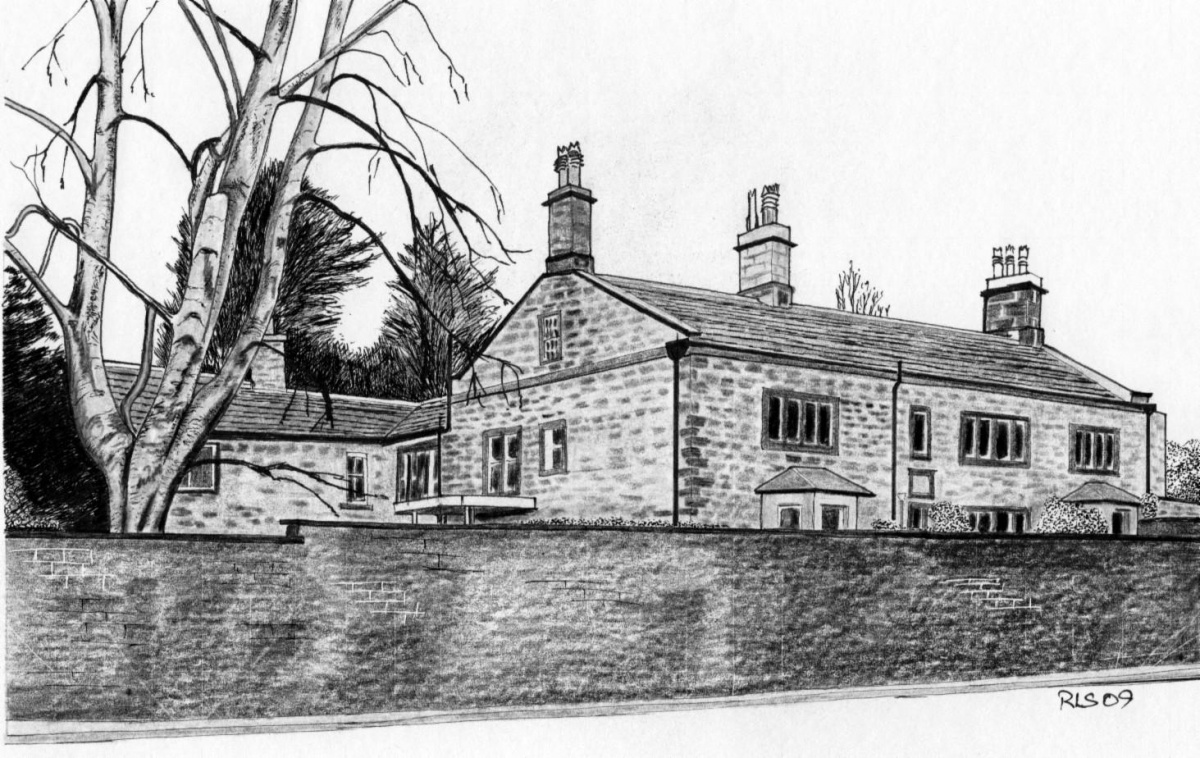
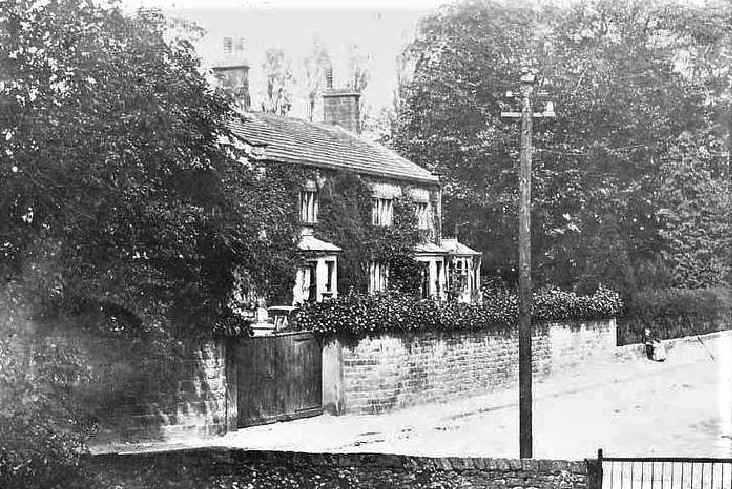
Baildon House, where Theodore grew up (Wikipedia).
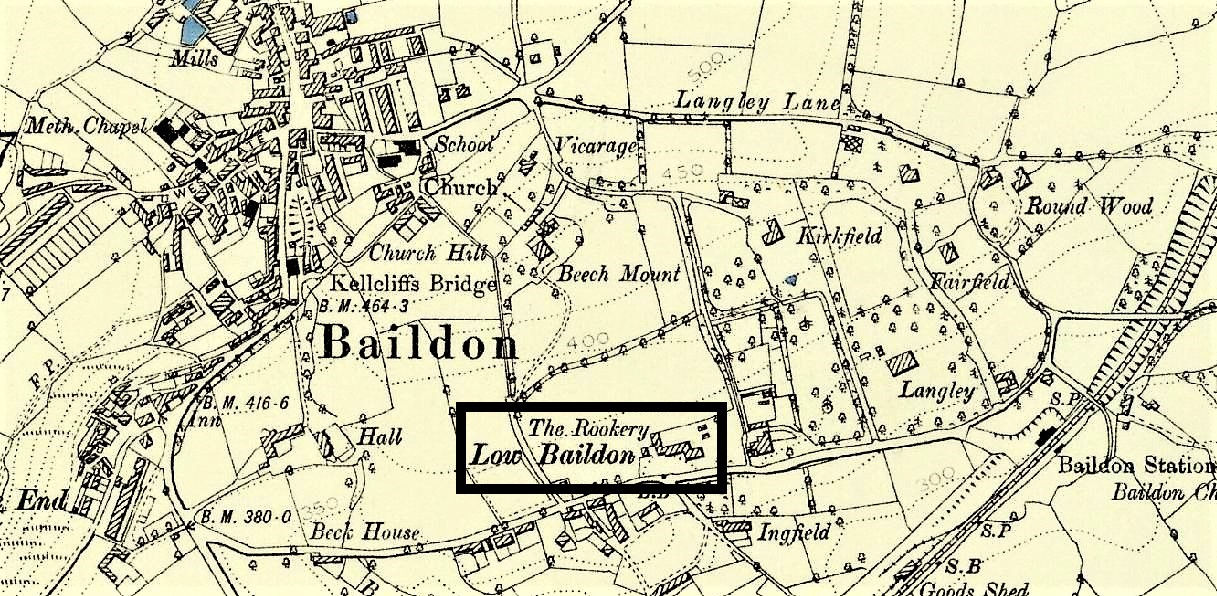
Stroll for a minute by Theodore Bent’s childhood home, wherever you are, even if, like the peripatetic Bents, you happen to be in Africa, Arabia, or excavating in the Eastern Med! This fine, Grade II listed, home consists of two dwellings, a cottage and house, now linked together. From the informative book ‘Baildon and the Baildons; a history of a Yorkshire manor and family’ by W.P. Baildon (1912, Baildon), we have it that the handsome residence also known as ‘The Rookery, Low Baildon… was probably built by Robert Holden; a stone on the south front [of the main house] has the initials “R. H.” and the date 1724; hence Holden Lane, which runs alongside; it was formerly known as “Baildon House.” William Holden of Low Baildon died in 1809, aged 71, leaving an only daughter, Anne, who married John Lambert. Mr. and Mrs. Lambert were both buried in Baildon Chapel, as also was their only son, William Holden Lambert… The property descended to two daughters, one of whom, Margaret Eleanor, married James Bent [Theodore Bent’s father]… Mr. and Mrs. Bent lived at Baildon House (The Rookery), and here was born, in 1852, their son, James Theodore Bent, the distinguished traveller and antiquary…’
In fact, Theodore was born in Liverpool on 30 March 1852, an only child at a time when large families were very much the norm – explained perhaps by the fact that his father, James, (1807-1876) was 45 when Theodore was born and his mother, Margaret (c. 1811-1873), 41; and their son’s name ‘a gift from God’ thus highly appropriate.
One of the Bents’ breweries at the turn of the 19th century; Stone, near Newcastle-under-Lyme (Wikipedia)
James Bent was was a member of a large and entrepreneurial clan, with, particularly, brewing interests; his marriage in April 1848 to a wealthy heiress, and with a grand house to boot, meant that he could semi-retire to Baildon, his wife’s village (as it was then), and enjoy a life of relative ease and manage quietly his estate and rents until his death in 1876. The mural tablet in the south aisle of the Bents’ local church, St John’s, suggests James’ comfort in his small, close, Baildon family (mercifully distant from the cutthroat, competitive and roller-coaster brewery businesses run by brothers John, William, Thomas and Rowland in Liverpool, Newcastle-under-Lyme and Macclesfield): ‘This Monument is erected in affectionate remembrance of Margaret Eleanor Bent, the beloved wife of James Bent, Esq., of Baildon House, who died November the eleventh, 1873, Aged 62. She was a loving wife, a devoted mother, and an humble Christian, Loving and greatly beloved. ” Thou wilt keep him in perfect peace whose mind is stayed on Thee, because he trusteth in Thee.” Isaiah, xxvi, 3 v. [‘Baildon and the Baildons’, p. 28]. (W.P. Baildon’s book also refers to the Bents having at their local church: ‘St John’s, Baildon: Pews 13 & 15 (latter for ‘servants’)… [and] a pew (34) for Major Bradley for his houses in Kirklands [pp. 193-4]; and page 195 lists James Bent as chapel trustee and ‘of Liverpool, common brewer’.)
James’ in-laws, the Lamberts (sometimes Lambarts) represented a prominent local family, Lords of the Manor of Baildon, with an elegant ‘Hall’ and local estates – memorials to them can be found today in St John’s church. Presumably the fact that his wife’s family resided in the town was a driver for James to move east into Yorkshire, close to busy, and business-like, Bradford.(An harmonious coda followed when Theodore married Mabel, her Irish mother coming from a distant branch of this family.)
For a glimpse of this area of Yorkshire (Aireborough, Baildon, Bingley, Shipley) in 1889/91 (when Theodore Bent was still a property owner there) there is an evocative 1894 OS 6″ map; and for delightful armchair ‘walks’ of Baildon, settle down with the series of on-line booklets produced by Baildon Local History Society (Commissioned by Baildon Parish Council) and no-nonsensely illustrated by Roy Lorrain-Smith (good maps by Vic McLindon). Their ‘Threshfield Walk‘ (revised 2016) includes the Lamberts’ ‘Baildon Hall’, the Bents’ ‘Baildon House’, and sections on Theodore Bent’s assets at ‘Brook Hill’, a portion of which “… is said to have been one of the properties sold by James Theodore Bent to finance his trip to Zimbabwe to visit the ruins in Mashonaland in 1890/91” – but this is uncorroborated.
After his father’s death, Theodore kept Baildon House, renting it out, residing with his wife at their (rented) townhouse in London (Great Cumberland Place, first 43, then 13) and their larger manor at Sutton Hall, outside Macclesfield. A few days after their wedding, however, Theodore sold off much of his Baildon land to the local authorities:
Bradford Town Council – A quarterly and special meeting of the Town Council will be held on Tuesday [14th August 1877]… accepting the offer of Mr James Theodore Bent to sell to the Corporation certain lands and hereditaments situate in the township of Baildon, containing 25 acres, 2 roods, and 18 perches [c. 10 ha], for the sum of £4,000 [c. £200,000].” (The Bradford Daily Telegraph, 11 August 1877)
On Theodore’s death in 1897, the Baildon property was sold to a Mr. Smith Feather, J. P.
The Wikipedia page for Baildon House provides informative architectural and design details: ‘Cottage and house, now single residence. Cottage: initialled and dated “R H M” 1 7 1 5 (Holden family); House initialled and dated “RH” 1724… Hammer-dressed stone, stone slate roofs, two storeys. A long range with cottage to left. This has two 1st floor windows. Doorway with tie-stone jambs with 2-light flat-faced mullioned window above; tripartite sashed windows with same above; doorway (blocked) with date stone over and a semicircular-arched window (blocked). Coped gable with kneelers and weathervane to left. Large stack to right gable. Linking passage to house, breaking forward, has 3-light windows to each floor. House: 3-room plan with four 1st floor windows. Quoins. Outer bays have mid-C20 canted bay windows with 4-light window above. 2nd bay has altered doorway with date stone over in decorative plaque with single-light window above. 3rd bay has 5-light window to each floor. 1st-floor windows have recessed flat-faced mullions with an inner chamfer. Moulded eaves cornice, coped gables with stacks… Interior: most rooms have richly moulded cornices. Stairhall has closed string staircase with wreathed and ramped handrail, slender turned balusters, 2 to each riser, pair of cast-iron columns the capitals enriched with acanthus decoration. Semicircular-arched doorway with impost, architrave and keystone.’
And as for the gardens, we don’t know much, but there is a pleasing reference in a local paper (December 1900): “In the rare old-world garden of Mr. Feather, with his wealth of shrubs and old-fashioned flowers, largely planted, I believe, by Mr. Theodore Bent, the oriental traveller, Mrs. Feather was able to cull some fine roses.” (Bradford Daily Argus – Thursday, 27 December 1900)
… and having completed your stroll, you will have earned a bottle or two of Bent’s Ales!
A selection of Bent’s Beers (some of their 20th-century brands) (Wikipedia).
Thoughts of and for Beira. The terrible floods caused recently by Cyclone Ida in Zimbabwe and Mozambique have tragically inundated Beira, in the central region of the country, where the great Pungwe slides into the Indian Ocean. The Bents knew Beira in late 1891. Mabel Bent writes in her diary as their party heads down east to the sea, and home, from Umtali. Nature then, as now, cares nothing:
“[Wednesday, October 21st, 1891.] Ink all dried up. Hens too tough to eat. Rode among hills. I had a weary time as I had a toothache or neuralgia and felt many a time as if I would tie my horse to a tree and walk. We found no water for a long way; ridge after ridge we climbed, always hoping for water in the next valley. At last, having left the track to seek water, Theodore said, ‘We must go back to the last water’. But I cried, ‘Anything but to go back! I don’t care how far we go now onward to Beira’. ‘Very well. We’ll go on!’ said Theodore…” (Mabel Bent’s ‘Chronicles’, Vol 2, Africa, page 141)
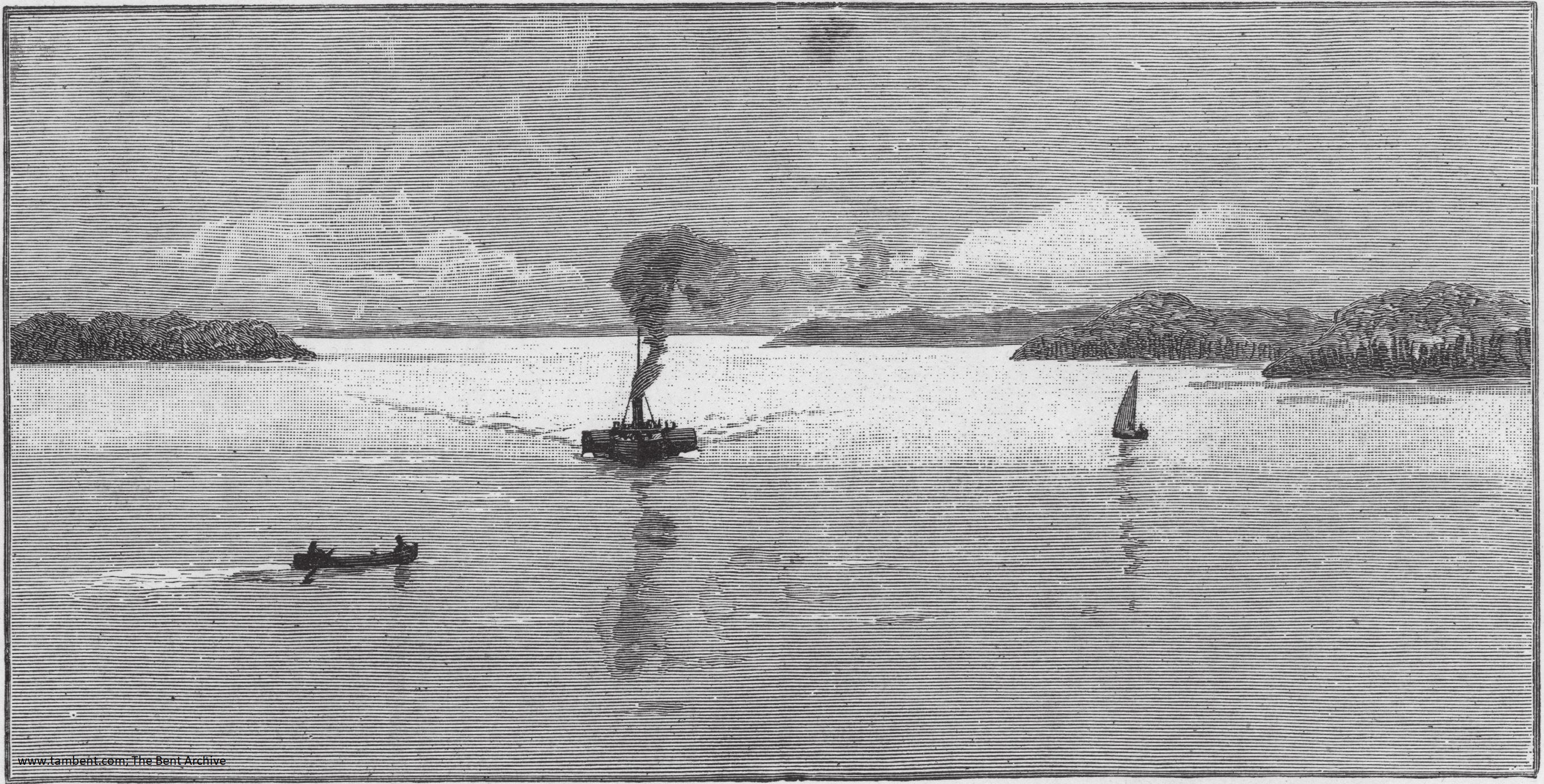
At last the Bents reached the Pungwe. In their day the river was navigable the 40 km or so from Beira only as far as Mpanda’s village and Neves Ferreira – and then only in the right season – by a few small steamers (reminiscent of the ‘African Queen’ for those who know the book/movie). One of these was ‘The Agnes’: “a fine, comfortable, flat-bottomed vessel built after the style of those boats one meets with on European lakes. She is the property of Messrs. Johnson and Co.” (D.C. De Waal, (trans. J.H. Hofmeyr de Waal), ‘With Rhodes in Mashonaland’. 1896, Cape Town, page 142)
Mabel continues: “At 2 next day [15/16 November, 1891] we rowed in a boat with about 25 others to the ‘Agnes’ at Neves Ferreira and went ashore… We went on board about 6. There were only Mr. Maunde and ourselves 1st class, but we were not sorted into classes at all and masters and servants, black and white, all eat at the same table in relays, for the saloon is very small and cockroachey [sic]. At 8.30 the dozen mattresses were served out and I rigged up my hammock and we all slept on deck. I went to the saloon and Theodore held up my dressing gown, for there were people there, and I undressed and in the morning made my toilette in the same way. We started at 9, to stop at 12, but at 11 got stuck on sand, so had to stay till 8 when the tide rose. We reached Beira about 12. The river is not interesting, though here and there are pretty huts nestling among palms, bananas and mangroves. We saw many rhinoceri and only one crocodile. We crossed what seems a lake to get to Beira, a most horrid place with few houses and much sand.” (Mabel Bent’s ‘Chronicles’, Vol 2, Africa, page 158)
The popular Christian nurses Blennerhasset and Sleeman are a little more kindly about the place: “The said town [Beira]… may be described as a long flat reach of sand, over which a few tents were scattered. There were also two iron shanties, and that was all. The place looked, even from afar, the picture of desolation.” However they enjoyed the scene more two years later on their way out: “In 1893 we founds streets, stores, and charming houses of the American chalet type”. (R.A. Blennerhassett and L.A.L. Sleeman, ‘Adventures in Mashonaland, by Two Hospital Nurses’. 1893, London, pages 61, 324)
The Bents left poor Beira on the S.S. Norseman around 24th November 1891, for their home journey south and onwards to Cape Town and London.
The illustration is ‘The Agnes steaming up the Pungwe River’. From a sketch by ‘Mr. Doyle Glanville’. ‘The Illustrated London News’, 15 August 1891, page 202. Private collection.
Postscript: Shortly after the Bent party had descended from the highlands of Mashonaland to coastal Mozambique, the Anglo-American Times of Friday, 20 November 1891 issued an alarming report: “The following notice has been received from the Emigrants’ Information Office:- ‘Cases of sickness and destitution having occurred among British subjects at the port of Beira, in South-Eastern Africa, persons intending to go to Mashonaland via that port, are warned that the route is at present impracticable owing to the rainy season and the prevalence of tsetse fly, and that, when reported open, it should only be used by those who have ample means to enable them to return if necessary to a British colony. The port of Beira is most unhealthy; detention there for a considerable time is often unavoidable, and there are no funds available for the relief and repatriation of British immigrants.’” It is another stark reminder of the perils the Bents continuously, and with great bravura, faced.
From Diary of the Right Hon. Sir Mountstuart E. Grant Duff for March 13 1897: “The Breakfast Club met at Herschel’s, Acton, Lyall, Trevelyan, Courtney, Mackenzie Wallace and Frederick Leveson – Gower being present. Acton confirmed a story which I had heard, but not from himself, to the effect that Mr. Rhodes had asked him: ‘Why does not Mr. Theodore Bent say that the Zimbabwe ruins are Phoenician?’ Acton replied: ‘Because he is not quite sure that they are.’ ‘Ah!’ said the other, ‘that is not the way that Empires are founded.’” [Sir Mountstuart E. Grant Duff, ‘Notes from a Diary, 1896 to January 23, 1901’; vol. 1, p.185. London, John Murray, 1905]
Unmissable (if you can access it) – this 1958 episode of the BBC archaeology series ‘Buried Treasure’, in which Sir Mortimer Wheeler scrambles over the site of Great Zimbabwe (then Southern Rhodesia). The 1891 explorer of this still-astonishing monument, Theodore Bent, is unfairly (only for this blog, of course) dismissed in Wheeler’s exposé as a ‘gullible antiquary’: Bent was paid to give some sort of explanation, and he did. ‘No ancient site in the world’, mutters Wheeler lugubriously through his pipe, ‘unless maybe for the Pyramids and Stonehenge, is more clogged than Zimbabwe with sticky romance…’ Wheeler explores the awe-inspiring stone ruins in the controversial company of Roger Summers, then Chairman of the Southern Rhodesia Historical Monuments Commission. The title of the episode is unhelpful – King Solomon’s Mines – but the programme is a delight for the fabulous black and white filming, and the sight of Wheeler in shorts chasing hippopotami. For modern interpretations of the Great Zimbabwe site, you must, of course, look elsewhere, i.e. the recent (2022) work of Innocent Pikirayi et al. on the probable water-storage system employed at Great Zimbabwe (‘Climate-smart harvesting and storing of water: The legacy of dhaka pits at Great Zimbabwe’, in Anthropocene, Volume 40, December 2022).
(Mabel Bent’s Chronicle of the year spent in Southern Africa (1891) is available from Archaeopress, Oxford)
There is another amusing association between Bent and Wheeler in terms of Africa, suggesting, perhaps, that the former might have played a role in Wheeler becoming a famous archaeologist. Wheeler recalls it himself in his Foreword to Peter Garlake’s 1973 book on Great Zimbabwe (opening with a reference to Bent’s questionable credentials): “but I recalled Bent because in spite of his spurious scholarship his travelogue-cum-report, The Ruined Cities of Mashonaland, was for its period (1892) both readable and liberally illustrated, and probably did more than anything else to impress Zimbabwe and its ilk upon the consciousness of the ‘nineties. I recollect how as a small boy, more than sixty years before I saw the site myself, I found constant delight in Bent’s soberly adventurous pages – so much less circus-like and more convincing than the dramas of Rider Haggard which otherwise represented Darkest Africa to one childlike mind!” (Peter Garlake, Great Zimbabwe, London 1973, p.67-8; italics, Bent Archive)
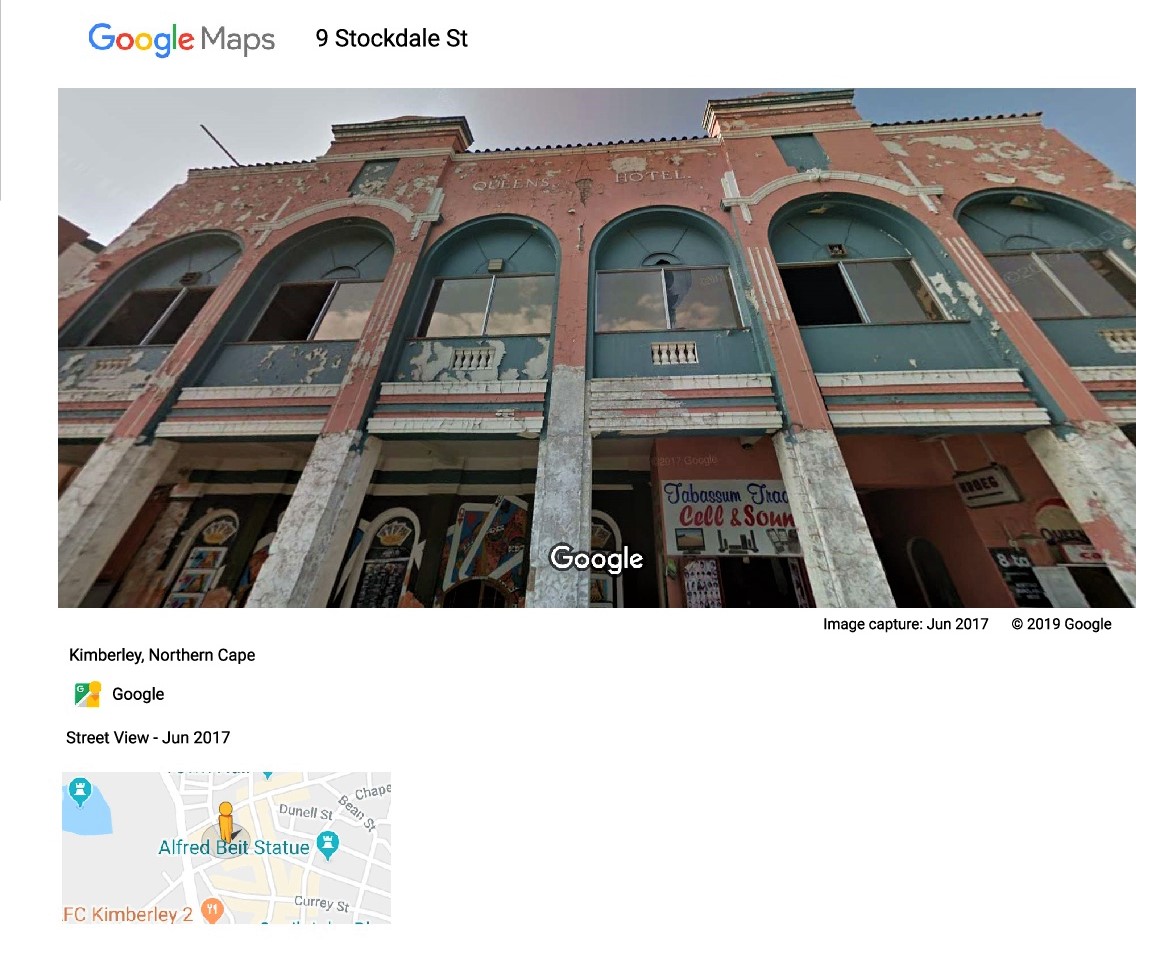
But let’s focus rather on the Queen’s Hotel, Kimberley; it still stands (at 10/12 Stockdale St). Well into its second century now it is not what it was, of course, but it stands for something. Theodore and Mabel Bent are on their way in early 1891 from Cape Town, by train, to explore the ruins of ‘Great Zimbabwe’ for Cecil Rhodes, and the couple stay at the hotel, a focal point and metaphor, from 26 February to 3 March 1891. The gables of the impressive structure, fashioned after the Dutch Cape Colonial style, bore the legend ‘1881 Queen’s Hotel’, carved in relief on inset panels. We clearly have a fancy brick edifice here, with elaborate, wrought iron verandas. At the time of the Bents’ stay the proprietor was probably one Henry Orkin, but the hotel’s prestige dates from the first phases of the diamond rush in the 1860s, and the later arrival of James and Catherine Jardine (Scots) from Pniel. Catherine bought the single plot, double-storey building and within a few years had added another twin double-storey structure to her hotel. But by the Bents’ arrival Catherine had retired back to Cape Town.
Kimberley, like it or not: the times were as they were, and all roads led to Rhodes. Arguably and extraordinarily, the diamonds from Kimberley (and gold from nearby) were used to buy what became Rhodesia, which went on to become Zimbabwe; and the wealth from these diamonds continues to circulate, somewhere – such forces don’t just disappear, we are talking Wagner here. Much of this (diamond Ring) story materialises within a couple of hundred metres of the Queen’s Hotel, Kimberley, in the second half of the 19th century, around the frenzied wheelers and dealers gravitating to southern Africa in search of fortunes, and totally heedless of the consequences of their activities, then and now. ‘Nothing in the external appearance… suggests either its fame or its wealth’, wrote Lord Randolph Churchill of Kimberley. Formerly ‘New Rush’, the town was named (June 1873) after John Wodehouse, 1st Earl of Kimberley, and became the capital of the Northern Cape. Few places on earth have generated, so quickly, so much power, greed and exploitation, beginning, in 1871, with a rough diamond of some 83 carats found on the farm called Vooruitzigt, belonging to the brothers De Beer. The story of how most of Kimberley’s mines were gradually acquired by Rhodes and his cockney, maverick sidekick, Barney Barnato, under the corporate banner of De Beers Consolidated Mines, is the stuff of legend and business-school texts. The great workings in the town, the ‘Big Hole’, are a tourist attraction still: ‘[One] of the most astonishing memorials to the impetus of avarice… [The] whole vast mess of the Big Hole was covered in a mesh of ropes, gently shimmering in the hot wind like an enormous spider’s web… The Big Hole, disused since 1914, became the largest man-made hole in the world – a mile round the top and nearly 700 feet deep’ (Jan Morris, ‘Pax Britannica, The Climax of an Empire’, 1998).
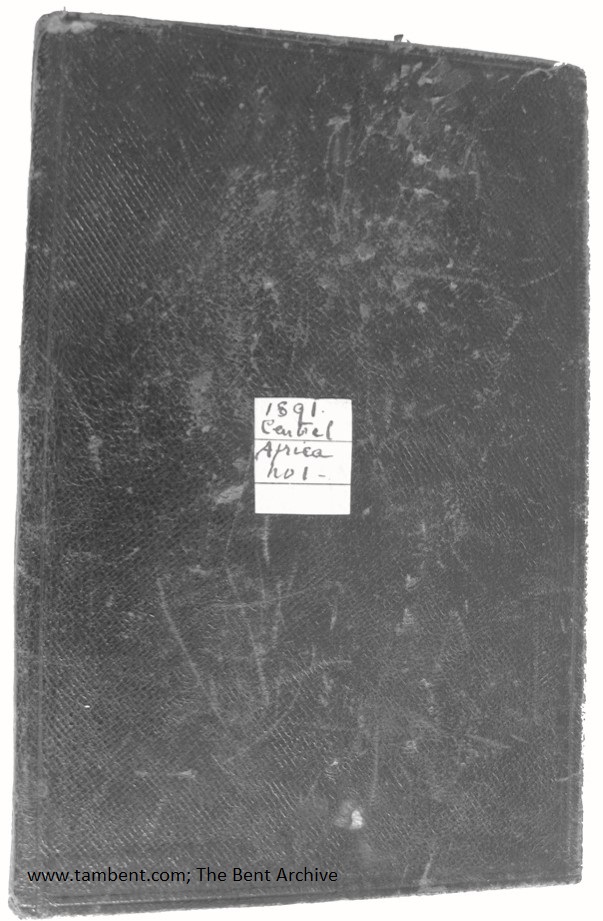
Mabel Bent’s ‘Chronicle’ for 1891 – Central Africa.
The Bents’ planned adventure of 1891 had been the talk of London’s Royal Geographical Society for several months: ‘Mr. Theodore Bent’s Expedition to Zimbabye: Mr. Bent left England last Friday (January 30th) on his mission to explore the strange ruined buildings in the gold region of South-east Africa. An unfortunate error in our note on this expedition in the January No. of the ‘Proceedings’ escaped correction in proof. It is the Chartered South African Company (not the East African) which has interested itself in Mr. Bent’s archaeological and topographical exploration. This company and our Society have each contributed a grant of 200l. towards the expenses of the expedition’ (‘Geographical Notes’, Proceedings of the Royal Geographical Society, Vol. 13, No. 2 (Feb., 1891), 105).
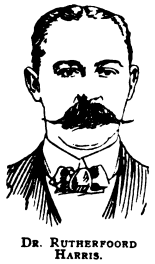
(1856-1920) (Wikipedia).
Resting at the Queen’s Hotel for a few days, Theodore and Mabel acquired the assets needed for their expedition (north to ‘Great Zimbabwe’) from the ‘Colossus’’ Alberichian lieutenant, Rutherfoord Harris. Dr Frederick Rutherfoord Harris (1856–1920) had qualified in Edinburgh, moving to Kimberley ten years before Mabel meets him. His rise in Rhodes’s service was rapid. Brian Roberts (‘Cecil Rhodes. Flawed Colossus’, 1987) describes him as a ‘coarse, ambitious adventurer… [who] came to be regarded as a loudmouthed braggart and born intriguer, whose penchant for mischief-making caused Rhodes endless trouble.’ But he clearly had something, and after his master’s death he is back in England by 1905, where he was ‘associated with some few finance Cos… and entered the arena of British politics in 1900 as Conservative M.P. for the Monmouth Burghs… Dr. Harris is a keen dog fancier, and is very popular in South Wales, where he spends most of his time’ (W. H. Wills and R. J. Barrett, ‘The Anglo-African Who’s Who & Biographical Sketch-Book’, 1905). Wikipedia adds a sad coda – that his widow, Florence, “hanged herself three months after his death in 1920, apparently overcome by grief”.
But thirty years before, in mercantile Kimberley, C. H. Weatherley, the B.S.A.C. Secretary in London, on Rhodes’ instructions, had already prepared Dr Harris to expect the Bents: ‘The Company’s contribution (viz: £200) towards… expenses has been paid to Mr. Bent, who has also been promised the Company’s assistance in the arrangement of his finances in connection with which he yesterday handed me a cheque for £1000. This sum has been placed to the credit of the Kimberley Office account, to be paid by you to Mr. Bent… [Please] provide Mr. Bent with letters of introduction… to any other persons whom you think can render assistance to [him] in his important and interesting expedition’ (B.S.A.C. ‘Out’ Letters, Rhodes House, MSS. Afr. s. 70-84, Folio 262/3, 22 January 1891). The ‘expedition’ was indeed important to Rhodes – Bent’s theories on the ‘Great Zimbabwe’ site suited his colonial ambitions for the territory.
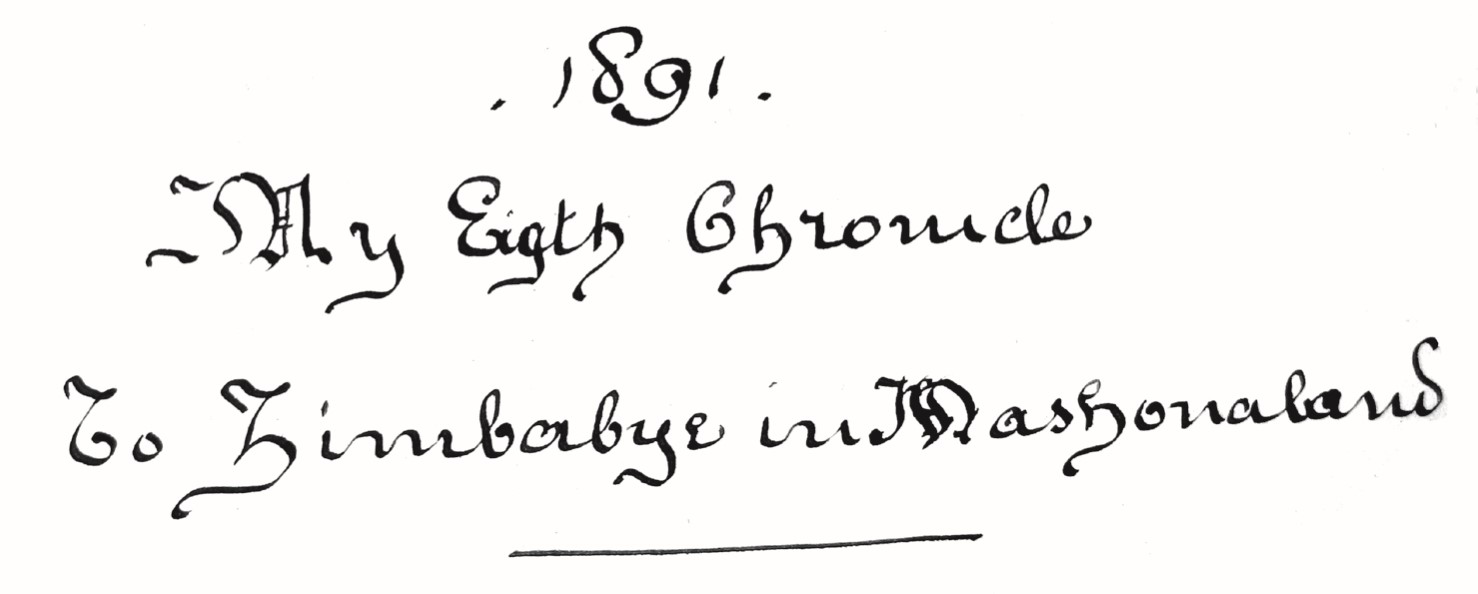
Opening page of Mabel’s 1891 ‘Chronicle’.
Thus set up, by the end of February 1891, the Bents had reached Kimberley, Mabel Bent recording the approach and arrival in her ‘Chronicles’, the indispensable diaries she kept for every year of the couple’s explorations: “We saw Miss Olive Schreiner, the authoress of the ‘Story of an African Farm’ and started at 8 on the 26th [February 1891] for Kimberley, which we reached next morning. The train goes very slowly and stops a good time outside each station and any time else that the driver pleases. Once it went off too soon, without us but kindly came back. Between Worcester and Matjiesfontein we had permission to travel on the cowcatcher over the Hex pass. It was a delightful break in the monotony of the journey over the Karoo desert… On reaching Kimberley [Friday, 27th February 1891] we found that Dr. Harris had engaged rooms for us at the Queen’s Hotel. He belongs to the British South Africa Co. and had been kindly buying our wagons and having them fitted up; also 36 oxen and provisions for four people for 6 months… We went down the De Beers diamond mine, 800 feet, dirty and disappointing, and also went into the compound where black people live for 4 months, only going to the mines – that was more interesting. Most men were dressed in blankets and they certainly seemed to have any amount of trousers, but they were nearly all spread out on the ground or hung up. All the store of diamonds was very wonderful to behold. Very few were comparatively white and many looked like lumps of gum Arabic… On Tuesday [3rd March 1891] we left Kimberley for Vryburg. The wagons were on the train and the oxen and all the provisions, so we took up 10 trucks. We travelled more slowly than ever. One could hear the grasshoppers above the noise of the train…” (Travel Chronicles of Mabel Bent, Vol. 2, pages 47–49).
Such a place was Kimberley then, and the Queen’s Hotel in Stockdale St. The grasshoppers will, no doubt, remain when the diamonds have gone… honey take me dancing.
(Mabel Bents Chronicle of her year (1891) spent travelling in Southern Africa is now available)
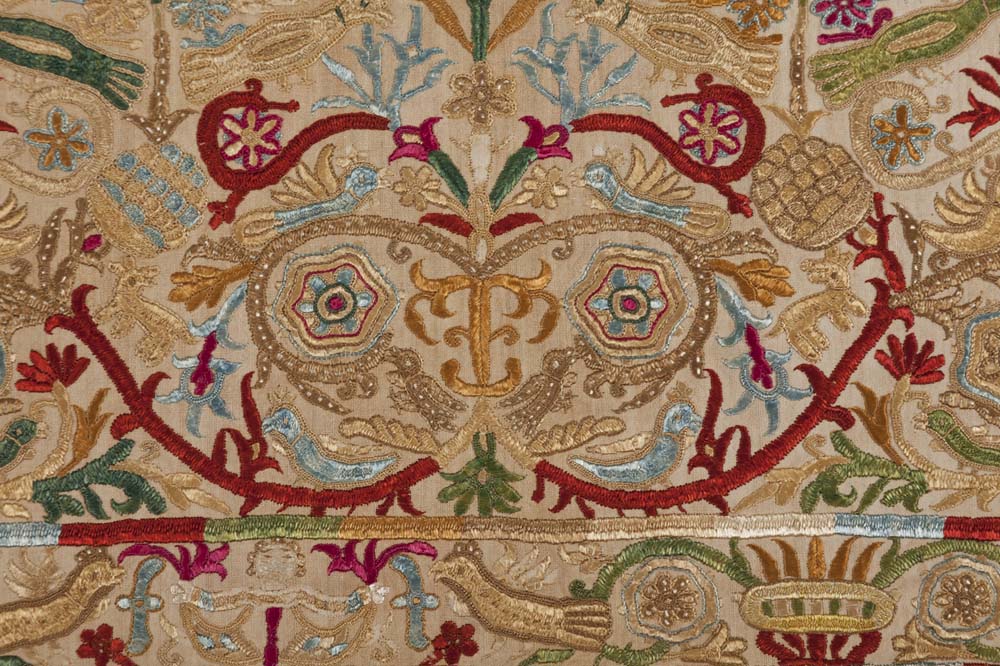
Greek Dress at the Hellenic Centre, London – 4 February until 2 March 2014 – The Bents’ acquisitions and their stories!
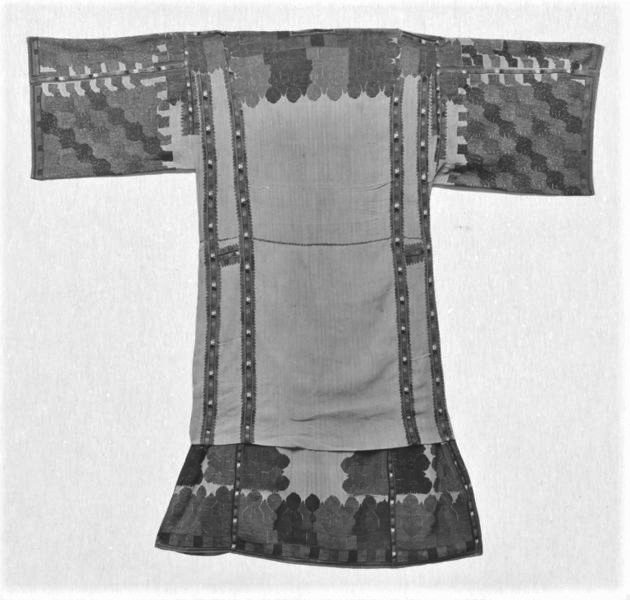
Although Theodore and Mabel Bent lived not so far away, Marylebone, in Central London, might seem an unlikely place for an exhibition of Greek costume, but it is the home of the Hellenic Centre, a focus for philhellenes and London’s Greek community. From 4 February until 2 March 2014, there was a rare opportunity to see an impressive range of Greek dress outside its native land. As part of the event (on Friday 28 February, 7.15 pm), Ann French, Textile Conservator at the Whitworth Art Gallery, the University of Manchester, used selected embroideries from the 1914 pioneering embroidery exhibition (click for the online catalogue) at the Burlington Fine Arts Club in London, to trace their individual collecting histories and reveal the different contexts, interpretations and values placed on them within UK based collections and museums. This exhibition, which drew on the leading collections of the day, primarily from the collection of Theodore and Mabel Bent and the archaeologists R M Dawkins & A J B Wace, of Greek Embroideries displayed, for the first time in the UK, historic Greek Embroideries as an art form. There is a short, but wonderful, promotional video on YouTube (April 2021).
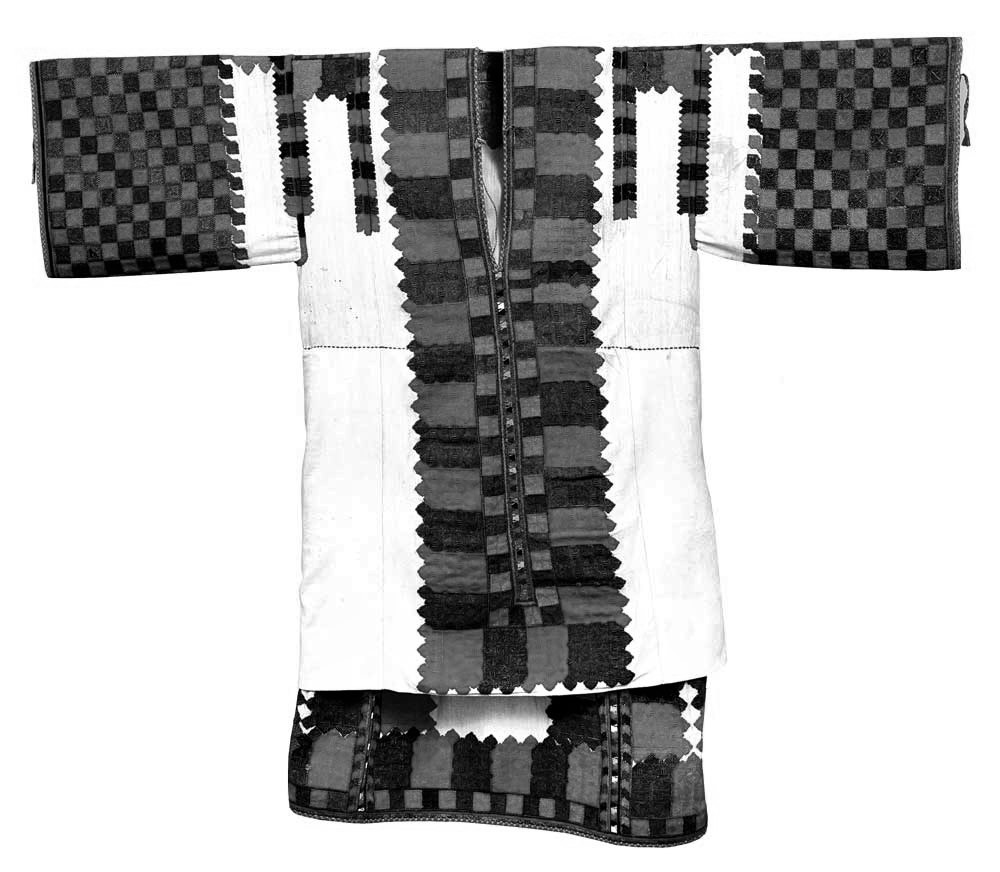
“Embroidered tunic and skirt of linen crepe with square sleeves, embroidered in tent and long cross stitches with various repeating patterns of debased floral and other forms arranged geometrically.” Now in the Victoria and Albert Museum, London (no: 346-1886; from Karpathos in the Dodecanese, acquired from the Bents (in 1886) after their visit to the island in early 1885) (Victoria and Albert Museum, London).
The exhibition features several of the Bent’s finest costumes and pieces, and Ann refers to them in the last five minutes or so of her talk in a fascinating account of how, on Mabel’s death, one of her Karpathos frocks found its way back to Greece! (One other is in store at the V & A, and two more from Nisyros are untraced – if you have them, let us know!)
Another of the dresses acquired by the Bents on Karpathos in 1885. After a long journey, this exquisite cotton costume of the 18th century returned to Greece and is now in the Benaki Museum, Athens (EE 923).
Click here also for the small collection of ‘Turkish’ embroideries once owned by the Bents and now in the Harris Museum and Gallery, Preston, UK, and here for dresses from Anafi in the Cyclades.
(For the Bents in Greece and Turkey, see Mabel Bent’s Chronicles, published by Archaeopress, Oxford, in 3 volumes)
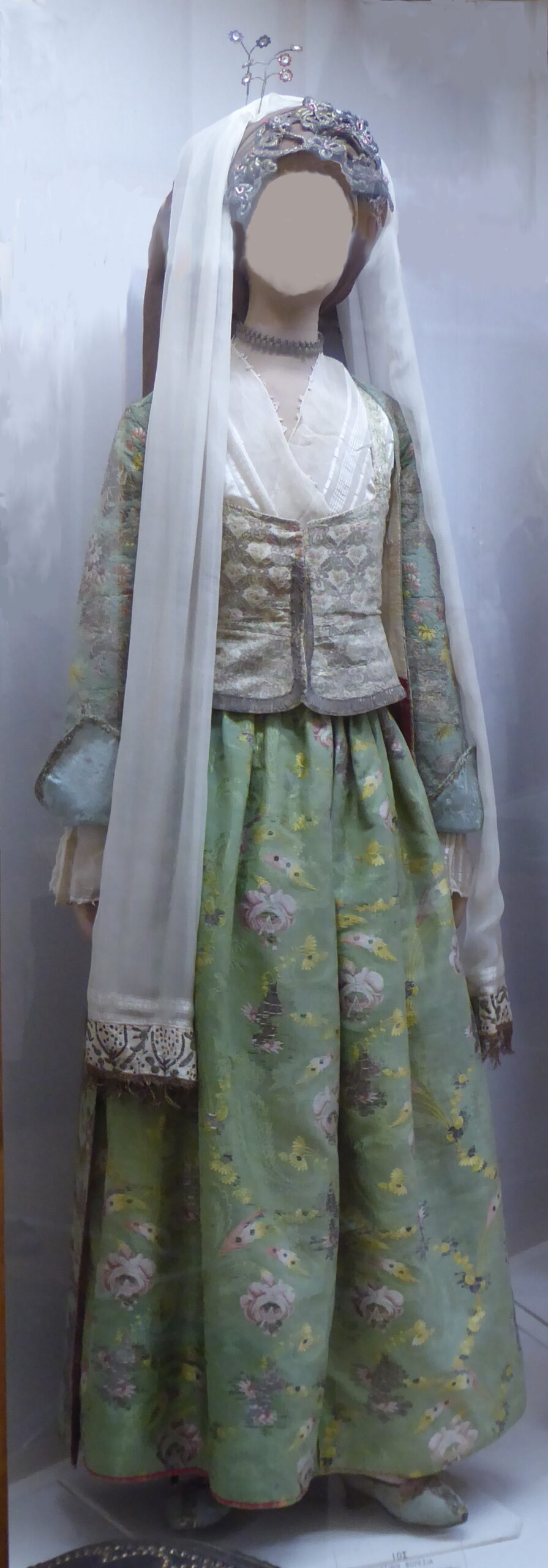
The costume worn by Ekaterina Lorenziades of Ios in the Cyclades to impress the Bents during their stay, now in the National Historical Museum, Athens (photo = Alan King).
See also the blog ‘Folk Costume and Embroidery‘ and Alan King’s post elsewhere on the costume worn by Ekaterina Lorenziades to impress the Bents during their stay on Ios, now in the National Historical Museum, Athens.
“I am also interested in a photograph of the Greek servant who accompanies Mr. and Mrs. Bent in their travels. He is a very superior man, intelligent, trustworthy, and devoted to his master and mistress, and when they return to England reluctantly leaves them and goes back to his farm until it is time to rejoin them.” The Gentlewoman, Saturday, 11 November 1893.
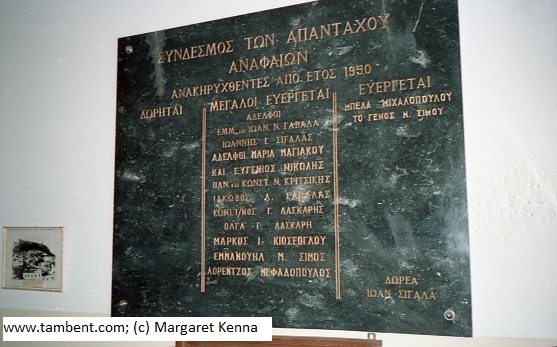
The plaque in the Anafiot Association of Athens in the 1950s, recording the Simos family as benefactors (courtesy of Margaret Kenna).
A superficially unremarkable photograph sent in by Anafi specialist Prof. Margaret Kenna contains a remarkable clue. The clue is a family name – Simos – on a plaque commemorating benefactors to the Association of Anafi Islanders (Greek Cyclades) in the early 1950s: a relatively prosperous family, thanks to one Matthaios Simos.
There is an archetype waiting for psychoanalysts to explore – the dragoman, the person you employ to facilitate your travel in foreign lands. Wiktionary helps here (if you want more, you are on your own): ‘From Middle English dragman, borrowed from Old French drugeman, from Medieval Latin dragumannus, from Byzantine Greek δραγομάνος (dragomános), from Arabic تُرْجُمَان (turjumān, “translator, interpreter”)’.
What type you get depends on your luck – from an Aristotle to a Zidane – and all travel narratives contain them, none more so than our great 19th-century accounts. And Theodore and Mabel Bent had an extraordinary one: not their first, Kostandinos Verviziotes (for the couple’s 1882/3 visit to Greece and Turkey), nor their second, George Phaedros from Smyrna, who started with the Bents as they left for the Cyclades in the winter of 1883. Theodore and Mabel engaged George on the recommendation of Mr Dennis at the Smyrna consulate. That he was only a moderate success may be inferred by Mabel’s initial lack of enthusiasm when he joins them again, at Ermoupolis, Syros, in December 1883. Apparently he enjoyed a drink, but he was also a grumbler and a terrible sailor – a distinct disadvantage when island-hopping, out of season, on small fishing boats. By Naxos, a few weeks later, the Bents had had enough of him, and one day, high up in a mountain village, they find themselves sitting in a warm room, and, “When Mr. Konstantinides our host came home he found 10 people drying their clothes, us two and Phaedros, Mr. Swan, and a man called Mantheos, a native of Anaphi who is to show Mr. Swan mines there…” George was dismissed on Naxos in January 1884 – with just five words in Mabel’s notebook: “We left Phaedros at Naxos”. The Bents went on, of course, to explore Anafi a few weeks later.
There is a sad letter (in English) from George folded into Mabel’s 1883/4 diary asking for remuneration, and although diversionary, no apologies are given for including it here, just skip it if you wish:
[C/O British Consulate Smyrna 1st February /84] Dear Mr Bent I am happy to learn from your favours of 20th January which I received on the 30th of the same, that both you and Mrs Bent are quite well. I have been always thinking of you how you managed with the continuation of your excursion, and how you got on with the unusual rough winter of this year exposing yourselves so, to the mercy and providence I dare say of God. As regards my passage to Smyrna after we departed, you will please learn that your hopes did not prove as expected for I did not escape of what I was fearing. The wretched steamer ‘Eptanisos’ which took you from Naxos on Monday the 7th of January 1884, did not come back to that island to pick me up for Syra until Wednesday the 9th January, (and about noon) and subsequently she kept going so slow, that I missed the Messageries steamer for Smyrna which was leaving Syra (bound for that town) on the same day. I have been waiting consequently six days in Syra and was obliged to spend almost all the money you gave me at Naxos, (viz: the 100 francs) that is to say in expenses for the Hotel in Syra, in changing my broken and shabby hat, and in paying for my passage or fare ticket to Smyrna which brought me home almost penniless. And my wife had already spent also, what I had sent her from Syra in buying some necessary things for the house, with the cause of the holidays etc. So my friends who expected me to return quite a rich man, contemplating, in their idea and opinion that I was getting £T5 [Turkish pounds] per day in consideration of the winter season travelling, were quite disappointed to find that I was obliged and in need to borrow money off them. Mr Dennis also told me that he did not think it was right for me to pay out of my pocket my passage to Syra and back and the expenses for the delay in waiting you in Syra etc., etc. As regards the salary I do not exactly appreciate the opinion of my friends, but I think it is fair that you should make a little allowance for the winter season, that is to say if you do not find it so inconvenient, so as to make it worth my while, as I am a fellow with a family as you know. I left Syra on the evening of Monday 14th January. I don’t know where you have spent that fearful evening and night but it was in my destiny to find myself in a most violent gale, but fortunately in a brave Arab steamer with Greek captains which was fighting with the elements of the nature that night and stand up like a giant against them. All the plates and glasses are broken and the water found its way in to the cabins. We overtook a steamer called ‘Simiotis’ and saw her bow deeped into the water and we thought she was going to be lost but we learnt that she turned back to Tinos. We kept up but we suffered until we faced the Bay of Smyrna. The impression of that night is still very brisk in my memory. But the necessity of a man is superior to the impression of fear. Although I foresee still bad weather going to be, I made up my mind to come and accompany you again and to be at Syra on the 16th February with the hopes that we shall ahoy the caïques and you will pay for my passage, etc. Please send through Mr. Binney some money for my travelling expenses, etc., enabling me thus to make my start. With my best regards to Mrs. Bent and Mr. Swan. I remain yours sincerely… George Phaedros.
At camp on Socotra: Matthaios Simos. From Theodore and Mabel Bent ‘Southern Arabia’ (1900), facing p. 365 (detail). Private collection.
This proved a letter in a bottle however and no reply to him is referenced. Within a few days of Phaedros’ abandonment, a whiskery Ariadne on Naxos, and Matthaios Simos (Mabel Bent spells him a multitude of ways over the next fifteen years, but ‘Manthaios’, awkwardly, seems to predominate) gets the top job as dragoman for the Bents, and begins a partnership – friendship really – with Theodore and Mabel that continues until 1897 and Theodore’s death. Missing only two or three seasons, Theodore (using the English telegraph station at Ermoupolis to reach him) wires Matthaios from London that he might be, on such and such a date, at Syros, or Rhodes, or Chios, or Alexandria, or Port Said, or wherever, to act as their translator, guide, cook, lodgings officer, victualler, foreman and general factotum. This small and wiry islander, who waited to marry until he had finished his career with the Bents, having by then sufficient resources, ‘plusios’ even, and a good catch. (As was the case with so many young Greeks who ventured far afield to escape difficult conditions back home.) Matthaios left his footprints in the sands of Southern Arabia, Sudan, Ethiopia, Egypt, Socotra, Yemen, as well as all around the Aegean.
It is fascinating to see in print and photographs how such a relationship developed. In his great book “The Cyclades”, this is Theodore in 1885: ‘My first experiences [of the islands] were made with the assistance of a dragoman; but, on better acquaintance with the language, I learnt to despise his services, and took as servant a native of one of the islands, who became invaluable in assisting me to discover points of folklore which without him it would have been impossible to arrive at.’
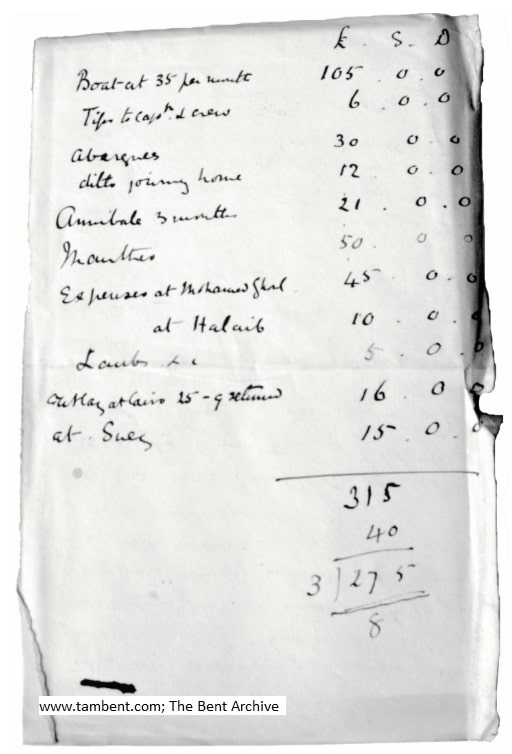
A modern registry listing of the birth (1846, no. 6) of Matthaios Simos on Anafi (courtesy of Margaret Kenna).Theodore Bent’s own reckoning of expedition costs to the Sudan in 1896, showing Matthaios’ payment at line 6 (The Bent Archive).
In the Community offices of Anafi, two hours’ ferry ride away and a little southeast of Santorini, the early registers of births (men only) record the arrival of Matthaios in 1846, son of a subsistence farmer, like nearly every other child. The chance that led him to Naxos and a meeting with the Bents in 1884, aged nearly forty, alters his life (there is a later reference by Theodore that he might have had a tobacco shop on the island as a younger man). In Mabel’s 1897 ‘Chronicle’, the year of her husband’s death, there is a list of travel costs payable, in Theodore’s hand. Matthaios’ wages for the trip to Socotra and Aden are £50, about £5000 today, and a huge sum for a Cycladic farmer at the turn of the 19th century; he is able to effectively retire to Anafi, marry, have a family (his descendants are now in Athens and no Simoses remain on the island), and tell of his adventures in foreign lands as dragoman and friend to an extraordinary English couple. He died in the mid-1930s, five years after Mabel’s death, with the only Bent expeditions he was not a valuable part of being: 1889 (to Persia), 1891 (to Great Zimbabwe) and 1895 (the couple’s second venture into the Wadi Hadramaut).
At camp on Socotra: Matthaios Simos, background, with Theodore Bent, assistant Ammar, and Ernest Bennett. From Theodore and Mabel Bent ‘Southern Arabia’ (1900), facing page 365. Private collection.
Mabel took his photograph on several occasions, the final one in Bent’s last camp, on Socotra in 1897: Theodore is on the left, taking down notes for his arcane dictionary of Socotran dialects. As well as their assistant Ammar, an unmistakable English figure in a topee, one Ernest Bennett, sits to the right. And between the two, just in the background, and alas not clear, stands a middle-aged man in his working clothes… this is Matthaios Simos. (There is also another splendid image of him sitting on a Sudanese camel; and we know too that, like a camel, he could exist on very little, as Mabel writes in her Tilos (the Dodecanese) journal in 1885: “… off [M] went bearing his coat, half a kid in one hand and a tied up bundle with his favourite scraps for his own eating. He is certainly cheap to feed. He eats all the fishes’ heads and yesterday lunched of cold lights.”)
For a glimpse of Anafi in the late 1970s, there is a wonderful video freely available we can recommend. The decades between 1884, and the Bents’ visit, and the making of the video, all seem to melt away, and much of what you see is how Theodore and Mabel would remember this extraordinary Cycladic isle.
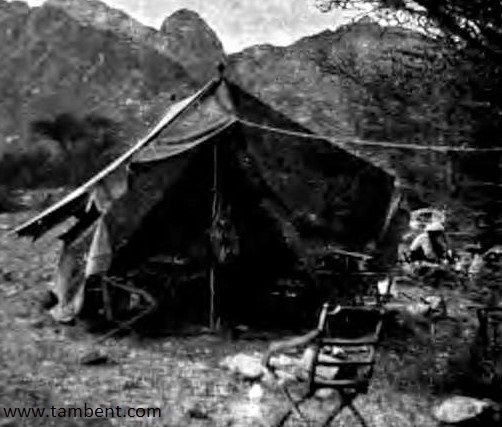
Early 1896, Matthaios Simos at his chores, behind a tent (right) in the Elba Mountains, Sudan (photo by Mabel Bent, or Alfred Cholmley, from the Bents’ ‘Southern Arabia’, 1900, opp. page 304).
There was another serendipitous meeting for Matthaios Simos. The writer Vincent Scott O’Connor travelled in the Cyclades in the 1920s and found his way to Anafi. O’Connor had a copy of Bent’s book on the islands and jumped at the chance of an interview with Theodore’s famous (at least on Anafi) dragoman. He records him one evening, up in Chora, “The story-teller relaxed from his labours; a fine little old man with a curved nose and clean-cut features…” Manthaios tells of how he ‘saved’ the Bents from pirates on Samos in 1886: “At Samos,” he said, “there were pirates, who had made up their minds to kidnap the English travellers, and for that reason my master was unable to leave the island. It was I who circumnavigated their wiles… But it was not in these isles that we had our greatest adventures, it was in Arabia… Mrs. Bent was always eager to press on. One night we slept in a damp spot, and while there I had a dream in which I saw two horses and a chariot in Anaphe; but there was no driver, and one of the horses fell down and died. The chariot was overturned. My interpretation of the dream was that this portended a disaster to our party. But Bent only laughed at my fears. He said dreams were nothing but dreams. Nevertheless, as I expected, Mrs. Bent fell seriously ill of a fever which each day grew worse. She could ride no more, and the Arabs refused to carry a Christian, especially a woman. But the Sheikh put his shoulder to one end of the litter, as I did to the other; and so we carried her till the rest of them became ashamed and each took his turn. We arrived at the sea and the Sheikh sent out some milk for the lady, but she was so ill that she could not retain it and daily she became worse; yet she went on, saying that it was only a little fever, and she would not hear of our abandoning the journey… I decided then to act upon my own initiative, and a dhow having come into the harbour, I spoke to the Captain and contracted with him to take us to Aden. Then, for I knew how obstinate are these English, I went to Bent and said, ‘Kyrios, why not take ship to Aden?’ ‘Nonsense,’ he replied, ‘you know very well that there is no ship.’ ‘Maybe, Kyrios, but suppose that there were one, would you take it?’ ‘Well! Yes,’ he said, ‘I would, for she is very ill.’ I took him to the top of a hill and showed him the Dhow at anchor! So we started; but on arriving at Aden, there was a ‘quarantine’ and Madame was not allowed to land. The Governor however intervened in her favour and a doctor came at once to see her. He was only just in time, but her life was saved. It was after this that Bent himself began the illness that ended in his death… All were agreed that here was a great traveller, one like unto Odysseus himself.”
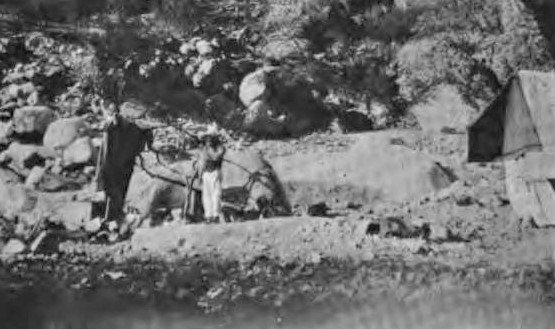
Matthaios Simos at camp in the Wadi Ambaya, Sudan in 1896 (photo by Mabel Bent or Alfred Cholmley, from ‘A Visit to the Northern Sudan’ by Theodore Bent, ‘The Geographical Journal’, Vol. 8 (4) (Oct), page 345)
And the same, of course, must be said of the dragomános extraordinaire, Matthaios Simos, of Anafi in the Cyclades, and all points south-east!
Some further notes on Matthew Simos and his family (June 2022)
We know only a little of the early story of Matthew Simos [Σίιμος Ματθαϊος], the Bents long-term ‘dragomanos’. The Anafi birth registers of the period record only males. Matthew is listed for 1846, the year before Mabel Hall-Dare first draws an Irish breath (1847), and six before Theodore Bent cries in Liverpool (1852). Matthew’s father is given as Anagnostis Simos [Σίιμος Αναγνώστης]; his grandfather was, probably, Jacobos. The Simos family appears not to be a long-established one on Anafi; conjecturally they arrived with Anagnostis from another Cycladic island (the Bents met Matthew on Naxos in the winter of 1883/4), the latter marrying an Anafiotissa. The term ‘sogambros’ might even be applicable to him.
Mabel records that Matthew had a brother on Anafi, and property, in which they stayed. This brother does not appear in the birth registers – was born on the island of his father? Mabel also mentions a niece of Matthew’s who had married into the Chalaris family. The Chalaris name is much represented today on Anafi, not so the Simos family. There is no reference by Mabel to Matthew’s parents, and perhaps they had both left us by the time the Bents made their brief visit to the island in 1884.
“We were three victims thus obliged to tarry [in Kavala, northern Greece], one moderately sentimental and soon sated with reminiscences of St Paul [i.e. Mabel Bent], one moderately fond of tobacco, and imbued with a feeling that there are other things to live for in this world beside smoke [i.e. Theodore Bent], and one, the servant to the other two [Matthew Simos], who keeps a tobacco shop in a far-off Greek island [Anafi in the Cyclades] ; he alone of the three was thoroughly happy at Cavalla during the enforced delay, and was busy all the time with his needle, padding his coat, waistcoat, and trousers with tobacco, with a view to deceiving the customs on his return home, and, when the time of our release eventually came, he presented the appearance of a fatted ox, and, as the weather was very hot, I tremble to think what his interior sensations must have been.” (J.T. Bent, 1889, ‘A Russian Monastery’. The Gentleman’s Magazine, Vol. 267, (Sep), 239-47 [quote is p.238].
Later in the Anafi birth registers we have the names of Matthew’s two boys – George, born in 1881, and Jacobus, born in 1886. We do not have his wife’s name, alas. In all the twenty years of so of Matthew’s work with the Bents in the Levant, Africa, and Arabia, the travellers make no reference to the wife and family of their loyal dragoman. Nor do we know the later family histories of George and Jacobos. Today the name Simos is no longer recognised on Anafi, and it seems that all the properties have gone; in one of Theodore’s essays he writes that Matthew had a tobacconist’s shop there. Matthew was still living on Anafi, however, in the late 1920s, and our photo shows him in old age (presumably he dies in the 1930s) with two of his grandchildren; his boys had presumably left for Athens by then, or abroad – tantalisingly, a George Simos, born 1886, in ‘Greece’, is listed in the US census data.
Matthew tells Vincent O’Connor (1929) of his times (and the ups and the downs) with the Bents, and shows him ‘two faded English photographs of Bent and his wife’ (if only we had them), and how that, when it comes to Theodore, ‘All were agreed that here was a great traveller, one like unto Odysseus himself.’ The same can be said of one Matthew Simos, of Anafi in the Cyclades.


 Leave a comment or contact us about this article