

After Vanessa Gordon, author of The Naxos Mysteries, kindly contributed to our Reading “The Cyclades” series, we asked if she would like to write us a short piece about her erstwhile Cycladic encounters with Theodore and Mabel Bent, and were delighted when she agreed.
Beginning her article on the island of Antiparos, where the Bents spent some happy weeks in early 1884, making their own mysterious discoveries, Vanessa writes…
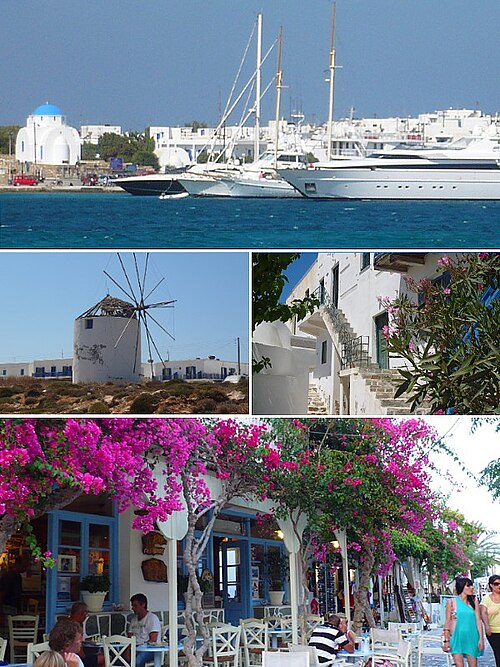
We eventually reached Antiparos, having made several visits to its larger neighbour, Paros, on other trips without managing to include Antiparos in our itinerary.
By the time I stood on the southern shore of Antiparos, looking out over the islet of Despotiko, I already knew something about Theodore and Mabel Bent. Their activities here had made an impression on me when I first read Theodore’s book The Cyclades, or Life among the Insular Greeks (1885), which I had discovered on the bookcase of a good friend in Athens who, being a classicist and archaeologist, had many interesting books that I scanned and subsequently acquired.
Imagine my disappointment, then, when we were told that there would be no more ferry crossings to Despotiko that day. My husband and I consoled ourselves with a superb fish lunch, and resolved to return the following summer.
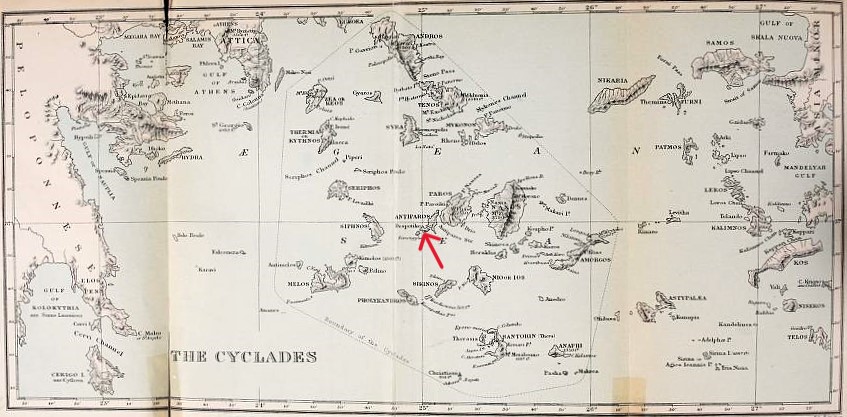
And so we did, and were much better prepared that time. Schedules had been consulted and hours put aside for exploring on Despotiko. In fact, we arrived too early, and ordered a coffee at a taverna close to the jetty. There we met another English couple, Steve and Diana, and a conversation began. They, too, were waiting for the ferry to Despotiko, and we ended up spending the whole day together. We first visited the ruined Sanctuary of Apollo, where the Bents had been long before us, and then re-boarded the ferry which took us round the coast to a swimming bay at the far side of the islet. It was there, as we walked into the warm water to have our swim, that our companions informed us they were once members of the British Olympic swimming team. We have remained friends ever since.
It was a serendipitous first encounter with the indomitable Bents, although with our new friends, and the inevitable feast afterwards at the local taverna, I’m not sure just how much I thought about them after we left the sanctuary. By the end of the day, though, I regarded them in a different way from how I had thought of them on reading Life Among the Insular Greeks. I had picked up even then that Theodore’s approach to antiquity was, in a sense, rather cavalier. I had formed an impression that some things might have been damaged in his search for other antiquities. That was understandable: these were early days, and the principles of archaeology, especially concerning the protection, conservation and sensitive excavation of finds, had barely been established at the time – and not established at all in the mind of Theodore. What else was to be expected from an enthusiastic explorer in a science that was barely past its adolescence? The bond I had formed with Theodore, therefore, was a fellow-feeling between two come-lately but passionate amateurs. I also admired him, of course, for having done so much in the pursuit of his passion, undeterred by hardships, adversity and ill-health.
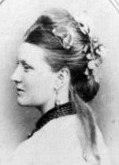
Then there was Mabel, his wife. Photographer and diarist, older than her husband, vivacious Irish woman, desperate to escape the confines of Victorian Ireland, she had accepted Theodore as her husband and his proposal to travel to foreign lands. They had set off soon after their wedding (1877) and were to explore together for many years; even after Theodore’s early death, Mabel continued this journeying. I was reminded of Joan Leigh-Fermor, partner and wife of Paddy, who crossed Greece with him in an era when it was almost as difficult to do so as for the Bents. Also of Agatha Christie, whose late marriage to Max Mallowan had taken her to remote archaeological sites in Egypt, where, with her trusty typewriter in her luggage, she had written some of her mysteries in makeshift accommodation in the desert. These were women whose husbands – archaeologists and explorers, writers and travellers – had opened up for them the possibility of a life which most women of the time had no chance to experience.
So it was that, inevitably perhaps, I introduced small references to the Bents in my own writing. The Naxos Mysteries pivot on archaeology and history, and my hero Martin Day gives long and enthusiastic explanations on his beloved subject to anyone who will listen. This gives me the perfect platform for introducing all sorts of interesting historical anecdotes into my books, and this includes the Bents.
It is not Martin Day, however, who first introduces the Bents to my readers: it is an elderly retired academic called Edward Childe, a character who quickly became one of my favourites. Edward persuades Day to create a documentary series on the subject of Greek marble, a series which is to be structured using Edward’s eclectic collection of historical memorabilia which, he explains, includes some unusual letters:
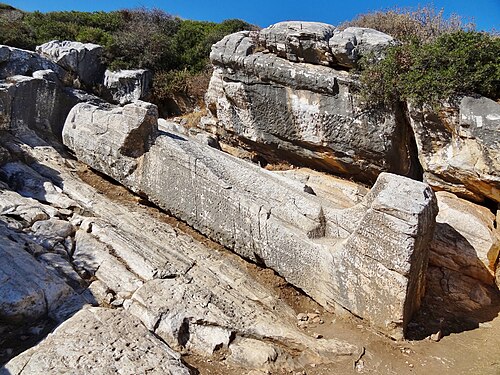
“There will be a major focus on Naxos, not only as a historic centre for Greek marble but also because I have some letters written by Mrs Mabel Bent to a friend in London, in which she describes how she and her more renowned husband Theodore were exploring Naxos in the late nineteenth century. I also have a couple of her photographs. One of them shows the Kouros of Apollo.”
“How on earth did you get hold of the Bent material, Edward?” interrupted Day.
“The letters were left to me when I was a student by an Oxford classicist I very much admired. His name was Augustus Bent Middleton. I don’t know if there’s a family connection with the famous Bents – perhaps you’d like to look into it, Martin?” (The Search for Artemis, 2021)
How did Edward acquire such material, you may ask? Mabel’s diaries, which formed the basis of her husband’s famous books, are in safe keeping now, not to mention being digitally accessible; but this is fiction, and there is always the chance of personal letters showing up decades later, don’t you agree?
The Bents are mentioned again later in the same book, when Day talks about them to his friend (later wife) Helen, in his usual, informative way:
“Edward said he had original letters from the wife of Theodore Bent. Do you know about him?”
“No, who was he?”
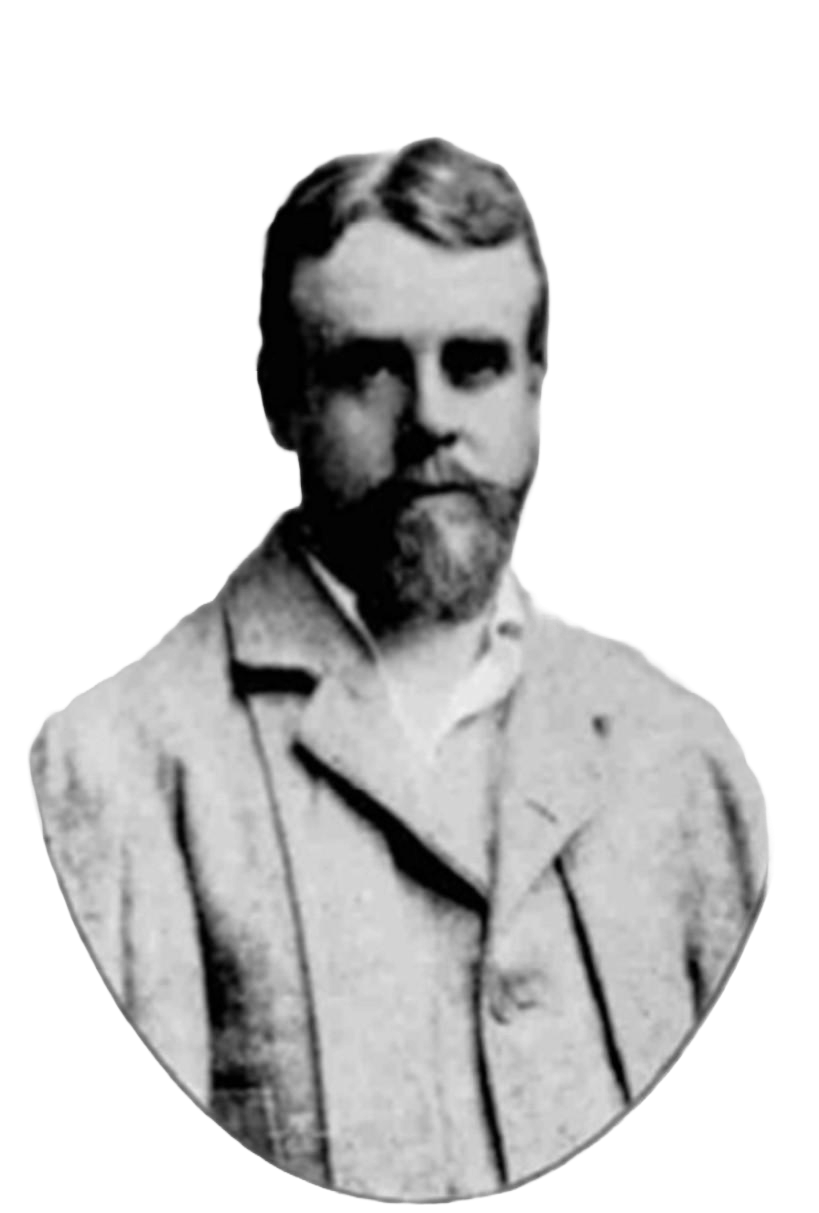
“He was a young Englishman from Yorkshire who lived at the same time as the giants of archaeology, like Arthur Evans and Heinrich Schliemann. note 1 He was completely self-taught, very young and inexperienced. Undeterred, he committed his short life to travel and archaeology, and his equally young wife Mabel went with him. They travelled through the Cyclades, writing about what they saw, not only about the ancient remains they found but also the lives of the local people. I’ll lend you the book, it makes good reading. It’s called something like Life among the Insular Greeks, I have a copy here in the house. Theodore was an Oxford graduate with no experience of excavation, yet when he had an opportunity to excavate on Antiparos, off Paros, it made his reputation. He died tragically young, in his mid-forties. His wife wrote travel notebooks, which are in library collections in London. Edward told me that he had some letters she wrote to a friend describing her time on Naxos with Theodore. I’ve seen her notebooks; I’d love to see those letters. note 2 ”
“I’d like to read the book.” (The Search for Artemis, 2021)
Another Naxos Mystery in which the Bents are specifically mentioned is The House in Apíranthos. The book is structured around a series of filming sessions, already referred to in The Search for Artemis, that take place at locations in the Cyclades. Day is presenting episodes based on current excavation sites, one of which is the exciting sanctuary on Despotiko, which I had visited years earlier with our new Olympian friends (see above). Here he is speaking into the camera:
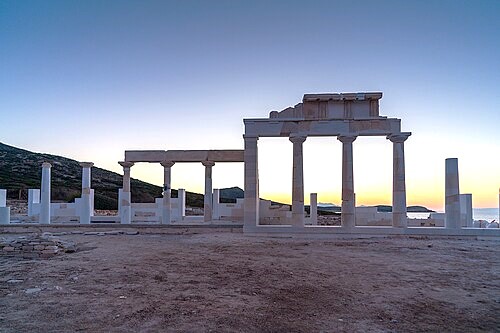
“Welcome to the Sanctuary of Apollo on the island of Despotiko. This is one of the most important excavations currently being undertaken in Greece, yet it is also one of the least well-known. Despotiko has been uninhabited for some time, protected by law both for its unspoilt natural habitat and its archaeological significance. Its long history, since first being mentioned by Pliny the Elder, has involved Venetians, Ottomans, and even pirates, and the English traveller Theodore Bent was here in the second half of the nineteenth century. Christos Tsountas, the brilliant Greek archaeologist, began excavating here at the end of that century, and more discoveries were made in the 1950s when an early Cycladic settlement was found.”
Day paused slightly to allow Ben to change to a different angle for the next line.
“Then, in 1997, the current excavation here began.”
He put on his sunglasses and turned away from the camera. note 3 (The House in Apíranthos, 2024)
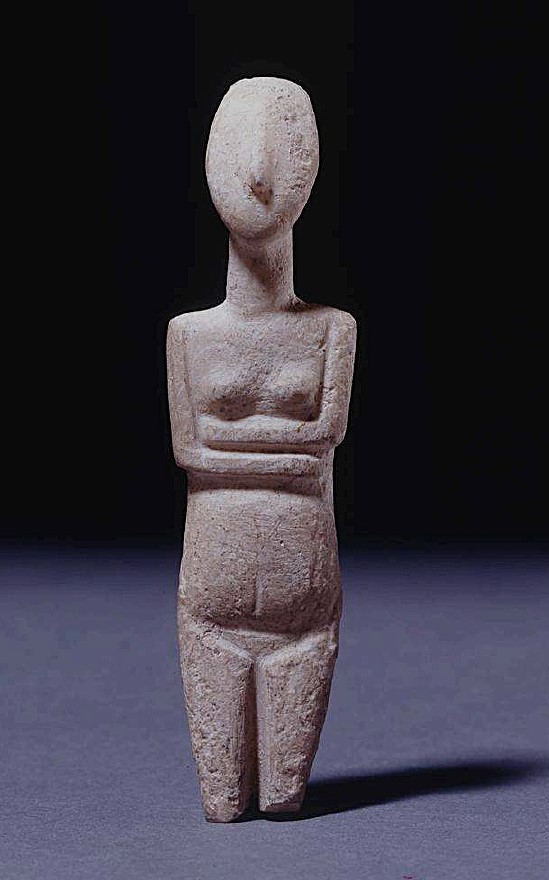
And with that brief reference I abandon Theodore and Mabel to their bravely-earned place in the history of early archaeological exploration and travel, but with a great deal of respect and fondness. There is just one more memory to share with you.
I was giving a talk on Naxos in 2025 to an audience of readers, archaeologists and locals about The House in Apíranthos. During the Q&A session I was surprised and delighted when one of the archaeologists expressed her pleasure that I knew about the Bents. I wondered fleetingly whether my introducing them had seemed rather presumptuous to readers not familiar with them, but the thought faded quickly. The Bents deserve their place and they are welcome in my books, not least because of the special bond I made with them, long gone though they are, on the island of Despotiko.
The Secrets of Stelida, Vanessa’s 7th book in ‘The Naxos Mysteries’ series has just been published (Spring 2026).
Footnotes
Return from Note 1
Return from Note 2
Return from Note 3
Some further reading:
J. Theodore Bent, The Cyclades, or Life Among the Insular Greeks (an edited reprint, Oxford, 2002)
The Travel Chronicles of Mrs J. Theodore Bent, Vol. 1: Greece and the Levantine Littoral (Oxford, 2006)
A selection of Theodore Bent’s articles on Greece
Scanned versions of Mabel Bent’s ‘Chronicles’ from the Hellenic Society’s archive
‘Of Crows and Swans and Calamine – the Archaeology Theatre of Antiparos’
‘The skeletal material excavated on Antiparos in 1883/4 by Theodore Bent’
In exalted female company – Mabel Bent, other women travellers, and the RGS women Fellows scandal of 1893
 Leave a comment or contact us about this article