
Theodore Bent was also an enthusiastic ‘collector’ of folk-lore wherever they went – an inexpensive hobby; he was an early member of the Folk-Lore Society of London and remained one until his death. Greece and the Levant provided him with rich and important source material and his ‘finds’ have been referred to by many, including the great Scottish social anthropologist and folklorist Sir James George Frazer: “The ruins of Olba, among the most extensive and remarkable in Asia Minor, were discovered in 1890 by Mr. J. Theodore Bent.” (The Golden Bough, Vol. 5, 151ff.).
Bent’s travel guide to the Cyclades (1885) is full of the islanders’ tales of the mysterious. Some of his articles to do with folklore are listed here.
- ‘Some Games Played by Modern Greeks’. [Samos] Athenæum, Issue 2931 (Dec. 1883), 866. [Reprinted in The Folk-Lore Journal, Vol. 2 (1884, Feb), 57-63].
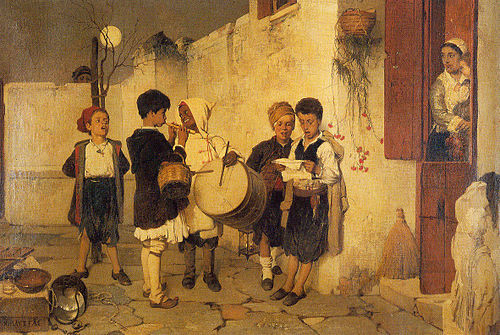
- ‘Christmas in Chios’. Cornhill Magazine, Vol. 54 (7), 596-607.
- ‘Notes from the Greek Islands – Surviving Customs’. [Samos, Lesbos] Athenæum, Issue 2986 (Jan. 1885), 87-9.
- ‘Old Mythology in New Apparel’. Macmillan’s Magazine, Vol. 51 (Nov. 1884/Apr 1885), 366-71.
- ‘The Survival of Mythology in the Greek Islands’. Archaeological Journal, 1886, 43:1, 124-136.
- ‘Personification of the Mysterious Amongst the Modern Greeks’. National Review, Vol. 9 (Apr. 1897), 224-33.
- ‘The Three Evils of Destiny’. Scottish Review, Vol. 10 (20) (Oct. 1888), 369-87. [Reprinted in Littell’s Living Age, Vol. 176 (1888), 410ff] ]
- ‘Parallels to Homeric Life Existing in Greece To-day’. The National Review, Vol. 11 (Aug. 1888), 825-36. [Reprinted in Littell’s Living Age, Vol. 178 (1888), 557ff]
- ‘The Sun Myths of Modern Hellas’. The Antiquary 19 (Jan. 1889), 7-11.
- Modern Life and Thought amongst the Greeks’, published in National Life and Thought of the Various Nations Throughout the World: A Series of Addresses (London 1891, pp. 287-302).
The Folk-Lore Journal, Vol. 2 (Feb), 1884, pp. 57-59, reprints Bent’s article ‘Some Games Played by Modern Greeks’ from Athenæum, Issue 2931 (Dec), p.866; and an anonymous review of Bent’s Cyclades appears in Vol. 3, 1885:
The Cyclades; or, Life among the Insular Greeks. By J. Theodore Bent. London, 1885 (Longman, Greens, & Co.), 8vo. pp. xx. 501.
“When a traveller of Mr. Bent’s archaeological knowledge takes the trouble to go amongst the people themselves, picking up their lore, and noting the antiquities amidst which they live, one naturally looks for a book of some importance. This Mr. Bent gives us unquestionably, though we confess we do not appreciate his method of treatment.
“The Cyclades among the Greek islands are specially valuable for a study of Greek folk-lore, because they have been less subject to the influences of conquest than the Continent; and when Mr. E.B. Tylor, a few years ago, treated of the ethnology of Greece, we do not think he took this important fact into consideration. Mr. Bent found the relics here of old pagan polytheism, occasionally interpreted by a Christian terminology, but old Greek in spirit and oftentimes in detail. For folk-lore of the sea there could be no better source. Nereids abound on every coast, and, in some cases, Mr. Bent records a modern custom which looks remarkably like a sacrifice of a human being to these spirits-as, for instance, the leaving of a child on the altar of a church for a night to see if the Nereid claimed it for its own. Songs and dances, marriage customs, birth customs, and funeral customs, noted down as they were observed, meet us on almost every page of Mr. Bent’s book; and he particularly draws attention to the importance of the incantations which accompanied the charms. There is a passage in Plato’s Laws which treats of charms and incantations, and it tells us that the accompanying songs were essential to success. The modern Greek charm is almost always accompanied with a rhyming or rhythmical incantation; and it is a thought worth bearing in mind by the student of folk-lore that the various charms to be met with in European folk-lore are more archaic if they have a rhythmical accompaniment.
“Another subject which Mr. Bent treats of in a most interesting manner is that of ‘games’. But perhaps the most curious portions in his volume are those which tell us of the modern Greek notion of the planets, the sun, and dawn. They are certainly personified. The sun is still to them a giant, like Hyperion, blood-thirsty when tinged with gold. The common saying is that the sun, when he seeks his kingdom, expects to find forty loaves prepared by his mother to appease his hunger after his long day’s journey. Woe to her if these loaves are not ready. The sun eats his brothers, sisters, father, and mother in his wrath. ‘He has been eating his mother’ is said when he rises red in the morning. But Mr. Bent’s volume is crowded with matters of interest like these. The modern Greek idea of death is distinctly pagan, and his method of lamentation is remarkably like much that one reads of among modern savage races. Charon is to-day a synonym for death.
“We should like to see a scientific folklorist take this book up and work from it the important lessons it contributes. Mr. Bent would have greatly aided this proposal if he had only given us an index.” (The Folk-Lore Journal, Vol. 3, 1885, pp. 191-2)
The Folk-Lore Journal (until 1889; previously the Folk-Lore Record (until 1883/4); after 1889 renamed Folk-Lore, A Quarterly Review (Incorporating The Archaeological Review and The Folk-Lore Journal)), lists Bent (of 13 Great Cumberland-place, W.) as a member until his demise. Volume 8, 1897, p.194, has the brief line (just two weeks after he died in London): “The death of Mr. J. Theodore Bent was announced” [at the meeting of Tuesday, 18 May 1897]; Volume 9, 1898, p.25, has, in the 20th Annual Report of the Council (18 January 1898), that: “During the year the Society has lost by death six Members, including Mr. J. Theodore Bent…”